The first thing you notice is the voice, described by one
writer as “rich as the finest burgundy”. That voice belonged to broadcaster and
writer Derek Cooper who died on Friday.
Derek first started broadcasting in the 1950s on Radio
Malaya, he ended up in the Far East following service in the Royal Navy. By the
end of the decade he was controller of programmes for the English Service (the ‘Blue Network’) but returned to
the UK in 1960 when the station was relocated to Kuala Lumpur.
Joining ITN Derek would produce and sometimes narrate the Roving Report films, short travelogues from
around the world. On YouTube checkout Roving
Report: Project Malaysia narrated by Nigel Ryan and produced by Derek
Cooper.
When, in January 1963, Granada started their World in Action series, again Derek was
on narrating duties, along with Wilfrid Thomas. In 1965 he joined the BBC working
on Tomorrow’s World. Raymond Baxter
was the presenter but it was Derek’s voice you heard on the filmed reports
about the latest technological advances. This clip comes from a 1969 edition:
On the radio Derek was a regular reporter on the Today programme. It’s a report he did
for Today that led to interest in all
things food and drink. He talked to foreign visitors to the UK about their
response to finding menus full of coq au vin and lasagne rather than traditional
British fayre. Articles in The Listener
and other publications prompted him to write The Bad Food Guide, published in 1967.
When the BBC Light Programme revamped their news coverage in
1967 and introduced the nightly News Time
(from 2 January) Derek was the first presenter. He remained with the programme,
alongside other presenters such as Corbet Woodall, when it transferred to Radio
2 and was on the final broadcast on 3 April 1970.
The following week over on Radio 4 the first edition of PM went out with the pairing of William
Hardcastle and Derek Cooper. Bill looked
after the hard news and Derek the lighter stories, though he was only with the
programme for a few months, being replaced by Steve Race.
On Radio 4 in the 1970s there were an increasing number of
consumer-based programmes: You and Yours (which
Derek presented), Checkpoint, Money Box, Going Places and Breakaway.
But there was little about the food and drink on national radio other Tony De Angeli
(“editor of The Grocer”) on the JY
Prog and Margaret Korving’s shopping basket items on You and Yours.Derek had first
proposed a TV series about the food industry in the early-70s but by the time
the budget for the pilot had been agreed he and producer Richard Wade had moved
on. In the interim Derek went on to present The
Food Programme for BBC Scotland and A
la Carte for Radio 4 before his original idea was eventually picked up by
Radio 4 for the ground-breaking The Food
Programme first aired on Sunday 30 September 1979.
This is a typical early edition from 1986 in which Derek looks at
the coffee trade.
When The Food Programme
hit the ten years milestone there was a special compilation edition broadcast
on 11 September 1989.
Derek would make other programmes some such as STV’s Scotland’s Larder (all episodes are on
YouTube) combining both his love of food and of Scotland – Derek was born in
London but his mother was from the Western Isles, his father from Kent. For
Radio 4 there was the 1989 series about the Western Isles, Islanders and in 1994 Cooper’s
Particular Pleasures. For the BBC World Service in the late 80s he was one
of the presenters of the arts programme Meridian.
He continued to write and broadcast about food but ‘retired’
from the microphone in 2002 – his last Food
Programme was in September of that year. His campaigning work in raising
standards in food production was recognised with an OBE, a Sony Award and
awards that carried his name such as the BBC
Food and Farming Derek Cooper Award and the Guild of Food Writers’ Derek Cooper Award for Campaigning and Investigative Food Writing or Broadcasting.
Series two
of The Hitch-Hiker’s Guide to the Galaxy
has just started a repeat run on BBC Radio 4 Extra.When it was first broadcast in January 1980
it bagged itself a Radio Times cover,
testament to the overwhelming success of the first series. (Was this the last
time a radio comedy made the cover? Readers with better memories than mine
please respond).
The
programme billings were something special too as they included artwork from renowned
graphic designer and illustrator George Hardie – think Led Zeppelin and Pink
Floyd album covers. They don’t all tie
into the events in that particular programme – the five episodes aired every
week night - as, notoriously, Douglas
Adams was still sweating over his scripts until the last minute and the final
episodes were still being edited as the week began.
Britpop is celebrated this week on Radio 6 Music and Radio 2
with the return of Whiley and Lamacq helmed Evening
Session and a number of new and repeated documentaries.
The rise of the guitar-based music scene produced some catchy
tunes infused with 60s pop and 70s punk and was a much-needed shot in the arm
for the music business. This week’s programmes coincide with the release twenty
years ago this month of Blur’s seminal album Parklife; though lest we get too carried away with the impact on
the pop charts of the time it’s worth remembering that this week’s number one
single was the Dutch one-hit wonder Doop.
Jo Whiley and Steve Lamacq remain closely associated with
the Britpop scene as their Radio 1 Evening
Session would be the main forum for new acts and live sessions. “we were
the only people to pick on that stuff and dared to put these bands live on the
radio”, recalls Jo. “No other station was interested in them for at least a
year.”
In fact by stroke of luck they just happened to be in the
right place at the right time and it was only the fallout from the Bannister-purge
at Radio 1 that secured them the job. The Evening
Session was an existing programme that had been presented by Mark Goodier since
September 1990. That early evening slot already had a 10-year history of live
sessions and breaking new acts with DJs Mike Read, David Jensen and Janice
Long.
Jo’s first Radio 1 appearance was In June 1993 when she covered
for Mark on the Evening Session for a
couple of weeks followed immediately by two weeks cover from Steve. He was back
for a week from 23 August 1993 and the following week saw their first joint
appearance. This temporary arrangement continued whilst Goodiebags looked after
the Breakfast Show. It became a
permanent gig from 25 October 1993 following a reshuffle with Mayo taking over
from the departing Bates and Goodier remaining at breakfast.
By chance I have the first 30 minutes of that 25 October
show with playlist comprising dance, house and a new album from INXS.
There’s a opportunity to hear some archive editions from the
Evening Session this week overnight
on 6 Music and Mark Goodier is back with one of the Radio 2 documentaries with Not Just Britpop: Pop on Wednesday
night.
The Face Behind the Voice features from the Radio Times in early 1994:
If you were listening to BBC Radio 2 on a Friday evening a
decade ago you may have been forgiven in thinking you’d been transported back
to the days of the Light Programme; a time before the Beatles, Elvis and the
invention of rock ‘n’ roll.Thanks for the Memory celebrated a 78
rpm world; the era of the Great American Songbook, Al Bowlly stepping up to the
microphone in front of Lew Stone’s Band. Of Tin Pan Alley, repertory theatre,
concert parties and dining at the Café de Paris with Noel Coward. The nostalgia-monger was Hubert Gregg:
broadcaster, composer, actor, director, producer and writer.
Hubert was ideally suited to Thanks for the Memory. Not only did he have “a retentive memory”
but, in many cases, he’d either met or seen the performer at the time, in a
career that lasted over seventy years. In
this post there’s a chance to hear once again some of those shows for “Wireless
Two” as I canter through the Gregg radio broadcasting highlights that span from
1933 to 2004.
Hubert Robert Harry Gregg was born in 1914 in Norfolk Road,
Islington. Within the sound of Bow Bells, so his song Maybe It’s Because I’m a Londoner – “there’s a magic in the fog and
rain” - is apt. The Gregg family hit on
hard times and had an itinerant existence moving from town to town no less than
fifteen times in eighteen years. But young Hubert was fascinated by the stage
and screen, taking part in a talent contest – singing “Eat more fruit! Don’t
eat mutton, don’t eat lamb.” – and watching the silent flicks. A scholarship to
St Dunstan’s College secured his education and any spare time was spent
watching variety acts at the local theatre or playing piano in the school dance
band. His first stage appearance, in 1928, was an amateur production of If Four Walls Told.
But Hubert’s real theatrical education came from an
audacious act when he was just seventeen. After a Shakespeare performance at
the Old Vic he hung around the stage door to collect his autographs and,
summoning up courage asked of actor Robert Harris:” I hope you won’t think me
mad but do you think it humanly possible for me to become a member of the Old
Vic?”He didn’t join the company but he
was introduced to Eric Earnshaw-Smith who became his mentor. Hubert went on to
study at the Webber Douglas School of Singing and Dramatic Art and then, with
encouragement from Roger Livesey, joined the Birmingham Rep.
It was during his time with the Birmingham Repertory Theatre
Company that Hubert made his first broadcast, on 25 October 1933, when the Midland
Regional Service of the BBC broadcast an excerpt from Foranzo’s comedy Cabbages and Kings. The following year, realising that others in
the profession “were queuing up for acting auditions in broadcasting” he
secured a part in Booth Tarkington’s Beauty
and the Jacobin alongside Pascoe Thornton, Barbara Couper, Rosalinde
Fuller, Leslie Perrins, Norman Shelley and Eric Anderson. “Herbert (sic) Gregg,
a newcomer, did well” said the Evening
News. It was the start of Hubert’s broadcasting career.Writing in his autobiography he has able to
say that by late 1934 “the BBC was now paying my rent and feeding me. I played
in plays, I read poetry, I read the Bible; I took part in Schools programmes
and in Children’s Hour; I read books, I was a narrator and a chronicler and
would have been happy to be a general vocal dogsbody provided it paid the odd
guinea or guinea and a half.”
In November 1935 came an offer to become a part-time
announcer on the Empire Service to fit around his other BBC commitments,
causing a headache for Chief Announcer Joe Shewen. On one occasion, Hubert
recalled, on duty at Broadcasting House in the middle of the night he was
summoned to the telephone by a phone call from Winston Churchill. “You’re the
only person in authority in the building”, informed the uniformed attendant.
“I’m working on my speech on the India Bill. Last week Sir Samuel Hoare took
twenty-five minutes. Am I expected to limit my speech to twenty?” asked
Churchill. Unsure of what to advise, “I’m only the announcer…” Hubert paused
and then ventured “But if I were you, I’d go on until I’d finished. They won’t
turn you off.”
But the pull of live theatre proved too great and Hubert
gave up his BBC staff job when he got a call to play in Hugh Miller’s revival
of Johnson’s The Alchemist. It only
ran for week but Hubert continued to work freelance for the corporation for the
rest of his career.
In 1937 Hubert got the opportunity to appear as Kit Neilan
in a Broadway production of Rattigan’s French
Without Tears. This American sojourn also gave him time to explore the
latest musicals and entertainers on both coasts and he was fortunate to see the
likes of Benny Goodman, Ella Fitzgerald, Cab Calloway, Tommy Dorsey and Fats
Waller.
An edition of Pond's Serenade to Beauty listed in Radio Pictorial 26 August 1939
Back in London the following year there was more radio work
for the BBC as well as appearances on Radio Luxembourg as the announcer on Pond’s Serenade to Beauty (sponsored by
Pond’s Cold Cream) featuring the music of Van Phillips and his Orchestra.
Taking care not to alert the Corporation of his work for the commercial station
– the programme was also transmitted by Radio Normandy -he used the pseudonym Michael Riley.Post-war Hubert would again work for
Luxembourg, albeit indirectly, producing radio dramas on behalf of the Young
and Rubicam advertising agency.
But it was song-writing rather than broadcasting that gave
Hubert his early fame. Although he wrote nearly 200 there are two which remain
his legacy: I’m Going to Get Lit-Up and
Maybe It’s Because I’m a Londoner.
The first was a typical rousing wartime number, the idea coming to him after he
was called up for duty as a private soldier and posted to Lincoln.
On this particular morning we were discussing London. One
lad had been on leave there and mentioned the severity of the blackout. They
had eased the restrictions quite a bit so that there were fewer deaths from
walking the dog but it was still a blackout and the bloody Hun had caused it –
this was the tenor of the conversation. In happened to say “I’m going to get
lit-up when the lights go up I can tell you!”. My lazy song-writing brain
stirred and began to move into action.
The song was not long in being made public, Hubert performed
it at an All-Forces concert broadcast from Thornaby in Yorkshire just days
later. The double meaning of the title appealed to the wartime sensibilities,
though the BBC were initially reluctant to broadcast it. It was a couple of
years later that it was finally published at a time when it was chosen by
theatre impresario George Black for the show Strike a New Note. The song was assigned to a young South African
singer named Zoe Gail. In time Zoe would become the first Mrs Gregg. Incidentally
one of the earliest clips of Hubert in the BBC’s archive comes from a 1949
edition of In Town Tonight where
roving reporter Brian Johnston spoke to the composer and introduced Miss Gail
who belted out the song from the balcony of the Criterion Restaurant
overlooking Piccadilly Circus. The occasion: the lights going on in London’s
theatreland after going ‘dark’ days in the early days of the war.
Maybe It’s Because I’m
a Londoner was one of those songs composed in a trice, about twenty minutes
as it happened, and then tucked away in a drawer and forgotten about.Two years later Jack Hylton was bringing the
Crazy Gang back to London and wanted a song for Bud Flanagan. Out came the
London song. Hylton was willing to pay one hundred for the exclusive stage
rights but Hubert insisted on five pounds per week, terms that were grudgingly
agreed. Together Again would run for four years but it all ended messily
for Hubert when Hylton sued him for £1500. It transpired that “some comedian in
Scunthorpe or somewhere had been singing [it] on stage”.
Meanwhile, back in war-torn London, a chance meeting with
actor Stephen Haggard led to more radio work, this time on programmes broadcast
to the German Forces by the clandestine Political Wartime Executive. Haggard,
who’d trained in Germany, was on the lookout for anyone with microphone
experience and at least a grasp of the German language. Hubert was not fluent
but “with a little practice I would rattle off seven or eight minutes of
scripted German in such a way that a Hun would be hard put to it to see through
the ruse.” During his time with the PWE, working on the programme Sending for die Deutsche Wehermacht, he
was roped in the supplement the cast of the film In Which We Serve, his first credited film role.
An appearance in Saturday-Night Theatre on the
Home Service 18 November 1950
There’s one literary work that runs like a thread throughout
Hubert’s career and that’s Jerome K. Jerome’s much-dramatised comic novel Three Men in a Boat. Hubert recalls how
when asked to appear on the Light Programme’s Saturday Night On the Light (“a radio kaleidoscope of words and
music”) he chose to read extracts from the book.Apparently “the reception was
phenomenal.”So much so that he was
immediately invited to ‘Jerome’ on Henry
Hall’s Guest Night and then Hall’s television show Face the Music. For this performance he chose to wear a bowler hat
and, as a result, was offered the film role of the bowler-hatted Mr Pusey,
duped by the wily crew of the Clyde puffer, in the Ealing comedy The Maggie.
Two years later he was back in the film studios, this time
at Shepperton , for the filming of Three
Men in a Boat, with a script by Hubert and Vernon Harris.Recognising a good thing when he found it he
added music and lyrics for a musical version of the tale broadcast on the Light
Programme at Christmas 1962 with Kenneth Horne as Harris, Leslie Philips as
George, Hubert as J and Percy Edwards barking Montmorency the dog. In fact it
was Hubert’s second appearance in a radio adaptation; the first some 18 years
earlier in a 1944 version with Basil Radford and Naunton Wayne, better known to
radio and film audiences as that cricket-loving duo Charters and Caldicott.
Surprisingly Hubert did very little regular television
work.In his obituaries only two shows
are mentioned, both from the 1950s. For the BBC there was the chairmanship of TV Brains Trust though there’s nothing
to suggest it was anything other than a handful of appearances as the question
master. Similarly over on ITV in 1957 he popped up as chairman of a few
editions of Granada’s Youth Wants to Know.The TV
Times billed this as “each week Granada invites to their TV centre in
Manchester two celebrities who are experts on a particular subject, but who
have opposing views. They will face a barrage of questions from a group of
Northern young people”.Hubert chaired
some of these shows between February and March, with the 10 April edition
looking at “The H Bomb”, a matter far removed from the world of theatre. (Others
in the chair that year were Leonard ‘The
Good Old Days’ Sachs and Elaine Grand, later of Thames TV’s Afternoon Plus).
Hubert first started to mine the vein of nostalgia in 1964
with his radio show A Square Deal: “a
round of yesterday’s records for the squares of today”. “At the time”, he
recalled in his autobiography, “there seemed to be nothing but pop music
blaring out of radio sets and I wondered how the millions who, like me, didn’t
care for cacophony, were managing.” The
programme, initially going out on the Home Service but transferring, a couple
of months later, to the Light, was seen by one critic as “a recuperative
refuge” with the delights of “the Andrews Sisters, Roy Fox, Al Bowlly, Nat
Gonella, Jack Hulbert and Bobby Howes”.
This clip comes from the programme of 21 March 1966.
A Square Deal, now
on Radio 2, ended in December 1967 but Hubert was back in the summer of 1968,
this time on Radio 4, with a weekly afternoon show I Remember It Well. Running for twelve weeks each edition would
also ask a well-known entertainer or actor to choose records that had
particular memories for them, they included Kenneth More, John Hanson, Danny Le
Rue, Adam Faith, Kay Hammond, John Clements and, in the final programme his
second wife, Pat Kirkwood.
In January 1968 Hubert took over as host for a couple of
months of the Friday night Radio 2 show Now
and Then – first heard in May 1968 and originally presented by Alan Dell –
which promised to discover “what was popular then is just as popular now …
although sometimes there’s a change of beat.”
It’s often overlooked that Hubert’s most popular and
long-running show, Thanks for the Memory,
wasn’t originally presented by him. It had started on Radio 2 in October 1969
with Gale Pedrick, the picker on Pick of
the Week, in the chair. When Pedrick died the following February producer
Sheila Anderson approached Hubert to take over the reins, so starting a 44 year
run.
A new series of Thanks for the Memory
7 April 1972. Gregg thought the programme title
was "tedious".
A few tweaks were made to the Thanks for the Memory format over the years. Out went the Victorian
memories and archive snippets, out went the theme – Beethoven’s Sonatina in C major for Mandolin and Piano
– and in came his old A Square Deal
theme Time Was by Nelson Riddle. And
in, of course, came Hubert himself singing a tune accompanied at the piano by
Gordon Langford.Over time too the
scripts became more stylised: the show was broadcast on “Wireless Two” and
would be back in “a sennight”. Eventually settling into a Friday night slot,
though for many years it darted around the schedule, it became “the Friday
night club” with Hubert “in the square chair” often with “jaggers and taggers”
to hand. Though it sounded impromptu… those pauses … were all scripted … the
page full of dots and dashes.
Here’s a relatively early recording of the programme, just
sixteen years in from February 1986:
Hubert claimed that one of the positive effects of Thanks for the Memory was on record
companies. In 1978 he told the Radio
Times: When it started, very little vintage material was available on
record. Two years of steady nagging at the record people finally convinced them
there was a public for their old stuff; now you can find whole racks of
wonderful re-issues”.
Such was the success of Thanks
for the Memory that Hubert was invited to present other programmes on the
network such as the 40-part Hubert Gregg
at the London Theatre (broadcast January to October in 1974) and five
series of what he termed “a personal spotlight on special people in
entertainment” titled I Call It Genius
and I Call It Style. The subjects of
these programmes were people whose work Hubert adored:“I have seen and heard
them play, sung their songs … watched them dance ---in some cases talked and
imbibed with them into small hours made great by conversation”.
Billing for a 1955 repeat of The Man About Town. Nearly 50
years later David Jacobs would present a tribute to Hubert
Indeed it was with Jack Buchanan that Hubert imbibed, on gin
and tonic, when he was working with the entertainer in the mid-50s. Jack had
been a childhood hero of Hubert’s – he’d queued outside the stage door to
collect his autograph. Thirty years later he was asked by Jack to provide a
weekly song about London – If I Could Take
My Pick I’d Pick Piccadilly and so on -as well as the title song for the 1955 Home Service series The Man About Town.
From the third series of I
Call It Style comes this appreciation of songwriter Harry Warren.
And now a later Thanks
for the Memory, I’ve no date for this recording:
In his later years Hubert remained busy, still broadcasting,
writing and, together with his third wife Carmel (they’d married in 1980),
studying for an Open University degree. The final edition of Thanks for the Memory was broadcast on 5
March 2004. Sadly just weeks later, ten years ago today, he passed away.
On 20 April 2004 David Jacobs presented Radio 2’s tribute to
Hubert. This programme includes excerpts from Man About Town, Three Men in
a Boat and, of course, Thanks for the
Memory.
Summing up his penchant for harking back to the past he
wrote;” The anecdotes come thick and fast because I love no time more than
yesterday. To remember it sees you through today; and it gives you a kind of
optimism because you look for the best in today for you to remember tomorrow.”
Hubert Gregg 1914-2004 Au revoir … to you.
With thanks to Carmel Gregg and Paul Langford.
For the Record
As this is a radio blog my review of Hubert’s life and
career missies out much of his theatre and film work. For a book packed full of
anecdotes I can whole-heartedly recommend his autobiography Maybe It’s Because…? available
exclusively from this website: http://www.hubertgregg.org.uk/
During the 1930s Hubert made somewhere in the region of
400-500 broadcasts. My research has uncovered details of just under 40 of them
showing the range of his work and the many stars (or stars in the making) he
worked alongside.
25 October
1933 Cabbages and Kings a comedy in
three acts by Foranzo with Cyril Maude and the Birmingham Repertory Theatre
Company
14 November 1933 Eleventh Hour a play in one act by Anthony Armstrong
5 July 1934 Beauty and the Jacobin by Booth
Tarkington with Pascoe Thornton, Barbara Couper, Hubert Gregg, Rosalinde
Fuller, Leslie Perrins, Norman Shelley and Eric Anderson. 24 September
1934 The Forsaken by Duncan Campbell
read by Hubert Gregg 26 September 1934 Troops Leaving Mudros by John Masefield read by Hubert Gregg 27 September 1934 In Lady Street by John Drinkwater read by Hubert Gregg 28 September 1934 Seeing the Wind by Roger Ascham read by Hubert Gregg
26 November
1934 Wuthering Heights
24 December
1934 Four Sonnets by William
Shakespeare read by Hubert Gregg
January 1935
The Winter’s Tale “Mr Gregg’s
Florizel was charmingly innocent”
22 March
1935 Last Voyage play about Sir
Walter Raleigh on the National Programme
11 April
1935 Three Moods of Fame by Lord
Dunsany with Hubert Greggg, Gladys Young, Lawrence Hanray
5 May 1935 Henry V cast included Leslie Banks and
John Laurie
24 June 1935
Chamber Music & Poetry
10 November 1935
Cut and Come Again by HE Bates. Short
story read by Hubert Gregg
3 January
1936 Decision-5 by Mabel Constanduros
with Gordon McLeod, Gladys Young, Ursula Marx and Hubert Gregg
6 February
1936 War Calls the Tune by C.K.
Munro, cast included George Sanders (Repeated 7 February 1936)
29 March
1936 From the LondonTheatre included an extract of William
Douglas Home’s Great Possessions starring
Arthur Powell, Hubert Gregg, Tully Comber, Geoffrey Keen, Marjory Clark, Jane
Welsh, Nigel Clarke and J. Leslie Frith (Repeated 30 March 1936)
10 May 1936 The Tragedy of Edward the Second by
Christopher Marlowe. Cast included a young Antony Quayle
19 May 1936 London Wall by John van Druten “Mr
Hubert Gregg gave a very plausible sketch of a tiresome, inarticulate and good
young man”.
8 June 1936
Socrates by Clifford Bax with Cedric Hardwicke, Anthony Ireland, J.B. Rowe,
Hubert Gregg, Miles Malleson, Leslie Perrins, Gladys Young, Leo Genn and
others. (Repeated 9 June 1936)
27 July 1936
Selections from the poetry and prose of Sir Walter Raleigh read by Hubert Gregg
and John Maude
August-September
1936 The Full Story a 5-part thriller
serial by John Watt and Henrik Ege
18 October
1936 Hippolytus with Margaret
Rawlings, Hermoine Hannen, Ion Swinley, Lilian Harrison, Gladys Young. With
Hubert Gregg playing Hippolytus
25 December
1936 The Christmas Journey-A Masque of
the Nativity
24 January
1937 Dr Samuel Johnson with Carelton
Hobbs
31 January
1937 The Merchant of Venice – cast
included Charles Hawtey
February and
March 1937 Children’s Hour plays Tales from the Nordic Sagas by L. du
Garde Peach also starring Hay Petrie, Norman Shelleyand Carleton Hobbs
17 February
1937 Children’s Hour with the play Tales of Western Hope by Sybil Clarke.
19 February
1937 The Blue Danube and Why It Was
Written with Neal Arden, Henry Hallett and others
25 April
1937 The Trojan Women by Euripides
co-starring Flora Robson
9 May 1937 The Kings Anointing compiled and
produced by Felix Felton
22 June 1937
National 6 by Jean-Jacques Bernard
with Jill Furse, J. Leslie Frith, Marjorie Gabain, Hubert Gregg & Austin
Trevor
9 July 1937 The Adventure of the Hansom Cabs. Cast
included Felix Aylmer and Robert Newton
22 February
1938 Experimental Hour: Devil’s Dyke,
a dramatic poem by Christopher Hassell
6 November
1938 The Winter’s Tale. Cast included
Nigel Stock, Miles Malleson, Sybil Thorndike and Gwen Ffrangcon-Davies
24 December
1938 Alas, Poor Ghost. Poetry
readings of Thomas Hardy, Walter de la Mare and others read by John Abbott, Nancy
Brown, Lillian Harrison, David King-Wood and Hubert Gregg
February
1939 Children’s Hour production of The Pilgrim’s Progress
7 March 1939
Royal Palaces by L. du Garde Peach.
Cast included Maurice Denham and Norman Shelley
24 June 1939
The Church by the Sea. Play by Hugh
Stewart with Peggy Bryan, Hubert Gregg and Gladys Young
12 January
1940 Roland written by EA Harding
co-starring Felix Aylmer & Francis de Woolf
15 January
1940 Astrophel and Stella with Hubert
Gregg as speaker
A Square Deal was
first broadcast on the BBC Home Service on 12 November 1964 and transferred to
the Light Programme (later Radio 2) from 7 January 1965. The programme ended on
28 December 1967
I Remember It Well
was broadcast on BBC Radio 4 from 9 July to 24 September 1968
Now and Then was
first broadcast on 10 May 1968 when the presenter was Alan Dell. Other
presenters in addition to Hubert were Jimmy Hanley, Henry Hall, Sam Costa, Peter
Brough, Joan Turner, Ted Ray, George Elrick and Brian Rix. The final edition
aired on 26 September 1969.
Thanks for the Memory
with Gale Pedrick was first broadcast on 3 October 1969 with Hubert taking over
the following March, though I don’t have the exact date for this one. A number of online sources incorrectly state
that the programme ran from 1972.
I Call It Genius was
broadcast over two series in 1980 and 1981 with out of sequence repeats
sometime combined with editions from I
Call It Style until 1985. The working title had been A Touch of Genius but during the show’s preparation that title was
used elsewhere on the radio, in fact by Robin Ray over on Radio 4.
s01e01
04.03.80 Walt Disney (rpt 24.12.85)
s01e02
11.03.80 Busby Berkeley, Part 1 (rpt 16.11.82)
s01e03
18.03.80 Busby Berkeley, Part 2 (rpt 23.11.82)
s01e04
25.03.80 Fats Waller (rpt 07.12.82)
s01e05
01.04.80 Laurel & Hardy (rpt 12.11.85)
s01e06
08.08.80 Gene Kelly (rpt 26.11.85)
s01e07
15.04.80 Maurice Chevalier (rpt 14.12.82)
s01e08
22.04.80 Lorenz Hart (rpt 21.12.82)
s02e01
19.05.81 Cole Porter, Part 1 (rpt 28.02.84)
s02e02
26.05.81 Cole Porter, Part 2 (rpt 06.03.84)
s02e03
02.06.81 Fred Astaire (rpt 05.12.85)
s02e04
09.06.81 Louis Armstrong (rpt 13.03.84)
s02e05
16.06.81 Johnny Mercer (rpt 20.03.84)
s02e06
23.06.81 C.B. Cochran (rpt 19.11.85)
s02e07
30.06.81 Irving Berlin, Parts 1 (rpt 27.03.84)
s02e08
07.07.81 Irving Berlin, Part 2 (rpt 03.04.84)
I Call It Style
was broadcast over three series between 1981 and 1985 with out of sequence
repeats into 1986. I’m not 100% certain about the running order for weeks four
to six of the second series as the industrial action prevented the printing of
the Radio Times.
s01e01
24.11.81 Ivor Novello (rpt 01.5.84)
s01e02
01.12.81 Judy Garland (rpt 14.1.85)
s01e03
08.12.81 Paul Whiteman (rpt 03.12.85)
s01e04
15.12.81 Noel Coward & Gertrude Lawrence (rpt 17.4.84)
s01e05
22.12.81 Danny Kaye (rpt 10.12.85)
s01e06
29.12.81 George & Ira Gershwin (rpt 17.12.85)
s01e07
05.01.82 James Cagney & Dick Powell
s01e08
12.01.82 Frank Sinatra
s02e01
15.03.83 Al Jolson (rpt 15.03.83)
s02e02
22.03.83 Jerome Kern, Part 1 (rpt 22.03.83)
s02e03
29.03.83 Jerome Kern, Part 2 (rpt 29.03.83)
s02e04
05.04.83 The Dorsey Brothers (rpt 10.04.84)
s02e05
12.04.83 Jack Buchanan (rpt 15.05.84)
s02e06
19.04.83 Frank Loesser (rpt 07.01.86)
s02e07
26.04.83 Carroll Gibbons (rpt 08.05.84)
s02e08
03.05.83 Duke Ellington (rpt 24.04.84)
s03e01
26.02.85 Richard Rodgers & Oscar Hammerstein II
s03e02
05.03.85 Rudy Vallee
s03e03
12.03.85 Vivian Ellis
s03e04
19.03.85 Joe Venuti & Eddie Long
s03e05
26.03.85 Ray Noble
s03e06
02.04.85 Harry Warren, Part 1
s03e07
09.04.85 Harry Warren, Part 2
s03e08
16.04.85 Jessie Matthews
Fifty years
ago today the sound of British radio changed forever with the launch of Radio
Caroline. It was the start of a brief three year starburst of offshore radio
activity. Derring-do on the high seas, an explosion of British pop music,
swinging jingles and flouting the law. For those broadcasting and listening it
was an exciting time.
Pirate radio
kick-started the careers of dozens of DJs who’d go on to work for Auntie Beeb
or the early ILR stations, and a fair few TV continuity announcers too. The
mid-Atlantic style was heavily influenced by aping Stateside DJs (not to
mention a great deal of Australian and Canadian input), liberal use of PAMS
jingles, self-op desks and strip programming all set the template when Radio
1 hit the airwaves in late 1967.
Caroline
wasn’t the first offshore pirate station, there’d been Scandinavian and Dutch
based offerings such as Radio Mercur, Radio Nord and Radio Veronica. But
Caroline made history as the first station to offer an English service with
live shows from the ship, trumping rivals Radio Atlanta on air by 46 days.
The first
voice on Radio Caroline that Saturday back in 1964 was Simon Dee – “this is
Radio Caroline on 199, your all-day music station” – though technically he was
beaten to it, if you count the test transmissions they made on Good Friday, by
a taped show from John Junkin. The comedy writer and one third of Hello Cheeky was briefly a Caroline DJ
recording shows in London with the tapes being shipped out to the station for
later broadcast.
But
listening back to the airchecks of the fledgling Caroline service you’d be hard
pressed to spot the difference between it and the BBC Light Programme,
punctuating the pop tunes are orchestral pieces, easy listening classics, show
tunes and jazz. The pace was slow, subdued almost, there was no chat just
straight announcements and, for the first month, no commercials (the first main
ad being for Bulova watches, “when you know what makes a watch tick you’ll buy
a Bulova”). But the attraction of an
all-music station proved an immediate success: over 20,000 letters were
received at Caroline’s London offices during the first fortnight and the
audience was estimated at seven million.
Here are
some clips from that opening weekend:
Following
the Caroline/Atlanta merger (forced by the lack of advertising) in the summer
of 64 there were two Caroline ships, one anchored off Harwich and one off
Ramsey. DJ Keith Skues recalled “Caroline North was a very successful station
and had a large audience, the DJs on the north ship had complete freedom from
Ronan [O’Rahilly] to choose and play the music they know their listeners wanted
to hear. [Allan] Crawford was very keen to ensure, as a music publisher, that
his Merit Music records were regularly played on Caroline South. The station
played more middle-of-the-road music with songs from shows and film
soundtracks.”
Meanwhile … Back on
Land
For those
that remember the 60s pirates the reason they tuned in was to hear pop music no
matter what the time of day. The BBC was hidebound
by needle-time restrictions and MU agreements. But what, exactly, did the BBC
offer when Caroline launched? Checking the Easter issue of the Radio Times (and the listings for the Light Programme) offers some clues, though,
of course, I’ve no idea as to what records they did or didn’t play.
On the
Saturday it was light music all the way until 9 a.m. when it was time for
Children’s Favourite’s. Perhaps guest presenter, Blue Peter’s Christopher
Trace, played some pop along with Nellie the Elephant?
There was
guaranteed pop at 10 a.m. with two hours of Saturday
Club. Brian Matthew's guests were Cliff and the Shadows, Mark Wynter, The
Hollies and Kenny Ball. Brain also popped up on Sunday morning with Easy Beat featuring Adam Faith, The
Bachelors, The Caravelles and, no doubt providing some cover versions, the
Johnny Howard Band.
At the
moment that Caroline launched the Light Programme had Exhibition Choice, one of those occasional shows that used to come
from either the Ideal Home Exhibition or the Radio Show, this one was hosted
by John Ellison.
Mixing
records and comedy clips at lunchtime was Jack Jackson’s Record Roundabout and in between the sport Three’s Company with the Polka Dots and The Searchers.There was pop of the European variety at 6.30
p.m. as Katie Boyle hosted Pop Over Europe.
Meanwhile on
Easter Sunday there’ll no doubt have been a handful of current tunes amongst
the record requests on the most listened to show on radio at that time, Two-Way Family Favourites, which
regularly pulled in 18 million listeners.
The only
guaranteed 100% pop record show was Pick
of the Pops with Fluff, back then running at just an hour between 4 and 5
p.m. , with that week’s chart seeing Can’t
Buy Me Love entering at number one. And
that was it as far as the weekend was concerned. During the week how about Parade of the Pops (Bob Miller and the
Millermen with guests Craig Douglas and Jan Burnette) or The Joe Loss Pop Show (with vocals from Ross McManus and guests
Billy J Kramer and the Dakotas).Other
than that you could take pot luck on Housewives’
Choice or Twelve O’Clock Spin.
Later in
1964 came Pop Inn, followed in 1965
by Newly Pressed and Swing Into Summer which became the daily
1-hour plus Swingalong in Autumn
1966. By then even the Radio Times was
minded to publish a Q&A asking “why no continuous pop?” The answer:
“Because nearly all of it is on records. The BBC has to buy the right to
broadcast them. It’s rationed to a fixed number of hours each week. That’s
called ‘needle-time’. The BBC can’t buy any more.”At the time the three networks had a total
needle-time of 75 hours a week.Concluding, just a little exasperatedly, the answer was “getting more
needle-time isn’t something the BBC can decide by itself. A lot of other people
have a say in it. In fact the other people have the last word.”
Pirate Memories
In 2009
Johnnie Walker recreated the sounds of the pirate era (though the pretence of broadcasting from onboard ship wore thin after a time) on Radio 2’s Pirate Johnnie Walker series.In this first clip the guest DJ is Emperor
Rosko.
Working on
both Caroline and London was Ed Stewart.
On both the
South and North ships was Dave Lee Travis.
From the
final programme from 27 December 2009 is Dave Cash who joined Radio London
within days of its launch in December 1964. There’s also a tribute to Mike
Ahern who died a couple of months earlier.
This series is currently getting overnight repeats on BBC 6 Music.
From 19
April the Radio Ship will be playing out old pirate radio programmes:
http://www.theradioship.net/ [Dead link] BBC Radio 2
has a 2-part documentary about the offshore pirates that airs next month (I
don’t have full details at the time of writing).
On Easter
Monday BBC Radio Norfolk has a full day of celebrations and are wheeling out
DJs that were associated with the pirate stations: Ray Clark, Andy Archer, Tom Edwards, Keith Skues and Colin Berry.
Sources: Radio Times 28 March 1964 and 8 October
1966 Pop Went the Pirates II by Keith Skues
(Lambs’Meadow Publications 2009) Radio Caroline: The True Story of the Boat
that Rocked by Ray Clark (The History Press 2014)
With thanks to
Robin Carmody for helping me track down a copy of the 1964 Radio Times
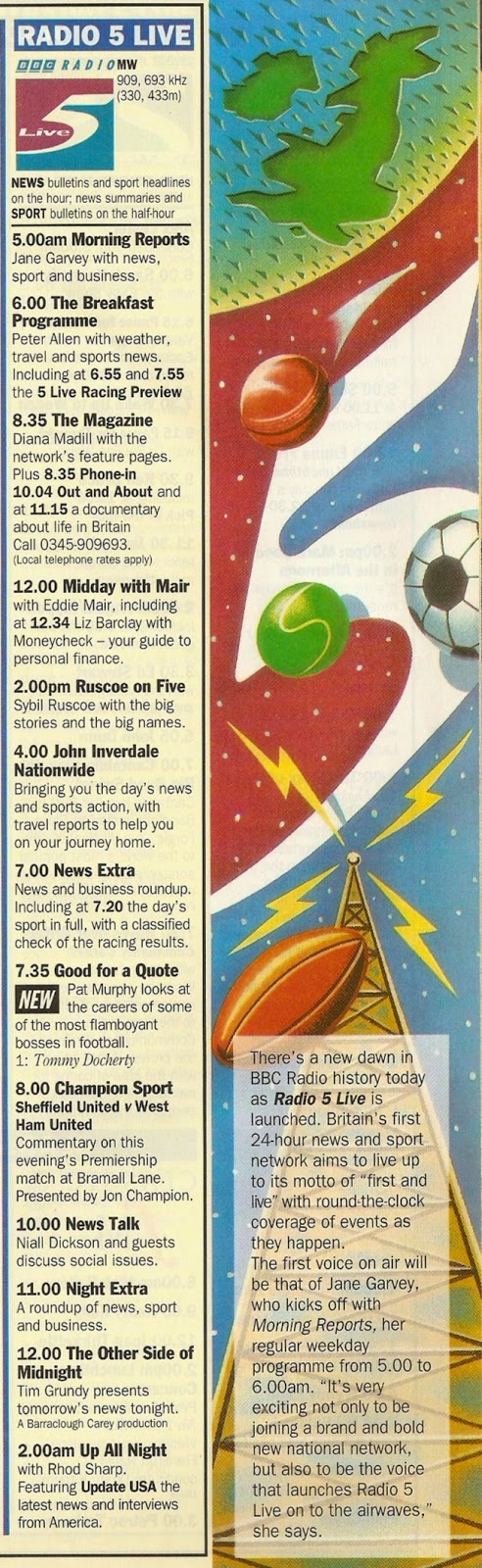
BBC Radio 5 Live celebrates twenty years on air this week
with the return of Jane Garvey, who launched the station on 28 March 1994, and
a week of ‘presenter swaps’ for Peter Allen who was also there at the start.
The station focussed on news and sport 24-hours a day; the
comedy, music, education and children’s shows of the old Radio 5 were cast to
the four winds.
Digging out the Radio
Times for that week here’s the schedule for day one:
Opening proceedings at 5 a.m. was Jane Garvey with Morning Reports, the programme remains a
5 Live fixture to this day.
Looking after The
Breakfast Programme was 5 Live’s kingpin Peter Allen, one of only three
voices heard that day that have lasted the full twenty years.
Poached from Today was
Diana Madill to present The Magazine from
8.35 a.m. to midday. As well as a
phone-in there were daily features on the environment, health, conservation,
science and film and video reviews.
Rising star Eddie Mair presented the two-hour Midday with Mair, at the time still
presenting Radio 4’s Saturday morning travel show Breakaway. Mair’s show included
a daily Moneycheck with Liz Barclay,
later of You and Yours.
From Radio 1’s Newsbeat
and, at the time the new BBC1 current affairs show Here and Now, came Sybil Ruscoe with Ruscoe on Five between 2 and 4 p.m.
The only daytime presenter to come over from the old Radio 5
was John Inverdale with the imaginatively titled John Inverdale Nationwide.‘Invers’ still works for the network, most recently hosting the
Cheltenham Festival coverage.
At 7 p.m. each day was News
Extra followed most evenings by sports coverage. On the launch day it was
Pat Murphy’s series Good for a Quote
starting with the career of Tommy Docherty and then Jon Champion with Champion Sport featuring commentary on
the Sheffield United/ West Ham match.In
week one there was also Football Plus
with Jonathan Legard and Trevor
Brooking’s Football Night.Friday
night’s, from week two, saw Parky back on the radio with Parkinson on Sport.
News Talk at 10
p.m. was an hour-long discussion of different aspects of news and current
affairs themed each evening. On Monday there was the BBC’s Social Affairs
Correspondent Niall Dickson. On Tuesday Paul Reynolds had a kind of From Our Own Correspondent.Wednesday was Nigel Cassidy on matters
financial and Thursday all things political with John Sergeant. Friday nights
were a little different with a 30 minute review of the newspaper business, Stop Press, usually presented by John
Diamond, followed by Financial Week
with Heather Peyton, who had previously worked on Radio 4’s The Financial World Tonight.
Between 11 p.m. and midnighta round-up of news, sport and business in Night Extra followed by The
Other Side of Midnight with Tim Grundy. On other evenings you'd hear After Hours, a live talk show “where
nothing is taboo”, though no host is listed, can anyone remember who it was?
Meanwhile on Thursday night Stuart Cosgrove’s talk show was Night Moves.
Rounding off the day, between 2 and 5 a.m., another stalwart
of the station’s schedules Up All Night
with Rhod Sharpe, the third of the voices still on air today. The weekend
presenter was former-LBC man Richard Dallyn.
And finally honorary mention must go to Adrian Chiles. He‘d
also worked on The Financial World Tonight
and joined Radio 5 Live as the business reporter in Wake Up to Money, which then was part of Morning Reports, and so was heard on day one. Of course he went
off to do his TV work for the Beeb and ITV but returned to the station last
year as co-host Friday’s 5 Live Drive.
Next week
sees the culmination of the 2014 battle to be Brain of Britain.‘Brain’ is
the UK’s second-longest running quiz after Round
Britain Quiz, though it likes claim itself as the longest-running quiz “open
to the public.”
Its origins
lie in the Light Programme show What Do
You Know?, billed as “a programme of problems and brain-teasers devised for
your entertainment”, first broadcast in 1953. Devised by John P. Wynn and
chaired by Franklin Engelmann it was originally in two parts: Beat the Experts and Ask Me Another, which was the quiz
played between contestants “representing all parts of the British Isles”. In
the first programme the panel of experts were Dilys Powell, Ivor Brown and
Christopher Cummings. Ask Me Another was
spun-off as a TV series in 1958 – also chaired by Engelmann and making resident
expert Ted Moult a household name - and it was this quiz element for which, by
the late 1950s, contestants would compete for the title of Brain of Britain,
the prize at that time being a diploma.
For the 1968
series What Do You Know? became Brain of Britain, the new title “seems
to be more indicative of the contest” explained producer Joan Clark. The
programme remained unchanged until the death of Engelmann in 1972 and Robert Robinson
took over as chairman – not sure if this was part way through the 1972 series
or not. It’s Mr Robinson who is now most closely associated with the show and
this recording comes from the 1980 series, complete with the souped-up Waldo de
los Rios version of the theme tune. (Previously posted under Radio Lives – Robert Robinson).
This is the grand final of the 1986 series:
Robinson
would always refer to the quiz as ‘Brian’. “When I receive BBC communications
about it the first word is often mis-typed as ‘Brian’, he told the Radio Times in 1985. “Thinking of it as
Brian of Britain is like recalling an old friend. The shedding of miscellaneous
information is what I do best. I’m not sure whether it’s a gift or an affliction.”
His final edition aired on 19 January
2009, and he died a little over two years later.
The final of
the current series chaired by Russell Davies is on Radio 4 next Monday
afternoon.
For the
Record
What Do You Know? ran from Sunday 2
August 1953 to Sunday 16 July 1967 on the BBC Light Programme. The Grand Finale
was on 2 July followed by two special challenge matches in which the three
finalists played against teams from The
World at One and Any Questions.
Brain of Britain started on Radio 2 on
Sunday 14 January 1968. It moved across to Radio 4 for the 1970 series
beginning on 3 January 1970.