Welcome to Just a Minute! For five decades it's been a case
of speaking without hesitation, deviation or repetition. A simple yet
frustratingly difficult task that has led to some great comic moments over the
900+ editions that have been heard since Just
a Minute first appeared on 22 December 1967.
The programme, devised by Ian Messiter, had had an earlier
1950s radio incarnation under the title One
Minute, Please with Roy Plomley, and later Michael Jackson, chairing,
though here it was a team game rather than pitting four individual players
against each other.
In 1967 Nicholas Parsons was enjoying radio success in the
topical satirical comedy series Listen to this Space. Seeking some new challenges he spoke to Ian Messiter who
suggested Just a Minute. Getting the
green light for the pilot producer David Hatch was called in - David would
guide and help shape the programme for its first decade or so - and with
Nicholas as one of the panellists it was Jimmy Edwards who was lined up as
chairman. In the event Edwards couldn't commit to the show so Nicholas Parsons
reluctantly agreed to step in as master of ceremonies, a role he's maintained,
apart from some role swapping in early editions, ever since.
The pilot episode was recorded on 16 July 1967 and
eventually scheduled as the first edition of a new series to start on Radio 4
that December, thus becoming the newly re-badged network's first bona fide hit.
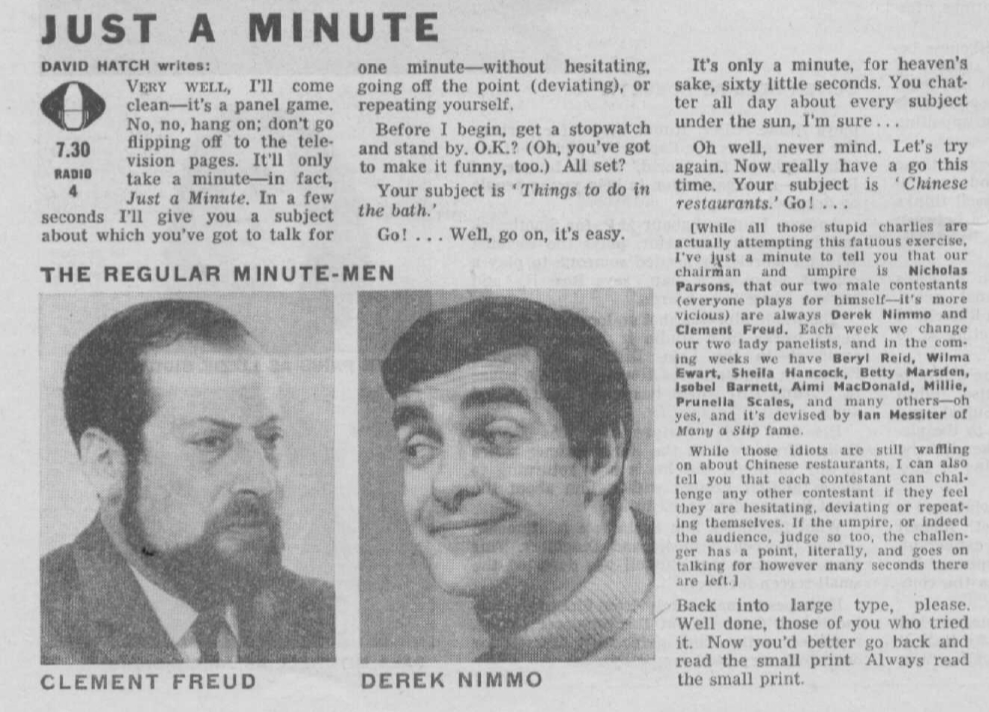
Show producer David Hatch writes a humourous introduction
for the Radio Times of 22 December 1967
Here is that first outing of Just a Minute. The panel consists of two participants who would
become regular players and two who never
appeared again. Chef, restaurateur, writer and nightclub owner Clement Freud
would eventually clock up 544 editions between 1967 and 2009. His game play
tactics were running off lists to fill the time, no mean feat without pausing,
and buzzing in with a challenge with a second or two to go, though players
couldn't see the clock. With him was actor Derek Nimmo (309 editions until
1999) whose regular foreign travels gave him plenty of material to talk for a
minute. The third member was actress Beryl Reid who struggled with the concept,
proving that actors used to performing from a script don't always make the best
exponents of Just a Minute. I've
always wondered who exactly the fourth panellists was as I've never heard the
name before. In fact it turns out that Wilma Ewart was one of Nicholas's
neighbours who had no experience of performing but who he found "witty and
entertaining". Wilma makes a decent job on the show but was never asked
back as her and husband had to move back to the USA.
The game as played in the early series is not what we now
know. The rules took some time to bed in; repetition was counted as repetition
of an idea as well as words. For a while you couldn't even repeat the words in
the subject title and there were penalty rounds such as speaking on a subject
without using certain words but these proved inhibiting.
The third major player of the game joined for the second
series when Derek Nimmo couldn't make the recordings due to filming
commitments. Producer David Hatch had been convinced of Kenneth Williams'
suitability for the game after seeing him on the panel of BBC TV's Call My Bluff and he asked Williams to
initially do six programmes. According to Kenneth's diary it seems it was a
somewhat reluctant agreement: "unfortunately it means working with that
Parsons fellow, but I said yes, 'cos it will be a nice fill-in". His attitude
to the chairman had mellowed somewhat by the time of the recording and it also
touches on the fact that Hatch would have to had to continually keep Kenneth
happy and praise his contributions: "... when we came to the performance I
just about managed and scraped through. But Nicholas was a great help and so
was Clemet Freud. David Hatch was very nice to me before (when I was actually
v. nervous) and afterwards. I like him very much - always have
actually".
Parsons, Williams, Nimmo and Jones. Radio Times 7 February 1985
With Williams on board the show was increasingly played for
laughs rather than just been a rules-based parlour game. His flamboyant style,
his appeals to the audience, those elongated vowels and then rattling along at
top speed became his game trademarks. Williams even unwittingly introduced some
catchphrases that are remembered to this day and only recently were referenced
by Paul Merton and Sheila Hancock: "I'm a cult figure". "I
haven't come all the way from Great Portland Street...". "It's a
disgrace" when, unreasonably to him, challenged or losing an appeal. And
"we shouldn't have women on this show", initially aimed at the 'lovely
Aimi Macdonald'. Kenny appeared on 346 radio episodes between 1968 and 1988.
In 1992 the programme celebrated its silver anniversary with
a 2-part retrospective, Silver Minutes.
This is part one from 20 July 1992 (though this is the commercially released
version).
The fourth member of what was seen for many years as the
'classic line-up' - was Peter Jones, who joined the show in 1971, again to fill
a gap left by a busy Nimmo. He had a more laid back approach to the game and
was often willing to sit back whilst the other fought it out only to buzz in
with a very funny or acerbic comment. His talks always seemed to start with
"well..." I recall. Peter made 326 appearances until 2000.
That so-called classic line-up appeared together in just 38
episodes so there were always guest slots to fill. Some became semi-regulars
and the longest-serving of these is Sheila Hancock who, like Nicholas Parsons
spans the five decades, appearing on the second edition of the first series in
December 1967 through to a couple of shows in the latest series, the 79th, this
autumn.
This is the second of the Silver Minutes programmes originally broadcast on 27 July 1992.
With the gradual loss of Kenneth Williams in 1988 there was
a vacancy for a regular player. Comedian Paul Merton had been an avid fan of
the show for years and had recorded and constantly replayed episodes to
himself. Convinced that he could contribute to the show he wrote to the then
producer Edward Taylor. At the same time he'd appeared as a panellist on the TV
game show Scruples on which Nick also
appeared (BBC Genome would suggest this was the 30 October 1988 edition) and he
mentioned how much he loved Just a Minute.
Paul's flights of surrealist fancy and running gags opened up the show and in
recent years, alongside that other semi-regular Gyles Brandreth, it has tended
to be comedians on the panel.
The programmes longevity can be put down to the fact that
one, it is a simple concept and two, that it has slowly evolved. Nicholas
Parsons, with a long history in the business has, to be fair, be very astute in
recognising the fact that the show needed to change to survive. Indeed in his
book on the programme he is very honest about the run-ins he had with Clement
Freud who still wanted to play strictly by the rules as first laid down by Ian
Messiter. Parsons recognised that much of the laughter comes from the
challenges, whether valid or not.
The first series of Just
a Minute that I committed to tape was the 14th that aired between December
1979 and March 1980. Playing alongside Williams, Nimmo, Jones and Freud were
Sheila Hancock, Aimi Macdonald, Tim Rice, Patrick Moore, Lance Percival, Barry
Cryer and John Junkin. Making their only appearances in the programme's history
were Peter Cook, Bob Monkhouse, Rob Buckman and Kenny Everett.
This is the first episode from series 14 from 11 December
1979.
Of course the real star, and the one constant, throughout the run has been Nicholas Parsons, still sounding as strong, if a little less posh, as he did in 1967. "I enjoy the position of chairman so much", he says in next week's issue of the Radio Times. "It's the greatest effort of concentration of any job I have. I'm listening intently and can see the way people's minds are working when they have a subject. We, as professionals, make it look easy and sound fun, but it's an incredibly difficult game." I can't do justice to the programme's 50 year history in
such a short post so I can direct you to the superb Just a Minute website.
Nicholas Parson's own history of the programme Welcome to Just a Minute was first published in 2014 and is
available in hardback, paperback and Kindle editions
or The Big Cult all the way from Great Portland Street
Surely there as few British celebrities who are so widely imitated – Frankie Howerd, Tommy Cooper and Jimmy Savile would be on the list – as Kenneth Williams. Everyone can do Kenny.But the public face that he presented, and of course that voice, was a mix of the real Williams together with a dash of all those characters created for him by some of the best scriptwriters in the business.
With the Radio 4 panel game Just a Minute celebrating its 45th year it’s perhaps timely to recall one of the great exponents of the game, the irrepressible and irreplaceable Kenneth Williams
Of course Just a Minute came relatively late in Williams’ career, he was already a veteran of some of the best known radio comedies of all time and a star, on no star money, of the Carry On series.
Kenneth’s appearance with Hancock and Horne are well represented by regular repeats on BBC 4 Extra and commercial releases so I’ll avoid reposting them here. [1] Instead I’m been rummaging in my ganderbag and I’ll be concentrating on his later shows including his last ever radio appearance in 1988.
Like many of his generation Kenneth’s first taste for performing came from his days with the Combined Services Entertainments, the successor to the famous ENSA. That was in 1947 where, as part of the Survey Section of the Royal Engineers, he was posted to the Far East. Here he also got his first taste of radio broadcasting on Radio Malaya and the Blighty Calling programme on the Forces Network of Radio Rangoon.
On demob Williams pursued his theatrical ambitions, and he remained dedicated to the stage for many years, with the Newquay Repertory Players. Throughout the 1950s Kenneth’s regular work was mostly in local rep before moving into revues that allowed him to use that voice to more comedic effect. Later he would make occasional forays into “legitimate” theatre.
According to Williams’ diary he earned his first BBC cheque in 1949 for a part in a John P. Wynn radio serial Gordon Grantley K.C. His first tv work came in 1952 in the role of the Angel in an H.G. Wells fantasy The Wonderful Visit. The first cinema role was the same year, a junior gardener in the murder thriller Trent’s Last Case. But generally work was slow even though, as he saw it, “I am destined to be a good actor.”
Kenny’s big break came, as is well-documented and was oft-repeated by Williams himself, when he played the part of the Dauphin in Saint Joan opposite Siobhan McKenna. “In the Epilogue to the play”, he relates in his autobiography, “I used a heavily ageing make-up and a querulous old man’s voice and to my astonishment this led to a call from the BBC asking me to join the radio programme, Hancock’s Half Hour”.
Roger Wilmut, in Tony Hancock ‘Artsiste’, takes up the story:
Main Wilson needed one more regular voice, to play the succession of lower-middle class bureaucrats with whom Hancock was expected to get involved. He rang round various theatrical agents without success, until one of them suggested that Main Wilson should go to see an actor – not on the agent’s books – who was appearing as the Dauphin in Shaw’s Saint Joan at the Arts Theatre. It was the twenty-eight-year old Kenneth Williams.
Main Wilson went to see the performance. He was not disappointed- Williams imbued the Dauphin with comedy, sadness, and towards the end, a malevolence that deeply impressed Main Wilson.
The first episode of Hancock’s Half-Hour was recorded at the Camden Theatre on 30 October 1954 and transmitted three days later on the Light Programme.In the show Williams plays the part of Lord Bayswater.
His diary entry for the recording states that it “went very well really, and I got through OK”, but the following week, ever critical of his own performances, he played a policeman and a judge “both badly”. A month later again he was “really very bad indeed” but also the Galton and Simpson script was “lousy”. This flipping of opinion from day to day, from show to show was not uncommon throughout his career and mirrored Williams’ own behaviour on shows such as Just a Minute: earnest and intellectual one moment and outrageous and lewd the next.Kenneth was well-read in prose and verse (he would contribute to several Radio 4 poetry programmes in later years) but the baser Cockney humour often surfaced.
Williams and Hancock got on famously at first but the latter’s gradual self-destruction through his search for some form of comedic truth led to the dropping of Williams – “it’s a gimmick-a funny voice-it’s cartoon stuff. It’s not true to life and I don’t want it in the show.” – and Bill Kerr, Hattie Jacques, Sid James and eventually Galton and Simpson.
The ‘snide’ voice and the catchphrase “stop messin’ about” may have been dropped by Hancock but they gave Williams a fame, of a kind he did not seek, and led to the start of his greatest period on the radio working with Kenneth Horne, whom he adored and admired, on Beyond Our Ken and Round the Horne.
For a while, in 1958 and 1959, Kenneth was on both Beyond Our Ken (the pilot had been recorded in 1957 but it went to series the following February) and Hancock’s Half Hour.From the off he thought the scripts by Eric Merriman and Barry Took “v. good” and the opening moments of the first episode show the “snide” voice back in use.
Carry On publicity shot
1958 also saw the start of that other great British institution, the Carry On series. In Carry on Sergeant, taking its cue from the hit Granada TV series The Army Game, Williams played the “supercilious know-all” James Bailey. The series, which nearly all featured Williams, made him a household name and added to the list of his catchphrases and quotable lines : “oh matron”, “infamy, infamy, they’ve all got it in for me”, “frying tonight!”. Eventually he came to loathe the “appalling” scripts but whilst enjoying the camaraderie and fun of the cast and crew. He never got rich on these films, the fee for Sergeant was £800 and remained so until 1962 when it was raised to £5,000 and was little changed for the remainder of the run. Years later, from the mid-70s on, more lucrative work came from commercial voiceovers.
Beyond Our Ken came to an end in 1964 following a dispute between the BBC and writer Eric Merriman. The follow-up series, planned as It’s Ken Again but changed to Round the Horne, was scripted by Barry Took and Marty Feldman, who had both been working on The Army Game. Those shows, running from 1965 to 1968, gave Williams free-reign to use all the voices in his repertoire, to ham it up mercilessly and to seemingly come out of character (Williams was a great ad-libber) , though it was, of course, all scripted.
I demand a rewrite. Give me back my youth. Take no notice listeners – I’m still young and lithe – I am a gilded youth. Gilded. Gilded.
The Round the Horne cast and script were all top-notch and are still deliciously funny today. Williams’ regular characters of Rambling Syd Rumpo, J. Peasmold Gruntfuttock, Dr Chou En Ginsberg, MA (Failed) and Sandy, to Paddick’s Julian, are stand out comic creations.
Typically Kenneth’s reactions to the series swung from a “marvellous series of scripts” to “moribund” but there’s no doubting that the sudden death of Kenneth Horne in 1968 was a blow; “I loved that man. His unselfish nature, his kindness, tolerance and gentleness were an example to everyone. God know what will happen to the series now”.
What happened was a series developed specifically for Williams, but seen as a rehash of RTH, called Stop Messing About. Barry Took, who dipped out of writing this series, concluded “it was not a great success and was soon abandoned”. Listening again to Stop Messing About you sense the loss of Kenneth Horne around whom all the madness used to happen. As if to compensate, announcer Douglas Smith gets more lines as the show’s straight man. The show lasted for two series.
Radio Times 1 Sept 1971
There followed a handful of short-lived comedy vehicles for Williiams: The Secret Life of Kenneth Williams (1971) and More of The Secret Life of Kenneth Williams (1973) written by R.D. Wingfield. These actually came from the BBC drama department, being produced by Keith Williams, the first producer on Waggoners’ Walk. The use of announcer Douglas Smith in the first series provided the link back to BOK and RTH. The Kenneth Williams Playhouse (1975) was four different shows one of which made it to a full series. That series was Oh, Get On with It! (1976) written by Pete Spence and co-starring his old mate Lance Percival and Miriam Margoyles. This was his last comedy series in a starring role, subsequent radio work was of the variety show style or as a guest panellist or speaker.
Another series around this time reunited him with his Carry On Teacher co-star Ted Ray, The Betty Witherspoon Show (1974). The cast also included Miriam Margolyes and Nigel Rees. Williams judged the first recording as “just all right”.
The panel game Just a Minute was first broadcast in December 1967 but it wasn’t until the second series the following year that Kenneth joined the show and stayed with it for the next 20 years, clocking up 346 appearances.The ‘classic’ line-up of regulars would eventually become Williams, Clement Freud, Derek Nimmo and Peter Jones (in fact they appeared together in 38 programmes).
This edition from series sixteen in 1982 features the four regulars. All are on top form as we hear attacks on Parsons’ chairmanship and a running gag about his wife, Nimmo’s world travels, witty interjections from Jones which Williams always relished (hear his braying laugh), and Freud’s use of lists and buzzing-in with seconds to go. It also gives an excellent opportunity to hear how Kenneth played the game-the swooping cadences, the change of voice mid-sentence, calls to “shut your row” and the final flourish, a full minute without interruption. You can just see those flaring nostrils.
On the whole Williams enjoyed these Just a Minute recordings though as he admitted he sometime behaved “outrageously” or “disgracefully”. Throughout the 1970s and 1980s he was now a regular on panel games and chat shows on both TV – Parkinson, Wogan, Harty, Aspel, Give Us a Clue, Whose Baby?, Through the Keyhole etc. – and radio.
On the radio you could catch Kenneth on the likes of Quote…Unquote, The Law Game, On the Air and Dealing with Daniels. From 1980 here he is on the quotations game. On the panel is John Lahr biographer of Kenneth’s old friend, playwright Joe Orton. Williams himself seems a little subdued at first, unwilling to play the game until coaxed by Rula Lenska’s anecdotes. Providing good value is Wynford Vaughan-Thomas.The chairman, as always, is Nigel Rees with Ronald Fletcher reading the quotations.
Kenneth Williams' Cabaret with Julie Covington and Pat Coombs
In 1982 Kenneth was one of the hosts on the Radio 2 series One Man’s Variety [2] providing the links between the musical and comedy acts. He’d done this role before of course on the late 60s TV series International Cabaret, but there’s now a growing sense of ‘haven’t we heard this all before?’. Kenneth himself wrote that “for years I have been using my own material in chat shows or panel games, and I feel that I have become drained of all the ad-lib inventiveness.”
He was again Master of Ceremonies the following year in the four-part series Kenneth Williams’ Cabaret. [3] Here’s the third programme with guests impressionist Peter Goodwright and singer Lois Lane. This was recorded on a poor quality tape so apologies for the tape hiss.
Williams recorded his second appearance on Desert Island Discs in March 1987 and you can hear that programme online.
The Spinners
His last radio recording was made at the BBC’s Paris Theatre Studios on 7 March 1988 when he was a guest of The Spinners – they were celebrating their 40th and final year in showbusiness. Kenneth’s diary entry reads: “Met the Spinners in the narration booth & then rehearsed with Terry Walsh [guitarist]…oh! it was a delight to see him again. Alas! we have both grown old since the days of ‘R.T.H.’. Eventually I went on and did the spot in an enclosed space-they screened off the studio saying it made a good atmosphere but the truth was that it was a sparse audience.”
Here’s the show The Spinners and Friends as broadcast on 4 August 1988 with Kenneth doing an old Rambling Syd Rumpo song and reminiscing about his time on Round the Horne and Just a Minute.
A little over a month after making this recording Kenneth was found dead in his London flat. Although he’d been ill for a year or more and had contemplated suicide many times in his life an inquest recorded an open verdict.
His legacy to entertainment lives on in those classic shows from radio’s golden age and the Carry On re-runs. It may not be the great acting legacy he always wanted, but it’s a great comic legacy nonetheless.
Kenneth Charles Williams 1926-1988.
[1] Hancock’s Half-Hour, Beyond Our Ken, Round the Horne and Stop Messing About are all available on CD from BBC Audio. Thanks to fellow radio enthusiasts I’ve been able to obtain copies of The Secret Life of Kenneth Williams,The Kenneth Williams Playhouse and Oh, Get On With It!. All the full length recordings in this post come from my own archive.
[2] One Man’s Variety (or One Woman’s Variety) was broadcast2202-2300 Tuesdays 02.02.82 to 23.03.82 on BBC Radio 2. Each programme hosted as follows: (1) Ray Alan & Lord Charles (2) Roy Walker (3) Roy Hudd (4) Colin Crompton (5) Vince Hill (6) Janet Brown (7) John Inman (8) Kenneth Williams. Producer Richard Willcox.
[3] Kenneth Williams’ Cabaret was broadcast2130-2200 Tuesdays 25.01.83 to 15.2.83 on BBC Radio 2. All shows featured singing group Cantabile. (1) Pat Coombs and Julie Covington (2) Peter Hudson, Barbara Jay & Tommy Whittle (3) Peter Goodwright and Lois Lane (4) Isla St Clair and Jonathan Adams. Producer Jonathan James-Moore
Quotes taken from:
Just Williams by Kenneth Williams, JM Dent & Sons 1985
The Kenneth Williams Diaries edited by Russell Davies, Harper Collins 1993
Round the Horne:The Complete and Utter History by Barry Took, Boxtree 1998
Tony Hancock ‘Artiste’ by Roger Wilmut, Methuen 1978