In an era of
24-hour rolling news it’s difficult to comprehend that there was a time when
broadcasters found that “the prospect of filling fifteen minutes each night with
original actuality material was a terrifying problem”. That was the problem
facing the producers ofRadio Newsreel
when it started in 1940. It was a programme that ‘provided a model for news
coverage that was urgent and involving’, it would be heard around the world for
half a century and in post-war Britain it was one of the most listened-to news
broadcasts. Here is a brief history of Radio
Newsreel.
The idea for
a daily programme that was “about the news of the day, introducing the voices
of the men and women of Britain” came from two men in BBC’s Overseas division.
First was Michael Barkway, the news editor for the Empire Service. But the main
driving force was Peter Pooley, a former Empire Service announcer and by 1940 the
Overseas News Talk Editor. He recalled the difficulties in sourcing news and
actuality as “there were no news agencies to collect it for us and send it
ticking into the office day and night. We had to wait for the news to break,
then try frantically to collect our sound pictures and stories in broadcastable
form and have our programme on the air by midnight”.
The first Radio Newsreel was broadcast on the
North American service on 8 July 1940 live from a Broadcasting House basement
studio at 4.30 in the morning. Producing and presenting that first edition was
Robin Duff who opened with “The British Broadcasting Corporation presents Radio Newsreel – Edition Number One.”
The title was meant to suggest the commentary with pictures approach familiar
to American movie-going audiences who would see newsreels produced by Fox
Movietone, Universal, Paramount and the March
of Time series. Indeed the producers were always on the lookout for
‘radiogenic’ stories. The approach of the writers and presenters was to adopt a
more conversational and informal approach than could be heard on the news
bulletins.
In that
first edition there was a talk by a bomber pilot about the fortnight he’d spent
drifting in an open boat, Geoffrey Cox (ITN’s news editor from 1956) on a
meeting of the French cabinet days before Petain’s surrender and an interview
with three Canadian soldiers in hospital.
It was Duff
who supposedly selected the library music that would open the programme, a
piece called Imperial Echoes by
Alfred Safroni in a 1928 recording by the Band of the RAF. It formed part of an
opening sequence that was eventually introduced with the recorded voice of
Canadian announcer Byng Whittaker who would intone “Whilst Britain awaits
another dawn, we bring you news from the Battle Fronts of the World in – Radio Newsreel”.
Audrey Russell and Barry Milne editing a disc for Radio Newsreel. The Sketch 5 January 1949
By October
1940 Radio Newsreel was also transmitted
on the Pacific Service and the following year by the African Service and on the
main General Overseas Service (World Service from 1965). There were also some
Latin-American editions: Radio Panorama
in the Spanish Service and Radio Gaceta
in the Brazilian Service. Its style heavily influenced War Report when it started on the Home Service in June 1944. With the
launch of the General Forces Programme in February 1944 it also carried a daily
edition (initially with the presenters Phillip Robinson – a post-war
Manchester-based producer - and actor and newsreader Norman Claridge) meaning that,
until July 1945, it also had a domestic audience. In December 1940 the Newsreel
team had temporarily decamped to Abbey Manor near Wood Norton but by June 1942
returned to London at the Overseas HQ at 200 Oxford Street (see Life at the ZOO). Reporters working on
the programme in the wartime era included Audrey Russell, Alan Melville, future
BBC tv newsreader Robert Dougall, John Irwin (later a post-war tv producer on Picture Page, In the News etc.) and George Weidenfeld (of Weidenfeld &
Nicolson publishing fame). Two of the producers were Stanley Maxted who went on
to became a war correspondent and George Innes, the creator of The Black and White Minstrel Show.
By November
1947 Radio Newsreel was a well established,
well respected world-wide programme with the Radio Times reporting that there had been 2,676 editions for North
America, 2,586 for the Pacific and 2,168 for Africa. So on Monday 3 November
1947 in addition to the six international editions a seventh domestic one was
first broadcast on the Light Programme. News editor Stanley Rumsam explained
that “every night at 7 o’clock it will bring to Light Programme listeners not
only the hard news facts of the day but a series of sound pictures illustrating
the news and current events. The editors will draw upon live and recorded
despatches from BBC correspondents in Washington, Paris, Berlin, Rome, Warsaw,
the Middle East, the Balkans, New Delhi or Karachi and elsewhere. Happenings at
home will be covered by radio reporters who will sometime be able to illustrate
their accounts with actuality recordings made on the spot”.
Of course,
this now sounds like every news programme but at the time all bulletins were
straight reads by an announcer and there were no other news or current affairs
shows. For nearly a decade Radio Newsreel
was the major source of broadcast evening news, the only other being a film
newsreel on BBC tv, though few folk had sets at that time, and competition from
ITN was still eight years away. The listening figures for the Light Programme
edition hit 4 million in the early fifties and it was still pulling in 3 million at
the end of the decade, despite the draw of television.
Radio Newsreel always used staff
announcers/newsreaders for the international and domestic editions, unlike
other news programmes that followed such as The
World at One and Outlook that
relied on presenters with a journalistic background. Here are some examples
from the Light Programme, Home Service and World Service dating from the 1960s
and 1980s. The announcers I can identify, or who are indentified on-air, are
Jimmy Kingsbury, Ronald Fletcher, Brian Hudson, Michael Murray, Pamela
Creighton, Sandy Walsh and Jasper Britton. There are reports from Leonard
Parkin, Reg Turnill, Conrad Voss Bark, Peter Nettleship and Harold Brierley.
The ‘Light
Reel’, as it was known in-house, came to be seen as the ‘master edition. A Radio Times article for the 21st
anniversary explained just how many daily editions were produced:
Half-way
through the evening programme, at 7.15 exactly, another Radio Newsreel goes on the air from another studio; this is heard
by listeners in Africa and the Mediterranean area, and it is one of six such programmes
broadcast daily in the BBC’s Overseas Services to different areas of the world.
In fact, out of 49 weekly editions, 42 are broadcast overseas.
The Newsreel’s day starts just after
midnight in London with an edition broadcast to America and Asia. Some hours
later, while in Britain we are just getting up, another edition is being heard
by West Africans at their breakfast and Australians at tea-and so on
through-out the twenty-four hours. Besides those who hear it directly from the
Overseas Services, in seventeen countries listeners have it relayed to them by
their local stations. And some foreign station stations record it for
re-broadcasting later, or select items of particular interest to them. For
instance, one network in the United States broadcast 300 hours of Radio
newsreel material in a single month; and 656 U.S. stations re-broadcast an item
on the Archbishop of Canterbury’s retirement.
The domestic
edition of Radio Newsreel moved from
the Light to the Home Service from Saturday 31 December 1966, although the
Sunday edition had been carried on the Home since September 1957. However, it
was dropped entirely in 1970 as part of the Broadcasting in the Seventies
re-alignment, with the final edition going out on Radio 4 on Friday 3 April. The
following week PM was launched at 5
pm with a 15-minute news bulletin at 6 pm and a 30-minute News Desk at 7 pm.
London Calling billing from October 1988
Radio Newsreel continued for a further 18 years on
the World Service though the number of daily editions started to reduce: five
per day in the early 1980s and down to four by the middle of the decade. By
1988 the newsroom was producing three editions a day plus similar newsreels for
the Australian and New Zealand broadcasting services
In 1979 the
old version of the theme was dropped, much to the consternation of many
listeners. The old 78 recording of Imperial
Echoes was now too worn to run off any more copies so the BBC commissioned
a new recording by the Philip Jones Brass Ensemble, who had also recorded a new
version of Lillibullero. But as luck
would have it some months later studio manager Keith Perrin had spotted a mint
copy of the 78 in a junk shop in Tiverton, Devon which meant the ‘rightful’ sig
tune could be restored.
In October
1988 the World Service announced ‘a new mix’ with some old programmes being
dropped, some renamed or retimed and the introduction of Newshour. As for Radio
Newsreel, presenter Sandy Walsh told listeners to the edition broadcast at
1500 GMT Friday 28 October that “our programme style is changing” and that it
was the final edition of the programme. From the following day it had a shorter
title, now just Newsreel, and a new
theme. Out went the old 1928 recording of Imperial
Echoes and in came a new electronic theme composed by Richard Atree of the
Radiophonic Workshop which borrowed the melody of the old one.
Newsreel was broadcast just three times a day
at 0215 GMT for Asia only (the rest of the world got Network UK), 1200 and 1500. But Newsreel’s
days were numbered and just over two and a half years later the final
edition was heard at 1500 GMT on Friday 31 May 1991, some 51 years after its
first broadcast.
It’s back to
1961 and the 21st anniversary of Radio
Newsreel. It’s likely that this recording was taped off a shortwave
broadcast so the sound quality is very ropey. The recording was recovered by
Duncan Lockhart, to whom I extend my thanks.
Notes
Michael
Barkway became the BBC’s Canadian correspondent and between 1962 and 1974 was
editor of The Financial Times of Canada.
Peter Pooley
resigned from the BBC in 1947 at a time when the news division came under the
management of Tahu Hole. He joined the Crown Film Unit and from 1951 worked for
NATO eventually becoming Assistant Director of Information.
Robin Duff
would go on to become a war reporter and covered the liberation of Paris in
1944.
Questions on
sport are always a part of any general knowledge quiz but radio has, with just
a couple of minor exceptions, pretty much stayed away sports-based quiz shows
for the last 30 years. Meanwhile, on the telly you could watch, at least until
recently, A Question of Sport or A League of their Own, though the BBC
offering had long since strayed from anything approaching a serious quiz and
Sky’s show was likened to A Question of
Sport without sports questions.
From the
1960s through to the 1990s radio regularly posed sports questions in Sporting Chance, Brain of Sport, Games People Play and a pre-tv version of They Thinks It’s All Over. Of more
recent vintage, and those minor exceptions I mentioned above, are a talkSPORT Sports Quiz and even some radio editions
of A Question of Sport, both
broadcast during the Covid pandemic.
In the 1940s
and 50s there were occasional sports quizzes on BBC radio such as the wartime Captain Cuttle’s Sports Quiz during Ack-Ack, Beer-Beer (the magazine for the
Anti-Aircraft, Balloon Barrage and Searchlight Units), youngsters competing in Children’s Hour quizzes or The Younger Generation Under 20 Parade,
this with Rex Alston as question master. The Welsh Home Service put sporting
questions to teams in Sports Forum
(1953-54) and although the Scottish Home Service also broadcast what was billed
as Sport Quiz (1950-52) this turns
out to be a “weekly feature in which experts answer questions on sport put to
them by members of a studio audience”.
Some serious
sports quizzing starts to appear in the autumn of 1957 when Sports Report (Light Programme)
broadcasts an Inter-Regional Quiz; this
pits a team of BBC national sports commentators against regional sports
reporter colleagues. But it was Welsh broadcasting legend and producer Alun
Williams who developed the idea of sports clubs competing in a knockout quiz. Going
out on the Welsh Home Service in late 1957/early 1958 was Top of the League. This saw football supporters clubs talking part
in a Top of the Form fashion, with
the recording made at two venues and the team and a quizmaster at each. Posing
the questions were Alun himself and Ifor Rees. This was followed by another
Welsh Home Service series, again devised by Alun, called Make Your Mark. For the first series in 1958 the slant was towards
the game of rugby with members of rugby clubs answering questions ‘on the laws
of the game, its personalities, their own club and general sport.’ For the second
1959-60 series both rugby and football clubs competed, this time dealing with
‘questions of a general sporting nature’. Joining Alun as question master for Make Your Mark was Cliff Morgan.Cliff also hosted a TV version of the quiz in
1959/60 as part of the weekly Welsh
Sports Parade.
Sporting Chance 24 June 1968
On national
radio the first regular sports quiz was the Light Programme show Sporting Chance (1960-74). The original
chairperson was Brian Johnston and it was devised by Michael Tuke-Hastings (who
later would also come up with the Treble
Chance quiz). Initially an inter-town quiz, later series were also
inter-services and from 1963 invited teams played against a resident team made
up of commentators and sports journalists.Setting the questions was cricketer and scorer Roy Webber who, following
his death in 1962, was succeeded in the role by two more Test Match Special statisticians: Arthur Wrigley and, from 1967, Bill Frindall.
The 1964
series of Sporting Chance had the
resident team of Maurice Edelston, Peter West and Alun Williams playing against
a team of four boys representing a school (with the supposition, no doubt, that
no girls would be interested in sport). Rounds included ‘I’ll Always Remember’
in which well-known sports persons recalls a highlight of their career, a ‘Guess
the Year Round’ and a ‘Spot the Mistake’ in which a commentator makes one
deliberate mistake. The questions were in the main confined to ‘Rugger, Soccer,
Cricket, Athletics, Swimming, Boxing and Lawn Tennis’ but apparently, according
to Frindall, horse racing was ‘‘for some unfathomable reason considered
unsuitable”.
Both Sporting Chance, and Brain of Sport that followed, took their
quizzing seriously probably because both were produced by the Sport and OB department.
Michael Tuke-Hastings was, from 1957 to 1972, the producer of Test Match Special which may explain the
reason he approached cricket scorers to set the questions. Other producers of Sporting Chance included Geoff Dobson
and John Fenton who both directed the Sports
Service on Network Three (later Radio 3) and Sport on 2.
A question from the Brain of Sport 1980 quiz book
Sporting Chance was followed by Brain of Sport (1975-89) with heats and a grand final and questions
split between general and specialist rounds. The programmes were recorded at
sports clubs and social clubs around the country. Again devised by Michael
Tuke-Hastings it was chaired by Peter Jones and this time writing the questions
was Chris Rhys. Chris was a rugby player turned freelance journalist who wrote
over 20 books on sport, including some Brain
of Sport quiz books, and also researched ITV’s response to A Question of Sport, Sporting Triangles. After Tuke-Hastings
stepped aside from production duties it fell to Paul Garside, Patricia Ewing,
Richard Maddock, Caroline Elliott, Joanne Watson, Pat Thornton and Gill
Pulsford.
The 13
champions of Brain of Sport are
listed on the UK Game Shows website and there’s a rare recording of a 1984
edition on the Ye Olde Sports Videos channel on YouTube. There were also
occasional Brain of Sport Challenge
specials were, much like the Sporting
Chance days, finalists would take on three sports commentators
Games People Play (Radio 2 1975-78) was a more
light-hearted affair, produced by Richard Willcox of the Light Entertainment
department, It was billed as testing the knowledge of ‘well-known stars of
entertainment and sport’. So, for instance, on the first show it was Mike and
Bernie Winters, Graham Hill and Bob Wilson. Other appearing in the first series
included Eric Morecambe, Bernard Cribbins, David Hamilton, Pete Murray, Chris
Brasher, Henry Cooper, Graham Hill, Fred Trueman and Barry John. Asking the
questions this time was Peter West.
Before its
went over to BBC1 They Think It’s All
Over enjoyed a short life on BBC Radio 5 (1992-4). It was created by comedy
writers Bill Matthews and Simon Bullivant, both of whom had started writing for
Week Ending. Chairing proceedings was
Des Lynam and as team captains were Rory McGrath, who went on to be a regular
on the TV version, and, getting the opportunity to try out his commentator
impressions, Rory Bremner.
From the second series comes this edition that was broadcast on Radio 5 on 21 February 1993, though my recording is of the Radio 4 repeat on 17 July. Des gets the first big laugh of the show with “Meet a man whose rich vocal talents are adored by millions. (short pause) Good evening”. The guest players in this edition are Steve Davis and Roger Black.
Which brings
me to Game, Set and Match and yet
another series with Chris Rhys setting the questions. If this one usually slips
under the sports quiz radar that’s because it aired on the BBC World Service.
Chairing this was World Service sports stalwart Paddy Feeny (so I find myself
writing about Paddy for the second time this year). I’ve little information
about the programme other than it ran for 20 editions over three series in
1993, 1994 and 1995. This recording comes from the third series (I can’t date
it precisely) and facing the questions are hurdler Kriss Akabusi (you’ll
recognise the laugh), hockey player Simon Mason, rower Steve Redgrave and
squash player Peter Nicol. Keeping the score is Louise Friend, extracts are
read by announcer John Stone and the producer is Gillian Grey.
Game, Set and Match
Series 1: 7
episodes August and September 1993
Series 2: 6
episodes August and September 1994
Series 3: 7
episodes in April and May 1995.
Sporting Chance with Brian Johnston, then John
Snagge, John Arlott , Alun Williams, Max Robertson and Peter Jones . BBC Light
Programme (with repeats on the Sports
Service of Network Three) and BBC Radio2 from 16 January 1960 to 16 June
1969 over 10 series. It returned as Quiz
on 2 as part of Sport on 2
November 1973 to January 1974 with Peter Jones as questionmaster. Reverted back
to Sporting Chance November to
December 1974 again with Peter Jones and again during Saturday afternoon’s Sport on 2.
Brain of Sport with Peter Jones. BBC Radio 2
November 1975 to December 1989 over 13 series. The first series was broadcast
as part of Sport on 2.
Games People Play chaired by Peter West. 39 programmes
over four series on BBC Radio 2 between 4 September 1975 and 22 September 1978.
The Matchplay Quiz was a junior sports quiz chaired by Paul McDowell. BBC Radio 2 for one series 8 August to 26 September 1987.
They Think It’s All
Over with
Desmond Lynam and team captains Rory Bremner and Rory McGrath. BBC Radio 5 6
episodes 21 February to 27 March 1992 then 8 episodes 14 February to 4 April
1993 plus two Christmas specials with guests Brian Johnston and John Motson
December 1993/January 1994.
talkSPORT Sports Quiz March to September 2020 with Darren
Bent and Laura Woods or Faye Carruthers or Lynsay Hipgrave
A Question of Sport with Mark Chapman, Matt Dawson and
Phil Tufnell 4 April to 13 June 2020 plus 24 December 2020.
If you have
any recordings of the other quizzes I’ve mentioned that you’d like to donate
I’d love to hear from you. Also if you happen to have any copies of London Calling orBBC Worldwide from the mid-90s please do get in touch.
And the answers to the Brain of Sport 'Who are they?' questions are: Sebastian Coe, Hallamshire Harriers, Alberto Jantuorena (Cuba) and Zurich
It’s the final Sarah
Ward Collection on Jazz FM this evening as Sarah ‘steps back’ from the
weekly show after seven decades in broadcasting. It marks the end of a career
for British radio’s longest-serving female presenter, a feat which deservedly is
being recognised. After tonight’s usual show there’s an hour long special The Sarah Ward Celebration in which Sarah talks about her career and we hear from some of the colleagues she worked with. [Note 1]
Ahead of that interview I thought I’d fill in as much as I
can about Sarah’s broadcasting career. It’s one that stretches back to the end
of the 1950s and would go on to include television roles in the 60s and, from
the 70s onwards, radio jobs with both the BBC and commercial radio. But it all
starts in Africa.
Sarah was born in Kenya into what she affectionately
describes as a colonial family – her grandparents were coffee farmers, her
stepfather in the King’s African Rifles. “I’ve heard a lot of people say that
Africa’s in your blood”, she told London
Calling in 1988. “For me, that’s certainly true. I went there for a visit
in the 70s-the homecoming as I arrived at the airport! The colour, the smell,
the rhythm. I have very emotional feelings about Africa”.
Staff at FBS Nairobi in 1960. Sarah is on the front row, second in from the right. Photo Alan Grace in The Link with Home-Sixty Years of Forces Radio
It was in Africa that Sarah got her first taste of radio
broadcasting. Aged just 15 it was at the Forces Broadcasting Service in Nairobi
that she helped out as tea-maker and general skivvy before getting the chance
to do some presenting because “the early hours made it difficult to recruit
people”. About a week in she arrived for a dawn shift, switched on the station
and saw, coiled round the mic, a snake. She fled the studio screaming – the mic
still open. The engineers had beefed up a snakeskin to look like the real thing
and made sure the raw recruit got some effective on-the-job training.
After spending some time with the Voice of Kenya English language
service, in 1964 Sarah decided to pursue her broadcasting career in the UK.
After just six months she landed a job as an in-vision BBC television
continuity announcer, presumably they were looking for the next Judith
Chalmers. The BBC also appointed two other ‘continuity girls’, Meryl O’Keeffe
and Maggie Clews. Sarah was also booked to present the weekly Junior Points of View which she
continued to appear on until June 1967. [Note 2]
The Daily Herald
of 11 September 1964 reported on Sarah’s arrival:
SARAH—THE NEW FACE ON
TV A 23-YEAR-OLD girl who has been working as a waitress and a theatre
programme seller is to be an announcer on BBC television. She is Sarah Ward,
who came to Britain six months ago from Kenya, where she has worked on TV.
Sarah took jobs as a waitress and programme seller while waiting for a ‘break’
with the BBC. Viewers first saw her last Sunday. She appeared in Junior Points of View last night.
Part of her role was to do interview spots at the end of the
evening programmes. Her most famous interviewee was undoubtedly Bob Dylan, but
it was a bizarre experience. Dylan was at the BBC to record a concert series
(shown on BBC1 in June 1965). The interview was live and possibly the first to
be done in the UK. Sarah recalls “It was a peculiar interview. He kept spinning
round in his chair, sometimes turning his back on me. He’d just been to the BBC
canteen and was still eating a biscuit, which he kept waving in my face. He
seemed to be fixated by the biscuit, ignoring most of my questions about the
pressures of life as a superstar. The only time he really came alive was when I
started asking him about the money he was making and he suddenly became very
shrewd and on the ball.”
Sarah with Come Here Often co-host Cliff Morgan
Sarah left the BBC in June 1967 and a month later popped up
on ‘the other side’ as co-host, alongside Cliff Morgan, on Come Here Often. Produced by Rediffusion, Come Here Often, was a twice –weekly (Tuesday and Friday tea-time)
‘topical magazine programme dealing with news and interesting events for
children aged between nine and fourteen’.
Producer Elizabeth Cowley described it as a ‘junior Tonight’ but it was probably closer to Blue Peter. It can be seen as a forerunner of Thames TV’s Magpie and indeed just before the series
ended on 23 July 1968 (as Rediffusion’s lost the franchise to Thames) future Magpie host Mick Robertson had been co-presenting
the last few shows with Sarah. [Note 3] Come
Here Often wasn’t without controversy as Sarah recalls: “one lively
programme [in August 1967] featured a debate between the British Power movement
and an opposing group of young blacks. One of the debaters became especially
overheated and pulled a knife, which led to the immediate blacking out of the
screen and the programme hitting the headlines in the British press the next
morning.”
By the early 1970s Sarah was working for the BBC World
Service appearing on the request spot at the end of The Merchant Navy Programme with Malcolm Billings, where she ‘built
up a huge fan-club of sailors’. Her ambitions to expand into general presentation
were initially thwarted, as whilst her boss at Bush House was “very sympathetic
towards her programme ideas ...unfortunately Radios One and Two just didn’t
want to know”.
Undeterred, Sarah went for an audition with commercial
rivals Capital Radio that was due to launch in October 1973. The audition was
for the job of record reviewer on Nicky Horne’s nightly rock show You’re Mother Wouldn’t Like It. “I did a
lovely late night audition with Nicky which was relaxed and nice”, she
remembers, “and apparently they liked my voice and said let’s use it for
something else.”
When Capital started director of programmes Michael Bukht
offered Sarah a role as one of the presenters (with ex-BBC radio’s Sean Kelly)
of Night Flight ‘late night music
that’s easy on the ear, open line for night owls to air problems, ask advice,
have a chat’. Later she gained her own show Sarah
and Friends. “It was always what I’d wanted to do, in fact ... I was saying
to myself and also to one or two people at the BBC that I would like to do a
late night show, a combination of music and chat.”
Of those Capital days Nicky Horne recalls that “there were
quite a few of us who were the more sort of leftfield thinkers, and Sarah was
really part of that gang. She was at the time a bit of a rock chick and loved
her rock. I remember in those early days there was chaos all round but that
Sarah always had a calmness and a serenity about her”. He describes her as
having a real love for the medium of
radio and, unlike a few others, she was unencumbered by ego. A magnificent
voice and a beautiful soul.” Sarah also expressed
her preference for radio: “there’s less emphasis on being the polished pretty
product. There’s more scope to be genuinely yourself and I enjoy the teamwork
which radio demands.”
Sarah left Capital in 1975 but would return at the end of
the 70s and continued to appear on the station presenting London Tonight for a while and latterly, until 1986, a Sunday
afternoon show. When Capital Gold was launched Sarah presented the late-night
show in 1988 and 1989.
Recalling her time at Capital, Sarah was doing a “fairly
hard-hitting interview with a journalist about Idi Amin’s Uganda. He was extremely
nervous and I was doing everything possible to help him and put him at his
ease. Out of the corner of my eye, I noticed the studio door slowly open and
someone- who shall remain nameless- crawling across the studio floor towards
us. To my horror, he grabbed hold of my interviewee’s foot and started to take
off his shoe. The interviewee was absolutely transfixed. It was just like
watching a rabbit freeze. We had to terminate the interview abruptly and go
into a commercial break.”
Back to 1975 ahead of the launch of Portsmouth’s Radio
Victory, head of programmes David Symonds recruited the “silky smooth” Sarah to
join the team. At first she was on late nights – playing quite a bit of album
rock - but was also involved in the Saturday lunchtime kid’s show Up 2 U and then devise, and for a while (in
1977/78) present The Wonderful Wobbly
Wireless Show. Both programmes featured significant involvement from local
children including two aspiring broadcasters: John Terrett and David Dunning.
At any one time about ten kids would be invited into the studio to present
reports, choose the music and interview guests, all under the supervision of
Sarah. As a reward they were allowed to raid the record box and grab any spare
promotional discs – John’s first pick was Springsteen’s Born to Run – but later they were offered expenses for turning up. On one occasion David remembers interviewing a
family friend who was a Solent shipping pilot based at Ryde Pier. Off we went
with a UHER tape recorder but “I had no concept of actually arranging it in
advance but gave the impression Uncle Sammy would be delighted to talk to us.
He wasn’t in the office when we arrived and lovely kind Sarah gave the
impression that ‘these things happen’ ...but even a naive 10 year old knew it
was my first big broadcasting cock up and she was a tad annoyed.”
London Calling April 1980
Meanwhile back at Bush House Sarah started to be offered
more work. In 1977 she had a daily 15-minute show of ‘music and chat’ as well
as being on the rota of presenters of the Request
Show. Between 1979 and the summer of
1986 she hosted a weekly 30 minute show of music and guests called Sarah and Company. When that came to end
Sarah was given the opportunity to ‘exploit her broad interest in all kinds of
popular music’ in the World Service’s Multitrack
3. This would feature ‘interviews with the more off-beat pop bands, new to
the music scene and unlikely to reach the charts but producing a brand of
non-mainstream music of interest to the programme’s young audience’. Multitrack
3 ran until August 1994. [Note 4]
In 1989 and early 1990 Sarah co-presented the weekend breakfast with Ed Boyle on LBC's short-lived Crown FM service.
1990 proved to be a significant year for Sarah, with the
start of her involvement in what was to become Jazz FM and presenting her first
national breakfast show. That breakfast show was on the newly launched BBC Radio 5, the education and sports channel, which came on-air in August 1990. Sarah
co-presented Morning Edition with Jon
Briggs (ex-Radio Oxford and future Voice of Siri and The Weakest Link) until February 1992.
From Wednesday 29 August 1990 here’s Sarah and Jon with Morning Edition.
In 1993 Sarah started to cover some shows on Classic FM and,
from February 1994, took over from Margaret Howard to present the nightly
weekday news and arts magazine show Classic
Reports. Sarah remained with Classic FM until early 1997 by which time she
was presenting the weekend breakfast shows.
Profile from the Radio Times in 1991
Sarah has long shared a passion for jazz with her life
partner Ken, himself a jazz saxophonist and composer. She remembers the time they
both visited Ronnie Scott’s Club when Charles Mingus was there “and Ken was
left in awe after briefly meeting him. Later in the evening, Mingus spotted Ken
smoking a pipe and asked him to swap tobacco. The ice was broken after this and
they chewed stories, mostly about Eric Dolphy.” She would broadcast on the
various incarnations of Jazz FM (Jazz 102.2, ejazz.fm, jazzfm.com) starting
shortly after it went on air in 1990 and again from 1997 onwards. Sarah is
mostly associated with three programmes: Dinner
Jazz that she first presented in 2004 (taking over from Helen Mayhew), and
again from the 2008 re-launch as Jazz FM. There’s also Jazz Travels – ‘a musical spin of the globe’ - that started in 2011
and, for almost a decade, The Sarah Ward
Collection.
For many years home for Sarah and Ken has been on the edge of
Dartmoor. In December 1998 and again in August 1999 she supported and broadcast
on the 28 day licence station Palm 106.2 in Torquay. Her shows for Jazz FM have
either been recorded at local radio studios in Devon and, more recently, from
her home studio.
From 19 December 2011 here’s part of that evening’s Dinner Jazz.
The final edition of The
Sarah Ward Collection is tonight at 6pm followed by The Sarah Ward Celebration at 9.pm.
Note 1: UK radio’s oldest broadcaster with a regular show is
David Hamilton, daily on Boom Radio. Until her death earlier this year the
second-longest serving female radio DJ would’ve been Annie Nightingale who was
a friend of Sarah’s.
Note2: Junior Points of View had started in
January 1963 as a spin-off from the main Points
of View programme but aimed at “younger viewers”. Initially presented by
Robert Robinson and then young tv announcer June Imray. June’s Scottish accent
was itself a cause of some controversy and she left the BBC in September 1964,
eventually returning to Grampian Television as an announcer.
Note3: Come Here Often had some stiff competition
on the BBC. On Tuesday it was up against Tom
Tom and on Friday Crackerjack and
(ironically) Junior Points of View. All episodes are missing.
Note 4: The BBC World Service Pop Music Unit produced three
editions of Multitrack each week. Multitrack
1 (Mons) was the top 20 show, Multitrack
2 (Weds) new releases, interviews and news and Multitrack 3 (Fris) on the ‘alternative’ scene.
Most of the quotes from this post come from Record and Radio Mirror (30 March 1974)
and London Calling (October 1988).
With thanks to David Dunning, John Terrett, Nicky Horne and
David Symonds
In May 2012 I wrote about the BBC World Service request show hosted by Sandi Jones and ended the post by writing “I've no recordings of
Sandi on the World Service - if you have please contact me”. Well nearly 13
years later I have a recording! More on that, in a moment.
The World Service request show had started in late 1975 and
ran until October 1988. Initially there were four shows a week with a different
presenter for each edition, at first Don Moss and Brian Matthew then a year or
so later by Don, Sandi Jones, Sarah Ward and Bob Holness. By 1979 there were
two editions per week presented by Sandi and Tony Myatt who would both continue
to share presenting duties for the rest of its run. [Sarah Ward continued on
the World Service with Sarah and Company,
Bob Holness with Anything Goes]. From
January 1981 just one edition per week was recorded going out on what would be
its fixed day and time of Sundays at 1345 GMT (initially with a midweek
repeat).
We get a chance to find out what a whole edition of the show
sounds like, in this case from Sunday 26 December 1982, thanks to a cassette
that has turned up. Unearthing the recording was Dennis Biggs. The tape had been
kept by his wife Doina who was producing the show at the time. This particular
edition was the final request show she produced and Sandi acknowledges this at
the end, as well as mentioning her daughter Nadina.
For many years Doina Biggs was a producer for the BBC’s
Romanian section at the BBC in Bush House. The Romanian Service had started
broadcasting on 15 September 1939 – it would close in 2008 – and when Doina
joined as a secretary in 1968 it was a time of change in the service which at
that point mainly consisted of pre-war emigrees such as Ion Podea and Liviu
Cristea. Doina and Dennis had married in Bucharest in September 1967 and after
being virtually expelled from Romania the following February she joined her
husband in London. By the early 1970s she’d undertaken training courses with a
view to becoming a programme producer. She would specialise in youth features
and pop music shows and was seconded to the English service for about a year
during which she produced the request show with Sandi Jones. Eventually, after
having to work many night shifts and as a result of internal politics, Doina
left the BBC in 1995. She continued to have an interest in Romanian issues and
took in a number of Romanian dissidents who she assisted in their citizenship
applications. She had frequently travelled to Romania until she was warned that
her safety couldn’t be guaranteed as her activities were being monitored by the
secret police. Doina passed away in September 2023.
London Calling magazine listings for 26 December 1982
In this edition of TheSandi Jones Request Show it’s
apparent that the programme enjoys wide listenership in Ghana as Accra is
mentioned many times and there are also messages from St Louis, Bahrain, Sri
Lanka, Cork, Singapore, India, Monrovia, Southampton, Paris, Bhutan, St Helena,
Saudi Arabia, Ascension Island and Malawi.
Although it’s a request show in most cases no particular
record is chosen or it’s a case of a “record of your choice please”. There are,
however, requests for specific records by Simon and Garfunkel, Carpenters,
Boney M as well as any Judy Garland track and also something by Chicago which
the team “just cannot trace”. The playlist is:
When I Need You –
Leo Sayer, O Holy Night – Nat King
Cole, Coat of Many Colours – Dolly
Parton (“a much loved record that’s been much played and is, I’m afraid,
sounding a bit ancient now”), Just You ‘n’ Me – Chicago, Where Do I Begin – Andy Williams, Ave Maria – Elaine Paige, The Wanderer –
Donna Summer, The Sound of Silence –
Simon and Garfunkel, Have Yourself A
Merry Little Christmas – Judy Garland, Every
Beat of My Heart – Gladys Knight, Top
of the World – Carpenters, Mary’s Boy
Child – Boney M and We Wish You a
Merry Christmas – Ray Conniff.
So its back 42 years to 1345 GMT on Boxing Day, Sunday 26
December 1982 for this edition of The
Sandi Jones Request Show.
With thanks to Dennis Biggs and in memory of Doina Biggs.
The crowning of King Charles III and Queen Camilla this
weekend will only be the third time that a Coronation has been broadcast.
The first, on 12 May 1937, was for King George VI and Queen
Elizabeth. It was, according to Engineer in Charge of Outside Broadcasts Robert
Wood, “the most complicated broadcast the BBC had ever attempted”. Two control
rooms were set up, one at Westminster Abbey for the National Programme and
Empire Service, and one at Middlesex Guildhall for all the foreign
commentators. The sound from 58 microphones – 11 along the route for
commentators, crowd noises and music, 15 for overseas use and 32 in the
Abbey.
BBC radio commentary
was provided for the procession to and from Westminster Abbey by the team of John
Snagge, Howard Marshall, George Blake, A.W. Dobbin, Michael Standing , Harold
Abrahams and Thomas Woodrooffe. As Snagge would later recall: “All the
commentators were as nervous as kittens, because there was no rehearsal, but we
came away with a feeling the broadcast had been pretty well done, under the
circumstances”. There was no commentary during the actual service though
microphones were installed in the Abbey to pick up the speech and music. The
BBC’s Director of Religion, the Rev Frederick Iremonger, was on hand to read
and explain ‘the rubrics’. For the Empire Service broadcast additional
shortwave transmitters were installed at Daventry to ensure coverage.
This was also the first televised Coronation so for any of
the 10,000 or so people in the London area with access to one of the
new-fangled television receivers three cameras were on hand to transmit
pictures of the procession near Hyde Park Corner. Permission to install a
further three cameras inside Westminster Abbey had been refused.Providing the tv commentary was Freddie
Grisewood.
The BBC radio coverage of the 1937 Coronation was issued on
78 rpm discs and recordings of the ceremony are online. Shortwave recordings of
the full day’s coverage as relayed by NBC in the States are also possibly
online somewhere, though I’ve failed to locate them. So I’m grateful to Sandy
Finlayson who kindly sent me some audio files five years ago. This sequence is
what was broadcast before and during the procession to Westminster Abbey. Note
that none of the ‘observers’ are actually named though John Snagge is
immediately recognisable. Making the opening ‘This is London’ announcement is
Stuart Hibberd. As the BBC was also sending sound output to the Office of Works
loudspeakers along the processional route, listen out at 12 minutes for in
instruction to turn down the loudspeakers near the Abbey annexe as “they’re
causing some interference”.
For the Coronation of Queen Elizabeth II in 1953 the radio
and television coverage was a major logistical exercise. In May 2013 I wrote
about the domestic radio coverage so in this post I’m dipping into the pages of
London Calling to see what listeners
around the world heard.
Programmes for Coronation Day, 2 June 1953
Programmes for 3 June 1953
At this time the General Overseas Service relied quite
heavily on rebroadcasting programmes already heard on the Home Service or Light
Programme. So on Coronation Day we inevitably have the same coverage of the
procession, the crowning service and the RAF fly past, the speeches by Winston
Churchill and the Queen and the fireworks.
The Director of External Broadcasting John Clark had his own personal memories of the 1937 Coronation
London Calling provides
a list of the large commentary team that includes sports commentators, former
war correspondents and some Commonwealth radio guest broadcasters. Whilst Richard Dimbleby was the senior
television commentator, on the wireless it was John Snagge, by now a veteran of
royal occasions. With John at Westminster Abbey were Howard Marshall, Audrey
Russell and Ted Briggs. Near Buckingham Palace and the Victoria Memorial were
Jean Metcalfe, Wynford Vaughan Thomas, William Richardson and the
splendidly-named Australian broadcaster Talbot Duckmanston. Others on team were
Raymond Baxter, Rex Alston, David Lloyd James, Alun Williams, Frank Gillard,
Tom Fleming, Charles Gardner, Henry Riddell and John Arlott.
Aside from the coverage of the Coronation itself the
Features Department, working with News and OB, made two major contributions. Long Live the Queen! was a ‘radio
pageant’ linked by Robert Donat’s narration and the music of William Alwyn. The
programme was “a series of close-ups of men and women of many lands, putting
into words their feelings, and the feelings of those for whom they speak, about
the Queen”.
Coronation Day Across
the World was an ambitious live programme – with some pre-recorded elements
– described as “using all the facilities of short-wave radio, (to) build up a
living, instantaneous sound-picture of the world’s rejoicing on Coronation Day”.It was similar in scope to the hour-long
features that had preceded the King’s Christmas Day speech for the previous decade.
Here’s Coronation Day
Across the World which was not without the odd technical hitch. Four
minutes in commentary passes to Wynford Vaughan Thomas outside Buckingham
Palace but evidently although he’d heard his cue at the time he was unable to
secure his position on the Victoria Memorial so large was the crowd.
At intervals during the day on the General Overseas Service are
extracts from the Commonwealth Gala
which had been heard on the Light Programme on the Sunday evening and featured
artists from Britain and the Commonwealth. Those on the bill included Elsie and
Doris Waters, Dick Bentley, Bernard Braden, Hutch, Ted Kavanagh, Gladys Young
and Cecily Courtneidge. Dick Bentley was also on Take It From Here which was also heard over on the Light Programme.
London Calling
provided a couple of pages of wavelength information, one listing the usual
wavelengths for the majority of the week’s programmes, the second showing all
the details for the Coronation broadcasts on 2 June. These included all the
wavelengths specifically directed the different regions or countries as well as
those which may be heard under favourable conditions, designated ‘secondary
coverage’. Listeners were also advised that many other organisations were
planning to re-broadcast the BBC transmissions.
Staying with royal events a little longer last year I posted
pages from the June 1977 issue of London Calling to mark the Queen’s Silver Jubilee. Again thanks to Sandy Finlayson
I now have copies of some of the World Service programmes featured in that month.
One of the programmes comes from the Theatre
of the Air drama stand and is a production of Laurence Housman’s 1934 play
about Queen Victoria, Victoria Regina.
The play, essentially as series of vignettes about the queen’s life over a
sixty year period, had been performed on BBC radio before, but this was the
first production in nearly thirty years. In this adaptation directed by John
Pitman, Jane Wenham stars as Queen Victoria. The cast includes John Castle as
Albert, Lockwood West as Gladstone, Betty Bascomb as Mrs Gladstone, Garard
Green as Palmerston, Manning Wilson as Melbourne, Brian Haines as Russell and
Denis McCarthy as Beaconsfield with Joan Hart as the Narrator.
This recording of Victoria
Regina was made in Canada and taken from a BBC World Service transmission
via the now defunct relay station at Sackville, New Brunswick.
For more on the 1937 Coronation this Transdiffusion articlehas extracts from the 1938 BBC handbook. And for an over view of Coronation broadcasts
please listen to the latest podcast from Paul Kerensa’s British Broadcasting Century.
Ninety years
ago tomorrow (19 December) the BBC began to broadcast to the world, or at least those parts of
it that were coloured red on the map, as the Director General John Reith opened
the Empire Service. In this post I look at the early history of the BBC’s
overseas broadcasting, dip into some back issues of London Calling and present some programmes that have celebrated the
history of the service.
From studio 3B in the recently opened Broadcasting House at 9.30 am on Saturday 19
December 1932, Reith broadcast to whoever was listening in on their shortwave
radios in Australia, New Zealand and Borneo. (1) In his live opening
announcement Reith talked about how this was a significant occasion in the
history of the British Empire. He continued: “There must be a few in any
civilised country who have yet to realise that broadcasting is a development
with which the future must reckon and reckon seriously. The more consideration
given to it today, the more experience gained, the more it will be realised
that here is an instrument of almost incalculable importance in the social and
political life of the community. Its influence will more and more be felt in
the daily life of the individual, in almost every sphere of human activity, in
affairs national and international.” “As to programmes”, he added (in an
oft-quoted sentence), they “will neither be very interesting nor very good”.
This was not
false modesty on Reith’s part. The broadcasts were an experiment but seemed, at
least in the early days, to mainly consist of music played from records,
interspersed with talks and ending with a news bulletin.A listener in Bermuda, used to hearing other
broadcasts from the States and Continental Europe wrote to say the programmes
were “inferior”, whilst a listener in Canada was of the opinion that it was
“feeble, asinine and hopeless for words.”Not surprising when you consider that the Empire Service only had a
staff of six and a weekly programme allowance of £10.(2)
Reith and BBC Chairman J.H. Whitley formally opened the Empire Service.
Reith had to
make that opening address a further four times – “I was very bored with it” he confessed
in his diary - at 2.30, 6.30 and 8.30pm and 1 am the next morning as transmissions to different parts of the
world started. First to India, Burma and the Federated Malay States, secondly
to South Africa and West Africa, next West Africa and the islands in the
Atlantic and finally Canada, West Indies and Pacific islands.(3)
The Director-General
had been keen to extend broadcasting across the globe for almost five years but
hit resistance from the Government as to how it should be funded – an eternal
area of disagreement and compromise throughout the history of the Corporation’s
overseas broadcasting. In the end the BBC was to foot the bill for the £40,000 shortwave
station at the existing Daventry site. (4)
What did
cement the reputation of the Empire Service was the Christmas Day message from
King George V whose broadcast was heard across the world, as well as the
National and Regional Programme. “Through one of the marvels of modern science,
I am enabled, this Christmas Day, to speak to all my peoples throughout the
Empire”, began the King’s speech, written for him by Rudyard Kipling. The royal
broadcast at just after 3pm followed an hour of Christmas greetings to and from
British “wherever they may be” in All the
World Over.
All the
Empire Service programmes were in English and were seen as a way of linking
together all the Brits scattered around the Empire. And it was essentially a
White British audience; the BBC Year Books of the time contain a table showing
the population of each country in each zone together with the “white
population”. Even so the General Overseas Service (as the English speaking
radio service became known) continued in this vein throughout the 40s and 50s
combining as it did a mix of programmes selected from the domestic services (the
National and Regional Programmes, and later the Home Service and Light
Programme), together with specifically produced fayre.
Within a
couple of years of its launch daily broadcasts were up to 16 hours a day and
would include music (light classics, popular and dance music, jazz and
variety), major events including sports commentaries, some talks and, most
popular of all news and the chimes of Big Ben. By 1934 the BBC had established
an Empire Orchestra of some 21 players with specially negotiated contracts to
allow for late-night and early morning playing, to account for live broadcasts
to different time zones. To allow for less reliance on the Home news team,
there was a separate news editor working with three sub-editors and the
beginnings of a Transcription Service providing pre-recorded programmes for
sale to overseas stations seen as “a valuable supplement to the direct Empire
Service” (more on that below).
Whilst the
impetus for the Empire Service came from the BBC it was political events in
Europe that drove the move into broadcasting in other languages. During the Second
Italo-Ethiopian War in 1935/36 the Fascist government in Italy set up a radio
station in Bari, southern Italy, that included anti-British broadcasts in
Arabic aimed at Egypt and Palestine where there was a strong British interest. In
the meantime the Ullswater Committee on broadcasting (reporting in 1936)
concluded that it was happy to see “the appropriate use of other languages
other than English.” Protracted discussions between the BBC, the Foreign Office
and the Colonial Office basically came down to funding and news values, the
Corporation not wishing to be seen as merely a propaganda arm of the UK
government. The funding compromise was an annual grant-in-aid (later on a 3-year
rolling basis) that was the main source of the External Services income until
April 2014. This did mean that the Government of the day was also able to
dictate the language services that the BBC should provide and, for many years,
the number of hours for each service.
The BBC’s
Arabic Service launched on 3 January 1938 although not without incident (5). A
Latin American service, seen as a counter to Italian and German broadcasts to
that part of the globe, followed on 15 March with 15-minute transmissions in
Spanish and Portuguese.
The
extension of radio services in French, German and Italian came about more or
less by chance at the time of the Munich crisis of September 1938. With minimum
preparation the Foreign Office asked the BBC to broadcast in those languages
the text of a speech being given by Prime Minister Neville Chamberlain. The
speech was at 8pm. The BBC was asked to translate it and re-broadcast it only
two hours beforehand. In the Voices Out
of the Air documentary below, Leonard Miall relates the confusion that
occurred behind the scenes as the BBC tried to track down people to simultaneously
translate Chamberlain’s speech including the German cartoonist Walter Goetz who
was dragged away from a cocktail party having never broadcast before. After
that daily news bulletins in the three languages continued and by the following
summer they had become consolidated into a European Service.
World War II
saw an increase in the hours of the Empire Servicer and a significant boost to
the number and duration of language broadcasts: from nine languages over 44
hours a week in September 1939 to 40 languages over 230 hours in December 1941.
That wartime expansion led to a split on the BBC worldwide broadcast
administration between the Overseas Service and the European Service, which
would be the first to move into Bush House.(6)The Overseas Service included the Empire Service (with five divisions:
Pacific, Eastern, African, North American, and British Forces) plus the Near East
Service and the Latin American Service. (7)
It was
during World War II that a piece of music was first used that would, for six
decades signify to listeners the world over that they were tuned into the BBC.
That music was Lilliburlero. The old
marching tune had been used as the theme for a 1942 Forces Programme broadcast Into Battle about the fighting spirit of
Britain. The following year it was used as an interval signal by the Chinese
Service. It was then appropriated by the General Overseas Service from 21
November 1943 to precede the news. It came about as part of an attempt by the
BBC to help listeners identify which service they were tuned into. What was
known as the Red network (Pacific, African and North American) used the notes
B-B-C played on a celeste as an interval signal and Heart of Oak to precede the news. The Green network (the GOS) used
Bow Bells and Lilliburlero. (8)
In 1949 a
Memorandum to the 1949 Broadcasting Committee described the BBC’s Overseas
output as: First “which is exemplified by the general overseas services in
English, is the provision for large and small British communities overseas of
what amounts to a Home service from Britain”. Second “programmes directed at
foreign countries” and finally “a third kind, not great in quantity but
nevertheless important, consisting of programmes addressed to nations or groups
within the Empire whose background and language are other than English”.
Dipping into
the London Calling listings for the
21st anniversary of Overseas Broadcasting here’s what was on offer
on the General Overseas Service for 19 December 1953:
You’ll spot
some familiar programmes, Educating
Archie, Much-Binding, The Archers etc. that were made for
domestic audiences. I reckon at least ten programmes were also carried by the
Home Service, Light Programme and even the Third Programme, including the rugby
union commentary. Of course there are some anniversary specials with greetings
from the Director General, Sir Ian Jacob, and the last of three features The Voice of Britain. Giving a talk on World Affairs is former diplomat and MP
Harold Nicholson who’d been a regular broadcaster on both the domestic and
overseas services, sometimes not without controversy (see blog post on Hilda Matheson). The Radio Princess, Princess Indira was making her usual
parliamentary review in The Debate
Continues. The inclusion of The
Archers was not wholly welcomed by all listeners. A 1955 survey showed that
recent exiles liked it but those who had not heard it back home were critical
and “declared it unsuitable for overseas listeners or said it was wrong to
present what they thought was an unfortunate picture of domestic life in
England”. By the end of the decade it was dropped though not without an
inevitable petition to have it re-instated. “How can the world’s
agriculturalists keep up to date with the news of Ambridge”. (9)
In this
Western edition of London Calling we
also get a glimpse into what was being beamed to specific regions of the globe.
Note the English by Radio programme,
a service the BBC introduced in 1942 and the use of “Calling” in titles. During
the week there was also Calling the West
Indies, Calling the Falkland Islands and
Calling Mauritius.
This section
lists the programmes for Europe in English and the vernacular services. Of
these languages the BBC now only provides Russian (online), Turkish and Serbian
(online). There’s also a French language service for Africa and a Portuguese
service for Latin America.
Further
afield the offerings for the Pacific and Asia:
In 1959
Martin Esslin gave this talk about the first 21 years of the European Service.
Martin had joined the European Service during the war as a German talks
producer. He’d go on to be Head of Radio Drama.
For the
External Services the 1950s could, in the view of Mansell, be described as a
“period of decline and lost opportunities”. There has cumulative cuts in
grant-in-aid since 1949, cuts in staff and language services, and transmitters
and aerials that really needed replacing or modernising.
From 1958,
under the newly appointed Head, Bob Gregson, the General Overseas Service made
the gradual shift away from focussing on a service for the Briton abroad (“audiences
in the Commonwealth, to British Forces, and to British communities overseas”
per the BBC Handbook) to one that would also cater for those for whom English
was a second language. This was in part a response to technology changes and
the increase in listening on transistor radios and in part a reaction to the
changing post-war geopolitical situation with the decolonisation of the Empire
and the Suez crisis (10).
The 1960s
would be “the decade of Africa” with the creation of a separate African Service
and, later in the decade, the building of a new Ascension Island relay station
to help shortwave coverage to West Africa (as well as to South America).Internally all the remaining services finally
moved into Bush House in late 1957 and there was also to be less dependence on
programmes from the domestic services. “We can no longer be merely an image of
the Home Service or Light Programme”, said Gregson. In May 1965 the name of the
service itself changed. It was no longer just catering for the Empire (or the
Commonwealth) but the world. So, in May 1965, it became the BBC World Service. (11)
Under
Gregson’s tenure there was also a “radical shift of emphasis to news, comment
and the background discussion of world affairs”. Some long-running programmes
starting in the era included the Saturday afternoon sports magazine Saturday Special (1959) with PaddyFeeny (changing to Sportsworld in late 1987), the “radio shop window for British industry" New Ideas (1958), Focus on Africa (1960), Topical
Tapes for rebroadcast by stations worldwide (1962),The World Today, Commentary, Science in Action (1964), Letterbox(1965), Outlook (1966) and World Radio Club (1967). To reflect the change in emphasis Home News from Britain was renamed News About Britain.
Back to London Calling and this time the edition
that coincides with the BBC’s 50th anniversary in November 1972.
Although
news has been the backbone of the World Service, from the mid-60s to the
early2000s it has always carried a full range of other programmes.
Drama:
plays, sometimes under umbrella titles such as Modern English Theatre, Theatre
of the Air, Globe Theatre or Plays of the Week with many of them
directed by the award-winning Gordon House. Drama serials some of which have
found their way onto Radio 4 Extra (The
Toff and Down Payment on Death
are recent examples). Even a soap set in a west London health centre called Westway.
Script cover for a recording of a 1966 production of The Masters (BW)
Music:
request shows like Records Round the
World and Anything Goes with Bob Holness. Pop music in Pop Club, A Jolly Good Show, Top Twenty and Multitrack. Rock music in Rock Salad with Tommy Vance. Jazz in
shows with Humphrey Lyttelton or Steve Race and Jazz for the Asking with Peter Clayton (later Malcolm Laycock).
Classical music in The Pleasure’s Yours
with Gordon Clyde and Classical Record
Review with Edward Greenfield. Any number of Radio 1 and Radio 2 DJs had
shows including John Peel, Brian Matthew, Paul Burnett, John Dunn, Gloria
Hunniford, Andy Kershaw, Ken Bruce and Steve Wright.
The presenters of Records Round the World pictured in 1969. Back l-r Sarah Ward, Don Moss, Colin Hamilton, Adrian Love Front l-r Gordon Clyde, Maggie Clews, Elizabeth London Chairing is Paddy Feeny
Arts:
magazine shows such as The Lively Arts,
Theatre Call, Book Choice, Focus on Film
and the long-running Meridian.
And before
this list gets too long some other programmes have included The Merchant Navy Programme which was
replaced by Seven Seas, the quiz Take It or Leave It with Michael Aspel, The Farming World, Waveguide, Network UK and
Omnibus.
For the 50th
anniversary of the External Services in 1982 it was not only a special cover
for London Calling but also a very
rare event, a Radio Times cover. The
accompanying article by Frances Donnelly helped promote the BBC1 documentary
(shown on 8 December 1982) Hang On, I’ll
Just Speak to the World, the title coming from announcer Keith Bosley as he
addresses the camera and realises he has a programme junction to announce.
You’ll find the documentary on YouTube uploaded by the producer Jenny
Barraclough.
The BBC also
issued an LP This is London narrated
by Leo McKern. This was adapted from the World Service programme Voices Out of the Air. It’s on the World
Service website under yet another title 50Years of Broadcasting to the World.
I’ve no
recordings marking the 60th anniversary (if you do please contact
me) but here are a few pages from the last ever edition of London Calling from October 1992. The following month it became
part of the BBC Worldwide magazine.
For the 70th
anniversary the World Service went to Table Mountain near Cape Town for 14
hours of live broadcasting presented by Heather Payton and Ben Malor. The
location was significant as it was the site of an early Empire Service link up
with the African Broadcasting Company for a “descriptive commentary by the
Johannesburg Station Director of the panorama from the summit of the mountain”
on 6 March 1933.
On 21
December 2002 the celebrations were reviewed in this edition of Pick of the World.The This
is London programmes mentioned in this programme are also online here.
In 2012 for
the 80th anniversary the celebrations were moved forward to February
as the World Service was now getting ready to pack up at Bush House and move
into the redeveloped Broadcasting House. On 29 February a number of programmes
were broadcast from the courtyard at Bush House. Some of these, including Outlook, World Have Your Say, World
Business Report and the live news meeting are online.
Here are a
couple of programmes from that day that are not available. First from 1000 GMT World Update with Dan Damon. Dan
presented this programme for 17 years but left the BBC in 2021 to become an
Ordained Minister for the Church of Wales.
From 1600
GMT World Briefing with Oliver
Conway.
It’s a low-key
affair for this year’s 90th anniversary, perhaps not surprising as
the BBC is yet again under the financial cosh and there are major cuts planned
for the language services, including the end of linear broadcasts for the
Arabic service. The Documentary with
Nick Rankin, listener’s programme memories on Over to You and a couple of editions of Witness History about Una Marson and broadcasting during the Cold War
seem to be the token offerings.
There are
two other services whose history is inextricably linked with the Empire
Service, and its later incarnations, that of the Monitoring Service and the
Transcription Services. The monitoring of foreign radio broadcasts started on
an informal level in 1937 with particular interest as to what was coming from
Italy and Nazi Germany. In the summer of 1939 the Ministry of Information asked
the BBC to undertake wartime monitoring and the service was set up with a base at
Wood Norton. Initially heading the service was Malcolm Frost of the BBC’s Overseas
Intelligence Department (originally set up in 1937 to conduct audience research
in countries that the Empire Service was broadcasting to) later to become the Director
of the Monitoring Service. The service moved to Caversham Park in April 1943
where it would remain until just over four years ago, moving into New
Broadcasting House. You can read more detail about the early days of the
Monitoring Service on Chris Greenway’s blog here.
As the
Empire Service often had to broadcast the same programme to different parts of
the world at different times it became an early adopter of recording the
original transmission for repeating during the day; what were initially called
‘bottled’ programmes (a term coined by the BBC’s first Chief Engineer Peter
Eckersley, though he’d left by the time the Empire Service launched). These
bottled programmes were either cut on discs (with a playing time of between 5
and 9 minutes) or recorded using the Blattnerphone system.At the same time the BBC was also looking at
providing radio stations around the world with a selection of its programmes on
disc. This would in part overcome some of the issues with shortwave listening,
help negate other station’s pirating BBC output and to generate income (albeit broadcasters were charged a nominal fee for the discs).
In July 1932 the BBC announced its intention
to supplement the proposed Empire Service with recorded programmes. “These
programmes, which will be produced with all the available artistic resources of
the BBC, are to be recorded on discs and circulated to all stations overseas
which subscribe to the service”.The
advantages were: “the original programmes will be available for broadcasting at
any time, and will be received by the local listener at perfect quality”.
The first
set of discs offered by the BBC included Cakes
and Ale, a programme of old English songs and choruses; Lily Morris,
Bransby Williams and Charles Coburn in vaudeville, with Henry Hall’s Dance
Orchestra; a dramatised biography of Christopher Wren; a programme of
traditional Scottish music; Postman’s
Knock, a British musical comedy written by Claude Hulbert; A.J. Alan telling
a story; A Pageant of English Life from 1812 to 1933; a Children’s Hour programme. Orders were placed from New Zealand,
Australia, India, Ceylon, Kenya, South Africa and Southern Rhodesia. A second
batch of discs was issued in 1934 and the Transcription Service was underway
under the leadership of Malcolm Frost as Head of the Empire Press Section (he
was also the post-war General Manager of the BBC Transcription Services).
Complications
arose at the start of World War II when the Foreign Office set up its own Joint
Broadcasting Committee (the director was the BBC’s ex-Head of Talks Hilda
Matheson) to provide British recorded programmes of a propaganda nature to
radio stations. The BBC was concerned that listeners may not be able to
distinguish between its own and JBC programmes but by October 1941 the services
were merged as London Transcription Services. By the end of the war it was
distributing programmes in nineteen languages to over 500 stations.
In 1946 the
LTS became BBC Transcription Services and was based at St Hilda’s (a former
convent) at the back of the Maida Vale studios. Programmes on offer were either
specially recorded for TS or selected from existing programmes broadcast on the
domestic or external services. They covered the full range of drama (the World Theatre series was particularly
successful), comedy, talks, concerts and musical performances, documentaries,
schools programmes and English by Radio. TS would either pick selected episodes
from a series to be issued on disc or perhaps take the whole series – this has
since been invaluable for repeats on BBC Radio 4 Extra were gaps in Sound
Archives holdings can be filled using TS disc copies. Programmes recorded
exclusively for TS included the long-running Top of the Pops presented by Brian Matthew and Pop Profiles (now both highly sought after by collectors) and the Vintage Goons series (1957-58).They also
had a mobile recording unit available for concerts, including The Proms, and
music festivals.
In 1964
Transcription Services moved to Kensington House in Shepherd’s Bush were it was
part of Overseas Regional Services (English), giving the Head of service the acronym
H.O.R.S.E. By the early 1990s all the masters were moved to Bush House and
eventually would find their way into Sound Archives, though with a great deal
of catalogue information missing. (12) BBC Radio International now provides a
similar service of licensing programmes for re-broadcast around the world.
(1) The BBC
had already dabbled with shortwave broadcasting setting up experimental station
G5SW at the Marconi works in Chelmsford, with the first major transmission to
Australia on 11 November 1927, By November 1928 the transmitter was in poor
condition and breakdowns were frequent but trial broadcasts seem to have
continued into 1931. Testing at the Daventry station had started on 14 November
1932 exactly 10 years to the day since the BBC’s first broadcast.
(2) Within
months the allowance had increased to £100 a week and by the end of 1933 it was
£200.
(3) Reith
wasn’t the first voice heard on the Empire Service; that fell to announcer William
Shewen who started with “This is London calling the Australian zone through the
British Empire Broadcasting Service at Daventry”. Shewen was the only staff
announcer for a while but by 1937 they had a team of five working in shifts and
where necessary sleeping over in one of the two bedrooms provided in
Broadcasting House. Other pre-war announcers, mostly ex-military types,included
Robert Dougall (later best known as a BBC tv newsreader), Pat Butler, former Talks Assistant H.P.K.Pooley, Hugh
Venables, Robin Duff (later a BBC War Correspondent) and Duncan Carse (the
voice of Dick Barton, Special Agent 1946-51).
(4) The
Empire Service site at Daventry included the main station building with a
transmitter hall, control rooms and offices plus five aerial array zones, one
for each of the geographic areas. Shortwave transmitting capacity was increased
at the start of World War II at Clevedon near Bristol, and Rampisham Down in
Dorset.
(5) The
first Arabic new broadcast on that opening day has been described as “the most
famous and perhaps the most controversial in the history of the Service”. It
included the item “Another Arab from Palestine was executed by hanging at Acre
this morning by order of the military court. He was arrested during recent
riots in the Hebron mountains and was found to possess a rifle and some
ammunition.” This seemingly innocuous
factual report sent shock waves though the Arab world and the Foreign Office.
“Is the BBC bound to broadcast to the Empire the execution of every Arab in
Palestine?” asked Rex Leaper, Head of the Foreign Office News department and
responsible for liaison with the Corporation. . The BBC took the stance that as
the item had been featured in an Empire Service bulletin it could see no reason
for not including it in the Arabic news.
(6) The
wartime overseas services found themselves scattered around bases in London and
over in Worcestershire. When land mines damaged Broadcasting House in December
1940 members of the European Service were re-housed at Maida Vale before moving
to Bush House in March 1941. The Maida Vale studios themselves took a hit in May
1941. Other bases were, at various times, at Wood Norton and also the nearby
Abbey Manor, Aldenham House in Elstree, and Bedford College in Regents Park. I
wrote about the studios at 200 Oxford Street in July 2017.
(7) The
wartime changes to the Overseas Services are a little complicated. In November
1939 the Empire Service was modified “so as to make it virtually a World
Service”, though the name Empire Service seems to have continued. In late 1942
it became known as the General Overseas Service. In February 1944 it merged
with the Forces Programme to become the General Forces Programme meaning it was
also available in the UK on the medium wave (see announcement in the Radio Times above). For home listeners the GFP was
replaced by the Light Programme in July 1945 but continued on shortwave for
troops outside N-W Europe. The old General Overseas Service title was back in
1947.According to the 1946 BBC Year Book “the BBC has always regarded the
General Forces Programme as being contained within the General Overseas Service”.
Photo BW
(8) The
colour coding of the networks persisted into the 1990s when Bush House still
had a Green continuity studio. The European Service used the V for victory drum
beats.
(9) That wasn't quite the end of The Archers for overseas listeners as in 1959 the Transcription Service offered slightly edited versions of the omnibus editions. A stash of these discs, 2,670 episodes were 'discovered' in 2003 and that story was told in Ambridge in the Decade of Love.
(10) In July
1956 the Government had established a Committee on Overseas Broadcasting
against a background of growing Foreign Office unease over the External
Services budget. The Suez Crisis that October was “the point at which the
strategic reassessment of the overseas services of the BBC became fused with
the problems of Britain’s evaporating influence in the Middle East...” (Webb)
(11) The new
name came not from the BBC but was included in the report of the Rapp
Committee’s 1964 report on “the methods and effectiveness of the External
Services”. Amongst the many recommendations on language services and relay
stations was the term BBC World Service which would have “more meaning to the
new audiences of English speakers around the Globe”. The World Service started
broadcasting around the clock in 1968.
(12) The Transcription Service masters included 16" discs, 1/4" tape and DATs. They were moved from Bush House in c. 2006 to the TV/Film archive in Windmill Road and then relocated to the new BBC Archives facility at Perivale in 2011.
Further
reading and listening:
In this blog
post I have only dipped a toe into the history of the BBC’s External Services. As
well as consulting back issues of London
Calling, BBC Year books and the Asa Briggs volumes I have also referred to
(and some quotes are taken from):
Let Truth Be Told by Gerard Mansell (Weidenfeld &
Nicholson, 1982)
A Skyful of Freedom by Andrew Walker (Broadside Books,
1992)
What did you do in the War, Auntie? By Tom Hickman (BBC Books, 1995)
London Calling by Alban Webb (Bloomsbury, 2014)
BBC World Service by Gordon Johnston & Emma
Robertson (Palgrave Macmillan, 2019)
I should
also mention Broadcasting Empire: The BBC
and the British World, 1922-1970 by Simon Potter (OUP, 2012) though I’ve
yet to find a physical copy that isn’t available for about £100.
For more on the history of Lillibullero there's this edition of Meridian from December 1998.


.jpg)


.jpg)


.jpeg)

.jpg)


.jpg)


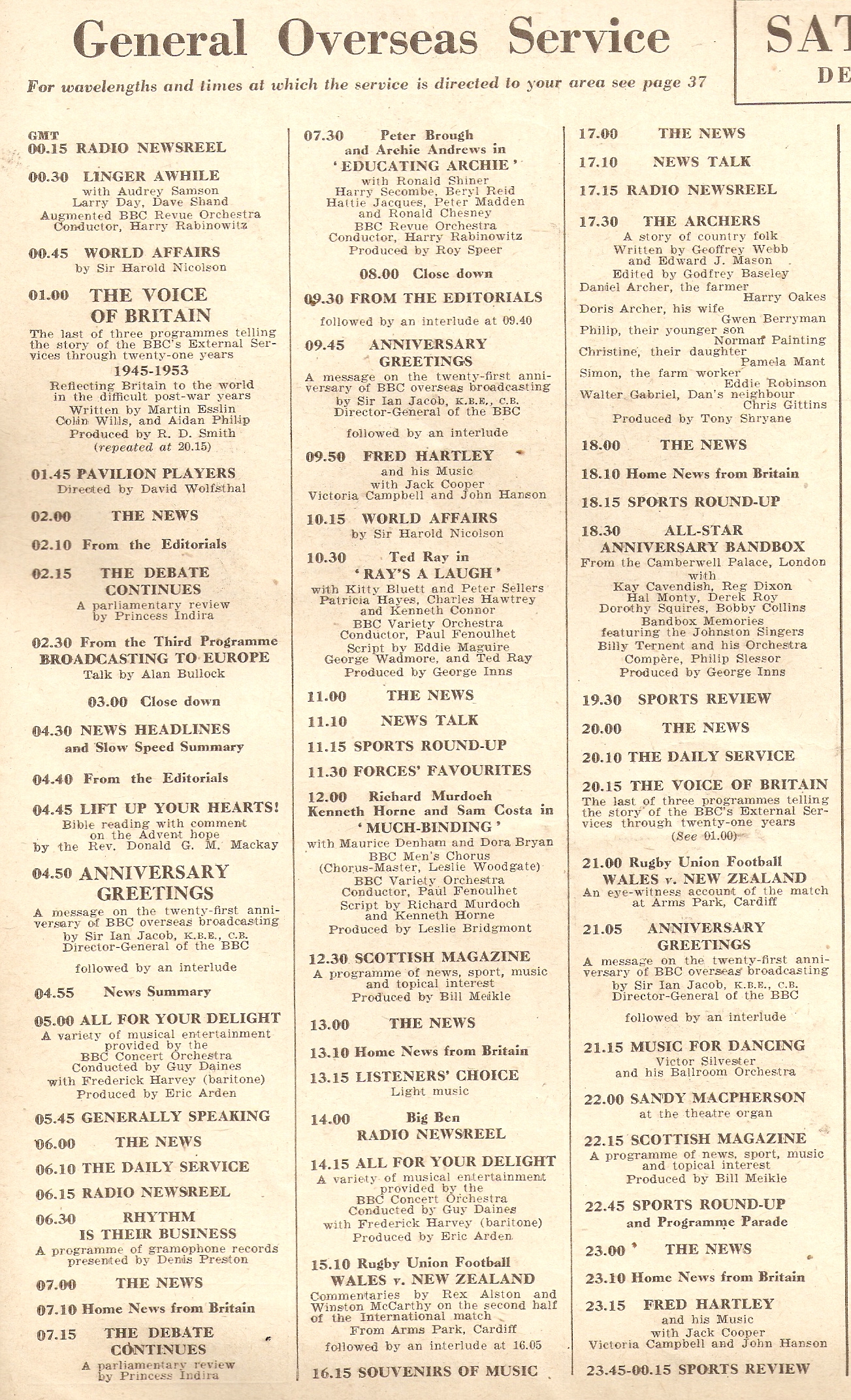

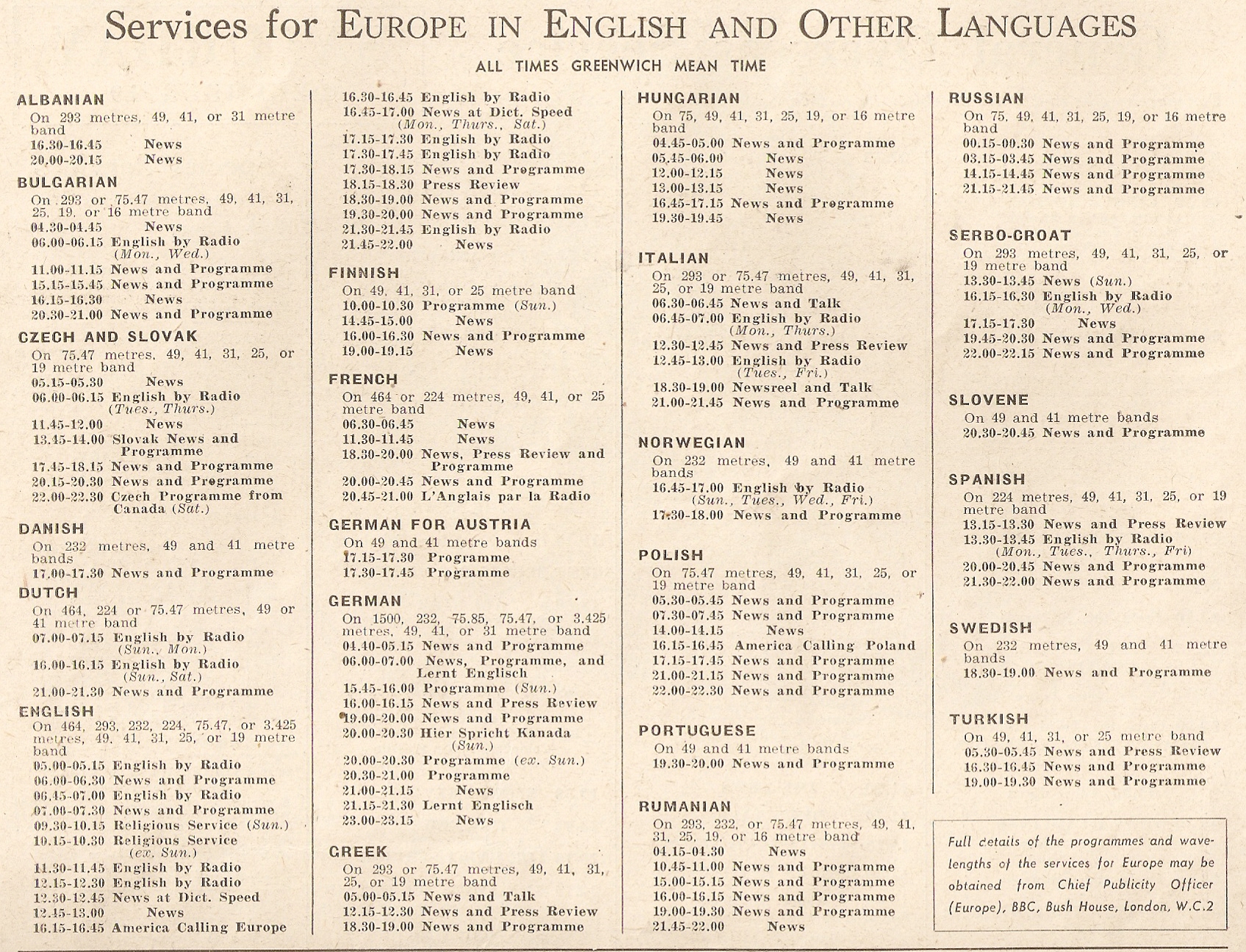
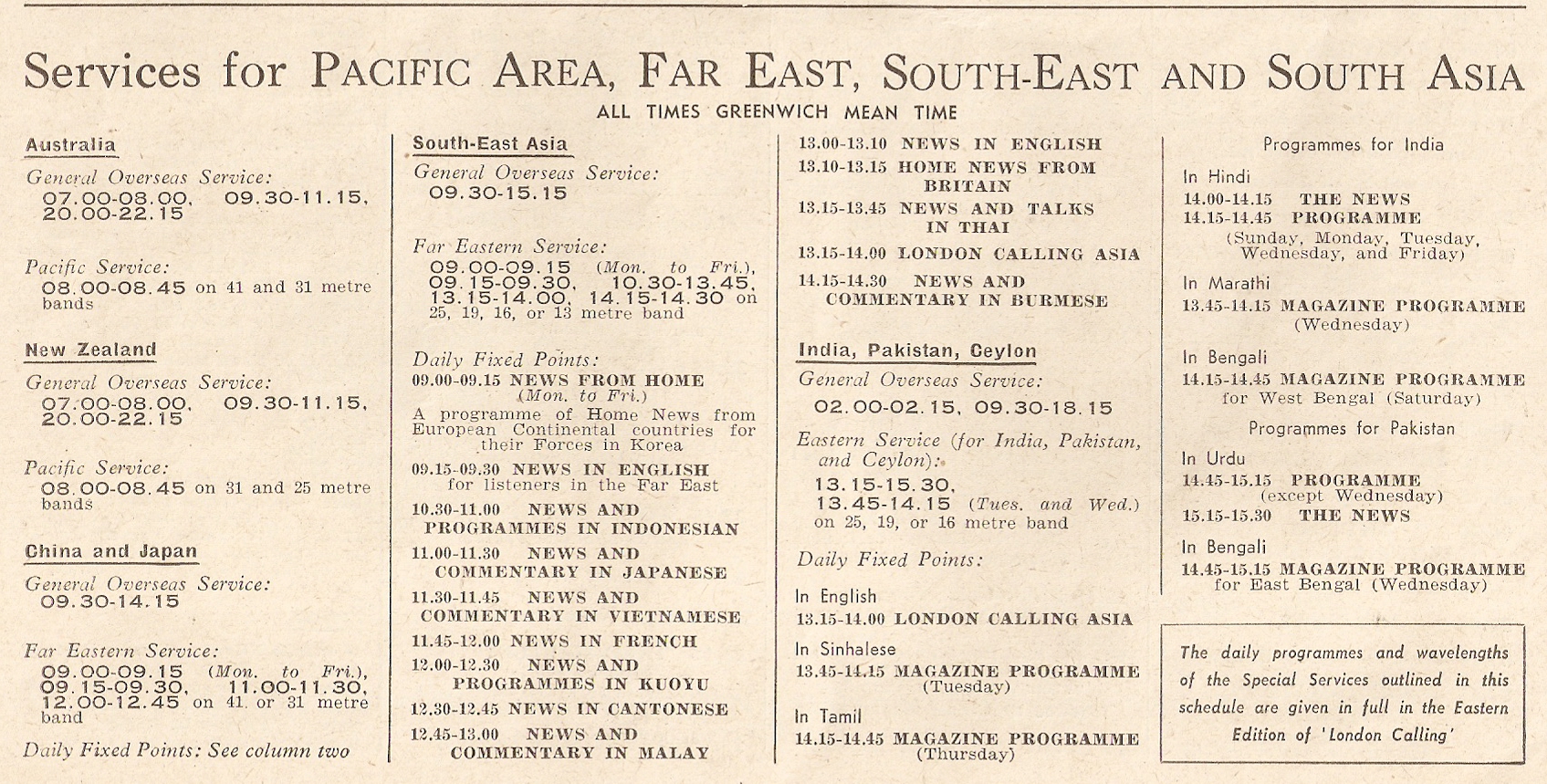
.jpg)
.jpg)
.jpg)
.jpg)
.jpg)
.jpg)

.jpg)
.jpg)
.jpg)
.jpg)
.jpg)
.jpg)
.jpg)
.jpg)
.jpg)

.jpg)


