Showing posts sorted by relevance for query Humph. Sort by date Show all posts

Tuesday, 30 April 2013

Radio Lives - Humphrey Lyttelton


“A well-known Old Etonian ex-Guards Officer jazz-trumpeter-broadcaster-cartoonist-bandleader-bird-watcher-gastrnome-humourist-panellist-TV-personality.” Who is this? Why Humphrey Lyttelton of course with the words taken from his self-penned comic obituary.

To many Humph is associated with a certain radio panel game and many a round of Mornington Crescent is played in his memory. But in this post I’m looking in more detail at Humph’s other radio career: as a jazz broadcaster over five decades. 

A well-known online encyclopaedia has this to say on Humphrey’s jazz broadcasting career: “From 1967 until April 2007, Lyttelton presented The Best of Jazz on BBC Radio 2, a programme which featured his idiosyncratic mix of top-quality recordings of all ages, including current material”. And that’s it. Shame the dates are wrong too.

His first broadcast was an impromptu and entirely accidental affair. On VE Day, 8 May 1945, Humphrey went up to London and joined friends outside Buckingham Palace. Happening to have his trumpet with him he played Run Rabbit Run and We’re Gonna Hang Out the Washing on the Siegfried Line to the delight of the crowd. He ended up leading a procession up the Mall and into Piccadilly. “In later years I wondered if I had dreamt all this”, he recalled. “Then to my delight a friend unearthed a BBC tape of a commentary by Howard Marshall in which I got a mention. Admittedly not by name, but he does say, ‘And as we return to the studio, somebody down there is playing a trumpet…’” 


Humph had discovered jazz when aged 15 he started collecting records by Nat Gonella. But his moment of epiphany was on hearing Louis Armstrong’s Basin Street Blues. (He would go on to present a Radio 2 documentary series, Satchmo, in 1974/5). Soon after he gave up playing the mouth-organ formed his first jazz band and took up the trumpet.

His war service saw him serving with the Grenadier Guards and on demob it seemed that a career as a cartoonist rather than full-time jazzman might be on the cards. On the back of the post-war New Orleans jazz revival Humph joined George Webb’s Dixielanders for a few months but by late 1947 he’d left and together with his friend the clarinetist and fellow cartoonist Wally Fawkes he formed his own band in January 1948. They soon became regulars at the newly formed London Jazz Club with a “jazz-for-dancing policy”.

It was also in 1948 that Humphrey made his first studio broadcast for the BBC in the series Jazz Club - this had started the previous year and ran, with breaks, until 1975. Writing for the Radio Times some 16 years later he recalled that Piccadilly studios broadcast: “It sticks in my mind because Mark White, Jazz Club’s originator and first producer, had cast me in the unlikely role of Louis Armstrong, and I had to play the scarifying introduction to Armstrong’s West End Blues. Throughout the tea break just before transmission I walked round and round Piccadilly Circus, wishing I was dead and fighting an urge to jump on the tube and flee to the furthest Stanmore or Collier’s Wood.”  (It seems even then he couldn’t resist a quick game of Mornington Crescent!)

As bandleader Humphrey would, of course, introduce the band and the songs, a task that he’d perform with wit and humour – something I was to witness many years later when I saw the band perform at the Beverley Picture Playhouse. By the late 1950s the BBC was also letting some bandleaders make their own announcements on air and Humph soon became an assured and natural broadcaster. This is an early Radio Times billing from 7 August 1958.


Alongside Jazz Club listeners could, in the late 50s also hear Just Jazz with Charles Melville and Steve Race, Jazz Session (1958-64) on the new Network 3 (later Third Network) as well as Ken Sykora’s Guitar Club. In the early 60s we got Jazz Today (Charles Melville again and Alexis Korner) and from 1962 Jazz Scene with Steve Race. By now the same names were coming up on these various programmes, broadcasters who would be associated with jazz on the BBC for many years and Humphrey was one such name, becoming an occasional and then regular host of Jazz Club from 1964, appearing on its short-lived successor show It’s Jazz and later alternating compering duties on The Jazz Scene with Benny Green.  In addition when, in December 1964, the Music Programme (the daytime service of the Third Programme) started to extend broadcasting hours and introduced the Saturday lunchtime Jazz Record Requests it was Humphrey who played the selection of ‘gramophone records’.


In the mid-60s there were also occasional forays into television with Jazz 625 and Jazz Goes to College, both produced by Terry Henebery who’d worked on Jazz Club for many years.


BBC Radio's jazz offerings in 1966 across all the networks.

On the launch of Radio 1 in September 1967 the old Light Programme show The Jazz Scene ended up scheduled on the new pop station. In the Radio Times Humphrey explained the changes, as well as providing something of a hard sell for British jazz radio:  

So Jazz Scene and Jazz Club henceforward go their own separate ways. As compere for both new programmes I’m aware of the apprehension in some quarters about our new Radio 1 environment. After a day of non-stop pop shall we feel like belated guests coming stone-cold sober into a roomful of whooping revellers? Jazz has admittedly grown away from pop to the extent that it is more concerned with enduring quality then fashions or trends. So Jazz Scene must present the vintage stuff as well as the newly pressed. And the great range of British jazz heard in Jazz Club will reflect the traditional as well as the trendy.

But jazz is happening now, it’s being talked about now, and it entertains and excites millions of people now. And we shall always keep this in sight. On Jazz Scene, for instance, as well as a half-hour review of new discs and the voices of leading musicians in Hear me Talkin’, we shall have Peter Clayton working as my ‘oppo’ chasing the jazz news right up to the last minute of rehearsal and ready to chip in with the latest happenings at any time during transmission.

As for Jazz Club, I can only repeat what I have said before. American artists, reared on a diet of canned, bottled and pickled radio back home, are staggered to find a place where radio broadcast means singing to real live people with a real live atmosphere, and not just talking to a man in a little box about your latest record. On Jazz Club, we don’t call on electronics to whip up an atmosphere. It’s built in – and you can’t get more trendy than that!

It was all change again in 1968 when The Jazz Scene morphed into The Best of Jazz, the programme for which Humphrey would become best known, panel games aside. Still on Radio 1 late on Sunday night it first aired on 13 October, moving over to Radio 2 in March 1970.

From late 1969 The Best of Jazz had an unusual unique existence on three BBC channels. Billed as a Radio 1 show on medium wave it also went out on Radio 2’s long wave and VHF. However, as Radio 2 still wasn’t in stereo you could hear most of it, aside from an extended news bulletin, over on Radio 3’s VHF stereo transmitters. This Sunday night arrangement continued for a couple of years. By the summer of 1973 The Best of Jazz was occupying what would be its most regular place in the schedules on a Monday evening.  

Here’s a couple of clips from The Best of Jazz from the 70s and 80s:


Meanwhile Humphrey was much in demand elsewhere, contributing to radio and TV arts programmes and starting the inevitable round of chat shows, quiz and panel show appearances that would include Sounds Familiar, Quote…Unquote and Jazz Score.  


Programmes for the BBC World Service included
Jazz in My Life (1975)
In 1971 he got the call to pilot a new radio panel game. The idea for I’m Sorry I Haven’t a Clue came from Graeme Garden’s desire to have a programme that contained the essence of the fun of I’m Sorry I’ll Read That Again without the hassle of writing a script.  Garden and radio producer David Hatch needed a chairman for the new show. Hatch recalls: “The notion was we should actually go off-piste and not have the words written down, but invent it. And the equivalent to the composed piece of music was jazz.” They both thought of Humphrey. “It needed a father figure. I mean it was a bit like Ken Horne used to be on Twenty Questions, that sort of gravitas. A large figure who could hold these wild young things together.”


Writing in his diary some three years later Humph remembered that “everyone agreed that it was too self-indulgent and dreadful to get off the ground Months later a BBC ‘high-up’ heard the pilot, fell about and insisted it should go on.” Relying on the comic skills of the panel increasingly the real star of Clue was the chairman. He feigned boredom (or was it real?) and sounded if he’d rather be elsewhere. He delivered the scripted game intros with a bewildered air that belied his comedy timing. “He’s the only person I’ve ever known who could get a laugh just with silence”, claimed friend and ISIHAC panellist Barry Cryer.


In October 1998 The Best of Jazz hit its 30th anniversary, here’s that show complete with a revived theme tune:


In April 2007 Humphrey decided to cut back on The Best of Jazz shows, presenting them for 12 weeks at a stretch, alternating with Jools Holland’s shows. On 17 March 2008 he bowed out with a typically under-stated show: no fanfare, no BBC send-off or mention in that week’s Radio Times. Here’s Humph’s swansong:


Just over a month later, on 25 April, Humphrey, passed away after post-operative complications.    

Humphrey Lyttelton 1921-2008

With thanks to Mrs Trellis of North Wales


Humph signed this CD cover for my late father-in-law. 
A few notes on Jazz Club

After Jazz Record Requests (still running on BBC Radio 3) and The Best of Jazz, the longest-running show was Jazz Club. It was first broadcast in the Light Programme on Saturday 15 March 1947 and billed as a “half-hour of music in the jazz idiom played by some of Britain’s leading jazz instrumentalists, coming to you from the heart of London’s West End”. The first presenter was Mark White who would later rise through the ranks of BBC management and is credited, amongst other things, as giving Terry Wogan his BBC break in 1966. Other presenters in the early years included Jack Jackson and Steve Race.  The programme’s theme, composed by Billy Munn, was Jazz Club Stomp.

The programme took a break in the early 1950s, replaced by the record show World of Jazz with presenters including Alun Morgan, Denis Preston, Rex Harris, Charles Melville and Kenneth Ashden and session performances in British Jazz with Dill Jones.

Jazz Club returned on 3 October 1957 and for this run the presenters included Dill Jones, Tony Hall, Hector Stewart, Alan Dell, George Melly, Diz Disley and Humphrey Lyttelton. It ended on 19 September 1964 only to be revived on Monday 22 March 1965 with Humphrey as the main host through until 26 December. From Sunday 2 January 1966 it becomes part of The Jazz Scene show, with the performance billed as In the Jazz Club.

With Humphrey presenting the show again becomes a stand-alone programme on Radio 1 from Wednesday 4 October 1967, later moving to Saturday nights in 1969. Major changes to all networks in April 1970 means Jazz Club is now on Radio 2, initially midweek but then swapping with The Best of Jazz to occupy a Sunday night slot post-midnight after Peter Clayton’s Jazznotes.

On 8 April 1973 Sounds of Jazz begins, this time on Radio 1, with Humph looking after the first hour as Jazz Club and Peter Clayton the second hour of jazz records. By October 1973 Humphrey no longer looks after proceedings and from 5 January 1975 when Sounds of Jazz moves to Radio 2, Jazz Club finally ends. Jazz Club sessions continued to feature as part of Sounds of Jazz which ran until 1990 and was succeeded by the nightly Jazz Parade.  Listeners to Radio Ulster can enjoy their version of Jazz Club every Sunday evening.

Monday, 16 February 2015

A Day on 2

Set the controls for the 18th of February 1985.

Imagine being able to fashion a radio time-travelling device that can receive your favourite show from the past or being able to listen again to an historic broadcast (and no I’m not talking about 4 Extra!)  
OK, so it probably wouldn’t be BBC Radio 2 on 18 February 1985. As far as I know nothing earth-shatteringly significant happened that day. But, for no real apparent reason, thirty years ago I decided to stick some tapes in my cassette recorder and capture that days output, well a large chunk of it.

This is your chance to hear again how the station sounded in the mid-80s, from Night Ride to Round Midnight, stopping off at the JY show, John Dunn’s Mystery Voice and all points in between.  Here's a quick rundown of the day in jingle form and the full Radio Times schedule.


These are the technical bits: I’m posting the clips on my YouTube channel just to ensure a wider audience. I’ve chopped out most of the commercial music tracks in order to avoid any copyright notices. So far this seems to have worked, though for some reason listeners in Germany may not be able to hear all the programmes, sorry Germany.

I’ll be posting the shows online during the day of the 18 February 2015 at the same time as their original start time – although to avoid staying up all night Peter Dickson and Colin Berry’s show will be available on Tuesday night. Each time a programme is added I’ll update this blog post, send a Tweet and update my Facebook page. All times in GMT of course.
Unfortunately I didn’t record every show that day. So you won’t hear the specialist music shows with Alan Dell and Humph, the mid-afternoon sequence Music All the Way or that evening’s Star Sound Special.  However, elsewhere on this blog you can read about and hear Alan Dell, Humphrey Lyttelton and Music All the Way.  Also the quality of the audio is variable, this is nothing to do with my FM reception at the time but more the fact I used budget tapes.

Kicking things off at 1 a.m. was Peter Dickson with a suitably jokey start to Nightride. Peter took care of the overnight shifts alternating with either Bill Rennells or Charles Nove. Lack of needletime meant we still had doses of the Radio Orchestra, the Brian Lemon Trio and so on. Making the first of two appearances that day is John Fogerty, whose new album Centrefield had just been released, although Peter seems not to know the former lead singer of Creedence Clearwater Revival. There’s a also a talk from Barney Lawrence – anyone know who he is? This kind of (mildly) comical talk was still a feature of Nightride just as they had been on You and the Night and the Music. 


Following Nightride was a repeat of the previous day’s Two’s Best with John Dunn, demonstrating that the current overnight repeat policy is nothing new. Sadly I didn’t record this programme.
At the time the king of the early shows was Colin Berry who’d had early starts, on and off, since January 1976. Getting up before dawn every day must have been taking its toll as Colin reports he’s practically wrecked the studio and nearly garrotted himself with his headphone lead. Note also a mention of changes that evening on BBC TV, he’s referring to a new BBC1 globe and the launch of EastEnders. Listen out too for a news summary from David Bellan.


At 6 a.m. enter the still much missed Ray Moore. Ray’s on form this morning, witness that lovely intro into the Shakin’ Stevens track There’s also mention of the announcers over on Radio 3 with Tarmac Rigby and Miss Hughes who’s apparently “gone into tax exile”. Towards the end of this recording catch Bill Rennells voicing a trail for Gloria’s show later that day and her special guest David Cassidy – more on that to follow.


It’s “hello chums” from Ken Bruce on the Radio 2 breakfast show. Perhaps it should have been the Late, Late Breakfast Show as Ken didn’t go on-air until 8.05 am. At the time of this recording he’d been presenting the programme for just six weeks. Punctuating proceedings are Steve Madden reading the news and Pause for Thought with the Rev Roger Royle. Listeners to Radio 2’s current morning output will notice how much calmer it all was thirty years ago; no shouting, no whooping, no laughing acolytes and no-one else to read the traffic news.


The matters on Jimmy Young’s agenda at 10.30 are the Falklands, the miners, school dinners and Winter Fuel Allowances. In this extract he interviews SNP MP Gordon Wilson about his Cold Climate Allowance Bill and Peter Smith of teachers’ union AMMA about school kids supposedly having ‘chips with everything’. In contrast to Jeremy Vine’s show no listeners appeared on the programme to voice their opinions, all the feedback from “the listener” is read out by Jim himself. “Bye for now!”


“Hello there!” It’s amazing to think that Radio 2 took an hour out each lunchtime for David Jacobs to play “our kind of music”. Much as I love the music he played it really did seem like the station was stepping back to the days of the Light Programme, even including a track by Frank Chacksfield, a regular on the Light.


As a reminder that Radio 2 used to have women presenters during the day on weekdays here’s Gloria Hunniford with an edited version of her 90-minute show. Promised guest David Cassidy is a no-show, having backed out at 12 noon due to a “contractual difficulty”, so instead its Bonnie Langford! Glo’s second guest is author John Byrne Cooke, son of Alistair Cooke. 


From 3.30 pm it’s as if Radio 2 had a short interlude and put up the audio equivalent of the test card whilst Music All the Way was on. This was a 30-minute sequence of music on record and BBC sessions. I didn’t record the programme for 18 February but you can hear an edition from February 1986 here. Of Music All the Way former Radio 2 presenter and announcer Charles Nove commented: “An odd little duty, that one, which involved heading for one of Broadcasting House's least popular studios (bit of lashup, no windows, dodgy ventilation etc) and doing the live top and tail for this, and playing in the music, ‘supervised’ by the BBC's most panicky producer and a bored engineer. Overmanning? Never!”

In all the recordings so far you’ll have heard very little new music, and certainly nothing that would trouble the charts. That’s why David Hamilton’s show was such a breath of fresh air, and rightly dubbed “the music show”. There’s also plenty of listener interaction and prizes available in The Music Game and Spot the Intro. 


The reigning monarch of drivetime for an eon was John Dunn. The show’s mix of music, topical interviews and a quiz – in this case the long-running Mystery Voice competition – is still the template for today’s Radio 2 offering. Providing the programme rundown at the end of this recording is John Marsh.


There are no recordings of Alan Dell’s double bill of the Dance Band Days and the Big Band Era but you can hear other editions here. Nor did I tape Humphrey Lyttelton with The Best of Jazz but there’s plenty of Humph here. And again I inexplicably failed to record Star Sound Special in which John Benson featured the music of Nelson Riddle. But what you can hear again is the third edition of a new panel game, and the second dose that day of David Hamilton, in Some of These Days. The premise of the programme was to answer questions about news, events, TV shows and music that happened on that day in history. On the panel are Peter Jones, Sheila Tracy, Fiona Fullerton and Barry Cryer.  


Closing proceedings for the day is Brian Matthew with the daily arts and music show Round Midnight, at this point more than halfway through its 12 year run.  Brian’s guests are Patrick Marr and James Roose-Evans talking about the revival of George Axelrod’s play The Seven Year Itch and author Nickolai Tolstoy plugging his latest book The Quest for Merlin. 

Monday, 11 April 2022

50 Years of Not Having a Clue


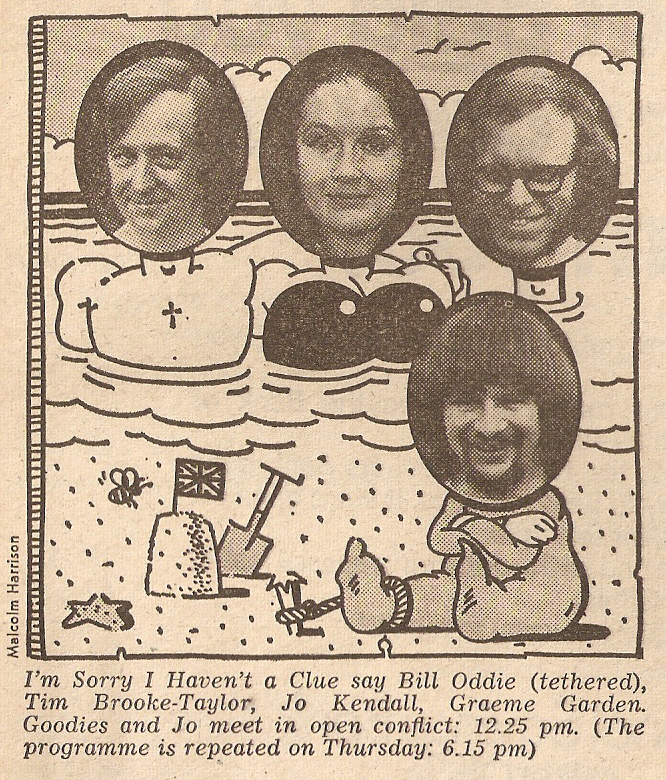
It's been fifty years since people were first given silly things to do with swanee whistles, song lyrics, London tube stations and sound charades with some of them accompanied by Colin Sell at the piano. Yes, radio's antidote to panel games I'm Sorry I Haven't a Clue was first heard by an unsuspecting public this day in 1972.

The genesis of I'm Sorry I Haven't a Clue goes back to 1969 after the conclusion of series seven of I'm Sorry I'll Read That Again (it came back for a final eighth series in the summer of 1972). Writer and performer Graeme Garden was already committed to working on BBC2's Broaden Your Mind with Tim, Bill and Jo from ISIRTA. This was followed by The Goodies (starting in late 1970) and scripts for LWT's Doctor in the House (also 1970), Doctor at Large (1971) and Doctor in Charge (1972).  

Despite all the tv work Graeme was still keen to work on radio and was thinking of recreating something that brought the fun and anarchy of ISIRTA but without the chore of script writing. A comedy panel game looked like it could provide the answer. Just a Minute and My Word! were already very popular and others had come and gone such as The Tennis Elbow Foot Game (1966-68) - which may have provided the spark for Clue's Word for Word round - The Clever Stupid Game and You Don't Say (both 1970).

But could Gyles Brandreth have provided the inspiration for Clue? It's possible. In 1971 Graeme was a panellist on eight editions of A Rhyme in Time, a comedy word game with a poetry twist in which the other panellists, consisting of Cyril Fletcher, Caryl Brahms and June Whitfield, would "converse in verse".  The programme was devised and introduced by Gyles Brandreth. Just seven months later Clue came on air

Graeme discussed his ideas for a new show with producer David Hatch and together they worked up a format and recorded a pilot. Getting the green light for a series the pilot aired on 11 April 1972 and 12 episodes followed, though for these Hatch was busy elsewhere and John Cassels produced. Early editions were, according to Garden "rather messy and self-indulgent". It seemed that completely dispensing with some scripted elements and preparation didn't work. He continues: "In the first series it was all virtually ad-libbed - that was my mistake, and since then we've all learned a bit more about doing panel games. We know that the audience like it a) because you appear to be witty, and b) because you appear to be put 'on the spot' and have to sweat. And those are two different things; if you've got to make up, say, a calypso, it's almost impossible to do that on the spot, and so you spend an hour or so beforehand writing it ... but the team's increasing experience, particularly in knowing which sections they should prepare, has led to a much improved control over the show."     


The idea of riffing on a theme and the fact that they were both jazz fans probably led to Graeme and David thinking of Humphrey Lyttelton as the chairman, an inspired choice and a major factor in its longevity. Those early editions all featured ISIRTA alumni (Bill Oddie, Tim Brooke-Taylor, Jo Kendall and John Cleese) plus Barry Cryer filling for Humph as chairman when he couldn't make a couple of the recording dates. But Bill, Jo and particularly John were not entirely comfortable with winging it.  Only Bill returned for the second series in 1973, along with Barry now as a regular panellist and by the third in 1974 Willie Rushton had come on board and we entered the first golden era for Clue with the famous four of Messrs Garden, Cryer, Brooke-Taylor and Rushton. By the fourth series in 1975 Colin Sell had replaced Dave Lee at the piano.

From my own ISIHAC archive comes this recording, in fact it's the first one I ever recorded, of the Christmas 1980 special so you get an extra 15 minutes or so. It features all the regulars from that time and the producer is Geoffrey Perkins.

The passage of time has taken its toll on Clue participants with the deaths of series regulars Willie Rushton, Humphrey Lyttelton, Jeremy Hardy, Tim Brooke-Taylor, writer Iain Pattinson and, just a few weeks ago, Barry Cryer. But the formula is still proving durable as it marks its golden anniversary and recent series with a host of new voices to the programme are just as funny with plenty of laugh out loud moments.

Radio 4 will be marking the programme's anniversary this Saturday in an edition of Archive on 4 at 8 pm. 50 Years Without a Clue is presented by Greg James.    

Notes:

Quotes cited in From Fringe to Flying Circus by Roger Wilmut (Eyre Methuen 1980). For more on the programme's history see The Clue Bible by Jem Roberts (Preface 2009)

The Tennis Elbow Foot Game was devised by Norman Hackforth (the 'Mystery Voice' on Twenty Questions) and produced by David Hatch (series 1) and Bill Worlsey (series 2). Regular panellists were Sheila Hancock, Olga Franklin, Paul Jennings, Fenella Fielding, Hackforth himself and Max Robertson as the umpire. Series 1 October to December 1966 (13 episodes) on the Home Service. Series 2 November 1967 to May 1968 (26 episodes) on Radio 4. It then transferred to BBC2 for a series of 12 episodes July to October 1968.    

The Clever Stupid Game was devised and chaired by Robin Ray. John Cleese was a panellist on one of the 8 episodes broadcast on Radio 4 May to July 1970.

You Don't Say was devised by Jimmy Thompson, Johnny Whyte and Nicholas Parsons and chaired by Cyril Fletcher. A 12 episode series produced by Alastair Scott Johnson was broadcast on Radio July to September 1970.

A Rhyme in Time was broadcast over 8 episodes from July to September 1971. In this BBC blog Gyles Brandreth says there were two series, the first produced by David Hatch and the second by Simon Brett. I can only trace the one series with Brett producing. My guess is that an unbroadcast pilot was produced by Hatch.     

Saturday, 30 November 2024

Jazz Score


There’s no shortage of music quizzes on the radio from the current all out pop variety of PopMaster and Ten to the Top and the former Pop Score (1972-92) to the general music quiz ‘from Bach to the Beatles’ of Counterpoint. But for pure jazz only content there was Jazz Score.

Jazz Score was heard on BBC Radio 2 over nineteen series spanning 1981 to 1997. As I’ve written before, though “ostensibly a music quiz it effectively allowed a load of jazzers to reminisce and entertain the audience with their anecdotes”.

The idea for the programme came from clarinettist Roy Pellet, a one-time member of the Clyde Valley Stompers. It was Roy that researched and wrote the questions. He told the Radio Times: “I spent 20 years travelling with jazz musicians and roaring with laughter at their stories. Each question is tailored to provoke a particular memory.”

In charge of production for most of the run was light entertainment producer, and part-time jazz trombone player, Richard Willcox. Chairing virtually every edition was Benny Green who reckoned that “a lot of people are listening just for the jokes. But don’t be fooled, underneath the banter there’s lots of knowledge”. Most often taking a spot on the panel and providing that banter were Humphrey Lyttelton, Ronnie Scott, George Melly and Acker Bilk.

Over 70 guests, mostly jazz performers, appeared though it often sounded like a gentlemen-only club, at least until later (and independently produced by Unique) series. Early series would often have special jazz enthusiast guests such as Eric Sykes, Kingsley Amis or Barry Cryer. To make everyone feel at home the shows were mostly recorded at Ronnie Scott’s on Frith Street or the 100 Club on Oxford Street.

I’ve uploaded a couple of editions of Jazz Score on YouTube. First from the start of the sixth series is a programme that was broadcast on Saturday 7 September 1985. Joining Benny are Humph, Acker, Chris Barber and Alan Elsdon.


Two years later the eighth series kicked off with this edition recorded in 1986 but broadcast in April 1987 (Radio Times billing above) just a few weeks after the death of special guest Buddy Rich. Also taking part are Barney Kessell, Ronnie Scott and George Melly.       


Jazz Score series details

Chaired by Benny Green except Shaw Taylor (s01e04/5), Peter Clayton (s02e05-7, s04e11-12) and Humphrey Lyttelton (s05e01-06),

The pilot episode was recorded in October 1980 and was broadcast at the start of series 1.  

Series 1: 3 October 1981 to 28 November 1981 (9 editions)

Special guests Eric Sykes, Deryck Guyler, Barry Took, Kingsley Amis, Jack Brymer, Barry Foster, Barry Cryer, Roy Castle and Mike Hailwood

Series 2: 17 April to 3 July 1982 (12)

Special guests: Arthur Davidson. Jimmy Edwards, Barry Fantoni and Philip Jones

Series 3: 26 March to 11 June 1983 (12)

Series 4: 31 December 1983 to 17 March 1984 (12)

Series 5: 6 October to 22 December 1984 (12)

Series 6: 7 September to 30 November 1985 (12) (not 28 Sept due to boxing coverage)

Special guests: Charlie Byrd, Don Lanphere, Slim Gaillard

Series 7: 30 March to 29 June 1986 (13)

Special guests: James Moody

Series 8: 26 April to 28 June 1987 (10)

Special guests: Buddy Rich and Barney Kessell

Series 9: 14 December 1987 to 22 February 1988 (12) (not 28 December)

Series 10: 8 November 1988 to 7 February 1989 (14)

Series 11: 20 November 1989 to 19 February 1990 (14)

Series 12: 2 February to 20 April 1991 (12)

Series 13: 9 November to 28 December 1991 (8)

Series 14: 19 October to 7 December 1992 (8)

Series 15: 3 January to 14 February 1994 (7)

Series 16: 7 November 1994 to 26 December 1994(8)

Series 17: 17 July to 4 September 1995 (8)

Series 18: 10 June to 5 August 1996 (9)

Series 19: 22 July to 26 August 1997 (6)

Series 16 to 19 were produced by Unique. The BBC World Service broadcast selected repeats between 1988 and 1997.

Panellists: George Chisholm, Humphrey Lyttelton, Annie Ross, Ronnie Scott, Acker Bilk, George Melly, Jack Parnell, Peter Clayton, Digby Fairweather, Chris Barber, John Turner, Richard Clegg, Beryl Bryden, Alan Clare, Alex Welsh, Kenny Ball, Ian Christie, Andy Cooper, Alan Elsdon, John Barnes, Roger Bennett, Geoff Nicholas, Eddie Thompson, Jack Fallon, Herb Ellis, Peter Ind, Ian Carr, Slim Gaillard, Coleridge Goode, John Dankworth, Geoff Nichols, Al Cohn, Yank Lawson, Murdell Lowe, Dave Shepherd, Barney Kessell, Charlie Byrd, George Masso, Nat Gonella, Max Jones, Roger Horton, Monty Sunshine, Campbell Burnap, Major Holley, Bobby Rosengarden, Peter Appleyard, Dave Shepherd, Derek Smith, Dick Charlesworth, Pete King, Diz Disley, Bob Wilber, Kenny Baker, Eddie Harvey, Oliver Jones, Ken Rattenbury, Tommy Burton, Carol Kidd, Al Gay, Roy Williams, Alan Barnes, Sheila Tracy, Dick Hyman, Rob McConnell, Cleo Laine, Brian Priestley, Marion Montgomery, Stan Tracey, Alan Plater, Bruce Adams, Vic Lewis and Larry Adler. 

Finally the answer to the question posed in the opening photo of Benny Green is Bobby Hackett and Lionel Hampton.

Related Posts Plugin for WordPress, Blogger...