In what is sure to be an election year in the UK the Prime
Minister (at time of writing Rishi Sunak) is fond of saying that were the
current Opposition (at time of writing, the Labour Party) to win then Britain
would be “back to square one”.
Ah yes, back to square one, an idiom often used but whose
origins seem to be uncertain. Look online and you’ll see references to the grid
printed in the Radio Times to help
describe the action during early football and rugby commentaries (note below).
This seems credible until you hear what are admittedly early recreations of
those commentaries and the second voice only just has time to say “Square 7, Square
5” etc. Indeed why would play be
described as going “back to square one”? Other suggestions are that it comes
from the games of Hopscotch or Snakes and Ladders with the earliest print
citation being as late as a 1952 UK Economic Journal which wrote "He has
the problem of maintaining the interest of the reader who is always being sent
back to square one in a sort of intellectual game of snakes and ladders."
Anyway, all this is by way of saying that the derivation of
everyday expressions and sayings would be ripe for the quiz format. And that is
exactly what BBC Radio 2 offered over seven series and 54 programmes in the
late 1980s and early 1990s in the quiz show Back
to Square One.
The premise was, according the chairman, the ever dependable
Chris Serle, that “all the questions are about the origins of everyday words,
well known expressions, superstitions, customs, places and pub signs and so
on”. The programme was devised by author Graeme Donald who went on to write a
number of books on history and the meaning of words.
A team captain throughout the run was author Leslie Thomas,
a regular on radio panel shows such as Quote...Unquote,
Hoax! and Trivia Test Match. For series one he’s joined by the queen of panel
shows Barbara Kelly. For series 4 to 7 the other captain is Pam Ayres.
Here’s the first ever edition from 9 December 1986 with Pam
Ferris and Roy Kinnear joining the panel.
They make no mention of ‘back to square one’ itself but it
did turn up in the fourth show – which I’m not uploading as the recording
quality is poor. Needless to say they go for the football commentary
definition.
Moving to 1988, for the third edition from the third series.
Sheila Steafel is the other team captain for this series and she and Leslie are
joined by Frances Edmonds and Bill Oddie. Writer Frances Edmonds was one of the
regular panellists (8 appearances), others were Sid Waddell (10 appearances,
including for two shows with Jeremy Hardy) and Bill Tidy (6 appearances).
Back to Square One
finally ran out of steam in 1992 by which time many of Radio 2’s quizzes and
panel games were getting the chop anyway. All the programmes enjoyed a
worldwide audience on the World Service and selected programmes were repeated
over on Radio 4 in 1991/92. 32 programmes were issued by the Transcription
Service for overseas sales.
Series Details
Series 1
9 December 1986 – 27 January 1989 (8 weeks) produced by Ron
McDonnell
Team captains: Leslie Thomas (except weeks 5 & 7 John
Dunn) & Barbara Kelly
Panellists: Roy Kinnear, Pam Ferris, Peter Moloney, Sheila
Steafel, Benny Green, Sheila Hancock, Stephen Fry and Jessica Martin
Series 2
15 September 1987 – 3 November 1987 (8 weeks) produced by
Ron McDonnell
Team captains: Leslie Thomas plus Lucinda Lambton (1&5)
Katie Boyle (2.4.6&8) and Moira Stuart (3&7)
Panellists:Moira
Stuart, Peter Moloney, Jane Reed, Jeffrey Holland, Pam Ayres, Sid Waddell,
Claire Rayner and Bernie Clifton
Series 3
26 April 1988 – 14 June 1988 (8 weeks) produced by Paul Z.
Jackson
Team captains: Leslie Thomas and Sheila Steafel
Panellists: Jeffrey Holland, Noddy Holder, Jeremy Hardy, Sid
Waddell, Frances Edmonds, Bill Oddie, Benny Green and Pam Ayres.
Series 4
13 June 1989 – 1 August 1989 (8 weeks) produced by Paul Z.
Jackson
Team captains: Leslie Thomas and Pam Ayres
Panellists: Molly Parkin, Sid Waddell, Jane Reed, Bill Tidy,
Maggie Fox, Jeremy Hardy, Frances Edmonds and Chris Stuart
Series 5
25 July 1990 – 12 September 1990 (8 weeks) produced by Paul
Z. Jackson
Team captains: Leslie Thomas and Pam Ayres
Panellists: Dillie Kean, Sid Waddell, Sandi Toksvig, Bill
Oddie, Bill Tidy, Helen Atkinson-Wood, Frances Edmonds and Peter Tinniswood
Series 6
30 October 1991 – 18 December 1991 (8 weeks) produced by
Paul Z. Jackson
Team captains: Leslie Thomas and Pam Ayres
Panellists: James Reeve, Jessica Martin, Stephen Fry,
Frances Edmonds, Sue Cook, Bill Tidy, Sid Waddell and Jane Reed
Series 7
17 November 1992 – 29 December 1992 (6 weeks) produced by
Andy Aliffe
Team captains: Leslie Thomas and Pam Ayres
Panellists: James Pickles, Gill Pyrah, Angela Douglas, David
Thornton, Natalie Wheen and James Reeve
Theme tune: A Fuguey
Day by Johnny Hawksworth played the Ron Grainer Harpsichord Group (Chappell
Music, 1966)
Note: Grids were first published in the Radio Times on 18 February 1927 one for football and one for
‘Rugger fans’.
On a BBC Radio 4 Extra all request weekend in August they
unearthed an edition of Petticoat Line,
the first time one had been broadcast in nearly half a century. Now largely
forgotten it was an all-woman panel programme at a time when most programmes
were male-dominated and any panel show often included a ‘token’ woman.
In style it sounded
like a more light-hearted version of The
Brains Trust or even Any Questions?mixed with an agony column of the air. Remarkably
it ran for 11 years – I know this because I see I edited its Wikipedia entry to
that effect – but what I hadn’t appreciated is that it clocked up just over 250
editions. So what on earth was it all about?
The germ of the idea came from Anona Winn (pictured above) who wanted to call
it The Ombudswomen. Listeners would
write in with their problems and she, acting as the chairperson, would get
advice from a panel of women.
At the time - this was the mid-sixties – Anona was best
known to listeners as one of the panellists on the long-running Twenty Questions that had started on the
Home Service in 1947. (1) Born in Sydney in 1904 – and the first of many
Australian connections in this post - she had trained as a singer and actress and
appeared in musicals, revues and panto as well as making early broadcasts on
station 6WF. Anona left for London in 1926 and she made her first BBC radio
broadcasts in 1928 and even appeared on some early Baird television
transmissions in 1933 and 1934. By the time she joined Twenty Questions Anona had already made hundreds of broadcasts,
written songs and plays, appeared on stage and in films, cut dozens of
gramophone records (the discs described her as ‘The Celebrated Broadcasting
Artiste’) and achieved that ultimate distinction of being featured on
collectable cigarette cards.
Helping Anona thrash out the format of the new show was ace
quiz deviser Ian Messiter, now best known for coming up with the idea for Just a Minute. Ian had previously worked
for the BBC before resigning and trying his luck out in South Africa at
Springbok Radio. Returning to London he worked for the advertising agency
Mather & Crowther before going back to the BBC. He was still making the
occasional commercial when he met up with Anona Winn and it was an advert being
filmed at the T.V.A. studios in Wardour Street that led to Renee Houston being
drafted into the new show. Renee was filming an advert for Flash, a few years
before fellow Scottish actress Molly Weir got the gig, when Ian bumped into
her. According to Ian he thought that Renee “had few inhibitions” and that
“being clever too, she was just the solid earth anchor woman needed to help
tame the ingenious Anona Winn”. He also saw how Renee “not lady-like”,
“talkative” but “had compassion” would be an ideal foil to Anona, “lady-like
but talked too much” and convinced her to join the panel show. The other
panellists would be changed weekly.
Renee Houston had been touring the music halls since the
1920s together with her sister Billie as the Houston Sisters, ‘The
Irresistibles’. She’d gone solo in the mid-30s performing songs and comedy
routines and appeared on BBC radio’s Music
Hall billed as ‘Half-singer, half-wit’.She continued to appear on radio variety shows and early television
shows throughout the 1940s by which time she’d formed a new stage partnership
with Donald Stewart – ‘variety’s sweethearts’ - who would become her third
husband. She was in demand as a film and tv actress in the 1950s and 60s,
including three Carry On films,
before joining the Petticoat Line.
Developing the programme format further it was agreed that
the show should be slightly anti-men. This allowed them to drop the title The Ombudswomen and go for Petticoat Line. (2) The programme opened
with a humorous question followed by a slightly more serious one. The middle
question would “rouse passions” and be something like ‘should we bring back
hanging?’ or ‘is fox hunting cruel?’. The next question would bring
light-hearted advice from the team and then they’d end with a silly question
such as ‘is it right that my husband likes to take a rubber duck into the bath
with him?’
The pilot got the green light from Head of Light
Entertainment Roy Rich and Bobby Jaye was assigned as the producer. At the
recording for the pilot Rich advised the panel not to talk over each other, not
to interrupt and, looking at Renee Houston, to “watch your language.” During the recording Renee interrupted, talked
over people and said bloody a few times. But Rich relented: “I gave you the
wrong steer. You were right, you’re the joker, you’re the wild card. Keep it
that way”. Even so Ian Messiter admits that eventually they had to ration Renee
to three bloodies per show. Having said that based on the evidence of the
recordings below she doesn’t swear once.
Radio Times billing for the 1st show
The first edition of Petticoat
Line went out on the Home Service on 6 January 1965. Alongside Renee
Houston the panel consisted of agony aunt Marjorie Proops, actress Jill Adams
and a young Jane Asher (just 18 at the time of the recording).
For an introductory Radio
Times article producer Bobby Jaye asked Anona Winn to explain the
programme’s format. And remember here that this was two years before the creation
in the UK of the Parliamentary Ombudsman.
An Ombudsman is a Scandinavian chap who listens to citizens’
grievances and grumbles and tries to put things right. The Petticoat Line will be four women discussing the grievances women
have against men and the complaints that men make about women – with me in the
chair to see fair play for both sides, we hope! They may be satisfied or
enraged, but at least these sex-war problems will get an airing. Some will end
in a laugh, while others will remain as a big headache for ever.
This first recording of Petticoat Line comes from the 6th
series broadcast on BBC Radio 4 on 11 November 1969. Joining Anona and Renee
are Sheila van Damm, Margaret Powell and Judy Innes. Van Damm, daughter of
Vivian van Damm owner of the infamous Windmill Theatre, came to acclaim due to
her motor rallying exploits in the 1950s. Margaret Powell had come into the
public eye following the publication of her memoir Below Stairs recounting her time in domestic service which
supposedly inspired Upstairs, Downstairs.
Judy Innes was a journalist for the Daily
Mail.
Anona Winn, ever the grand dame of panel shows, would insist
on the stage lighting being just so, presumably for the benefit of the studio
audience rather than those at home. “She need not have bothered,” exclaimed
Terry Wogan who chaired the World Service version of Animal, Vegetable or Mineral?. “We recorded ...in the Playhouse
Theatre on the river near Charing Cross, and the front two rows were usually
made up of Lascars, brought in out of the cold by the Seaman’s Mission”.
The second recording comes from the penultimate 11th
series broadcast on Radio 4 on 26 February 1975. On the panel are Marjorie
Anderson, presenter of Woman’s Hour,
comedienne and actress Beryl Reid and writer Janet Hitchman.
Petticoat Line did
not shy away from difficult subjects, listen to the discussion on adoption in
the second programme, but there’s a sense in which the often homespun
philosophy often espoused by Renee Houston wins out. Note how, in the first
programme, the team are quick to blame ‘the young’, an obvious and perennial
group at which to point a wagging finger, as the lack of a Christmas Day
broadcast from the Queen (we now know this was the Queen’s own decision). Judy
Innes, the relative youngster on the panel, though she’d be 32 at the time of
recording, is in the minority here.
The discussion on foreign aid is fascinating – and still
pertinent today - with Margaret Powell arguing that payment was justified as
Britain had milked many of the countries at their expense, Anona Winn’s reply
as to the benefits of Britain’s colonial past is telling.
Over its run Petticoat
Line featured 200 panellists many of whom were actresses and journalists.
Occasionally a politician would be asked on, Margaret Thatcher and Barbara
Castle for example. If the panel seemed be slanted towards middle-aged women of
a ‘certain age’ they did try to tip the age balance with the likes of Jane
Asher, Joan Bakewell, Erin Pizzey or Anthea Askey.
Radio Times billing for 4 October 1972
The panel may have been all-female but the producers were
always male. The first producer, Bobby Jaye, would go on to head up the radio
Light Entertainment department. Next was John Cassels, at the time producing Roundabout for the Light Programme whose
other credits would include Twenty
Questions and the early series of I’m
Sorry I Haven’t a Clue. Looking after production from 1969 to 1973 was
Chris Serle, later better known as one of Esther’s boys on That’s Life! He was also producing Radio 2’s Late Night Extra and would also work again with Ian Messiter on the
Radio 4 panel game Right or Wrong. In
the last three years production duties fell to Alastair Scott Johnson, mostly
associated with The Navy Lark,
Trafford Whitelock and John Bridges.
Despite the long runs of each series Petticoat Line was not universally praised. According to David
Hendy in Life on Four it “sounded
more like a showcase of arch 1950s-style femininity. Winn’s faithful following
among older listeners protected the programme from the Controller’s axe since,
as (Tony) Whitby put it, he would be hanged ‘from the lampposts of Bond Street’
if she was removed. That did not stop others in Broadcasting House from damning
the programme as ‘unendurable’, and its contributors as ‘female dinosaurs’ who
belonged not to the last generation, but to the generation before the last’.”
Radio producer David Hatch recalls a visit to the Playhouse
Theatre: “It was an amazing sight – Renee Houston on the left, Anona in the
chair, all of them in hats. And an audience in the Playhouse of probably 500!
All in hats! You know it was a wonderful sight!”
Radio Times billing for the 1st edition 28 September 1968
In 1968 Radio 4 sought to give the men a chance to reply to Petticoat Line in a series called Be Reasonable! Yes, for some reason it
was thought that the chaps hadn’t been offered much of a voice so they could
get to discuss the same issues as the women. In effect it was an attempt to
resurrect the We Beg to Differ format
(see below).
Be Reasonable!
would pick up on the exact same questions that had been posed to the women and
would include a clip of at least one response from Petticoat Line before chairman Michael Smee would offer it over to
the men to discuss. So on one edition we get the topics of women cleaning up after
men, whether money is best spent on art rather than housing or charity and why
are women coy about giving their age. The regular panellist was Humphrey
Lyttelton, who on the first edition was joined by Radio 1 DJ David Symonds,
Colonel Sammy Lohan (the former ‘bowler-hatted, moustachioed civil servant’ who
in the sixties had headed the Government D notice committee) and John Taylor
(not sure which John Taylor this is, perhaps the composer?).
Radio listeners in the sixties may have been thinking that
they’d heard all this ‘Battle of the Sexes’ type stuff before, and they’d have
been right. We Beg to Differ, which
had aired during the 1950s (and was resurrected in 1966), was billed as “a
lively discussion on subjects which the sexes may disagree with.” Devised by
producer Pat Dixon from an idea by actress Charmian Innes it pitted the likes
of Kay Hammond, Joyce Grenfell, Gladys Young and Innes herself against actor
John Clements (married to Hammond) and Charles Hill ‘The Radio Doctor’ but who
was soon replaced by the harrumphing Gilbert Harding. Keeping the peace was
chairman Roy Plomley. (3)
We Beg to Differ
itself was, according to Gale Pedrick writing for the Radio Times, a kind of Brains
Trust with a difference. The format was not too dissimilar to that later
adopted for the comedy panel show Does
the Team Think?, indeed questions on We
Beg to Differ were often posed as “does the team think that.....?” The
revived 1966 series played down the men vs women aspect and was just a general
talking shop.
How to Manage Men 31 July 1958
How To Manage Men
was a short-lived series broadcast in 1958/59 described by Denis Gifford as a
“pioneering feminist series”. Yet again the initial premise came from an
actress, or in this case two Australian actresses, Gwen Plumb and Thelma Scott.
Both enjoyed acting success in later Aussie soaps, Gwen in Young Doctors and Thelma in Number
96. Producer C.F. ‘Mike’ Meehan, veteran of such programmes as In Town Tonight and Twenty Questions, described How
To Manage Men for the Radio Times:
‘It gives women who have a grievance
against men – husband, fiancé or office boss – the opportunity to sit at home
without fear of detection, and hear a panel of experienced women offer advice
as to how to deal with the offending male’.
The chairperson was actress Jacqueline Mackenzie (4) who read
out the problem letters and summed up the ensuing discussion. Each week a
different male guest was in attendance ‘to defend his sex, support the male
viewpoint and, if he possibly can, try to convince the panel how very wrong
they are about the wickedness of men’.
The panel consisted of three actress/singers Frances Day,
Diana Decker and Vanessa Lee plus that panel show regular Charmian Innes. Other
panellists were Diana Graves and Helen Bailey. Representing the men were the
likes of Kenneth Horne, Bill Owen, Gerard Hoffnung and Peter Haigh.
(1) It finally ended on Radio 4 in 1976 with Anona still on
the panel
(2) Ian Messiter doesn’t explain where the title comes from
exactly but you suspect they were unaware of the Regency slang ‘in the petticoat
line’ which referred to associating with women of easy virtue
(3) Playing ‘Comedy Connections’ for a moment Plomley would
go onto work with Ian Messiter again as chair for One Minute Please, the forerunner to Just a Minute and the panel game Many a Slip. Charmian Innes would appear on about 30 editions of Petticoat Line and was a panellist on
earlier editions of Just a Minute and
on We Beg to Differ.
(4) Jacqueline
Mackenzie was later, under the name Jackie Forster, ‘a trailblazing gay rights activist’.
See article by Marc Saul on the Television Heaven website. There’s also a
further Australian connection which may explain Jacqueline’s involvement with
the show. Earlier that year (1958) she co-starred in the BBC tv comedy Trouble for Two alongside Australian
singer and actress Lorrae Desmond. She also shared the writing credits with
Johnny Whyte who would later emigrate to Australia and was a scriptwriter on Number 96.
Petticoat Line series details
The most frequently appearing panellists were:Sheila
Van Damm, Charmian Innes, Bettine le Beau, Juno Alexander and Isobel Barnett
Series 1 to 3 broadcast on Home Service, all others on Radio
4. Number of episodes in brackets.
Series 1:6.1.65
to 31.3.65 (13)
Series 2: 7.10.65 to 31.12.65 (13)
Series 3: 6.10.66 to 29.12.66(13)
Series 4: 2.10.67 to 25.36.68 (26)
Series 5: 24.9368 to 1.4.69 (28)
Series 6: 9.9.67 to 3.3.70 (26)
Series 7: 7.10.70 to 31.3.71 (26)
Series 8: 29.9.71 to 22.3.72 (26)
Series 9: 4.10.72 to 28.3.73 (26)
Series 10: 3.10.73 to 27.3.74 (26)
Series 11: 9.10.74 to 2.4.75 (26)
Series 12: 29.10.75 to 21.1.76 (13)
Theme music: Fluter’s
Holiday by Bert Kaempfert and his Orchestra.
The full list of panellists in order of appearance are:
Renee Houston, Marjorie Proops, JillAdams, Jane Asher, Dee Wells, Francesca Annis, Sheila Van Damm,
AnnekeWills, MaureenCleave, MollyWeir, MelanieFranklin,
SerenaSinclair, LucyBartlett, EthelRevnell, NanWinton, ShirleySummerskill,
BerylReid, BrendaBruce, FlorenceDesmond, CarolBinstead, Cathy McGowan, Joy Adamson,
HeatherJenner, NormaRonald, LouiseDunn, JudyFallon, Virginia Lewis, Sheila Hancock, Jill Browne, Mary Stocks, Romany
Bain, Charmian Innes, Susan Messier, Fanny Craddock, Debbie Bowen, MargaretPowell, Joan Turner, Elisabeth Welch, Isobel
Barnett, Libby Morris, Barbara Blake, Katie Boyle, Dilys Watling, Sheila Scott,
AnneEdwards, Unity Hall, Frankie
McGowan, Janette Rowsell, Ann Meo, AnneSummer, Mary Pemberton, Bettine Le Beau, Miriam Karlin, Pamela Townsend,
Vivienne Nixon, Eleanor Summerfield, JuneMurphy, Irene Thomas, Valerie Ann Fisher, Joan Bakewell, Rita Merkelis,
Winnifred Ewing, Deirdre Costello, Danae Brook, Avril Angers, Dee Annan, Ann
Nightingale, Beverley Philpotts, Teddie Beverley, Juno Alexander, Jill
Fletcher, Barbara Kelly, Diana Dors, Judy Innes, Edwina Coven, Joy Nichols,
Katherine Whitehorn, Beverley Walker, Rose Shaw, Mary Kenny, Irene Ward, Aida
Young, Drusilla Beyfus, Kay Nash, Sarah Stocks, Jacqueline Mackenzie, Sally
Beauman, Margaret Thatcher, Andree Melly, Anthea Askey, Jane Hascom, Anne Shelton,
Julia Clements, Lady Dartmouth, Anne Corfield, Hy Hazell, Roberta Rex, Nina
Francis, Jenny Russell, Hilary Bamford, Ginette Spanier, Mary Griffiths, Ailey
Wands Worster, Molly Kenyon Jones, Olga Franklin, Anna Coote, Bunty James,
Barbara Castle, Janet Hitchman, Baroness Masham, Patricia Laffan, Anne Suter,
Eileen Fowler, Joyce Lyon, Doreen Stephens, Jean Rook, Nemone Lethbridge,
Josephine Douglas, Rosemary Palmer, Evelyn Home, Denise Bryer, Elsie Waters,
Doris Waters, Dame Marie Rambert, Beryl Te Wiata, Joan Hall, Jane Lehrer,
Hephzibah Menuhin, Nancy Wise, Sylvia Anderson, Renny Lister, Barbara Cartland,
Jill Knight, Alice Hemming, Ann Holloway, Yvonne Zackerwich, Maxine Audley,
Gwen Grant, ValHudson, Caroline Coon,
Mary Whitehouse, Molly Parkin, Pamela Manson, Hilda Angus-Whiting, Polly Elwes,
Gwenda Goldman, Rachel Heyhoe, Esther Vilar, Jonquil Antony, Katherine Hadley,
Linda Blanford, Barbara Mullen, Joan Vickers, Renee Short, Zena Skinner,
Ninette Mongador, Adrienne Corri, Beryl Grey, Patricia Melly, Diana Cooper,
Peggy Cochrane, June Whitfield, Trixie Gardner, Christian Howard, Dr Christine
Pickard, Louisa Service, Elizabeth Taylor, Kathleen J. Smith, Nan Kenway,
Shirley Becke, Ena Twigg, Peggy Mount, Jean Marsh, Anita Lonsbrough, Betty
Knightly, Ann Burdess, Jeanne Heal, Betty Marsden, Marika Hanbury-Tenison,
Freddie Bloom, Elaine Stritch, Dame Eva Turner, Anetta Hoffnung, Claudia
Flanders, Gabrielle Sherston-Baker, Erin Pizzey, Aimi MacDonald, Jean Kent,
Myrtle Simpson, Nikki Archer, Elspeth Rhys-Williams, Elizabeth Chater, Marjorie
Anderson, Trudi van Doorn, Carrie Leonard, Pat Jacob, Susan Reynolds, Gretta
Gouriet, Doris Hare and AnneValery
Be Reasonable! series details
Broadcast Saturdays (repeat on Tuesdays) for 28 weeks: 28
September 1968 to 29 March 1969 on Radio 4
Chaired by Michael Smee.
Panellists: Humphrey Lyttelton (appeared in 23 editions),
David Symonds (11 editions), Peter Clayton, Col Sammy Lohan, Godfrey Winn, John
Taylor, Tony Bilbow, Lord Arran, John Jensen, Barry Took, Tim Brinton, Stuart
Henry, Terence Alexander, Cyril Fletcher, Bernard Braden, Alan Pegler, Leslie
Crowther, Denny Piercy, David Franklin, Danny Blanchflower, Tony Brandon, Wolf
Mankowitz, Donald Zec, Jonathan Lynn, Jon Petwee, Nick Clarke, Kingsley Amis,
Brian Matthew, Ian Wallace, The Dean of St Paul’s, Ronnie Fletcher, John Ebdon,
Bernard Spear, Val Guest and Milton Shulman.
Theme music: A jazzed up version of Ordinary Man from My Fair
Lady by Helmut Zacharias and his Orchestra.
We Beg to Differ series details
All programmes on the Home Service
Series 1: 23.9.49 to 10.3.50
Series 2: 20.10.50 to 6.2.51
Series 3: 3.4.51 to 31.7.51
Christmas Special: 25.12.51
Series 4: 21.1.52 to 14.4.52
New Year Special: 31.12.52
Christmas Special: 24.12.53
Series 5: 28.12.53 to 8.2.54
Series 6: 6.1.66 to 31.3.66 chaired by Kenneth Horne with
Michael Denison & Dulcie Gray, John Boulting and Juliet Harmer
Series 7: 7.4.66 to 30.6.66 chaired by Michael Smee with
Bernard Braden & Barbara Kelly, Charmian Innes, Steve Race and Bernard
Levin.
How to Manage Men
Series 1 broadcast on the Light Programme, series 2 on the
Home Service
Series 1: 31.7.58 to 25.9.58 (9)
The male guests were (in order): Kenneth Horne, Peter Haigh,
Gerard Hoffnung, John Paddy Carstairs, Stephen Grenfell, Godfrey Harrison, Tony
van der Burgh, John Ellison and Bill Owen.
Series 2: 23.12.58 and 8.1.59 (2)
Chaired by Eleanor Summerfield with the panel of Frances
Day, Helen Bailey, Diana Graves and Charmian Innes with male guest Bill Owen
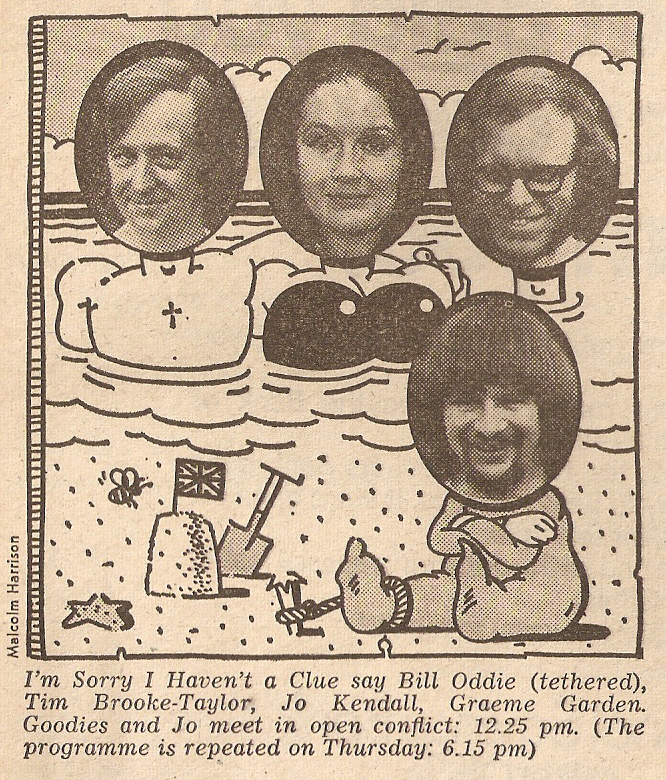
It's been fifty years since people were first given silly
things to do with swanee whistles, song lyrics, London tube stations and sound
charades with some of them accompanied by Colin Sell at the piano. Yes, radio's
antidote to panel games I'm Sorry I
Haven't a Clue was first heard by an unsuspecting public this day in 1972.
The genesis of I'm
Sorry I Haven't a Clue goes back to 1969 after the conclusion of series
seven of I'm Sorry I'll Read That Again
(it came back for a final eighth series in the summer of 1972). Writer and
performer Graeme Garden was already committed to working on BBC2's Broaden Your Mind with Tim, Bill and Jo
from ISIRTA. This was followed by The Goodies (starting in late 1970) and
scripts for LWT's Doctor in the House
(also 1970), Doctor at Large (1971)
and Doctor in Charge (1972).
Despite all the tv work Graeme was still keen to work on radio
and was thinking of recreating something that brought the fun and anarchy of ISIRTA but without the chore of script
writing. A comedy panel game looked like it could provide the answer. Just a Minute and My Word! were already very popular and others had come and gone
such as The Tennis Elbow Foot Game
(1966-68) - which may have provided the spark for Clue's Word for Word round - The
Clever Stupid Game and You Don't Say
(both 1970).
But could Gyles Brandreth have provided the inspiration for Clue? It's possible. In 1971 Graeme was
a panellist on eight editions of A Rhyme
in Time, a comedy word game with a poetry twist in which the other
panellists, consisting of Cyril Fletcher, Caryl Brahms and June Whitfield, would
"converse in verse".The
programme was devised and introduced by Gyles Brandreth. Just seven months
later Clue came on air
Graeme discussed his ideas for a new show with producer
David Hatch and together they worked up a format and recorded a pilot. Getting
the green light for a series the pilot aired on 11 April 1972 and 12 episodes
followed, though for these Hatch was busy elsewhere and John Cassels produced. Early
editions were, according to Garden "rather messy and self-indulgent".
It seemed that completely dispensing with some scripted elements and preparation
didn't work. He continues: "In the first series it was all virtually
ad-libbed - that was my mistake, and since then we've all learned a bit more
about doing panel games. We know that the audience like it a) because you
appear to be witty, and b) because you appear to be put 'on the spot' and have
to sweat. And those are two different things; if you've got to make up, say, a
calypso, it's almost impossible to do that on the spot, and so you spend an
hour or so beforehand writing it ... but the team's increasing experience,
particularly in knowing which sections they should prepare, has led to a much
improved control over the show."
The idea of riffing on a theme and the fact that they were both
jazz fans probably led to Graeme and David thinking of Humphrey Lyttelton as
the chairman, an inspired choice and a major factor in its longevity. Those
early editions all featured ISIRTA
alumni (Bill Oddie, Tim Brooke-Taylor, Jo Kendall and John Cleese) plus Barry
Cryer filling for Humph as chairman when he couldn't make a couple of the
recording dates. But Bill, Jo and particularly John were not entirely
comfortable with winging it.Only Bill
returned for the second series in 1973, along with Barry now as a regular
panellist and by the third in 1974 Willie Rushton had come on board and we
entered the first golden era for Clue
with the famous four of Messrs Garden, Cryer, Brooke-Taylor and Rushton. By the
fourth series in 1975 Colin Sell had replaced Dave Lee at the piano.
From my own ISIHAC
archive comes this recording, in fact it's the first one I ever recorded, of
the Christmas 1980 special so you get an extra 15 minutes or so. It features
all the regulars from that time and the producer is Geoffrey Perkins.
The passage of time has taken its toll on Clue participants with the deaths of
series regulars Willie Rushton, Humphrey Lyttelton, Jeremy Hardy, Tim
Brooke-Taylor, writer Iain Pattinson and, just a few weeks ago, Barry Cryer.
But the formula is still proving durable as it marks its golden anniversary and
recent series with a host of new voices to the programme are just as funny with
plenty of laugh out loud moments.
Radio 4 will be marking the programme's anniversary this
Saturday in an edition of Archive on
4 at 8 pm. 50 Years Without a Clue is
presented by Greg James.
Notes:
Quotes cited in From
Fringe to Flying Circus by Roger Wilmut (Eyre Methuen 1980). For more on
the programme's history see The Clue
Bible by Jem Roberts (Preface 2009)
The Tennis Elbow Foot
Game was devised by Norman Hackforth (the 'Mystery Voice' on Twenty Questions) and produced by David
Hatch (series 1) and Bill Worlsey (series 2). Regular panellists were Sheila
Hancock, Olga Franklin, Paul Jennings, Fenella Fielding, Hackforth himself and
Max Robertson as the umpire. Series 1 October to December 1966 (13 episodes) on
the Home Service. Series 2 November 1967 to May 1968 (26 episodes) on Radio 4.
It then transferred to BBC2 for a series of 12 episodes July to October 1968.
The Clever Stupid Game
was devised and chaired by Robin Ray. John Cleese was a panellist on one of the
8 episodes broadcast on Radio 4 May to July 1970.
You Don't Say was
devised by Jimmy Thompson, Johnny Whyte and Nicholas Parsons and chaired by
Cyril Fletcher. A 12 episode series produced by Alastair Scott Johnson was
broadcast on Radio July to September 1970.
A Rhyme in Time
was broadcast over 8 episodes from July to September 1971. In this BBC blog
Gyles Brandreth says there were two series, the first produced by David Hatch
and the second by Simon Brett. I can only trace the one series with Brett
producing. My guess is that an unbroadcast pilot was produced by Hatch.
You've Got to be
Joking was the radio comedy panel show that ran for six series between 1976
and 1982. I say panel game though there was no discernible format. The chairman
Cardew Robinson would give each of the three comedians a subject or maybe the
start of a story that they would follow-up with gags, a shaggy-dog story (the
shaggier the better) or a song.
The show was devised by the BBC resident comedy guru in
Manchester, producer Mike Craig, though obits for Cardew, who died in 1992,
erroneously credit him with the idea.
Accompanying the comics for the songs was Harry Hayward,
perhaps best known for his numerous appearances on Workers' Playtime and later Ken Frith who often played with the
Northern Dance Orchestra.
The six series started off on Radio 2, where it really
belonged, but with series 3 and 4 turning up on Radio 4, though both stations
repeated some editions that had been heard on the other one.
Providing the comedy were invariably Northern comics, well
steeped in touring the clubs and theatres. Some were fairly regular
broadcasters like Duggie Brown, Bernie Clifton, Tom Mennard, Dave Evans.
Cardew Robinson had been broadcasting on the radio since
1947 initially billed as Douglas 'Cardew' Robinson and then adapting The Cad
persona. He'd pop up on numerous variety shows such as Variety Bandbox, Variety
Fanfare (where he was the resident comic), Music-Hall, over 80 editions of Workers'
Playtime, Blackpool Night, Variety Playhouse and London Lights. He was also on the mid-
60s Ken Dodd shows and over 60 editions of the comedy panel show Does the Team Think?
I've a couple of editions of You've Got to be Joking that I recorded. From the start of the 1980
series on Radio 4 comes this gem of a show with Tom Mennard, one fine form
here, Bernie Clifton, with a 3½ minute gag fest at the start, and Tony Peers. First
broadcast on 9 July 1980 and repeated on Radio 2 on 30 June 1981 it has not
been heard since.
From the fifth series here are Mike Burton, Malcolm Stent
and Jan Harding. This was broadcast just the once on 24 March 1982.
Series Guide
Series 1: 13 December
1976-7 March 1977 (13 episodes) BBC Radio 2
Duggie Brown, Bernie Clifton, Tom O'Connor, Bobby Knutt,
Mick Miller, Jack Platts and Peter Wallis,
Series 2:28 November
1977-27 February 1978 (13 episodes) BBC Radio 2
Bernie Clifton, Norman Collier, Tom Mennard, Jan Harding,
Tony Kent, Bobby Knutt, Don Maclean, Peter Wallis, Mick Miller and Ron
Delta
Series 3: 28 November
1978-20 February 1979 (13 episodes) BBC Radio 4
Bernie Clifton, Tom Mennard, Dave Evans, Jan Harding, Peter
Robinson, Duggie Brown and Mike Newman
Series 4: 9 July-13
August 1980 (6 episodes) BBC Radio 4
Tom Mennard, Bernie Clifton, Tony Peers, George Roper, Jan
Harding and Peter Robinson
Series 5: 10 March-14
April 1982 (6 episodes) BBC Radio 2
Alan Fox, Colin Price, Tony Kent, Mike Newman, Malcolm
Stent, Vince Earle, Mike Burton and Jan Harding
Series 6: 10
November-15 December 1982 (6 episodes) BBC Radio 2
Mike Burton, Mike Newman, Jan Harding, Tony
Kent, Vince Earle, Ronnie Hayward, Phil Cool and Colin Price
"How well do you know the law? Find out by joining us
for The Law Game. Along with our
celebrity panel you can hear details of law cases and judge which side you
think won. And on the bench as usual presiding over the programme is your chairman
Shaw Taylor."
Back in the day when panel games had a regular place in BBC
Radio 2's schedule The Law Game was
one of the best known and longest-running - 17 series over 16 years. The
premise was straightforward enough: three playlets were acted out by three
members of the BBC's Drama Repertory Company in which matters of the law are
played out in various settings or in court. After chairman Shaw Taylor dings
his bell to end the sketch the celebrity panel have to identify what laws have
been broken and by whom. Team members then bet points, from their starting pot
of 50 points, on the outcome of the case. "It's quite educational, not
just an excuse for three celebrities to fool about", said Shaw Taylor to
the Radio Times in 1985.
The Law Game was devised
by comedy writer Brad Ashton and he wrote all the mini-dramas, offering
injecting the odd comedy line. Ashton had been writing since the mid-1950s on
radio shows such as Show Band Show, London Lights and later series of Life with the Lyons. On TV he wrote for Tommy
Cooper, Dick Emery, Mike and Bernie Winters, Lennie Bennett and Jerry Stevens
and for Little and Large. The format of The
Law Game was perhaps inspired by the guess who committed the crime programme
Guilty Party (1954-62). See John
Arlott blog post.
Shaw Taylor, best known on TV for Police 5, seemed a natural choice as series chairman with a mix of
light-hearted authority. He was not unfamiliar in this type of role having
presented a number of ATV game shows in the late 1950s/early 1960s when
commercial television was devouring as many US formats as it could get through.
On Radio 2 in the 1970s he also chaired The
78 Show and Pros and Cons, more
of which later.
The Law Game first
aired on Radio 2 in September 1976. The celebrity panel usually featured at
least one actor together with journalists, broadcasters and comics, though not
as many as today's panel games are stuffed with. Favoured panellists were
Claire Rayner, Denise Coffey and Nerys Hughes. Produced by the Light
Entertainment department initially under the guidance of Richard Willcox,
though over the years several young producers who went on to bigger things got
a chance to work on the show including the late Danny Greenstone, Paul
Mayhew-Archer, Richard Edis, Jan Ravens, Andy Aliffe, Dan Patterson, Lissa
Evans, Sioned William, Sarah Smith and Caroline Leddy.
The Law Game hasn't
been repeated since it ended nearly 30 years ago so here's an opportunity to
hear a couple more (in addition to the two I've already uploaded to YouTube in
2015 and 2020.
From 23 November 1981 this edition has a panel of Diane
Keen, John Junkin and Lance Percival. Acting out the scenes are Miranda Forbes,
Nicholas Courtney (so one for Doctor Who
fans)and Ronald Herdman.
From the following year, 19 July 1982, we have Sandra
Dickinson, Matthew Kelly and Fred Housego sitting in judgement. The actors are
Steve Hodson, Miranda Forbes and Vincent Brimble.
The other Brad Ashton creation was Pros and Cons. In fact it started the year before The Law Game but had a shorter run, just
seven series over eight years. A number of the cons were experienced by Brad
himself, including one in the 1982 edition below. Many others came from
contacts he'd made at Scotland Yard. Writing in the Radio Times in 1980 he admitted that "I get strange looks when
I tell people that my hobby is collecting confidence tricks. So far I've got
340 and used 144 of them in the sketches aimed as fooling the panel." His
interest began on a trip to new York in 1956. "I was a prototype for all
innocents abroad. The airport cab driver circled the whole of New York State to
get me to my hotel just two miles away. He was about to do a lap of honour when
I recognised a store we'd passed three times."
The format of Pros and
Cons was the same as The Law Game,
three short sketches played out with enough clues to help or mislead the three
celebrities on the panel to identify the con, the person(s) doing the conning
and the person(s) being conned. The panellists were a pretty mixed bunch (see
series details below) but included a fair number of personalities from the
sister show. The series producers
included some very experienced BBC hands such as Alistair Scott-Johnson of The Navy Lark fame, Ian Fenner and
Trafford Whitelock, as well as Ros Bartlett, Jamie Rix and Richard Edis.
In this edition from 17 November 1980 the sleuths are Claire
Rayner, David Jason and Roy Hudd. The repertory company are Rowena Roberts,
John Church and Trevor Cooper.
The second recording comes from 24 February 1982. The
panellists here are Kenny Everett (that week's Radio Times cover star), Stephanie Turner (at the time known for
her lead role in cop drama Juliet Bravo)
and Derek Nimmo. Acting out the scenes are Adrian Egan, Miranda Forbes and
George Parsons.
The Law Game Series Guide
Series 1: 22
September-27 October 1976
Diana Dors, Pete Murray, Leslie Randall, Rachel
Heyhoe-Flint, Patrick Mower and Bob Wilson
Series 2: 30 March-27
April 1977
Margaret Howard, Francis Matthews, Pete Murray, Rachel
Heyhoe-Flint, Barry Norman, Claire Rayner, James Burke and Patrick Mower
Series 3: 30 November
1977-4 January 1978
Claire Rayner, Francis Matthews, Dr Magnus Pyke, Rachel
Heyhoe -Flint, Patrick Mower, Leslie Randall, Henry Cooper, William Franklyn
and Anoushka Hempel
Series 4: 4 December
1978-15 January 1979(no tx 25 December
1978)
Claire Rayner, Francis Matthews, Peter Purves, Shirley Anne
Field, James Burke, Dr Magnus Pyke, Diana Dors, Russell Davies and Patrick Mower
Series 5: 7
January-18 February 1980 (no tx 4 February)
John Junkin, Aimi Macdonald, James Burke, Peter Purves,
Diane Keen, William Franklyn, Lance Percival, Shirley Anne Field and Francis
Matthews
Series 6: 20
January-24 March 1981
Julia McKenzie, David Jason, Andrew Sachs, Liza Goddard,
John Junkin, Lance Percival, Judy Carne, Graeme Garden, Don Maclean, Patricia
Hayes, Tim Brooke-Taylor, Frank Windsor, Nyree Dawn Porter, Ray Alan and Duggie
Brown
Series 7: 16 November
1981-11 January 1982 (no tx 28 December)
Diane Keen, John Junkin, Lance Percival, Stephanie Turner,
William Franklyn, Alfred Marks, Joyce Blair, Patrick Mower, Matthew Kelly,
Diana Dors, Lionel Blair and Glyn Worsnip
Series 8: 19 July-6
September 1982
Sandra Dickinson, Matthew Kelly, Fred Housego, Janet Street
Porter, Nigel Dempster, Wendy Richard, Patrick Moore, Denise Coffey,
Christopher Biggins, Rob Buckman, John Peel and Paddy O'Byrne
Programmes listed on BBC Genome in 1983 are repeats of
series 7 and 8
Series 9: 12 March-30
April 1985
Christopher Biggins, Denise Coffey, Patrick Moore, Bill
Oddie, Aimi Macdonald, Ian Lavender, Stubby Kaye, Bettine Le Beau, Andrew
Sachs, Gyles Brandreth, Katie Boyle and Dr Magnus Pyke
Series 10: 4 March-6
May 1986
Barry Took, Patricia Hodge, Steve Jones, William Franklyn,
Jean Rook, Nigel Rees, David Hamilton, Anna Carteret, Martin Jarvis, Mark
Curry, Toni Arthur, Chris Serle, Iain Johnstone, June Whitfield and Christopher
Biggins
Series 11: 28 April-7
July 1987 (no tx 26 May)
Ian McCaskill, Pat Coombs, Peter Jones, Jimmy Perry, Claire
Rayner, Steve Jones, Denise Coffey, Colin Baker, Brian Johnston, Stephen Fry,
Anna Raeburn, Morwenna Banks, Neil Mullarkey, John Junkin, Patrick Moore and Su
Pollard
Series 12: 5 January-23
February 1988
Nerys Hughes, Kenneth Williams, Ian McCaskill, Brian
Johnston, Denise Coffey, Derek Nimmo, Stephen Fry, Patricia Hodge, John Gordon
Sinclair, Alfred Marks, June Whitfield and Alan Titchmarsh
Series 13: 21
November 1988-23 January 1989
Barry Cryer, Ian Hislop, Nerys Hughes, Denise Coffey, Alan
Titchmarsh, Susan Rae, Sally Burton, Graeme Garden, Trevor McDonald, Martin
Jarvis, Ian McCaskill, Claire Rayner, John Gordon Sinclair and Alfred
Marks
Series 14: 3
October-21 November 1989
Lynda Bellingham, Duggie Brown, Bob Holness, Joe Brown,
Barry Cryer, Claire Rayner, Sue Cook, Chris Emmett, Nerys Hughes, Polly James,
Wendy Richard and Tim Brooke-Taylor
Series 15: 14
November 1990-9 January 1991
Mark Steel, Jenny Eclair, Barry Cryer, Rob Newman, Tony
Slattery, Claire Rayner, Bob Downes, Nerys Hughes, Denise Coffey, Barbara
Windsor, Wendy Richard and Graham Garden
Series 16: 24
September-12 November 1991
Michael Melia. Cynthia Payne, Craig Charles, Emlyn Hughes,
Helen Atkinson-Wood, Geoffrey Durham, Lesley Joseph, Ken Livingstone, Neil
Mullarkey, Susie Blake, Frances Edmonds and Craig Ferguson
Series 17: 9
September-4 November 1992 (no tx 14 October)
Anna Raeburn, Peter Jones, Paul Ross, Bill Pertwee, Denise
Coffey, Bill Tidy, Fred Housego, Jan Leeming, Chris Dunkley, Miles Kington,
Sandi Toksvig and Chris Stuart
Pros and Cons Series
Guide
Series 1: 24 July-28
August 1975
Marj Proops, Pete Murray, Sydney Tafler, Bettine Le Beau,
Leslie Randall, Fred Trueman, Eleanor Summerfield, Tony Brandon, Sheridan
Morley, Norma Ronald, Brian Johnston, Leonard Sachs, Charmain Innes, Percy
Edwards, Alfred Marks, Isobel Barnett, , George Layton and Barry Took
Series 2: 31 December
1975-24 March 1976
Kathleen J. Smith, Sheridan Morley, Ian Wallace, Jessie
Matthews, Brian Johnston, Ned Sherrin, Miriam Karlin, Noel Edmonds, Barry Took,
Eleanor Summerfield, Robert McKenzie, John Julius Norwich, Sheila Van Damm,
Peter Bull, Patrick Moore, Bettine Le Beau, Deryck Guyler, Bill Jupe, Jonathan
Miller, June Whitfield, Fred Trueman, Linda Blanford, George Layton, Wynford
Vaughan-Thomas, Patricia Hayes, Milton Shulman, Michael Bentine, Thora Hird,
Professor Eric Laithwaite, Sydney Tafler, Katie Boyle, Jonathan Aitken, Larry
Adler, Beryl Reid, David Jacobs, Dan Maskell, Marj Proops, Pete Murray and
Leslie Randall
Series 3: 7 July-25
August 1977
Patricia Hayes, Michael Robbins, Jean Rook, George Chisholm,
Pat Coombs, Sheila Scott, Henry Cooper, Jenny Hanley, Yootha Joyce, Keith
Fordyce, Liz Fraser, Claire Rayner, Lionel Blair, Sara Leighton, Aimi
Macdonald, Joyce Blair, John Snagge, Bob Todd, Bettine Le Beau, Patrick Moore,
Marj Proops, Bill Owen, Wendy Richard and Terry Wogan
Series 4: 16 April
1979-9 July 1979
Leslie Phillips, Thora Hird, Paul Jennings, Roy Hudd, Dora
Bryan, Roy Plomley, Peter Jones, Sheila Van Damm, Barry Took, Jack de Manio,
Mirima Karlin, Ian Wallace, Johnny Morris, Mollie Sugden, Barry Cryer, Leslie
Randall, Sheila Hancock, Bill Oddie, Brian Rix, Janet Brown and Terry Wogan
Series 5: 10
November-29 December 1980
Roy Hudd, Claire Rayner, David Jason, Nerys Hughes, Bernard
Cribbins, Francis Matthews, Ray Alan, Lorraine Chase, John Craven, Liza
Goddard, Don Maclean and Ian Lavender
Series 6: 27
January-3 March 1982
Honor Blackman, Terry Wogan, Tony Haygarth, Diana Dors,
Martin Jarvis, Lennie Bennett, Kenny Everett, Stephanie Turner and Derek Nimmo
Series 7: 5 January-9
February 1983
John Junkin, Stephanie Turner, Roger Cook, William Franklin,
Liza Goddard, Garfield Morgan, Jeremy Beadle, Joanna Munro and Matthew Kelly
Here's a fascinating piece of analysis that, according to The Guardian, is the "most
comprehensive analysis ever carried out of comedy panel shows". Conducted
by Stuart Lowe of the Open Data Institute it concludes that "only once in
the history of British TV and radio has a programme had an all-female line-up".
Lowe observed that few women appeared on panel games and was
determined to undertake a more scientific approach to analysing whether or not
this was actually the case. The Guardian
report continues: "Of more than 4,700 individual episodes examined ...
1,488 programmes since 1967 have been made up solely of men. But only on one
occasion in 49 years has there been a programme in which the presenter and all
the panel were women – an episode of BBC Radio 4’s Heresy in January 2012 presented by Victoria Coren-Mitchell".
Whilst Lowe appears to overlook Petticoat Line (1965-74) which arguably became a more comedic show -
a sort of all-women Does the Team Think
- and was always 100% female then in theory this edition from the eighth series
of Heresy is a piece of broadcasting
history.
According to Coren-Mitchell “the thing that surprised me is
that it turned out to be the silliest episode of the series. My theory is that,
because productions usually put one woman on a panel show (or none) and stop
there, women get used to having to (at some wearisome level) ‘represent’ female
humour when we appear on these shows ... but with four women the pressure was
off. It was nobody’s individual responsibility to prove anything. So we all got
the chance to just mess about, relax and make free jokes like men do.”
So here is that edition of Heresy from 4 January 2012 (though I think my recording is of a
subsequent repeat). With Victoria Coren-Mitchell are Sue Perkins, Cerys
Matthews and Maureen Lipman.
Postscript
Since I first drafted this blog post last week I've been in
touch with Stuart about the Petticoat
Line and he's now updated his data and created a Wikipedia article on the
show. I was pretty sure I had a couple of audio clips but so far I've only
tracked this one down from 1969.
Petticoat Line
aside Stuart's basic arguments remain that on radio and TV "nearly all
these long-running shows under-represent women even if you ignore the regulars.
Few shows have equal representation amongst guests."
There was a time when most evenings you’d hear a comedy show or quiz on Radio 2 produced by the Radio Light Entertainment department. Nowadays the network considers itself to be much more of a music station and such programming has virtually disappeared.
In fact budget cuts in the early 90s started the fall-off in these shows. Killed off in 1992 were The ABC Quiz, Back to Square One, Beat the Record, The Grumbleweeds, The Law Game, On the Air, Pop Score and Some of These Days. “The shows are expensive in Radio 2 terms and they don’t do very good business” said BBC’s Radio MD David Hatch. “In addition some of these shows have been on longer than they ought to have been. Beat the Record has been running 20 years and The Law Game 15 years.” He went on to say that “there will continue to be light entertainment on Radio 2 with The News Huddlines, cinema programmes and some new shows.”
It seems that Radio 4 Extra, and its predecessor Radio 7, rarely revisit these Radio 2 shows so I thought I’d fill the gap. So in this post I’m recalling one of the network's panel games from the 1980s - Dealing with Daniels. Running from 1982 to 1989 it was yet another creation from the mind of Ian Messiter, he of Just a Minute fame. Hosted by magician Paul Daniels (“you’ll like this…not a lot”) the idea was for the panellist to answer not-too-serious questions from a pack of question cards based on playing cards. So each suite was a different category and each card worth a different number of points, court cards and aces being worth more. If a player asked for a card that had already been drawn they’d get the horn from Mr Daniels. Playing a joker could wipe out any minus points and guessing when all the cards had been used gained you 10 points. Clear?
The first series started on 28 December 1982 with a panel of Barry Cryer, Lorraine Chase and Mathew Kelly, but the series regulars became Patrick Moore and Duggie Brown.
Here’s the first programme of the second series which features Michelle Dotrice alongside Patrick and Duggie. This programme was broadcast at 10 p.m. on Tuesday 29 May 1984.

.jpg)