This year sees the 50th anniversary of that radio perennial Just a Minute. There are some special
programmes this month marking the golden anniversary but on Christmas Day last
year Radio 4 broadcast this extended version of the game with some added, if rather
flimsy, panto elements. Joining the regulars of Paul Merton, Sheila Hancock and
Gyles Brandreth are Tony Hawks, Tom Allen, Rufus Hound, Pippa Evans and Julian
Clary. As ever the chairman is Nicholas Parsons.
The format reverts to a team effort, even if it does
sometimes get undermined, a throwback to Just
a Minute's predecessor One Minute,
Please and there's a lovely nod to the days of Kenneth Williams.
Welcome to Just a Minute! For five decades it's been a case
of speaking without hesitation, deviation or repetition. A simple yet
frustratingly difficult task that has led to some great comic moments over the
900+ editions that have been heard since Just
a Minute first appeared on 22 December 1967.
The programme, devised by Ian Messiter, had had an earlier
1950s radio incarnation under the title One
Minute, Please with Roy Plomley, and later Michael Jackson, chairing,
though here it was a team game rather than pitting four individual players
against each other.
In 1967 Nicholas Parsons was enjoying radio success in the
topical satirical comedy series Listen to this Space. Seeking some new challenges he spoke to Ian Messiter who
suggested Just a Minute. Getting the
green light for the pilot producer David Hatch was called in - David would
guide and help shape the programme for its first decade or so - and with
Nicholas as one of the panellists it was Jimmy Edwards who was lined up as
chairman. In the event Edwards couldn't commit to the show so Nicholas Parsons
reluctantly agreed to step in as master of ceremonies, a role he's maintained,
apart from some role swapping in early editions, ever since.
The pilot episode was recorded on 16 July 1967 and
eventually scheduled as the first edition of a new series to start on Radio 4
that December, thus becoming the newly re-badged network's first bona fide hit.
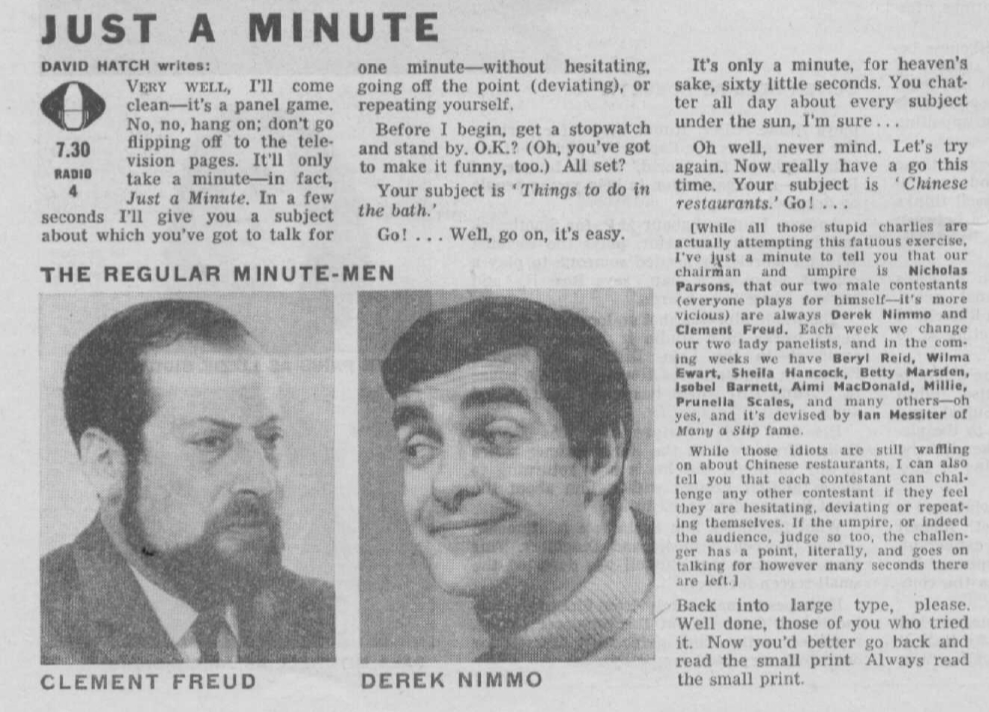
Show producer David Hatch writes a humourous introduction
for the Radio Times of 22 December 1967
Here is that first outing of Just a Minute. The panel consists of two participants who would
become regular players and two who never
appeared again. Chef, restaurateur, writer and nightclub owner Clement Freud
would eventually clock up 544 editions between 1967 and 2009. His game play
tactics were running off lists to fill the time, no mean feat without pausing,
and buzzing in with a challenge with a second or two to go, though players
couldn't see the clock. With him was actor Derek Nimmo (309 editions until
1999) whose regular foreign travels gave him plenty of material to talk for a
minute. The third member was actress Beryl Reid who struggled with the concept,
proving that actors used to performing from a script don't always make the best
exponents of Just a Minute. I've
always wondered who exactly the fourth panellists was as I've never heard the
name before. In fact it turns out that Wilma Ewart was one of Nicholas's
neighbours who had no experience of performing but who he found "witty and
entertaining". Wilma makes a decent job on the show but was never asked
back as her and husband had to move back to the USA.
The game as played in the early series is not what we now
know. The rules took some time to bed in; repetition was counted as repetition
of an idea as well as words. For a while you couldn't even repeat the words in
the subject title and there were penalty rounds such as speaking on a subject
without using certain words but these proved inhibiting.
The third major player of the game joined for the second
series when Derek Nimmo couldn't make the recordings due to filming
commitments. Producer David Hatch had been convinced of Kenneth Williams'
suitability for the game after seeing him on the panel of BBC TV's Call My Bluff and he asked Williams to
initially do six programmes. According to Kenneth's diary it seems it was a
somewhat reluctant agreement: "unfortunately it means working with that
Parsons fellow, but I said yes, 'cos it will be a nice fill-in". His attitude
to the chairman had mellowed somewhat by the time of the recording and it also
touches on the fact that Hatch would have to had to continually keep Kenneth
happy and praise his contributions: "... when we came to the performance I
just about managed and scraped through. But Nicholas was a great help and so
was Clemet Freud. David Hatch was very nice to me before (when I was actually
v. nervous) and afterwards. I like him very much - always have
actually".
Parsons, Williams, Nimmo and Jones. Radio Times 7 February 1985
With Williams on board the show was increasingly played for
laughs rather than just been a rules-based parlour game. His flamboyant style,
his appeals to the audience, those elongated vowels and then rattling along at
top speed became his game trademarks. Williams even unwittingly introduced some
catchphrases that are remembered to this day and only recently were referenced
by Paul Merton and Sheila Hancock: "I'm a cult figure". "I
haven't come all the way from Great Portland Street...". "It's a
disgrace" when, unreasonably to him, challenged or losing an appeal. And
"we shouldn't have women on this show", initially aimed at the 'lovely
Aimi Macdonald'. Kenny appeared on 346 radio episodes between 1968 and 1988.
In 1992 the programme celebrated its silver anniversary with
a 2-part retrospective, Silver Minutes.
This is part one from 20 July 1992 (though this is the commercially released
version).
The fourth member of what was seen for many years as the
'classic line-up' - was Peter Jones, who joined the show in 1971, again to fill
a gap left by a busy Nimmo. He had a more laid back approach to the game and
was often willing to sit back whilst the other fought it out only to buzz in
with a very funny or acerbic comment. His talks always seemed to start with
"well..." I recall. Peter made 326 appearances until 2000.
That so-called classic line-up appeared together in just 38
episodes so there were always guest slots to fill. Some became semi-regulars
and the longest-serving of these is Sheila Hancock who, like Nicholas Parsons
spans the five decades, appearing on the second edition of the first series in
December 1967 through to a couple of shows in the latest series, the 79th, this
autumn.
This is the second of the Silver Minutes programmes originally broadcast on 27 July 1992.
With the gradual loss of Kenneth Williams in 1988 there was
a vacancy for a regular player. Comedian Paul Merton had been an avid fan of
the show for years and had recorded and constantly replayed episodes to
himself. Convinced that he could contribute to the show he wrote to the then
producer Edward Taylor. At the same time he'd appeared as a panellist on the TV
game show Scruples on which Nick also
appeared (BBC Genome would suggest this was the 30 October 1988 edition) and he
mentioned how much he loved Just a Minute.
Paul's flights of surrealist fancy and running gags opened up the show and in
recent years, alongside that other semi-regular Gyles Brandreth, it has tended
to be comedians on the panel.
The programmes longevity can be put down to the fact that
one, it is a simple concept and two, that it has slowly evolved. Nicholas
Parsons, with a long history in the business has, to be fair, be very astute in
recognising the fact that the show needed to change to survive. Indeed in his
book on the programme he is very honest about the run-ins he had with Clement
Freud who still wanted to play strictly by the rules as first laid down by Ian
Messiter. Parsons recognised that much of the laughter comes from the
challenges, whether valid or not.
The first series of Just
a Minute that I committed to tape was the 14th that aired between December
1979 and March 1980. Playing alongside Williams, Nimmo, Jones and Freud were
Sheila Hancock, Aimi Macdonald, Tim Rice, Patrick Moore, Lance Percival, Barry
Cryer and John Junkin. Making their only appearances in the programme's history
were Peter Cook, Bob Monkhouse, Rob Buckman and Kenny Everett.
This is the first episode from series 14 from 11 December
1979.
Of course the real star, and the one constant, throughout the run has been Nicholas Parsons, still sounding as strong, if a little less posh, as he did in 1967. "I enjoy the position of chairman so much", he says in next week's issue of the Radio Times. "It's the greatest effort of concentration of any job I have. I'm listening intently and can see the way people's minds are working when they have a subject. We, as professionals, make it look easy and sound fun, but it's an incredibly difficult game." I can't do justice to the programme's 50 year history in
such a short post so I can direct you to the superb Just a Minute website.
Nicholas Parson's own history of the programme Welcome to Just a Minute was first published in 2014 and is
available in hardback, paperback and Kindle editions
How much easier is it to research a radio blog such as this with the internet? For starters you realise how many other like-minded people recorded and saved radio output, kept magazines, cuttings, leaflets, car stickers etc etc.
Although I either sold or threw away a lot of “stuff” (not nearly enough according to my long-suffering wife) before leaving the UK and moving to France I still have recourse to 30+ years of tapes, books, Radio Times, notebooks, publicity and magazines.
Just to show you that I was undertaking radio research as far back as 1982 here’s a copy of the Information Please section of the Radio Times from 20 November of that year with my letter asking for more gen on Radio 4’s Just a Minute.
No letter to the Radio Times required today. In a few clicks here’s all the information I need about that first series and without too much difficulty you can track down a recording (albeit a home recording) of that first programme from 1967. Too easy!