This post was to be titled From Children’s Hour to Woman’s Hour but on reflection it didn’t seem to do justice to the career of Sandra Chalmers who sadly died on 2nd February following a stroke.
Like her elder sister Judith, Sandra’s professional career started early, as an actor on Children’s Hour programmes for the Northern region. But rather then go on to be straight woman to Ken Dodd and globe-trotting on Wish You Were Here, Sandra worked with Tich and Quackers and worked in Manchester and Stoke!
Appearing alongside Ray Alan on Tichpuzzle in 1964 Sandra spoke to the Radio Times:
“I was a bit wary of television work at first”, she says, “because of Judith, but now I’m thrilled about it.” Sandra made ger TV series debut last week in Tichpuzzle and tonight she can be seen again along with Tich and the daffy duck Quackers, asking puzzle questions and giving answers to young viewers.
A Manchester University graduate – she studied English language and literature and American literature – Sandra joined the BBC in Manchester two months ago. Her job involves some odd working hours but she does not mind this. “I’m used to working shift jobs – once as a ground hostess at Manchester airport and another time in a breakfast-food factory. I put plastic spacemen into cereal packets … one a second!”
Life is certainly very exciting for Sandra at the moment. Apart from her radio work and Tichpuzzle she is busy saving hard and preparing for her wedding – to a mechanical engineer – which is to be some time next year.
Tichpuzzle is Sandra’s first ‘proper’ television work. “I began broadcasting when I was thirteen, in radio,” she said, “in Children’s Hour. I also did a few tiny parts in Harry Worth’s series about three years ago, and I had some walk-on parts in University plays. But that’s all.”
Sandra went on to be the Presentation Organiser for the BBC in the North and in 1970 joined the BBC’s newest local station, Radio Manchester, as a presenter and senior producer. She hosted phone-ins, then in their infancy, programmes of personal reminiscences in I Remember and the breakfast show Up and About. In 2010 she was invited back to the station as part of their 40th anniversary celebrations and to read the 10 am news bulletin just as she had done on the day of launch:
In 1976 Sandra was appointed manager of BBC Radio Stoke (pictured at the top of the page with programme organiser Geoff Lawrence), taking over from David Harding, and becoming the first woman to hold such a position. By 1983 she was down in London as editor of Woman’s Hour – maintaining the Chalmers family connection with the programme; Judith had presented it during the 60s. Under Sandy’s stewardship the programme, according to Jenni Murray, “started to proactively set its own agenda and play a more active role.” The Woman’s Hour Unit at that time also produced the Radio 4 phone-in shows Tuesday Call and, jointly with the World Service, It’s Your World.
It was back into management from 1987 when Sandy became Head of Radio Publicity and Promotions during which time she created The BBC Experience before moving on to become General Manager, External Affairs. She left the Corporation in 1994 and for six years was Director of Communications for Help the Aged, offering media training and regularly acting as an expert contributor on TV and radio on over-50s issues. Latterly Sandy ran Chalmers Communications, was on the Board of Directors at Saga Radio and presented programmes on Primetime Radio between 2000 and 2006 such as The Collection on Sunday afternoons. Here's a scoped version of a show from 14 December 2005:
In 2010 memories of Children’s Hour were revisited in a series for Radio 7, in this introductory clip from a Radio 4 Extra repeat:
Sandra Chalmers 1940-2015
A big thank you to Noel Tyrrel for the Primetime Radio audio.
With the recent announcement by OFCOM of two applications to
run D2, the second national, commercial digital multiplex and last Friday's Drive to Digital: NOW conference, it’s timely to remember of
just how far we’ve come in the last 20 years.
It was 1995 when the BBC started digital broadcasts, testing
the EUREKA DAB system. But listeners had to wait a further three years before
they could buy the digital radios to hear the transmissions, and fork out a few
hundred quid into the bargain. The first
model on the market, the Arcam Alpha 10 DRT, would have set you back £800.
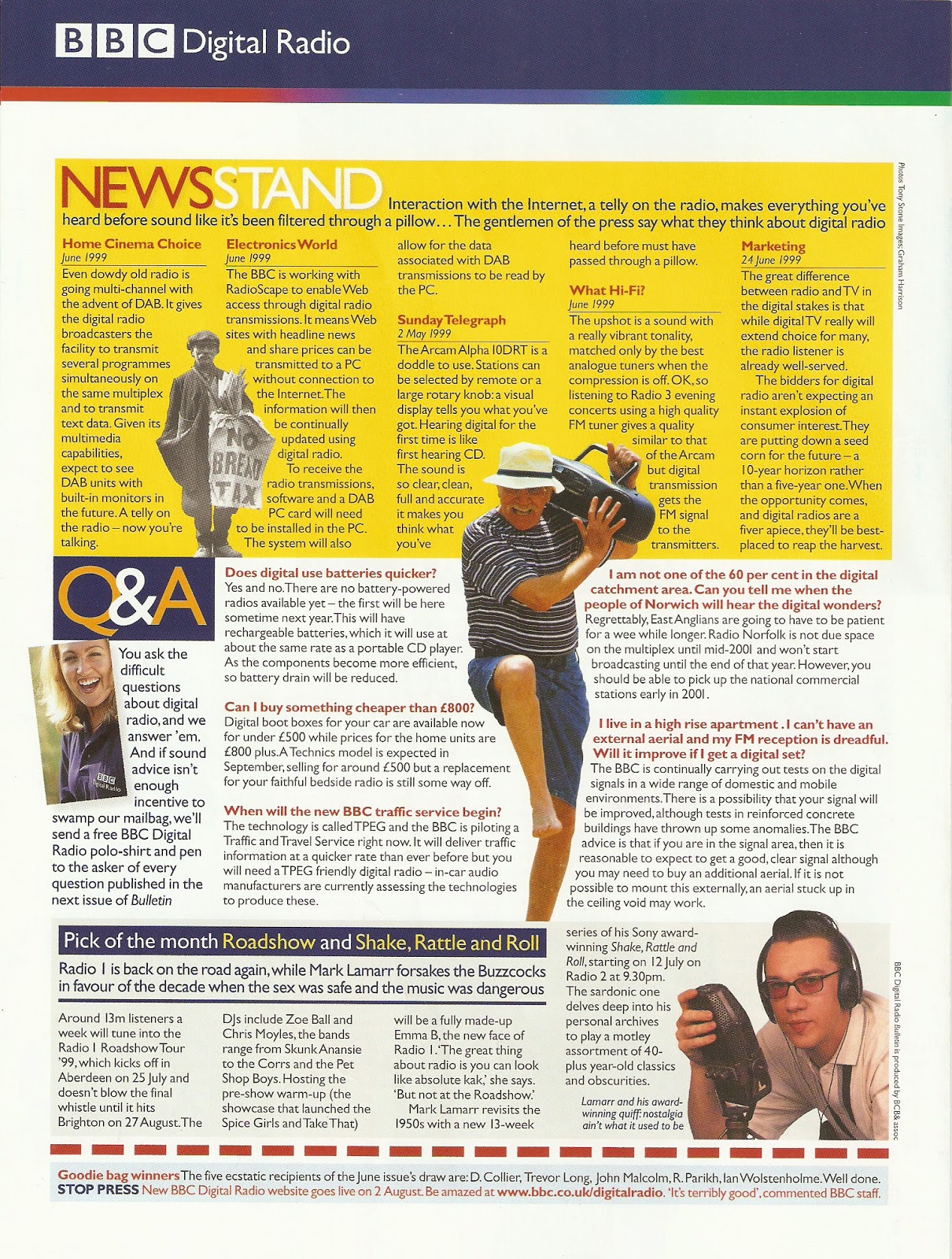
In the summer of 1999 the Corporation issued its first Digital Radio Bulletin. I can’t track
down a copy of that issue, but here’s the second edition from August.
The BBC’s national and local stations were all guaranteed a
slot on the digital dial (well OK there wasn’t a dial as such), with the local
licences for Greater London and Glasgow starting in the September, swiftly
followed by South Yorkshire, Tyne & Wear and Cardiff/Newport before the end
of the year. The first national commercial licence had already gone to Digital
One, and was due to launch that October (in the event it was 15 November). The
local licences for Birmingham and Manchester were awarded to CE Digital, a
group formed by Capital Radio and Emap Radio, with eight services for each one.
“We would like to squeeze on more stations but the quality would suffer”, said
Tracy Mullins, spokesperson for the Radio Authority.
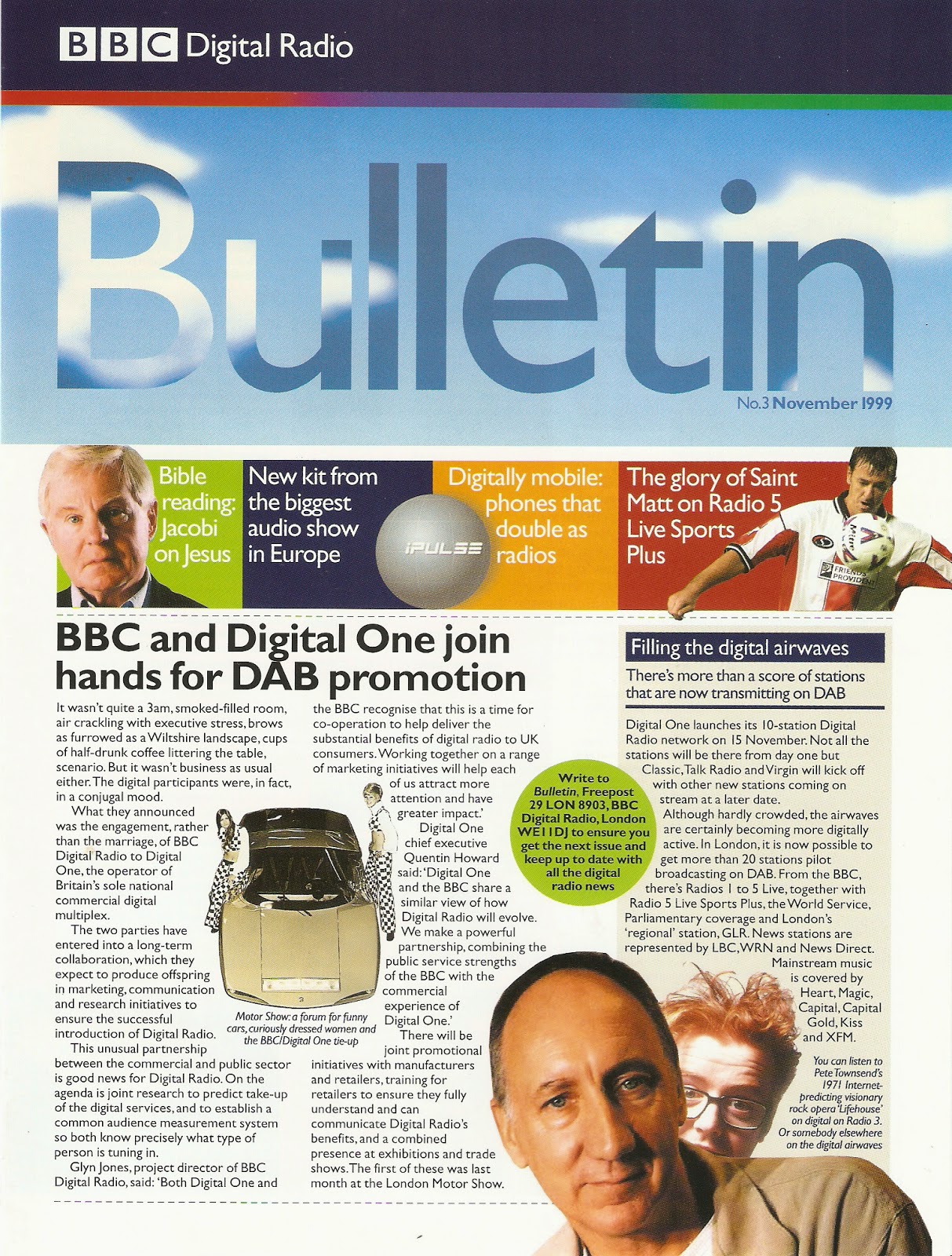
In the third bulletin from November 1999 there’s news of a
joint BBC/Digital One marketing campaign. Glyn Jones, the BBC’s project
director, said: “Both Digital One and the BBC recognise that this is a time for
co-operation to help deliver the substantial benefits of digital radio to UK
consumers. Working together on a range of marketing initiatives will help each
of us attract more attention and have greater impact.” There’s also news on
Radio 5 Live Sports Plus and that Mark Byford, chief executive of the World
Service, had his digital car radio stolen.
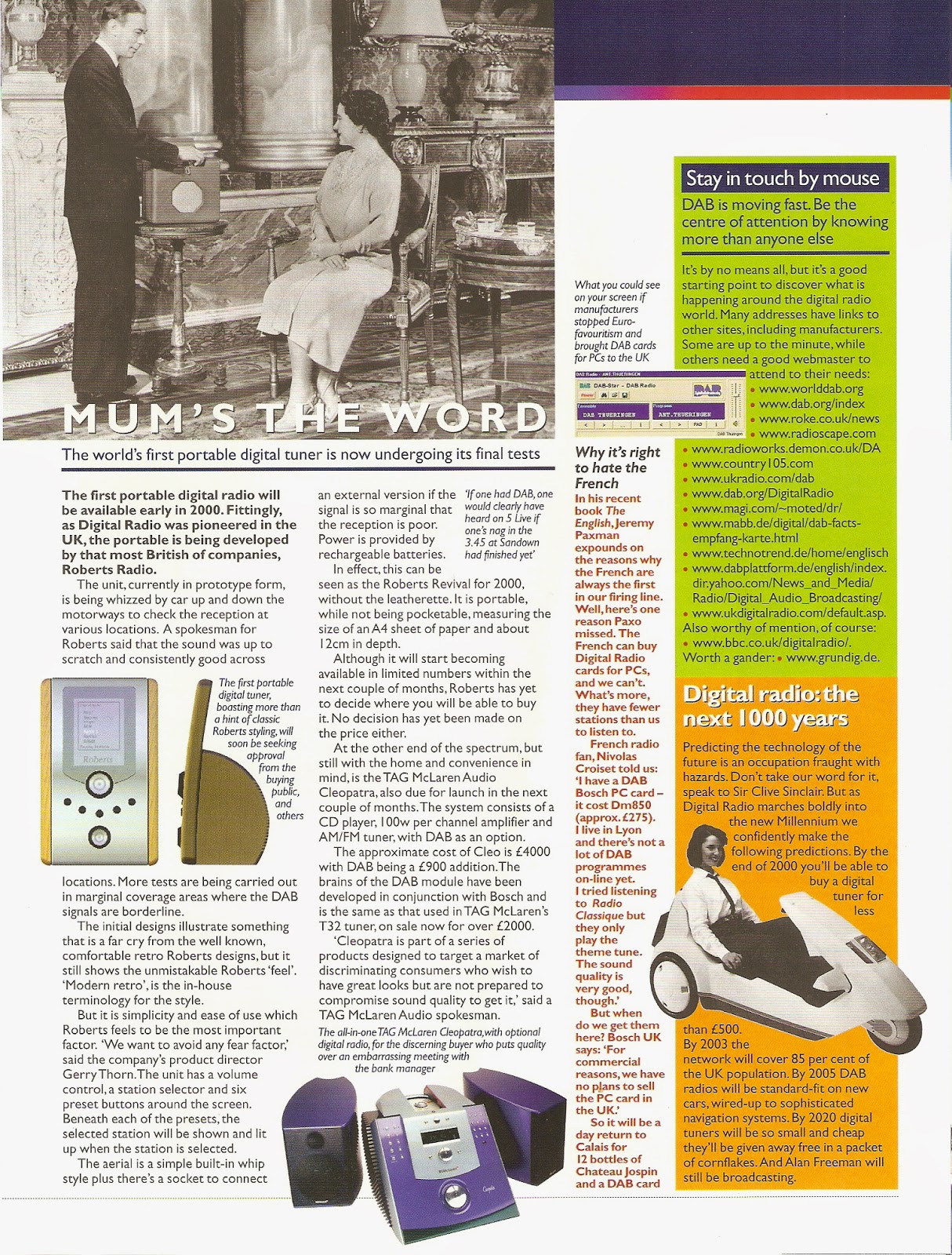
January 2000, and in this issue there are plans from the BBC
for an “album and archive station”, plus services “devoted to the UK’s black
music scene, a part-hours service for the Asian community, and another
archive-based station – this one for the BBC’s extensive hoard of radio plays,
comedy programmes and readings”. Page three announces that the “first portable
digital radio will be available early in 2000” with news that Roberts Radio are
to launch a new receiver. For those with deep pockets you could buy the TAG
McLaren Audio Cleopatra at just £4000 plus £900 for the digital option.
Ned Sherrin’s life and career is recalled on BBC Radio 4
Extra this Saturday in Side by Side By Sherrin, a career he described as one of “happy accidents”.
Sherrin’s abiding passion was for the theatre: later he
would write for it, write about it, interview many actors and revel in
theatrical gossip. Initially he trained in law, not for the theatricality of
the court room but to placate his father. It was, however, a chance meeting in
the street in 1955 with an old friend, which swayed him away from life as a
barrister at Grays Inn to the glamour of show business as a producer and
director for the fledgling ATV, in Birmingham.
An early ITV credit from the TV Times
4 September 1956
It was another chance acquaintance between his friend and
long-time writing collaborator Caryl Brahms (they’d met in 1954) and Cecil
McGivern, Director of Programmes for BBC television, that led Ned Sherrin back
to London two years later with a job working for the BBC. Initially it was as a
Light Entertainment producer on such shows as Ask Me Another, a TV version of radio’s What Do You Know, the forerunner to Brain of Britain, a programme showcasing zither-playing Shirley
Abicair and the panel game Laugh Line.
Soon Sherrin was working for the formidable Grace Wyndham
Goldie – at the time Assistant Head of Talks but soon to head up the Talks and
Current Affairs division – where he joined the influential daily show Tonight as a studio director.
By a stroke of good luck Tonight
drew together a team whose reputations would be far-reaching: Alasdair Milne,
Donald Baverstock, Alan Whicker, Cliff Michelmore, Julian Pettifer, Fyfe
Robinson, Antony Jay, Kenneth Allsop, Magnus Magnusson, Jack Gold etc.
In Deirdre MacDonald’s history of the programme she observes
that Sherrin was “a brilliant studio director … who added a visual sparkle to
every interview with his eye for detail and speed of observation. When Dame
Edith Sitwell was interviewed by Cliff Michelmore, Sherrin kept the camera on
her beringed fingers for the closing moments of the item. When one actress was
sounding pompous and boring to Sherrin, he focused on the sleeping dachshund
she had insisted on bringing with her.”
One of Ned Sherrin’s major contributions was also in
bringing new talent to the screen. MacDonald goes on to say: “He was an avid
searcher, a conscientious theatre-goer – from the West End to the end of the
pier in seaside towns. When he was studio directing Tonight, he was frequently an immaculate figure in a dinner-jacket:
by the time Tonight came off the air
as 7.30 the curtain would have gone up and the first act of plays and shows
that Sherrin was attending would have got underway. ‘Grace Wyndham Goldie once
met me in the corridor and asked whether I always directed Tonight in a dinner-jacket.”Yes, Grace”, I replied. “It’s an old
BBC tradition.” I’m afraid she swallowed it hook line and sinker. “very nice
sense of tradition Ned has”, she used to tell people. “Likes to direct in a
dinner jacket.”’
By the summer of 1962 the Tonight team were working on a new programme called That Was The Week That Was. The first
pilot was fronted by Manchester Guardian columnist Brian Redhead and David
Frost, whom Sherrin had spotted at the Blue
Angel nightclub in Mayfair (although at the time Frost was contracted to
Associated-Rediffusion).
It was again pure chance that production of TW3 was handed
to Sherrin. Roger Wilmut writes that it was Director-General Hugh
Carelton-Greene’s decision to take the programme away from Light Entertainment
“when a programme featuring the American satirist Mort Sahl was mounted by
Light Entertainment, in which introductory remarks were made along the lines of
‘Fancy Auntie BBC putting this on’. This so annoyed Greene that he gave the new
idea to Current Affairs to mount; Light Entertainment Department never forgave
him.”
That Was the Week That
Was didn’t get an immediate go-ahead and the circumstances surrounding this
sound a little bizarre. Wilmut recalls this in From Fringe to Flying Circus:
One of the highlights of the recording came in a debate between drama critic and political columnist Bernard Levin and a group of Conservative ladies. According to Sherrin, writing in the Sunday Mirror in 1966, the debate took on almost surreal proportions, with one of the ladies reiterating, ‘Mr MacMillan has always satisfied me’ and asking: ’Mr Levin, how would you like it if your daughter was out in a dark lane at night and nothing done about it?’
The recording was played back to a group of television executives, who felt that it was hardly suitable material for broadcasting. However, Sherrin says that the programme was saved, strangely enough by the Conservative ladies; they protested to the Conservative Central Office, who complained to the BBC, as a result of which Kenneth Adam, the Director of Television, had to see the recording. He saw the potential in it, and the programme went ahead. TW3 was, of
course, a huge success not only for its satirical humour and for launching of
many careers too long to list here, but for the way Sherrin’s direction changed
the grammar of television production: no attempt was made to hide the
paraphernalia of the studio.
Sherrin went on to make Not
So Much a Programme, More A Way of Life with David Frost and then BBC3 with Robert Robinson as the front
man, before being lured to Columbia Pictures UK operation as a film producer. Those
films were, shall we say, of varying quality; from The Virgin Soldiers to Up the
Chastity Belt and Rentadick.
Other TV shows of note are the adaptations of Feydeau farces
in Ooh Laa Laa, the translations and adaptations
by Sherrin and Caryl Brahms. Two long lost shows produced by Sherrin in 1969
were Eleanor Bron and John Fortune in Where
Was Spring? and a parody of current affairs shows such as Panorama and World in Action from the pen of N.F. Simpson titled World in Ferment.
Illustration for the second series of Medium Dry Sherrin
(Radio Times 1980)
Ned Sherrin didn’t entirely move away from topical comedy
and he presented what was perhaps a forerunner to The News Quiz and Have I Got
News for You in the late 60s Quiz of
the Week on BBC1. There was also Terra
Firma on BBC2 (1976) with his old TW3
colleague Donald Baverstock as editor, We
Interrupt This Week for PBS in the States (1978) and Friday Night…Saturday Morning on BBC2 (1979/80).
Whilst all this was going on Sherrin was also writing plays
and musicals for the theatre and in 1976 was asked to produce and narrate the
phenomenally successful Side by Side by
Sondheim, bringing along former Tonight
and TW3 singer Millicent Martin.
Meanwhile on the radio we had yet to hear much of Ned
Sherrin the broadcaster. He was making only occasional appearances in the 1960s
and early 1970s on programmes such as Any
Questions? and the odd panel game such as the World Service literary quiz Chapter and Verse and the movie quiz Ask a Cine Question for Radio 2.
Regular radio work didn’t come along until 1976 when Nigel
Rees was looking for panellists on his brand-new show Quote…Unquote. Sherrin was in an inveterate collector of the
quotes, particularly from the world of theatre and would edit several volumes
of them, so he seemed a natural for the panel. When producer John Lloyd phoned
him to invite him to take part Ned roared with laughter for no apparent reason.
It later transpired that Ned had some time before already recorded a pilot for
a TV quotations quiz, Who Said That? –
indeed a six-part series was broadcast on BBC2 that summer.
Billing for the first Medium Dry Sherrin
Radio 2 5th September 1979
Ned’s first star vehicle for radio was the late-night Medium Dry Sherrin, the start of a run
of pun-laden titles. Essentially this was an excuse for Ned to chat with actors
and entertainers, and not from the comfort of the studios, but from Quaglino’s
Restaurant in Mayfair. Running for two series on Radio 2 in 1979 and 1980 the
guests included Diana Rigg, Joan Collins, Reginald Bosenquet, Bernard Levin,
Gerard Kenny, Dennis Waterman and Andrew Sachs.
Working with producer Ian Gardhouse there were a number of
programmes on Radio 4: several weeks on Midweek,
which acquired the subtitle Sherrin After
Breakfast, another late-night cocktail of music and conversation in And So to Ned – I warned you!- in 1982
and Extra Dry Sherrin in 1983.
January 1986 saw the launch of Loose Ends, a Saturday morning talk show to fill the gap when Pick of the Week got moved to a Sunday.
Planned for a 13-week run it’s still going some 30 years later. It had its
genesis in an earlier show, also co-produced by Ian Gardhouse, The Colour Supplement, a Sunday
lunchtime magazine show hosted by Margo MacDonald. Ned chaired the proceedings on Loose Ends surrounded by, according to Paul Donovan, “a group of
laughing acolytes.” The list of regulars included Emma Freud, Craig Charles,
Carol Thatcher, Robert Elms, Richard Jobson, John Walters, Victor Lewis-Smith, Stephen
Fry, Victoria Mather, Jonathan Ross, John Sessions and Arthur Smith.
Author Sue Limb described the programme as “a bit like Plato’s
Symposium: a forum where bright young things are encouraged to show off by a
disreputable old philosopher with a penchant for saucy questions.”
Here’s another chance to hear how it all started with a
recording of most of the first edition from 4 January 1986. You’ll hear
contributions from Angela Gordon of The
Times, Robert Elms of The Face,
writer Antony Jay, who’d worked with Ned on TW3,
author Martin Barker plus writer and comic book aficionado Denis Gifford. In
the early shows there were pre-recorded features which here are John Walters on
the satellite TV choice, Nigel Farrell (who’d also been a regular on The Colour Supplement) talking a bus
trip in Farrell’s Travels and Mat
Coward taking a course in self-improvement. Credited with providing ‘additional
material’ was Alistair Beaton, essentially he was providing the script to the
opening monologue always delivered at breakneck speed by Sherrin.
This is another early edition of Loose Ends from 4 July 1987, the date when the show also got a
late-night repeat at 11 pm, billed as Even
Looser Ends. In this truncated recording you’ll also hear Carol Thatcher,
Emma Freud, Craig Charles and Robert Elms. There’s also one of those breathless freewheeling comic monologues from Victor Lewis-Smith, proving you
can always get a laugh from Thora Hird, a busload of Germans and the mention of
Money Box presenter Louise Botting.
At the start of the 1988 series Loose Ends received the ultimate accolade, a Radio Times cover and an article, St Ned’s School Report, written by Alistair Beaton.
In the summer of 1986 Sherrin started an association with
another long-running Radio 4 show, Counterpoint.
This is a music quiz that covers all musical tastes, but with more of a leaning
to the classical, devised by Edward Cole who was well-known to listeners as a continuity
announcer.
This is the final of the 19th series of Counterpoint from 1 August 2005.
Ned had to give up broadcasting in 2006 when throat cancer
took hold. He died on 1 October 2007. The following day Alistair Beaton delivered
a personal tribute in a special programme broadcast at 6.30 pm.
Ned Sherrin 1931-2007
Additional Tonight and TW3 information and quotes from: Tonight: A Short History by Deirdre Macdonald (BFI Dossier 15 1982) From Fringe to Flying Circus by Roger Wilmut (Eyre Methuen 1980)
There now follows a brief history of the shipping forecast: Daventry. 5XX. 1925. Later Droitwich increasing in strength nationally. Wartime. Sea strength rough. Visibiity poor. Postwar. Home then Light. 1500 metres. Veering Radio 2 at 1967 later. Station Change. Radio 4. 1978. Sailing By imminent. Continuity announcer calm.
In this post I unpick the history of the broadcasting of the
shipping forecast, come to a few conclusions, correct some misconceptions and
raise a few questions.
Question: When exactly was the shipping forecast first
broadcast?
The answer to that one is either 89, 90 or 91 years ago.
In Charlie Connelly’s hugely enjoyable Attention All Shipping (in which he attempts to visit all the sea
areas) he tells us that “the shipping forecast first appeared in something
approximating its current format on January 1, 1924” with the waters round
Britain divided into thirteen regions.
The Met Office elaborates on this further: “On 1 January 1924, in appreciation of the
valuable help given to the meteorological service of this country by the radio
weather reports from ships, a weather bulletin called Weather Shipping was
started, broadcast twice daily at 0900 and 2000 GMT, from the powerful Air
Ministry station G.F.A. in London, on a wavelength of 4,100 metres using CW
(continuous wave) transmission which was capable of being received at a
distance of up to 2,400 miles to the west and some 2,000 miles to the south”.
There are no
clues as to who read these bulletins but it’s clear that the BBC didn’t get
involved with them until the following year when, from July 1925, the
forecast was “was broadcast by telephony from the BBC station 5XX at Daventry
twice daily on 1,600 metres”. The long
wave transmitter at Daventry had been in operation since July of that year and
provided excellent coverage to most of the UK.
The BBC
Handbook from 1928 tells us more about the ‘Daventry shipping forecasts’: “This
forecast briefly covers the various coastal areas, giving probable weather and
winds. When it is given for the first time, at 10.30 a.m., it is read twice –
once at normal speed and again at long-hand dictation speed so that ships’
captains may have it taken down for reference”.
Meanwhile, a
quick check of the BBC Genome website reveals that the first listing of a
shipping forecast in the Radio Times
is at 21.10 on 14 February 1926 on the 5XX station. So the shipping forecast
started in either 1924, 1925 or 1926, take your pick.
What we do
know is that the shipping forecasts continued on 5XX from Daventry until 6
September 1934 when the National Programme switched to the new Droitwich
transmitter on the now familiar 1500 metres long wave. Those forecasts stopped
for the duration of the war, the last being 2 September 1939, and resumed on
the cessation of hostilities on 3 June 1945.
Edit 301224: Well the BBC are going for 1925 as on New Year's Day 2025 there's a day of programmes to celebrate 100 years of the Shipping Forecast. More on this here. Question:Has the shipping forecast always being
carried on long wave? That’s a
clear and definite no. When the bulletins returned after the Second World War
it was on the Home Service, at that time on a number of medium wave
frequencies, and not the Light Programme. It continued on the Home Service for
the next eleven years.
There had
already been a re-drawing of the shipping areas in 1949 but further tweaks were
discussed in 1955 and implemented the following year. They included Heligoland
becoming German Bight, Iceland renamed South East Iceland and the dividing of
Dogger and Forties to create the new areas of Fisher and Viking. To coincide
with the changes the BBC moved the shipping forecast from the Home Service to
the Light Programme on 1500 metres from Sunday 22 April 1956. To mark the
occasion there was even a one-off 10 minute programme on long wave just before Two-Way Family Favourites titled Ships at Sea. Presented by announcer
Sandy Grandison for the “benefit of landlubbers” seamen gave their points of
view on the importance of the new shipping areas.
At this juncture
it’s also worth mentioning the other shipping forecast, that for coastal
waters, later referred to as the Inshore
Forecast. This was first heard nationally on the Home Service on 6 March
1965. That week’s Radio Times
explained: “Additional informal shipping forecasts for coastal waters will be
broadcast as from tonight, just before close-down on most Home Service
wavelengths – normally at about 11.45. These forecasts are being issued by the Meteorological
Office at the request of the BBC”. It went on to say that listeners in Northern
Ireland would get their own bulletin whilst the Scottish Home Service, which
already enjoyed this service, would have the forecast at a fixed time.
Meanwhile
the shipping forecast over on the Light Programme made the transition to Radio
2 in September 1967. Here’s the bulletin read by Douglas Smith on the morning
of 2 January 1970. Question:
When was the final shipping forecast on Radio 2? Well if your
answer is November 1978 then you’re kinda right but also technically wrong. The shake-up
of the wavelengths in 1978 meant that 1500 metres long wave would become the
new home for “Radio 4 UK”. On the evening of Wednesday 22 November 1978 Jimmy
Kingsbury, the then Presentation Editor for Radio 2, read the final Radio 2 long
wave only shipping forecast during the John Dunn show.
And here at
midnight-fifteen on 23 November is part of the first Radio 4 forecast with David Symonds.
Although
Jimmy Kingsbury had been a continuity announcer for many years, by 1978 he
rarely appeared on air but managed to add his name to the rota for that final
long wave forecast and the following morning to open up Radio 2 on VHF and the
new medium wave frequencies. But in fact it wasn’t Jimmy’s final shipping
forecast nor was it the last forecast on Radio 2. That happened just over a
year later. Here’s why.
On Monday 17
December 1979, 90 mph winds battered the country and one casualty was the long
wave transmitter. The following day The
Times reported that “More than a million Radio 4 listeners were left
without sound when the transmitter at Droitwich, which serves England and
Wales, collapsed”. As a
consequence Radio 4 couldn’t broadcast the 17.50 shipping forecast on long wave
and it fell to Radio 2 to air it on the medium wave. My notes from the time
read: “Mon 1750-55 Jimmy Kinsgbury. Shipping forecast, R4 LW aerial blown
down.” The Droitwich transmitter was out of action for a few days and Jimmy’s
name appears again for the 17.50 forecasts on Wednesday and Thursday (I have no
record for Tuesday). I can only assume that the other forecasts went out on Radio
4 VHF/FM only. Does anyone remember?
Question:
Has Sailing By always preceded the
late shipping forecast on Radio 4? Ronald
Binge’s soothing waltz is firmly associated in the public consciousness with
the end of the day on Radio 4 but for a while in 1993 it was dropped from
weekday schedules, seemingly to save money.
Writing for
the Radio Waves column of The Sunday Times on 29 August 1993,
Roland White (who was not a fan of the tune, likening it to the Grim Reaper’s
theme song) observed that Sailing By
had sailed into the sunset: “Not so that Radio 4 listeners could fall into
cheerful sleep, but to save money. Each time Sailing By was played, Radio 4 paid a royalty to Mrs Vera Binge,
widow of composer Ronald Binge, who wrote the tune to celebrate his love of the
sea. Michael Green, controller of Radio 4, dropped Sailing By as a cost-cutting measure, but he will allow it to be
played on weekends and bank holidays, when the news is normally shorter. Fans
can stay up specially”. Needless to
say there was a public outcry from the ever vociferous Radio 4 listeners and Sailing By was re-instated some months
later, though I’ve seen one online source that puts the length of this
‘no-play’ period as two years.
Simon
Elmes’s book And Now on Radio 4 also
recalls the storm in a teacup about Sailing
By, though seems to get his wires crossed: “Three years before (James)
Boyle took his hot seat in the controller’s office, a storm force 10 had broken
out over a plan to axe the tune. Marion Greenwood was the press office in the
firing line: ‘I don’t think we had quite expected the huge great onslaught that
there was, because it was just this bit of music!’ The move wasn’t just a whim
on the part of the controller, Michael Green. He need to make some space (and
save some cash - £30,000 in royalties no less) to schedule his Late Book, and the fixed timing of the
forecast (in those days fifteen minutes earlier at midnight-thirty) made it all
just too tight to have Sailing By as
well”. There’s a
small flaw in this description. The Late Book
didn’t appear in Radio 4’s schedules until October 1995, some two years later.
And indeed there was an outcry about that at the time, but that was because the
new programme delayed the shipping forecast by a further 15 minutes. The Radio Times reported that the time shift
“has upset some mariners, not to mention listeners’ group, Radio 4 Watch”.
Question:
When was Sailing By first used as a
prelude to the late-night shipping forecast? The
recognised date for the first appearance of Sailing By before the shipping forecast is 23
November 1978 (listen to my recording of it above). Even then, printed sources
seem confused about this.
Peter
Jefferson, a continuity voice long associated with reading the forecast, wrote And Now the Shipping Forecast in 2011.
On the use of Sailing By Jefferson
states that “in 1967 Jim Black, the Presentation Editor of Radio 4, chose it as
a piece to precede the shipping forecast. It proved to be a remarkably enduring
choice…” Unfortunately this is misleading, perhaps it’s just a typo. The shipping forecast
wasn’t on Radio 4 in 1967 and neither was Jim Black the Presentation Editor in
that year. Separate network Presentation Editor posts were not created until 1972
and Black joined Radio 4 from Staff Training, prior to that he’d worked as a
studio manager in London and then a producer at the newly established Radio
Merseyside. And Now on Radio 4 has this to say on the matter: “It sailed on to Radio 4’s airwaves as a timing buffer for the shipping forecast (which must start on the dot at midnight-forty-eight) when Radio 4 acquired the BBC’s long wave frequency in 1978.” Indeed the November 1978 schedules list “followed by an interlude” between the midnight news and weather and, as it was then timed, the midnight-fifteen forecast. But before the change from medium wave to long wave Radio 4 had carried the Inshore Forecast at the end of its broadcasting day, following the 23.30 News and Weather – no late nights for the network back then – and there was an interlude until the Inshore Forecast at 00.20. Did that interlude include Sailing By? Perhaps those of you with longer memories or recordings of Radio 4 output could enlighten.
Just to
confuse the issue Paul Donovan’s The
Radio Companion tells us that Sailing
By is a “soothing instrumental lullaby … which has been used to close down
Radio 4 since 1973”. Pedants will note that Sailing
By has never closed the network, that’s the National Anthem of course. The mention
of 1973 is apposite. Firstly from 1 October that year there was a Radio 4 schedule
change that saw the Closedown and Inshore Forecast swapped round.
Previously the programmes ran, with some very precise timings, as: 23.15 News preceded by Weather, 23.31 Market Trends, 23.36 Closedown and 23.45-23.48 Inshore Forecast. From October this
changed to: 23.30 News preceded by
Weather, 23.46 Inshore forecast,
23.49 Closedown.
In addition in
October 1973 BBC Records issued a single version of Sailing By played by the John Fox Orchestra. Coincidence?
Interestingly
it seems that Sailing By was not
unknown to radio audiences prior to its use on Radio 4. As I’ve previously mentioned the tune cropped up on Tony Brandon’s midday show on Radio 2 in 1972
and 1973 when he used it as background music to a daily gardening spot with a
character called Ebeneezer Growmore. Edit 240817: Since I wrote this piece I've found the sleeve notes to the 1977 album by the John Fox Orchestra in which announcer David Willmott writes that from 1974 Sailing By was just one of the tracks used before the Inshore forecast. Listeners wrote in to ask for the title and that it became such a firm favourite that it was used just before the forecast. So that suggests Radio 4 was using it before it moved over to long wave.
So there you
have it: a few questions answered and a few unanswered ones too. One final
question: how well do you know your shipping areas? The colour map at the top
of this post comes from a 1995 edition of the Radio Times, but one area was inadvertently missed. Can you spot
the missing one?
The Listener first
appeared on newsstands this day in 1929. The new journal, published by the BBC,
proclaimed itself ‘a necessary auxiliary to the microphone’, ‘an enterprise in
the service of broadcasting, undertaken in discharge of an important part of
the Corporation’s responsibilities towards the listener, the citizen’.
A circular sent to prospective advertisers and agents prior
to publication outlined the lofty ideals of The
Listener:
The BBC’s new literary weekly. It will be of interest to you to know that, partly in order to meet the constant demands of listeners for the text of broadcast talks, and still more to strengthen the general cultural influence of the broadcast programme, the British Broadcasting Corporation has decided to publish, commencing on Wednesday 16 January 1929, a new weekly illustrated journal, price 2d, under the title of The Listener.
This journal will be literary with a broad educational aim; that is, it will be such a paper as will appeal to every intelligent man or woman seeking for the best kind of entertainment and information. The Listener will not be confined merely to the publication of the principal broadcast talks of the week, but will also contain articles covering all the serious interests of the listening public.
The mere suggestion of a literary magazine from the BBC met with some considerable opposition from other publishers, led by the New Statesman who saw it as “thoroughly objectionable”. In order to appease these concerns Reith and his Board of Governors agreed that it consist of no more than 10% of “original contributed matter not related to broadcasting” and that it would only accept advertising necessary “to cover its total cost”. In the event it didn’t even do that, it made a loss every year in its first decade of publication and rarely made anything approaching a profit for most of its 62-year run.
Its peak years, in terms of circulation, were 1948 and 1949
when it achieved 153,090. By 1990 it could only claim a circulation of just
17,000 and the final issue was in January 1991.
Over the years, like its BBC stable mate the Radio Times, The Listener was a great patron of graphic artists. One such was
Peter Brookes who was commissioned to draw many delightful and often humorous Radio Times covers – if you have the
2015 Radio Times calendar, check out
July. From my own, admittedly small, archive of The Listener I’ve selected six covers by Brookes:
Before they invented the World Wide Web and Google if you
had a burning question you wanted answering, such as the origin of the phrase
Dutch courage, you’d have to scurry off to your local library or bookshop (no
Amazon remember). Or, this being the 1980s, you could pop your question on a
postcard and send it off the John Dunn’s Answers
Please on Radio 2 or to Radio 4’s Enquire
Within.
Running for thirteen years Enquire Within offered listeners the resources of the BBC’s
Reference Library to answer those “niggling little questions”. In charge of
proceedings was Neil Landor (1978-87) and then Dilly Barlow (1987-1991). In this edition from 21 March 1985 Neil Landor
tackles that question of Dutch courage as well as gold braid oak leafs on the
caps of senior officers in the armed forces. Riveting stuff or what!
The readers are Hilda Bamber and Christopher Douglas. Those
of you with long memories may remember that both Neil and Hilda read the IRN
news in the late 70s. The producer of this edition was Stephen Shipley, though
I note that editions later that year were produced by a certain Andrew Parfitt,
some years before his elevation to Controller of Radio 1.
Continuing this fine radio tradition Simon Mayo offers a similar service to bemused parents in his Homework Sucks feature on his Radio 2 drivetime show.
Over the years Lance Percival, who died earlier this week,
must have written dozens of his topical calypsos; these often improvised songs
were a feature of his appearances on TW3
and Start the Week.
Comic actor and singer Lance Percival’s career started on
stage in revues such as Hand Me Your
Sticks and One Over the Eight. Those appearances eventually led to producer Ned
Sherrin inviting Lance to join the cast of the hugely influential That Was the Week That Was, thus
launching his TV, film and radio career.
On the radio Lance had a couple of music shows on the Light
Programme in the mid-60s with him singing and introducing musical guests in Lance Percival (1964) and the
delightfully titled Lance A’GoGo
(1965) intriguingly billed as “some records, odd sounds and odd voices.”
Between 1972 and 1976 Lance was back with those topical
calypsos as part of Radio 4’s Start the
Week with Richard Baker. But the bulk of his radio work was on a succession
of panel games where his quick wit and improvisational humour was invaluable. The
shows included the word game Many A Slip,
Pop Score, Just a Minute, The Law Game
and Press Gang.
Between 1976 and 1983 Lance was in charge of the
comedy game Wit’s End which offered
the opportunity for club comedians to crack some hoary old gags. By way of a tribute here’s an edition from the
fourth series, first broadcast on BBC Radio 2 on 6 July 1980. The comics are
Dave Ismay, Mike Newman and Kenny Smiles. The announcer is Richard Clegg and
the series producer Danny Greenstone.