The Long Hot Satsuma
was a short-lived sketch comedy series that combined the talents of Clue chums Graeme Garden and Barry
Cryer. Just eight episodes aired on BBC Radio 2 in the summer of 1989 in the
Thursday night 10 pm comedy slot that was most often occupied by The News Huddlines.
Garden and Cryer were of course on the writing team along
with fellow cast member Paul B. Davies, Dan Patterson (who produced the pilot episode)
and Martin Booth (the comedy writer who later became a parish priest). Also taking
part were Alison Steadman and Julia Hills.
Although Alison Steadman is fixed in the public imagination
as Beverly in Abigail’s Party or Pam
in Gavin & Stacey but she had a
long stretch in radio sketch comedy. Her credits included Eddie Braben’s The Worst Show on the Wireless, The Show with Ten Legs and The Show with No Name, The News Huddlines and Three Plus One, which I wrote about last
October.
Julia Hills had, at this point, been in the Channel 4 sketch
show Who Dares Wins and would go on
to play Bill Porter’s best friend Rona in 2point4
Children.
Paul B. Davies was a comedy writer and actor much in
evidence in the 1980s. He wrote for dozens of episodes of Week Ending and The News
Huddlines, as well as Don’t Stop Now
It’s Fundation, In One Ear and The Good Human Guide. He appeared in The Fosdyke Saga and co-wrote and
starred alongside Jeremy Hardy in Unnatural
Acts, At Home with the Hardys and
Jeremy Hardy Speaks to the Nation.
The series is previewed by David Gillard for the Radio Times
The Long Hot Satsuma
was broadcast on Radio 2 between 25 May and 13 July 1989. It seems that the BBC
only kept a couple of episodes and these would appear to be the ones issued by
the BBC Transcription Service (no. CN5425S1) comprising the first pilot episode
and (I think) the second episode. The two episodes finally got a repeat on BBC7
in 2006 and again in 2007 and 2008. By 2009 the ‘missing’ episodes came back to
the BBC from home recordings and the full series was heard once again that year
and in 2011 and 2012. Back in 1989 I recorded just a couple episodes, the first
and third.
So here’s how The Long
Hot Satsuma sounded in the third episodes from 8 June 1989 complete with
opening Radio 2 jingle and some post show continuity with Tim Gudgin.
In this episode the inspiration for the skits come from the
Orson Welles radio production of The War
of the Worlds, Radio 4’s In the
Psychiatrist’s Chair, Antiques
Roadshow and a sketch about déjà-vu that you may have heard before. The
producer is Dirk Maggs.
The crowning of King Charles III and Queen Camilla this
weekend will only be the third time that a Coronation has been broadcast.
The first, on 12 May 1937, was for King George VI and Queen
Elizabeth. It was, according to Engineer in Charge of Outside Broadcasts Robert
Wood, “the most complicated broadcast the BBC had ever attempted”. Two control
rooms were set up, one at Westminster Abbey for the National Programme and
Empire Service, and one at Middlesex Guildhall for all the foreign
commentators. The sound from 58 microphones – 11 along the route for
commentators, crowd noises and music, 15 for overseas use and 32 in the
Abbey.
BBC radio commentary
was provided for the procession to and from Westminster Abbey by the team of John
Snagge, Howard Marshall, George Blake, A.W. Dobbin, Michael Standing , Harold
Abrahams and Thomas Woodrooffe. As Snagge would later recall: “All the
commentators were as nervous as kittens, because there was no rehearsal, but we
came away with a feeling the broadcast had been pretty well done, under the
circumstances”. There was no commentary during the actual service though
microphones were installed in the Abbey to pick up the speech and music. The
BBC’s Director of Religion, the Rev Frederick Iremonger, was on hand to read
and explain ‘the rubrics’. For the Empire Service broadcast additional
shortwave transmitters were installed at Daventry to ensure coverage.
This was also the first televised Coronation so for any of
the 10,000 or so people in the London area with access to one of the
new-fangled television receivers three cameras were on hand to transmit
pictures of the procession near Hyde Park Corner. Permission to install a
further three cameras inside Westminster Abbey had been refused.Providing the tv commentary was Freddie
Grisewood.
The BBC radio coverage of the 1937 Coronation was issued on
78 rpm discs and recordings of the ceremony are online. Shortwave recordings of
the full day’s coverage as relayed by NBC in the States are also possibly
online somewhere, though I’ve failed to locate them. So I’m grateful to Sandy
Finlayson who kindly sent me some audio files five years ago. This sequence is
what was broadcast before and during the procession to Westminster Abbey. Note
that none of the ‘observers’ are actually named though John Snagge is
immediately recognisable. Making the opening ‘This is London’ announcement is
Stuart Hibberd. As the BBC was also sending sound output to the Office of Works
loudspeakers along the processional route, listen out at 12 minutes for in
instruction to turn down the loudspeakers near the Abbey annexe as “they’re
causing some interference”.
For the Coronation of Queen Elizabeth II in 1953 the radio
and television coverage was a major logistical exercise. In May 2013 I wrote
about the domestic radio coverage so in this post I’m dipping into the pages of
London Calling to see what listeners
around the world heard.
Programmes for Coronation Day, 2 June 1953
Programmes for 3 June 1953
At this time the General Overseas Service relied quite
heavily on rebroadcasting programmes already heard on the Home Service or Light
Programme. So on Coronation Day we inevitably have the same coverage of the
procession, the crowning service and the RAF fly past, the speeches by Winston
Churchill and the Queen and the fireworks.
The Director of External Broadcasting John Clark had his own personal memories of the 1937 Coronation
London Calling provides
a list of the large commentary team that includes sports commentators, former
war correspondents and some Commonwealth radio guest broadcasters. Whilst Richard Dimbleby was the senior
television commentator, on the wireless it was John Snagge, by now a veteran of
royal occasions. With John at Westminster Abbey were Howard Marshall, Audrey
Russell and Ted Briggs. Near Buckingham Palace and the Victoria Memorial were
Jean Metcalfe, Wynford Vaughan Thomas, William Richardson and the
splendidly-named Australian broadcaster Talbot Duckmanston. Others on team were
Raymond Baxter, Rex Alston, David Lloyd James, Alun Williams, Frank Gillard,
Tom Fleming, Charles Gardner, Henry Riddell and John Arlott.
Aside from the coverage of the Coronation itself the
Features Department, working with News and OB, made two major contributions. Long Live the Queen! was a ‘radio
pageant’ linked by Robert Donat’s narration and the music of William Alwyn. The
programme was “a series of close-ups of men and women of many lands, putting
into words their feelings, and the feelings of those for whom they speak, about
the Queen”.
Coronation Day Across
the World was an ambitious live programme – with some pre-recorded elements
– described as “using all the facilities of short-wave radio, (to) build up a
living, instantaneous sound-picture of the world’s rejoicing on Coronation Day”.It was similar in scope to the hour-long
features that had preceded the King’s Christmas Day speech for the previous decade.
Here’s Coronation Day
Across the World which was not without the odd technical hitch. Four
minutes in commentary passes to Wynford Vaughan Thomas outside Buckingham
Palace but evidently although he’d heard his cue at the time he was unable to
secure his position on the Victoria Memorial so large was the crowd.
At intervals during the day on the General Overseas Service are
extracts from the Commonwealth Gala
which had been heard on the Light Programme on the Sunday evening and featured
artists from Britain and the Commonwealth. Those on the bill included Elsie and
Doris Waters, Dick Bentley, Bernard Braden, Hutch, Ted Kavanagh, Gladys Young
and Cecily Courtneidge. Dick Bentley was also on Take It From Here which was also heard over on the Light Programme.
London Calling
provided a couple of pages of wavelength information, one listing the usual
wavelengths for the majority of the week’s programmes, the second showing all
the details for the Coronation broadcasts on 2 June. These included all the
wavelengths specifically directed the different regions or countries as well as
those which may be heard under favourable conditions, designated ‘secondary
coverage’. Listeners were also advised that many other organisations were
planning to re-broadcast the BBC transmissions.
Staying with royal events a little longer last year I posted
pages from the June 1977 issue of London Calling to mark the Queen’s Silver Jubilee. Again thanks to Sandy Finlayson
I now have copies of some of the World Service programmes featured in that month.
One of the programmes comes from the Theatre
of the Air drama stand and is a production of Laurence Housman’s 1934 play
about Queen Victoria, Victoria Regina.
The play, essentially as series of vignettes about the queen’s life over a
sixty year period, had been performed on BBC radio before, but this was the
first production in nearly thirty years. In this adaptation directed by John
Pitman, Jane Wenham stars as Queen Victoria. The cast includes John Castle as
Albert, Lockwood West as Gladstone, Betty Bascomb as Mrs Gladstone, Garard
Green as Palmerston, Manning Wilson as Melbourne, Brian Haines as Russell and
Denis McCarthy as Beaconsfield with Joan Hart as the Narrator.
This recording of Victoria
Regina was made in Canada and taken from a BBC World Service transmission
via the now defunct relay station at Sackville, New Brunswick.
For more on the 1937 Coronation this Transdiffusion articlehas extracts from the 1938 BBC handbook. And for an over view of Coronation broadcasts
please listen to the latest podcast from Paul Kerensa’s British Broadcasting Century.
Whenever the quiz question that starts “name the radio
soap....” comes up you know the answer’s going to be The Archers. But BBC Radio 4 did have another drama serial, another
soap. Citizens is largely forgotten
as it ran for just under four years and clocked up only 300+ episodes. Next
month The Archers will hit the 20,000th
episode.
Citizens has gone
down in radio history as the drama experiment that didn’t work; the series that
was “grey, drab and miserable”. But is that assessment fair?
The programme had been commissioned in March 1987 by the
recently appointed Radio 4 network controller Michael Green.He thought that there was room for a second
serial as the station’s drama output was skewed towards the single play. He
also wanted to address the issue of the mid-morning audience dip and to attract
a younger audience, those in their twenties and thirties. Aiming for something
to balance the rural setting of The
Archers the new serial would, perhaps buoyed by the recent success of EastEnders,be more urban, more working class and
grittier.
Tasked with getting the series on the air were drama
producers Marilyn Imrie, who’d been working for the BBC in Scotland, and
Anthony (A.J.) Quinn, a more recent recruit and former RSC assistant director.
According to publicity at the time Imrie and Quinn “decided from the start that
the story would be based on five young hopefuls living in London but that it
would not revolve exclusively around the capital. The lives of the central
characters are inextricably linked with those of their families, in East
Anglia, the Midlands, Merseyside and Scotland, and regular listeners will get
to know their families on their home turf”. A working title for the series had
been Mind the Gap but that was
rejected (1) and a last minute decision was made to call it Citizens.
By May of 1987 a synopsis was ready but it wasn’t until
July, just three months before transmission, that the characters were set and
cast auditioning started. Two researchers joined the team to build up files on
the characters, their back stories, their likes and dislikes, their habits.
Script meetings were held nine weeks before launch and episodes recorded six
weeks ahead, though this dropped to three weeks to ensure some degree of
topicality.
The initial setting was 5 Limerick Road, a shabby South London
house – “no proper heating and the wiring’s about to blow-up” - in the
fictional London district of Ditcham, a prophetic title as four years down the
line Radio 4 would indeed ‘ditch ‘em’.
The characters living at that address were:
Alexandra Parker played by Kate Duchêne. Alex is the
daughter of a well-off family from East Anglia. She is the ‘landlady’ of the
group. Her father is letting her live in the property but that she must be
self-supporting. She has a three-month old baby, William, but the father is
absent. She managed a poor degree in English just before the birth and spent a
miserable summer with her folks before leaving for London. She juggles
motherhood with her job at the Bread Street community arts centre.
Anita Sharma played by Seeta Indrani. Alex’s friend from
university she’s the youngest daughter of an Asian family from Birmingham.
She’s spent the last five years studying medicine in Leicester and now has a
houseman’s job at a nearby hospital.
Julia Brennan played by Beverly Hills. From a Liverpool
Irish Catholic family she’s down in London with her twin brother Michael. Julia
read history and is determined to fulfil herself professionally. She’s a retail
management trainee at Bott & Co. department store.
Michael Brennan played by Russell Boulter. Julia’s
idealistic twin brother is the apple of their parents’ eye. Studied philosophy
but dropped out before his finals and goes to London to search for direction in
his life. Unlike Julia, who rejects her Catholic upbringing, Mike has a great
interest in the church.
Hugh Hamilton played by James MacPherson. A working class
Scot from Kilmarnock with a first in economics he has secured a job with a
merchant bank. He is drawn to the idea of a high-powered lifestyle with all the
hi-tech trimmings but always short of ready cash.
Ernest Bond played by Brian Murphy. The freelance catering
manager lives in the basement flat with his cat Salome. (2)
Episodes of Citizens,
running at about 22 minutes, aired at 11.02 each Tuesday and Thursday with an
omnibus edition going out at 18.25 on Saturday evening. Many of the weekday
editions were heard on long wave only (FM carried schools programmes) so will
have impacted on audience engagement. A synopsis of the current storylines was
on CEEFAX page 144.
The jazzy theme was written and performed by Harvey Brough,
of the vocal jazz group Harvey and the Wallbangers fame. The group had already
had a couple of series on Radio 2 and they’d provided the music on two BBC
Scotland dramas, one directed by Marilyn Imrie and the other by her husband
James Runcie.(3)
For the first year each set of episodes were all titled and
the writing duties mostly fell to one of Leigh Jackson, Charlotte Keatley,
Marcia Kahan, Mark Power or Mike Walker with either Marilyn Imrie or Anthony
Quinn directing. Others who contributed scripts in that year included Meera
Syal, Kay Trainor, Ginne Hole, Rona Munro and Alan Clews. (4)
To introduce the series Radio 4 broadcast the feature The Making of Citizens. It looks at how
the characters, plots and even locations were researched, the script meetings
and workshops. This is a recording of the Saturday evening 24 October 1987
broadcast. It was repeated the following Thursday morning.
The first episodes, titled A-Z, are of course, the scene-setters that focus on the key
characters, all friends linked by their time studying at university in Leicester.
Mike Brennan is down from Liverpool but there’s a question as to why he’s left
the family home. Expect nothing too dramatic other than a lost London A-Z and a
builder’s estimate for £15k. This is the omnibus version from 31 October 1987.
The writer is Leigh Jackson and the director Marilyn Imrie.
The next recording I have is part two of Couples from 18 August 1988. This was
from one of the weeks, every third week at the time, where some of the action
moves away from Limerick Road to one of the families. Here Alex is back in
Norfolk with her father played by Jack Hedley, grandfather (James Grout) and
grandmother (Mary Wimbush). There are some other familiar names in the cast
such as John Baddeley, Anthony Jackson (a veteran of Waggoners’ Walk), Stuart Milligan, Jane Wenham and David Rintoul.
Meanwhile Hugh has financial worries. This story was scripted by Mike Walker
and directed by Anthony Quinn.
Unusually Citizens
was also heard on the World Service with the episodes also going out on Tuesday
and Thursday (each having two repeats). (5) It garnered a cover on London Calling for October 1987 though
oddly the title wasn’t given as, apparently, it was “cloaked in mystery – only
the producers know and they aren’t telling until the last minute”. The World
Service carried the series until it bailed out early in March 1989. One
correspondent to London Calling
missed it. Writing from Saudi Arabia Mrs E. Jalal said: “I’m very disappointed
to see that the BBC has decided to take Citizens
off the air...tuning in every Tuesday and Thursday has become very much a part
of my life here. I know there are other dramas on World Service, but it’s not
quite the same.” Merchant Navy man Fred Laugharne was scathing: “May I say how
delighted I was to hear that the detestable series Citizens has at last been axed from the World Service. I can hardly
express my loathing with which I have long regarded this programme and pray it
will never sully the air waves again. The idiotic posturing and supermarket
philosophies of the lifestylers of Limerick Road would be more appropriate to a
teenage girls’ magazine.”
It’s fair to say that Citizens
was not the success that was hoped for. Radio 4 listeners are largely change
averse. The twice-weekly scheduling wasn’t great. Younger listeners were
unlikely to be tuning in at 11 am on weekdays. And to cap it all the storylines
were seen as “more soap box than soap opera” and “radio’s answer to watching
paint dry.”Critic Hilary Kingsley
summed it up as “excellent dialogue and outstanding acting but the effect is
slightly dull.”
According to Michael Green, speaking in January 1989 on Call the Controller, the weekday audience for Citizens was ½ million- no worse than other programmes in that slot
- whilst the Saturday omnibus, which had been between 100,000 and 200,000,had
increased to 300,000 by Autumn 1988. However The Archers omnibus grabbed one million. (6)
Discussions on how to sharpen the scripts and the characters
continued and early in 1989 Clive Brill, who’d been directing The Archers, was drafted in. The cast of
characters was expanded and more locations introduced including the local bar The Chariots of Fire. Brill himself
would direct some episodes but as Imrie and then Quinn moved on the directing
duties fell to David Hitchinson, Sally Avens, Adrian Bean, Tracey Neale and
Mike Adams.
In 1990 a regular Radio Times Backstage feature introduced
some of the actors and the characters they played in Citizens including:
Tara Dominick as Mireille ‘the Joan Collins of Citizens’
Ben Onwukwe as Colin Jones ‘a likeable, likely lad’
John Hollis as Joe Sweeney, Ditcham’s Mister Big ‘a
self-made man who hasn’t made a very good job of it’
Adjoah Andoh as JJ ‘a black Yuppie’
Mark Fletcher as Steve ‘a young Jack the lad scratching
around for a few bob here and there’
Marcella Riordan as Pat Brennan ‘long-suffering wife to
feckless Tony’
Richard Tate as Tony Brennan ‘he’s a compulsive gambler and
a terrible womaniser’
Hetty Baynes as Suzi, ‘a bit of a lost soul who’s been
through all sorts of phases and crazes, trying to find herself’
Scott Farrell who, in July 1989, took over the role of Mike
Brennan ‘used to be a very right-on Christian, but he’s really upset his mother
recently by getting involved with Mary (played by Alice Arnold) and her baby’
The next episode moves the action forward to July 1991, the
final month for the series, and its now high drama with a kidnap situation at
Limerick Road with Helen Morgan (played by Jenny McCraken) held captive by
Cliff Crowley (Jeffrey Gear). This episode was written by Mark Power and
directed by Adrian Bean. (7)
Other well known actors popping into the series included Adrienne
Corri, Polly James, Nicholas Courtney, Sean Barrett, Norman Beaton, Carmen
Munroe, Margaret John, Jo Kendall, Cyril Nri and Holly Aird. Lenny Henry
appeared as himself in a Comic Relief themed episode on 4 February 1988 and
Alexei Sayle on 20 December 1988.
By 1991 the axe came down on Limerick Road. According to
Michael Green “to schedule something twice a week wasn’t enough” and that “we
all agreed in the end, the storyline wasn’t absorbing enough, those characters
were not characters that people felt sufficiently close to.” Green reflected
that: “It created the opportunity to start to do more series and serials, to
demolish one or two bricks in the edifice, and that allowed you to try other
experiments. Citizens was an attempt
to say something a bit more contemporary about British life, but I would argue
that it has allowed The Archers to
come of age in some ways. And radio drama suddenly became slightly more open
and contemporary. So all was not lost even in things that didn’t quite work at
the time”. David Hendy sums it up as “Citizens
had failed to establish a foothold but...it had not really disappeared without
leaving a footprint”. (8)
The final episodes aired on 23 and 25 July 1991. There are
fractious rehearsals for a show at the arts centre. Julia is heading off for
Spain and Hugh is heart-broken. Alex is breaking up with Neville and in the
final scene it’s just her and son William. This recording, kindly donated by
Nigel Hall, is of the final omnibus version. It was written by Christophe Reason
and directed by Adrian Bean.
Citizens 27
October 1987 to 25 July 1991
(1) Mind the Gap
wasn’t totally forgotten as it was used as episode titles in June 1988.
(2) Three of the original cast went on to play TV law
enforcers with Seeta Indranijoining The Bill to play WPC Datta in September
1989, just a month after Anita’s character was written out. Also in The Bill was Russell Boulter as DS John
Boulton. Meanwhile James MacPherson would play DC Mike Jardine in Taggart.
(3) The productions were Archangels
Don’t Play Pinball (1986) and Porch
Song (1987). For Citizens Harvey
Brough composed a short opening and closing theme plus a slower piano only
version that I’ve tagged onto the end of The
Making of Citizens.
(4) Other writers included Christopher Reason, Graeme Curry,
Scott Cherry, Christina Reid, Greg Snow, Shaun Prendergast, Jonathan Wolf,
Steve Chambers, Carolyn Sally Jones, Jonathan Myerson and Shelagh Stephenson.
(5) By default Citizens
was also on Radio 5 when it started in August 1990 as they took some Radio 4
programmes during the day. The simulcasts ended in March 1991.
(6) That edition of Call
the Controller became infamous as Victor Lewis-Smith posing as Harold
Coltart of Driffield harangued Green about Citizens.
(7) I had this labelled as 4 July 1991 but I think it’s
actually from 9 July or possibly 11 July
(8) Quotes from And
now on Radio 4 by Simon Elmes and
Life on Air by David Hendy. It’s also worth pointing out that Citizens was recorded in stereo at a
time when The Archers was still in
mono and it didn’t switch over until 1992.
“Swifter than mercury from high Olympus the strains of the
pipes bore their message to John O’Groats and Maidenkirk ushering in a new
medium of social life and expanding civilisation”.
On this day in 1923 the skirl of the bagpipes – playing the
folk song Hey, Johnnie Cope, Are Ye
Waking Yet? - heralded the opening of station 5SC, the BBC’s first Scottish
radio station. John Reith announced that 5SC, the Glasgow station of the
British Broadcasting Company, was calling before the usual introductory remarks
and speeches of congratulations from the BBC chairman Lord Gainford, the Lord
Provost of Glasgow, the Principal of Glasgow University and Sir William Noble
interspersed with orchestral and vocal items. The report in the Glasgow Herald (above) was positively
lyrical.
In fact 5SC wasn’t Scotland’s first licensed radio station.
Just a few weeks before the BBC arrived on air the Daimler Motor Company, in a
joint venture with Marconi, hosted a temporary low-power station, with the
call-sign 2BP. Thus ran for just over a week at the end of January/beginning of
February 1923. Opened to coincide with the Scottish Motor Show at Kelvin Hall,
and broadcast from a makeshift studio built in Daimler’s Hughenden Road depot
and showroom, it allowed them to demonstrate the new Marconi-installed in-car
radio receivers. 2BP broadcast during the day with a programme of announcements,
musical items and children’s stories. Such was its success – it could be heard
in Edinburgh, Dunfermline and even up to Inverness – there were calls for it to
continue until the BBC arrived on the scene but the licence was not extended. (1)
More significant was station 5MG which had been in operation
from about October 1922 (the exact date remains uncertain). It was the
brainwave of wireless equipment dealer Frank Milligan (owner of Milligan’s
Wireless Shop in Renfrew Street) and his friend George Garscadden, a household
appliance business owner based at Rex House, 202 Bath Street, Glasgow. They
broadcast for a few hours a week over a transmitter designed by fellow
enthusiast James Cameron. One of the voices heard on air was that of George’s
daughter Kathleen, a pianist and singer at the local Park Parish Church.
Occasionally they would also feature organist and choirmaster Herbert
Carruthers (pictured at the microphone above), who also played at the same church. The Minister at that church was
the Rev George Murray Reith, cousin of one John Reith, the then Managing
Director of the BBC.
It is perhaps no coincidence that when the BBC came to set
up 5SC they took both equipment and staff from 5MG. George Garscadden leased
the top floor and attics at 202 Bath Street to the BBC to use as studio and
office space. Cameron would become the station engineer, Kathleen would perform
and in time would look after the women’s programmes and Children’s Corner (when she was known at first to her young
audience as Auntie Cyclone until the BBC decided it might confuse listeners-in)
and Carruthers would be the station director. The two station assistants, appointed
a few weeks after the launch, were Mungo Dewar and Alex Swinton Paterson.
Multi-tasking was the key to these early stations so they would either be
announcing, news reading, performing or presenting – all took turns on Children’s Corner. (2)
The initial 5SC team would all go on to long careers with
the BBC. Kathleen Garscadden (pictured above) continued to be involved with children’s programmes
from Scotland - becoming the Children's Hour Organiser in 1940 - until her
retirement in 1960. James Cameron would also help set up the other Scottish
stations, move to London to head up the administration of the Engineering
Division before returning north as Deputy Regional Director. Part-way through
the war he was Area Director at Bangor. Mungo
Dewar held several posts in Belfast, the Empire Service and a number of
administration roles before becoming Head of Sound Broadcasting Administration
in 1955 and retiring in 1963. Alex Swinton Paterson was the Edinburgh
Representative and, for many years, the Aberdeen Representative until retiring
in 1959. Herbert Carruthers, on the other hand, became the Musical Director
when 5SC moved to larger premised at Blythswood Square in November 1924.
Although his musical credentials were not in doubt his managerial qualities were
and eventually he was dismissed in 1929.
The 5SC transmitting station was a little over a mile away
at the Pinkston Power Station at Port Dundas, used to generate electricity for
the city’s trams. The cage type aerial was slung between two tall chimneys
above the glass roof of the power station. The BBC’s Director of Programmes,
Arthur Burrows recalls visiting the site: “the final approach is by a spiral
staircase of iron, and the hum of the transformers and the weird glow which is
thrown over everything by the lemon-yellow lights from the valves, make a
fitting climax to the little adventure which the visit to the station entails”.
That first night’s broadcast on Tuesday 6 March 1923 came
from the small studio, about 30 feet square and draped with hessian, at the top
of Rex House. According to Popular
Wireless “speech and music alike were heard clearly and loudly throughout
Glasgow and the neighbourhood. The results achieved show that the Glasgow
station will give a satisfactory service over a very large area”
In Sir William Noble’s opening speech he alluded to an issue
that would dog the BBC for many years, that of why the BBC’s headquarters would
not be in the capital. (It has switched between the two cities over the
intervening years). (3) The policy at the time was, according to Noble “to
provide eight stations centrally situated so that they might to the greatest
good to the greatest number at the smallest cost to the public”. Noble also
reminded his audience the many leading the BBC were Scottish: “the head of the
broadcasting department was a Scot from Glasgow, two of the six directors were
Scots and the four other directors loved Scotch” (cue laughter).
The early days of 5SC’s output was confined to musical items
from the orchestra and solo artists, news bulletins and Children’s Corner. There were occasional talks, the first from Rev
John Smith, Moderator of the Church of Scotland on The Progress of Education. The first OB was on 19 March with a live
relay from the Coliseum Theatre in Eglinton Street, Using just a single
microphone excerpts of the opening night of Das
Rheingold by British National Opera Company were broadcast. The orchestra
that evening was conducted by Percy Pitt, who would shortly after join the BBC
as Musical Director. The broadcast had a mixed response: “The singing was heard
very clearly when the microphone in the footlights was approached but was less
distinct up stage, while the orchestra, probably owing to the fact that they
were playing behind the microphone, was usually heard as a flat sound” (Glasgow Herald). Glaswegians obviously
loved their opera as 5SC was back for more live BNO productions that month with
The Valkyrie, Madame Butterfly, The
Marriage of Figaro, Il Travatore,
Il Seraglio and Seigfried.
One person that gave 5SC its first national radio success
was R.E. Jeffrey, an actor, theatrical producer, playwright and elocutionist.
He made his first broadcast on 30 March billed as ‘elocutionist’ when it’s
likely he’ll have read some poetry or prose. That spring he was appointed as
the drama producer. He was keen to take radio drama beyond the staples of
Shakespearean speeches and relays from local theatres and to create dramatic
presentations designed for the microphone. His first major production was based
on Scott’s Rob Roy - “the largest
production that any station has yet attempted” - which Jeffrey adapted and
directed as well as playing the title role, whilst his wife played Helen
MacGregor. It also featured the Wireless Station Orchestra, the Pipers and the
Military Band of the 1st Royal Scots Fusiliers and the Choir of the
Lyric Club. Quite how this ensemble fitted into the studio space remains
unclear. Its success led to a repeat on 6 October carried by other BBC’s
stations as by now Simultaneous Broadcast circuits were in operation.
By the time of the repeat Jeffrey had already moved on to be
station director as 2BD in Aberdeen where he continued his artistic ambitions
even at such as small station. By the following June he’d moved down to London
and was appointed as the new Dramatic Director. “In the interests of listeners
who like plays and play-going, a special department for the investigation of
microphone effects and the development of radio drama generally has been
created.”
One area of broadcasting that 5SC led the way on was
programmes for schools. By January 1924 the BBC had established an Educational
Advisory Committee at which Reith himself travelled to Glasgow to address the
inaugural meeting. With the support of Glasgow Corporation’s Director of
Education the station set up an experimental closed circuit broadcast on 26
February with Alex Swinton Paterson presenting a programme for pupils of
Garnetbank School. Regular schools broadcasts from 5SC followed from 9 May
usually on the Wednesday and Friday afternoon of each week. (4)
5SC’s life was relatively short as the BBC moved to a
regional operation from March 1930 and in June 1932, when the new transmitter
at Westerglen came on stream, the Port Dundas site was de-commissioned.
BBC Radio Scotland will be marking the 100th
anniversary during the day and there’s a special edition of Breaking the News on both the radio and television.
BBC Scotland television celebrates with The Big Birthday Bash as 8pm.
(1) The 2BP call-sign
had been allocated before for use by Marconi and Daimler at the Olympia Motor
Show in November 1922, again to demonstrate the potential of car radios, though
I’ve not yet found conclusive evidence that it broadcast. It was used again in
August 1923 for a temporary licence by Marconi during the RDS (Royal Dublin
Society) Horse Show in Ballsbridge, Dublin with the studio set up a little
further down the coast at the Royal Marine Hotel in Dún Laoghaire.
(2) For the first three years or so 5SC used the title Children’s Corner rather than Children’s Hour, or indeed 5WA’s Hour of the Kiddiewinks.
(3) Edinburgh would get a relay station, 2EH, on 1 May 1924.
Aberdeen station 2BD started on 10 October 1923 and Dundee’s relay station 2DE
on 12 November 1924.
(4) 2LO London, 2ZY Manchester, 5NO Newcastle and 5WA
Cardiff carried the programme. 5IT Birmingham carried a concert by the Band of
the RAF.
(5) 2LO started experimental schools broadcasts over 6 weeks
in April and May 1924 and the first BBC schools programme is often quoted as
being by composer Sir Henry Walford Davies on 4 April 1924. Regular schools
broadcasts from 2LO started on 6 October 1924 by which time 2ZY was also
carrying them.
For further reading on the history of the BBC in Scotland see:
The announcement on 17 January this year sent shockwaves
throughout the nation. People were asking: “just what the hell are Radio2
playing at?” Others were saying what a feather in the cap it was for Bauer.
Yes, after 31 years on the mid-morning show, Ken Bruce was leaving. And taking PopMaster with him!
Coming as it did on the heels of the departure of Steve
Wright (from weekday afternoons at least), Paul O’Grady and Vanessa Feltz, the
loss was a major blow for the station. Ken’s show has Radio 2’s largest
audience at 8.2m listeners, about a million ahead of the breakfast show. The
world really did seem to stop for PopMaster.
Ken has been heard on Radio 2 for 43 years, has been
full-time for 38 of them and on mid-mornings for a total of 35 years (a four year
run from 1986 to 1990 and then back from 1992). Three decades on the same show
on the same station is pretty remarkable so you can understand Ken’s decision
to quit whilst he’s ahead, and well before he’s inevitably given the push. No
doubt Radio 2’s daytime music policy was also behind the decision.
Ken got his break into radio by volunteering at Glasgow’s
Hospital Broadcasting Service. One of his contemporaries at HBS was a young lad
named Charles Nove. In 2018 they got together for an hour as part of an HBS
48-hour charity marathon. Here’s what they had to say:
It was through BBC Scotland announcer Iain Purdon, himself a
former HBS volunteer, that Ken got a job as radio announcer. His first
broadcast was “a badly read 10 o’clock news” and, typically for that time, his
other duties ranged from programme links, introducing concert to reading
football results. In 1977, and into 1978, Radio Scotland had Radio 4 as its
sustaining service so the announcers were expected to not only introduce any
Scottish opt-outs, but to also cover all gaps between programmes emanating from
London. From November 1978, coinciding
with a number of other wavelength changes across the BBC network, Radio
Scotland became a full single service for all of the country. Ken was one of
the voices heard on the opening gala night and he secured both a weeknight show
Night Beat – ‘music and chat for your
late night entertainment’ – alternating duties with Iain Purdon and later
Charles Nove, plus the Saturday morning edition of Good Morning, Scotland with ‘news and interviews, music to suit all
tastes, a look at the gardener’s world, information for the traveller and a
guide to what’s on in Scotland’.
By February 1980 Ken was presenting his own afternoon show on
Radio Scotland, initially 3 days a week then every weekday later that year. By
now freelance rather than on the staff, he switched to mid-mornings in 1981, ultimately
achieving a listenership of 500,000, and was then back to afternoons in January
1983. Ken was also presenting the Sunday morning show Beat the Band. The concept here was that listeners would phone in
and challenge the studio band, the Bernard Sumner Quartet, to play whatever
tune they named. If they didn’t know it the caller could claim a £4 reward.
Ken had already started to make the occasional appearance on
national radio in 1980 when he took over the presenting duties from David
Findlay, who’d tragically died earlier that year, on the occasional (every 6
weeks or so) Scottish editions of Radio 2
Ballroom featuring Jim MacLeod and his Band.
In 1982 Ken was keen to move south and went down to London
to meet Radio 2 boss David Hatch. The result was some holiday cover for Ray
Moore on Radio 2’s early show for a couple of weeks that September and a full
month the following May. It was something of a baptism of fire on his first day
as Terry Wogan, who was due to follow on the breakfast show, had slept in and
Ken had to cover for an hour. It got his name known. Ken and Ray’s styles were
not dissimilar and their careers would continue to cross until Ray untimely
death in 1989. It would be Ken that presented the tribute programme to
Ray.
By now a known name at Broadcasting House it was Incoming
Radio 2 controller Bryant Marriott that offered Ken his first regular show on
the station, a Saturday late-night show to start in January 1984. Publicising
the show in the Radio Times the
article opened on the unscheduled Wogan cover and let the rest of the country
know about his mammoth three hour and 20 minute afternoon show on Radio
Scotland. As to his broadcasting style he described it to be “as natural as
possible under the circumstances. I like to think of the people I’m talking to
as rather like me. That way it’s easy to relate to them.”
1984 proved to be a busy year for Ken with his daily show in
Scotland, weekend commutes to London for the Saturday show as well as covering
for Steve Jones on Radio 2’s lunchtime show for a couple of weeks and then a
fortnight in for John Dunn at drivetime. The reward was to be offered the prime
slot, weekday breakfast starting in January 1985 when Wogan left to start his 3
times a week BBC1 chat show. The move meant an end to his time at Radio
Scotland. Wogan’s natural successor had been seen as Ray Moore – David
Hamilton’s name was also in the frame – so Ken’s promotion was big news.
The scheduling of the breakfast show was a little crazy, starting
quite late at 8.05 and running to 10.30 am but in the event Ken’s tenure was
short, just fifteen months. From April 1986 they’d offered it to ex-Fleet
Street editor Derek Jameson.
To compensate for the loss of the breakfast slot Ken was
moved to a weekday mid-morning show, a time that would become his natural home
for most of the next 30+ years, The show was mainly requests and dedications
(what we now seem to call ‘shout outs’), billed as ‘a mid-morning mix of
melodic music, featuring your favourite Golden Moments’.
This was a busy time for Ken. In addition to his regular
music shows he also appeared elsewhere on the network. In 1986 he took over as
team captain, and later as quizmaster, on the long-running quiz Pop Score. He also chaired The ABC Quiz which ran for six series
between 1986 and 1991. From 1997 through to 2018 he was a semi-regular
presenter of Friday Night is Music Night.
Of course Ken has also been linked with the radio commentary
for the Eurovision Song Contest for
over three decades. He took over from Ray Moore in 1988 and has covered them
all since. Prior to that he had been involved with A Song for Europe when he was the Scottish spokesperson in 1978 and
first appeared in-vision in the role in 1983. He continued to be associated
with A Song for Europe for many
years, either providing the radio commentary whilst Terry Wogan covered the TV
side or in previewing the entries on his mid-morning show.
In this montage of clips you’ll hear Ken from 1984 through
to 1990. The recordings date from 18 August 1984, 22 December 1984, 29 December
1984, 27 January 1986, 7 April 1986, Olympics coverage 24 September 1988, 9
February 1989, 2 April 1990, The ABC Quiz
18 August 1986 and the Eurovision Song
Contest 5 May 1990.
Over on Radio 4 Ken presented the Saturday morning travel
show Breakaway between September 1990
and April 1992. Meanwhile on the BBC World Service he had a weekly 30 minute
show starting in May 1988 and running through to August 1993.
London Calling (May 1988) announces the start of Ken's BBC World Service show
Ken would occasionally appear as a panellist on radio
quizzes or game shows including Some of
These Days, The Press Gang, Quote...Unquote and, in this example, On the Air. This was a quiz about radio
and in this recording from the fourth series from 1987 he’s appearing with
three broadcasting veterans: Michael Aspel, Barry Took and Nigel Rees. On the Air was devised and presented by
David Rider.
It was change again in April 1990 when a reshuffle under yet
another controller, this time Frances Line, saw Ken moved to a weekday late
show with a 10 pm start, taking over from Brian Matthew’s highly successful Round Midnight. He was told that it was “a chance to launch a
brand new programme into a new area”. Ken saw it as a demotion. It offered some
features such as reports from the BBC’s regional correspondents, a short story,
a newspaper review but by Ken’s own admission he struggled with the hours. “I
was a morning person.”
That show only lasted nine months as from January 1991 he
did a swap with Chris Stuart, who’d been looking after the early show since the
death of Ray Moore. Finally after a year of early shifts from 6 January 1992 Ken
was moved back to weekday mid-mornings with a 9.30 start. Exactly where he’s been
ever since, until this week.
At first those mid-morning shows picked up he’d left off in
1990 with requests and dedications. The main feature was Pick of the Hits (1992-96) with listeners also asked to send in
their Pick of the Year letters. 1998
saw a bit of an overhaul as the show gained an extra 30 minutes –Jimmy Young’s
show start time being moved from 11.30 to noon – and the introduction of The Headline Hunt (1998-2001), though
I’m scratching my head to recall what this was all about. Two others features
that year have become part of the radio landscape: Love Songs and, of course, PopMaster.
Tracks of My Years would follow in
2000.
The 2022 PopMaster trophy
On the origins of PopMaster
Ken recalls a meeting with his producer Colin Martin. “Colin suggested a quiz
might bring some added value to the show, so between us, with the invaluable
additions to the think tank of pop maestro Phil Swern, we came up with the
format and title for PopMaster.”
First heard on 16 February 1998 the format has hardly changed since with its
straightforward scoring system, six point bonus questions and the 3 in 10. The
prizes have changed, from an inflatable chair, shower radio, Radio 2 watch, CD
wallet, digital radio, through to Bluetooth headphones and the much sought
after One Year Out Tee Shirt. Showing
great foresight Ken, Colin and Phil trademarked PopMaster in July 1998 which is why radio’s most listened to quiz
is going with Ken over to GHR.
On 28 May 2021 Ken hosted a PopMaster rematch between the first ever contestants back in 1998,
brothers David and Mark Taylor. It’s not exactly a high-scoring contest.
Ken’s last show on BBC Radio 2 is this Friday (3 March). His
first show on Greatest Hits Radio is on Monday 3 April.
In 2020 Ken spoke to David Lloyd for his Radio Conversations
series. You’ll find that online on Audioboom, Podfollow etc. in 2013 Tim
Blackmore spoke to Ken for the Radio Academy podcast. I’ve uploaded that
interview on YouTube.
Here’s Ken in action on this selection of airchecks.
(1) From 18 February 1985 just six weeks into Ken’s run on
the breakfast show.
(2) Later that year on 14 November 1985 a scoped version of
the first hour of the breakfast show.
(3) From 24 December 1990 Ken is covering the early show a
couple of weeks ahead of him taking over the programme.
(4) Moving on a year here’s Ken again on the early show on
17 December 1991.
(5) A mid-morning show from 30 January 2004 with all the
regular features. Tracks of My Years
features Gary Jules and listeners can vote for the final Something for the Weekend record. Note how PopMaster is in two separate parts and contestants get a choice of
three bonus categories.
(6) Almost exactly five years later from 28 January 2009
with Tracks of My Years chosen by
Craig David. We hear the tail end of Terry’s show, Lynn Bowles has the traffic
and the news is read by Charles Nove and Fenella Fudge.
(7) Ken celebrates his 70th birthday from his
home studio in this recording from 2 February 2021.
Radio 2 show dates:
Saturday night late show 21 January 1984 to 29 December 1984
Breakfast Show 7 January 1985 to 4 April 1986
Mid-morning show 7 April 1986 to 30 March 1990
Late show (Monday-Thursday) 2 April 1990 to 27 December 1990
Weekday Early show 7 January 1991 to 20 December 1991
On Tuesday
13 February 1923 from a cramped studio over a cinema opposite Cardiff Castle
came the sound of a new BBC station, station 5WA. (1) Anyone tuning in their
crystal radio sets to 353 metres will have heard some children’s stories and a
concert from the Wireless Orchestra (sounds grand but it was just seven
players) and the Carston Quartet that featured Welsh baritone Mostyn Thomas, contralto
Gladys Palmer and entertainer Tom Jenkins. There was a brief introduction from
John Reith himself (announcing “Hello 5WA, the Cardiff station of the British
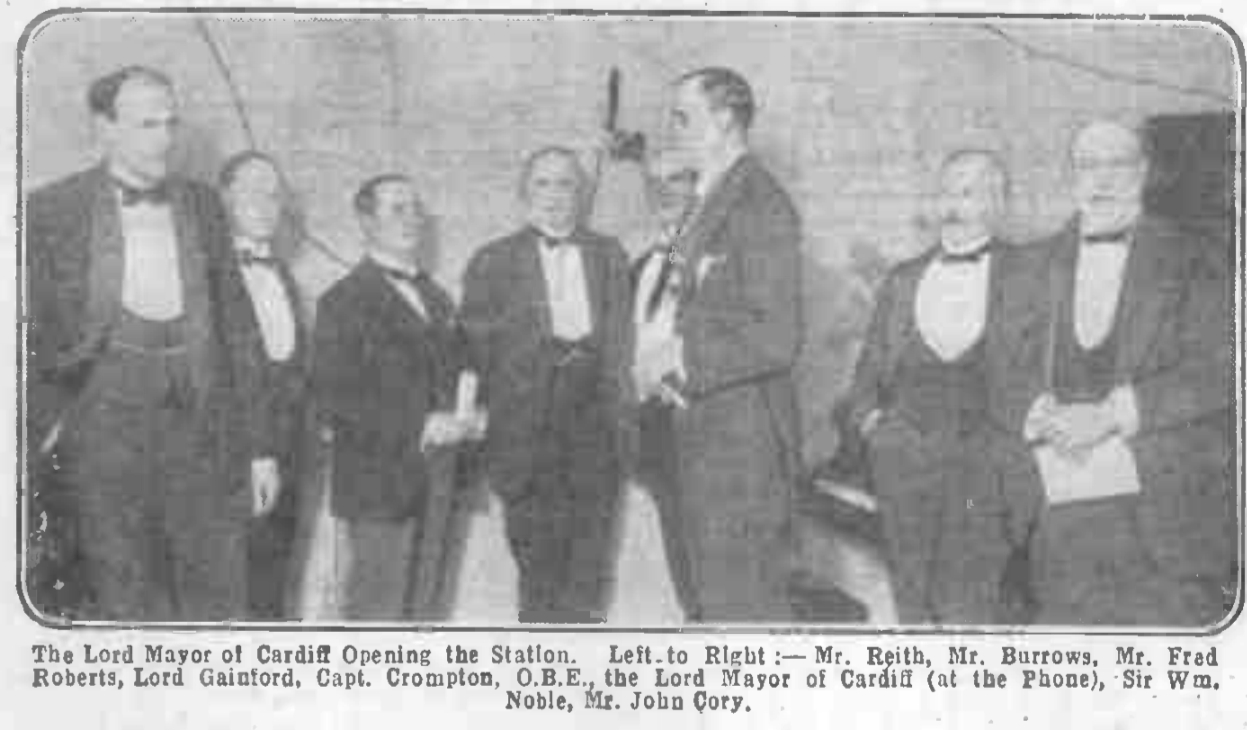
Broadcasting Company calling”) and speeches from BBC chairman Lord Gainsford,
BBC director Sir William Noble and the Mayor of Cardiff, Alderman Sir John
James Edgerton Biggs, and two news bulletins.
Station 5WA
was the fifth BBC station on air, following 2LO in London, 5IT in Birmingham,
2ZY in Manchester and 5NO on Newcastle. Cardiff was effectively chosen as the
base by a 1922 House of Commons Wireless Sub-Committee which proposed a “number
of radio-telephone broadcasting stations” in areas centred on London, Cardiff,
Plymouth (though in the event this moved to Bournemouth), Birmingham,
Manchester, Newcastle, Glasgow or Edinburgh and Aberdeen. At the time Cardiff
was the most populous city in Wales but still some three decades away from
being declared the capital.
The Castle Street premises are now home to the Mad Dog Brewery & Taproom
One of the
men responsible for getting 5WA on air was Rex Palmer, the BBC’s sixth employee
who would become station director of 2LO. ‘Uncle Rex’ was sent over from London
to find the accommodation, where he leased that studio space at 19 Castle
Street. The first station director, appointed by Director of Programmes Arthur
Burrows at the end of January, was Frederick Roberts, a well know local musician
and conductor. (2) It was Fred that would conduct the orchestra and read those
children’s stories on the opening night. However, after the station went on air
he lasted just 48 hours, dismissed after being found drunk in his office,
presumably still enjoying the launch party hospitality! To steady the ship both
Palmer and then Cecil Lewis (‘Uncle Caractacus’ on 2LO’s Children’s Hour) were sent out from London. From 26 March a new
station director had been appointed, yet another ex-military type as so many
where in the early days of the BBC, a Major Arthur Corbett-Smith.
Corbett-Smith
would bring considerable imagination and flair to the station but his
“distinctive outlook towards broadcasting” would ultimately see him moved back
to London when the BBC bigwigs became more concerned about standardisation and
formality.
Born in Cheltenham
in 1879 and educated at Winchester and Christ Church College, Oxford Corbett-Smith
had a colourful working career before becoming an artillery officer in the
First World War. Those jobs included being called to the Bar (Middle Temple)
and deputy secretary to the Shanghai Municipal Council. His time in China would
prove useful when he provided background assistance for the 1913-14 production
of the Anglo-Chinese play Mr Wu at London’s
Strand Theatre. (3) He lectured on Public Health Law – his father had been a
leading public health reformer – and in 1914 published the book The Problem of the Nations: A Study in the
Causes, Symptoms and Effects of Sexual Disease, and the Education of the
Individual therein. Post-war he wrote a number of military history books
about the conflict and was the director of publicity for the British National
Opera where he produced a number of National Opera Handbooks. No wonder that
his Who’s Who entry listed his
recreation as ‘change of work’.
He had
married Neath-born Tessie Thomas, a violinist of some renown, in 1921. She was
the daughter of conductor Oscar Thomas who, under the name Oliver Raymond,
would go on to conduct the 5WA Station Symphony Orchestra. The Corbett-Smiths
had one son and one daughter.
As 5WA
station director Corbett-Smith saw his role as “to energise and innovate”.
Assisting him was his deputy, and programme announcer, Norman Settle. Whereas
other stations would offer ‘talks’ the Cardiff station broadcast ‘chats’. So
there was, for example, a Chat on
Gardening, Chat on Bees and Bee-Keeping, Chat on Wireless for Amateurs, and even a Chat on "Five Minutes Exercise for the Busy Man". The
station greeting was changed from “Hullo Everybody” to the less formal “Hullo
Comradios” or even “Cymradios”. Like all BBC stations they adopted a Children’s Hour but this was later
billed as Hour of the Kiddiewinks. (4)
Corbett-Smith
would himself take to the microphone with a regular series of chats in which Mr Everyman Looks at the World. In
addition, showing a pioneering zeal, he would do some of the continuity
announcing, present Children’s Hour,
conduct the orchestra, act (including, unlikely as it seems, appearing as Romeo
in a re-enactment of the Balcony Scene alongside Marjory Unett as Juliet),
produce and direct adaptations of an astounding twenty Shakespeare plays
performed by the ‘Station Repertory Company’ and even write Elizabeth, a one act opera. He also
composed the Cardiff Station March known as Comradios
under the alias Aston Tyrrold (a number of his compositions use this name). He
truly was 5WA’s everyman.
The station
also ran a regular Women’s Hour (albeit
running for 30 minutes). Corbett-Smith would later write that he was an
advocate of more women being involved in broadcasting which might in turn
encourage more to listen. Of the female listener he reckoned: “A radio
item, even more than a good gramophone record, demands concentration in the
listener. Women do not concentrate; except in the things which really matter to
them-such as motherhood (sometimes), their men folk, dress, and care of the
person”. However he laid this lack of engagement as the door of the
predominantly male broadcasters: “since radio, both in manner and in matter, is
so patently lacking in personality and vivid human interest, it is only natural
that woman should find in it little to interest her”. (Modern Wireless
November 1928)
BBC chiefs and civic dignitaries gather for the launch of 5WA
Station 5WA and
had regular theme nights and there was an ambitious and strong emphasis on live
classical music with performances devoted to composers ranging from Beethoven
to Wagner. Writing in the Musical News
and Herald a year before joining the BBC, Corbett-Smith had declared that
“every town should make an effort to form (an orchestra). Good music is not a
luxury but a necessity.”
Popular
music was not neglected so listeners could also hear the likes of Viona’s
Syncopated Banjo Trio, the Cymmer Colliery Military Band and regular programmes
of dance music. An early radio feature, The
Magic Carpet, was broadcast over 19 weeks long before the BBC started a
Features Department. It mixed speech, song and music with the idea being that
listeners would take an audio magic carpet ride to different countries
‘piloted’ each week by a presenter or expert on that country with appropriate
musical accompaniment from the studio orchestra. The 1924 series was, said the Radio Times, “highly popular”.
There’s no
doubt that Corbett-Smith’s approach was noted at BBC headquarters. In Broadcasting from Within Cecil Lewis described
him as having a personality and determination that “have resulted in a high level
of programmes being transmitted from that station, which have assumed a
particular character somewhat different from those of other stations, owing to
the wide experience and artistic qualifications of their director”.
The musicians and singers performing the opening concert
In 1923 it
was not possible to receive programmes by line from London until the late
summer of that year, so all early programmes were locally produced. The first outside
broadcasts, starting in June 1923, were from the Capitol Cinema with the
Orchestra conducted by Lionel Falkman. (5) These afternoon programmes, heard 4
or 5 times a week, ran until May 1926. The engineer tasked with broadcasting
the music would switch on his control room equipment, go down to the Capitol
Cinema (about a 5 minute walk away) and switch on the amplifier and microphone
to announce the opening and then go off to the auditorium to watch the film,
popping back to make the closing announcement.
Notable in
these early broadcasts was the absence of spoken Welsh. Welsh songs and music
were plentiful and filled the schedules but virtually all the speech was
English. This situation persisted under the next station director, Ernest
Appleton, who, although claiming to be fluent in the language, was reluctant to
permit spoken Welsh on the station. In the 1928 BBC Handbook, he rather pointedly writes: “At present various prominent
people in Wales are striving to influence broadcasting, but unfortunately they
are often divided against themselves”.
By the end
of 1923 land lines between the BBC stations were now well established allowing
for the Simultaneous Broadcast of programmes from one station by another,
though programmes from London dominated. With BBC management increasingly
wishing to stamp a corporate approach across the network some of what were seen
as eccentric decisions of Corbett-Smith were frowned upon. In Reith’s words
what was important was “the periodic supervision of stations, the inspection on
the spot, the rooting down to all details and the setting matters right”. In
his mind “only persons of distinction should be allowed to broadcast”. There
was also some criticism of the station’s output in the local Welsh press though
the Major dismissed this: “We don’t care two little pins for that”.
Some of the BBC staff at Savoy Hill with Corbett-Smith pictured bottom-left
In March
1924 – weeks before 5WA moved into larger premises at 39 Park Place – and just
a year after his appointment, Corbett-Smith was encouraged to move back to
London and offered a central role as Artist Director. At 5WA chats were again
talks and “kiddiewinks and comradios were consigned to oblivion”. A later BBC
review noted that Corbett-Smith’s “exuberant personality was found to be a
little overwhelming for a Station Director’s post”.
According to
Peter Eckersley (the BBC’s first Chief Engineer and yet another creative
maverick) “Corbett-Smith was asked to come to Head Office, where he would have
more scope” but that “the scope was, in fact, curiously limited so he left.” Arthur Burrows, more diplomatically said “he
was called to London to undertake more specialised work”. (6) Reith would write
that the first choice of Station Directors had to be “a matter of trial and
error” and that many mistakes were made.
Whilst
Artistic Director, Corbett-Smith did concern himself with a couple of
significant areas of programme policy. On the matter of classical music he
issued a memorandum with this call to action: “we pour out a mass of
educational matter, of talks by notable authorities, of noble music. But all
this remains a misshapen and unwieldy mass, with no steady driving force behind
it directed towards a definite end”. On the hugely popular Children’s Hour programmes he issued some of the first guidance on
how to present to children. He warned that “Buffoonery and noisy ensemble
talking must not be permitted” and that presenters should be natural and not
talk down to children. A story should be told and not read out, so the
presenter was advised to adapt the script themselves to ensure their
personality came through. He recommended only expert artists be used and that BBC
officials should not do it for their own amusement. An obvious dig at some of
the Uncles and Aunties no doubt. (7)
After only a
few months in post as Artistic Director he moved again in December 1924 to the
BBC’s Intelligence section; nothing to do with espionage but a team concerned
with the criticism of programmes. He was, however, still involved in some
programme-making such as what sounds like an ambitious night’s broadcasting in
September 1924 with Sportsmen All! ‘a
comedy of sporting memories.’ (8) In the summer of 1926 he was back at the
microphone with a series of “Six Radio Recitals with Music” on The Sea Affair and Harry Binns. But by that
September he’d been dismissed by the BBC in view of his “general attitude,
brought to a head during the recent emergency (the General Strike)” and that
“it was decided to dispense with his services as a critic at the earliest
possible moment”.
He would
write about his time in radio in My Radio
Year (1925) and Our Radio Programmes:
What is wrong, and why (1926). In the latter he summarised his thoughts on
the company that had employed him thus: “Those men were all men of note in
commerce and industry, engaged in the manufacture or sale of radio apparatus.
Their interests were wholly industrial or commercial. They began the creation
of a great machine. They created that machine – and a machine it remains: a
machine without a soul. And that is what is wrong with the BBC”.
In the
thirties and forties Corbett-Smith continued to advise on matters of public
health and wrote a number of books ranging from a study of Lord Nelson and a
book of verse (A People’s War) to,
and here demonstrating that no topic was off limits for him, the volume Women: Theme and Variations (9) and
even Love Technique: an introduction.
Apparently
he was in the habit of making periodic announcements in the press about his
imminent suicide. Sadly he did follow up on that threat. In January 1945, aged
65, and by now living in Herne Bay, he shot himself. His note to the police
read: "I've had a very wonderful life, but I'm too old now. . . . I view
with loathing the incidence and stigmata of old age. Age, with rare exceptions,
is repulsive to look upon, and its so-called wisdoms are very problematical.
Every man and woman at the age of 60 should show cause why he or she should
continue to exist. . . ."
So what
happened to pre-war radio in Wales? Briefly this. In December1924 5WA was
joined by the Swansea relay station 5SX, the last of the BBC’s original
stations. By now plans were already in train to move to regional broadcasting,
a plan driven both internally with the desire to rationalise station management
and to better dictate policy from the centre and externally with the need to rationalise
the use of wavelengths under the proposed Geneva Plan (and the later 1929
Prague Plan). Rolling out from 1927, by which time the BBC was now a
Corporation, South Wales would be part of the West Region, under the
directorship of Ernest Appleton, and based in Cardiff – much to the annoyance
of Bristolians on the other side of the channel. Meanwhile North Wales would effectively
come under the Northern Region based in Manchester (though a studio in Bangor
was opened in November 1935). This meant mid-Wales was not actually in a region
at all and left listeners tuning in to the National Programme (5XX) from
Daventry. Eventually, with the opening of a second transmitter at Washford in
Somerset and a new site at Penmon on Anglesey, in July 1937 it was possible to
split off a true Welsh region service. (10)
(1) BBC
Director of Programmes Arthur Burrows recalled that “No amount of shuttering
proved sufficient to cut out the rumbling noises of trams passing below.” The
studio space was small and, according to a contemporary report on the launch “would
not comfortably hold more than the officials, the musicians, and the two or
three guests” Most sources say the studio was above a cinema but Davies quotes a source referring to it being above Mr Kinshot's music shop.
(2) Fred
Roberts was 31 when appointed to the job. He’d served as an Army bandmaster and
was an experienced concert and theatre orchestra conductor. The Roberts Band
was well-known in South Wales and played at dinners, dances and social
functions.
(3) In the
programme for Mr Wu (a play written
by Harold Owen and Harry Vernon) the producer (and actor who played the leading
role) wrote this dedication: “Mr Matheson Lang desires to acknowledge valuable
assistance rendered to him by Mr A. Corbett-Smith in arranging details and
Customs of Chinese life of the present day in Hong Kong.” Corbett-Smith would
also write about The Chinese and Their
Music for the September 1912 edition of The
Musical Times.
(4) Later as
Artistic Director for the BBC he would write in a memo on Children’s Hour that “to adopt a tone of superiority or aloofness is
to court immediate disaster”
(5) Lionel
Falkman (1892-1963) would later make regular broadcasts (142 in total) with his
Apache Band (formed in 1933) on Music While You Work plus dozens of broadcast on the Forces Programme, Home
Service and Light Programme simply billed as Falkman. The Capitol Theatre was demolished in 1983. The site is
now the Capitol Centre indoor shopping mall.
(6) Writing
further about Corbett-Smith in The Story
of Broadcasting (1924) Burrows described him as follows: “Major
Corbett Smith is one of the new -comers to headquarters, but is one of the
senior officials of the company, having spent over a year at Cardiff as
director of the Cardiff station. It was evident from the outset that Major
Corbett Smith had a distinctive outlook towards broadcasting and an unusual
variety of interests, ranging from music, art, and literature to things naval
and military. As the programmes developed so it became evident that an artistic
director was needed to clothe ideas in appropriate garments and to link
harmoniously together the variety of material which is usually to be found in a
night's broadcast entertainment. Major Corbett Smith is a strong believer in
continuity programmes on special occasions, and has backed his faith by
producing feature nights on festivals such as Empire Day. These programmes bear
the same relation to broadcasting as the old diorama did to other contemporary
forms of entertainment. Major Corbett Smith's brain is never resting. He finds
recreation in writing books and composing operas”.
(8) The Radio Times featured this programme in
its Gossip About Broadcasting page
and at the same time offered yet another glimpse into Corbett-Smith’s past: “With
the atmosphere of an English country house of fine sporting traditions, a
birthday dinner-party, and a dozen or so famous sportsmen round the tables
spinning yarns of old days and singing the famous old songs, there is an
entertainment which should certainly make a wide appeal. Sir Theodore Cook,
Editor of The Field, will be our
host. The programme has been arranged by our Artistic Director, who was by the
way something of a notable sportsman in his younger days and so may be presumed
to know what he is talking about”.
(9)
Publicising this book his publishers claimed that Corbett-Smith had 14
occupations, had written 35 books on 12 subjects and nine musical compositions.
(10)
Washford transmitting station (above) was notable for its garden which used to attract
many summer visitors. The former transmitter hall, control rooms and office
block, a Grade II listed building, is now home to the Tropiquaria Zoo. The site
still transmits DAB services and on AM talkSPORT and Radio Wales. The Penmon
site closed in June 2021.
You can hear
historian John Davies talking about the history of broadcasting in Wales in
this 1994 edition of Meet for Lunch
with Vincent Kane.
I’ve only
scratched the surface about the life of Arthur Corbett-Smith. I know that he
wrote his memoirs, written in the third person, but I’ve not had sight of them.
A copy exists at The British Library.
There’s also
far more to say about 5WA and 5SX. The best source of information is Broadcasting and the BBC in Wales by
John Davies (University of Wales Press, 1994).
The story of
the early history of 5WA is told in a ‘2-part sitcom-documentary’ written by
Gareth Gwynn called The Ministry of Happiness. Part 1 was broadcast last week and Part 2 airs this evening. It
will be available for 30 days on BBC Sounds. Last week Gareth spoke to Mishal Husain on the Today programme.
With thanks
to Dr Andrea Smith and Alan Stafford for their help in tracking down photos of
the Major and to Al Dupres for taking the Cardiff photos. The photos of the station opening come from Popular Wireless Weekly.


.jpg)
.jpg)


.jpg)
.jpg)
.jpg)