.jpg)
Station 5WA
was the fifth BBC station on air, following 2LO in London, 5IT in Birmingham,
2ZY in Manchester and 5NO on Newcastle. Cardiff was effectively chosen as the
base by a 1922 House of Commons Wireless Sub-Committee which proposed a “number
of radio-telephone broadcasting stations” in areas centred on London, Cardiff,
Plymouth (though in the event this moved to Bournemouth), Birmingham,
Manchester, Newcastle, Glasgow or Edinburgh and Aberdeen. At the time Cardiff
was the most populous city in Wales but still some three decades away from
being declared the capital.
.jpg) |
| The Castle Street premises are now home to the Mad Dog Brewery & Taproom |
One of the men responsible for getting 5WA on air was Rex Palmer, the BBC’s sixth employee who would become station director of 2LO. ‘Uncle Rex’ was sent over from London to find the accommodation, where he leased that studio space at 19 Castle Street. The first station director, appointed by Director of Programmes Arthur Burrows at the end of January, was Frederick Roberts, a well know local musician and conductor. (2) It was Fred that would conduct the orchestra and read those children’s stories on the opening night. However, after the station went on air he lasted just 48 hours, dismissed after being found drunk in his office, presumably still enjoying the launch party hospitality! To steady the ship both Palmer and then Cecil Lewis (‘Uncle Caractacus’ on 2LO’s Children’s Hour) were sent out from London. From 26 March a new station director had been appointed, yet another ex-military type as so many where in the early days of the BBC, a Major Arthur Corbett-Smith.
Corbett-Smith
would bring considerable imagination and flair to the station but his
“distinctive outlook towards broadcasting” would ultimately see him moved back
to London when the BBC bigwigs became more concerned about standardisation and
formality.
Born in Cheltenham
in 1879 and educated at Winchester and Christ Church College, Oxford Corbett-Smith
had a colourful working career before becoming an artillery officer in the
First World War. Those jobs included being called to the Bar (Middle Temple)
and deputy secretary to the Shanghai Municipal Council. His time in China would
prove useful when he provided background assistance for the 1913-14 production
of the Anglo-Chinese play Mr Wu at London’s
Strand Theatre. (3) He lectured on Public Health Law – his father had been a
leading public health reformer – and in 1914 published the book The Problem of the Nations: A Study in the
Causes, Symptoms and Effects of Sexual Disease, and the Education of the
Individual therein. Post-war he wrote a number of military history books
about the conflict and was the director of publicity for the British National
Opera where he produced a number of National Opera Handbooks. No wonder that
his Who’s Who entry listed his
recreation as ‘change of work’.
He had
married Neath-born Tessie Thomas, a violinist of some renown, in 1921. She was
the daughter of conductor Oscar Thomas who, under the name Oliver Raymond,
would go on to conduct the 5WA Station Symphony Orchestra. The Corbett-Smiths
had one son and one daughter.
As 5WA
station director Corbett-Smith saw his role as “to energise and innovate”.
Assisting him was his deputy, and programme announcer, Norman Settle. Whereas
other stations would offer ‘talks’ the Cardiff station broadcast ‘chats’. So
there was, for example, a Chat on
Gardening, Chat on Bees and Bee-Keeping, Chat on Wireless for Amateurs, and even a Chat on "Five Minutes Exercise for the Busy Man". The
station greeting was changed from “Hullo Everybody” to the less formal “Hullo
Comradios” or even “Cymradios”. Like all BBC stations they adopted a Children’s Hour but this was later
billed as Hour of the Kiddiewinks. (4)

Corbett-Smith would himself take to the microphone with a regular series of chats in which Mr Everyman Looks at the World. In addition, showing a pioneering zeal, he would do some of the continuity announcing, present Children’s Hour, conduct the orchestra, act (including, unlikely as it seems, appearing as Romeo in a re-enactment of the Balcony Scene alongside Marjory Unett as Juliet), produce and direct adaptations of an astounding twenty Shakespeare plays performed by the ‘Station Repertory Company’ and even write Elizabeth, a one act opera. He also composed the Cardiff Station March known as Comradios under the alias Aston Tyrrold (a number of his compositions use this name). He truly was 5WA’s everyman.
The station
also ran a regular Women’s Hour (albeit
running for 30 minutes). Corbett-Smith would later write that he was an
advocate of more women being involved in broadcasting which might in turn
encourage more to listen. Of the female listener he reckoned: “A radio
item, even more than a good gramophone record, demands concentration in the
listener. Women do not concentrate; except in the things which really matter to
them-such as motherhood (sometimes), their men folk, dress, and care of the
person”. However he laid this lack of engagement as the door of the
predominantly male broadcasters: “since radio, both in manner and in matter, is
so patently lacking in personality and vivid human interest, it is only natural
that woman should find in it little to interest her”. (Modern Wireless
November 1928)
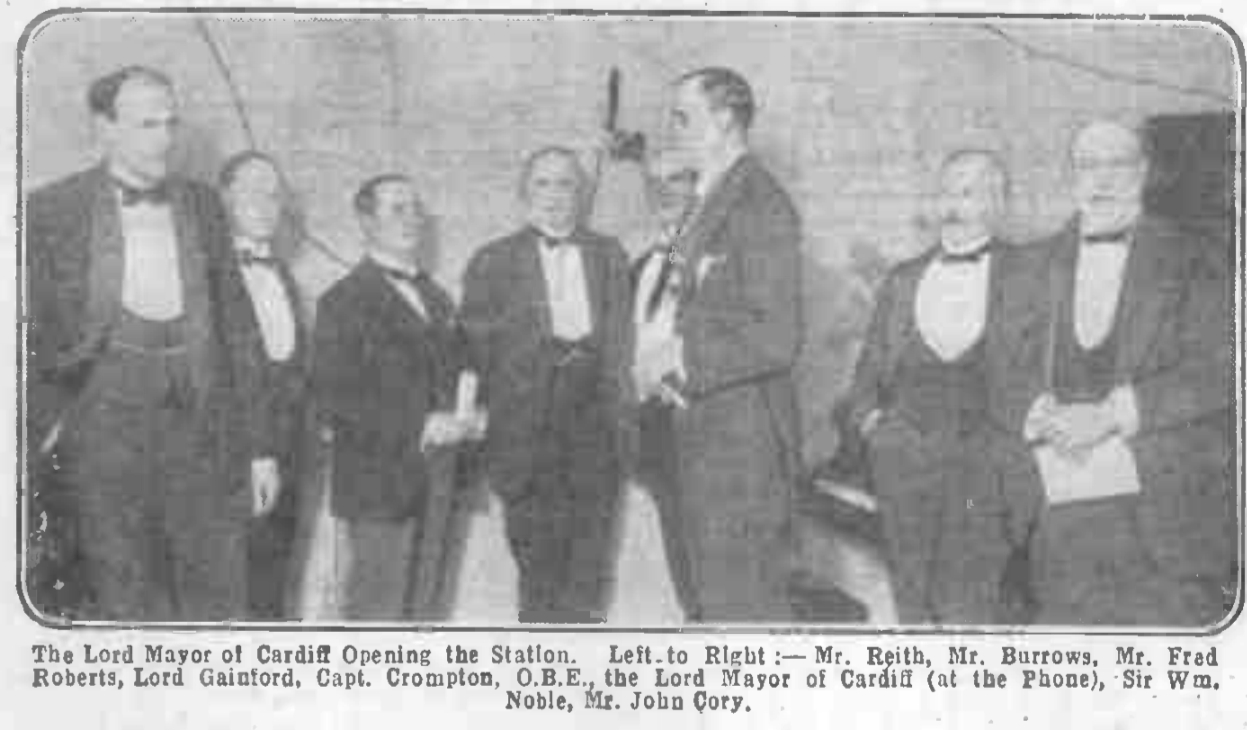 |
| BBC chiefs and civic dignitaries gather for the launch of 5WA |
Station 5WA and had regular theme nights and there was an ambitious and strong emphasis on live classical music with performances devoted to composers ranging from Beethoven to Wagner. Writing in the Musical News and Herald a year before joining the BBC, Corbett-Smith had declared that “every town should make an effort to form (an orchestra). Good music is not a luxury but a necessity.”
Popular
music was not neglected so listeners could also hear the likes of Viona’s
Syncopated Banjo Trio, the Cymmer Colliery Military Band and regular programmes
of dance music. An early radio feature, The
Magic Carpet, was broadcast over 19 weeks long before the BBC started a
Features Department. It mixed speech, song and music with the idea being that
listeners would take an audio magic carpet ride to different countries
‘piloted’ each week by a presenter or expert on that country with appropriate
musical accompaniment from the studio orchestra. The 1924 series was, said the Radio Times, “highly popular”.
There’s no
doubt that Corbett-Smith’s approach was noted at BBC headquarters. In Broadcasting from Within Cecil Lewis described
him as having a personality and determination that “have resulted in a high level
of programmes being transmitted from that station, which have assumed a
particular character somewhat different from those of other stations, owing to
the wide experience and artistic qualifications of their director”.
 |
| The musicians and singers performing the opening concert |
In 1923 it was not possible to receive programmes by line from London until the late summer of that year, so all early programmes were locally produced. The first outside broadcasts, starting in June 1923, were from the Capitol Cinema with the Orchestra conducted by Lionel Falkman. (5) These afternoon programmes, heard 4 or 5 times a week, ran until May 1926. The engineer tasked with broadcasting the music would switch on his control room equipment, go down to the Capitol Cinema (about a 5 minute walk away) and switch on the amplifier and microphone to announce the opening and then go off to the auditorium to watch the film, popping back to make the closing announcement.
Notable in
these early broadcasts was the absence of spoken Welsh. Welsh songs and music
were plentiful and filled the schedules but virtually all the speech was
English. This situation persisted under the next station director, Ernest
Appleton, who, although claiming to be fluent in the language, was reluctant to
permit spoken Welsh on the station. In the 1928 BBC Handbook, he rather pointedly writes: “At present various prominent
people in Wales are striving to influence broadcasting, but unfortunately they
are often divided against themselves”.
By the end
of 1923 land lines between the BBC stations were now well established allowing
for the Simultaneous Broadcast of programmes from one station by another,
though programmes from London dominated. With BBC management increasingly
wishing to stamp a corporate approach across the network some of what were seen
as eccentric decisions of Corbett-Smith were frowned upon. In Reith’s words
what was important was “the periodic supervision of stations, the inspection on
the spot, the rooting down to all details and the setting matters right”. In
his mind “only persons of distinction should be allowed to broadcast”. There
was also some criticism of the station’s output in the local Welsh press though
the Major dismissed this: “We don’t care two little pins for that”.
 |
| Some of the BBC staff at Savoy Hill with Corbett-Smith pictured bottom-left |
In March 1924 – weeks before 5WA moved into larger premises at 39 Park Place – and just a year after his appointment, Corbett-Smith was encouraged to move back to London and offered a central role as Artist Director. At 5WA chats were again talks and “kiddiewinks and comradios were consigned to oblivion”. A later BBC review noted that Corbett-Smith’s “exuberant personality was found to be a little overwhelming for a Station Director’s post”.
According to
Peter Eckersley (the BBC’s first Chief Engineer and yet another creative
maverick) “Corbett-Smith was asked to come to Head Office, where he would have
more scope” but that “the scope was, in fact, curiously limited so he left.” Arthur Burrows, more diplomatically said “he
was called to London to undertake more specialised work”. (6) Reith would write
that the first choice of Station Directors had to be “a matter of trial and
error” and that many mistakes were made.
Whilst
Artistic Director, Corbett-Smith did concern himself with a couple of
significant areas of programme policy. On the matter of classical music he
issued a memorandum with this call to action: “we pour out a mass of
educational matter, of talks by notable authorities, of noble music. But all
this remains a misshapen and unwieldy mass, with no steady driving force behind
it directed towards a definite end”. On the hugely popular Children’s Hour programmes he issued some of the first guidance on
how to present to children. He warned that “Buffoonery and noisy ensemble
talking must not be permitted” and that presenters should be natural and not
talk down to children. A story should be told and not read out, so the
presenter was advised to adapt the script themselves to ensure their
personality came through. He recommended only expert artists be used and that BBC
officials should not do it for their own amusement. An obvious dig at some of
the Uncles and Aunties no doubt. (7)
After only a
few months in post as Artistic Director he moved again in December 1924 to the
BBC’s Intelligence section; nothing to do with espionage but a team concerned
with the criticism of programmes. He was, however, still involved in some
programme-making such as what sounds like an ambitious night’s broadcasting in
September 1924 with Sportsmen All! ‘a
comedy of sporting memories.’ (8) In the summer of 1926 he was back at the
microphone with a series of “Six Radio Recitals with Music” on The Sea Affair and Harry Binns. But by that
September he’d been dismissed by the BBC in view of his “general attitude,
brought to a head during the recent emergency (the General Strike)” and that
“it was decided to dispense with his services as a critic at the earliest
possible moment”.
He would
write about his time in radio in My Radio
Year (1925) and Our Radio Programmes:
What is wrong, and why (1926). In the latter he summarised his thoughts on
the company that had employed him thus: “Those men were all men of note in
commerce and industry, engaged in the manufacture or sale of radio apparatus.
Their interests were wholly industrial or commercial. They began the creation
of a great machine. They created that machine – and a machine it remains: a
machine without a soul. And that is what is wrong with the BBC”.
In the
thirties and forties Corbett-Smith continued to advise on matters of public
health and wrote a number of books ranging from a study of Lord Nelson and a
book of verse (A People’s War) to,
and here demonstrating that no topic was off limits for him, the volume Women: Theme and Variations (9) and
even Love Technique: an introduction.
Apparently
he was in the habit of making periodic announcements in the press about his
imminent suicide. Sadly he did follow up on that threat. In January 1945, aged
65, and by now living in Herne Bay, he shot himself. His note to the police
read: "I've had a very wonderful life, but I'm too old now. . . . I view
with loathing the incidence and stigmata of old age. Age, with rare exceptions,
is repulsive to look upon, and its so-called wisdoms are very problematical.
Every man and woman at the age of 60 should show cause why he or she should
continue to exist. . . ."
So what
happened to pre-war radio in Wales? Briefly this. In December1924 5WA was
joined by the Swansea relay station 5SX, the last of the BBC’s original
stations. By now plans were already in train to move to regional broadcasting,
a plan driven both internally with the desire to rationalise station management
and to better dictate policy from the centre and externally with the need to rationalise
the use of wavelengths under the proposed Geneva Plan (and the later 1929
Prague Plan). Rolling out from 1927, by which time the BBC was now a
Corporation, South Wales would be part of the West Region, under the
directorship of Ernest Appleton, and based in Cardiff – much to the annoyance
of Bristolians on the other side of the channel. Meanwhile North Wales would effectively
come under the Northern Region based in Manchester (though a studio in Bangor
was opened in November 1935). This meant mid-Wales was not actually in a region
at all and left listeners tuning in to the National Programme (5XX) from
Daventry. Eventually, with the opening of a second transmitter at Washford in
Somerset and a new site at Penmon on Anglesey, in July 1937 it was possible to
split off a true Welsh region service. (10)
(1) BBC
Director of Programmes Arthur Burrows recalled that “No amount of shuttering
proved sufficient to cut out the rumbling noises of trams passing below.” The
studio space was small and, according to a contemporary report on the launch “would
not comfortably hold more than the officials, the musicians, and the two or
three guests” Most sources say the studio was above a cinema but Davies quotes a source referring to it being above Mr Kinshot's music shop.
(2) Fred
Roberts was 31 when appointed to the job. He’d served as an Army bandmaster and
was an experienced concert and theatre orchestra conductor. The Roberts Band
was well-known in South Wales and played at dinners, dances and social
functions.
(3) In the
programme for Mr Wu (a play written
by Harold Owen and Harry Vernon) the producer (and actor who played the leading
role) wrote this dedication: “Mr Matheson Lang desires to acknowledge valuable
assistance rendered to him by Mr A. Corbett-Smith in arranging details and
Customs of Chinese life of the present day in Hong Kong.” Corbett-Smith would
also write about The Chinese and Their
Music for the September 1912 edition of The
Musical Times.
(4) Later as
Artistic Director for the BBC he would write in a memo on Children’s Hour that “to adopt a tone of superiority or aloofness is
to court immediate disaster”
(5) Lionel
Falkman (1892-1963) would later make regular broadcasts (142 in total) with his
Apache Band (formed in 1933) on Music While You Work plus dozens of broadcast on the Forces Programme, Home
Service and Light Programme simply billed as Falkman. The Capitol Theatre was demolished in 1983. The site is
now the Capitol Centre indoor shopping mall.
(6) Writing further about Corbett-Smith in The Story of Broadcasting (1924) Burrows described him as follows: “Major Corbett Smith is one of the new -comers to headquarters, but is one of the senior officials of the company, having spent over a year at Cardiff as director of the Cardiff station. It was evident from the outset that Major Corbett Smith had a distinctive outlook towards broadcasting and an unusual variety of interests, ranging from music, art, and literature to things naval and military. As the programmes developed so it became evident that an artistic director was needed to clothe ideas in appropriate garments and to link harmoniously together the variety of material which is usually to be found in a night's broadcast entertainment. Major Corbett Smith is a strong believer in continuity programmes on special occasions, and has backed his faith by producing feature nights on festivals such as Empire Day. These programmes bear the same relation to broadcasting as the old diorama did to other contemporary forms of entertainment. Major Corbett Smith's brain is never resting. He finds recreation in writing books and composing operas”.
(7) For more
on this see The BBC and the Child RadioListener in the 1920s by Zara Healy.
(8) The Radio Times featured this programme in
its Gossip About Broadcasting page
and at the same time offered yet another glimpse into Corbett-Smith’s past: “With
the atmosphere of an English country house of fine sporting traditions, a
birthday dinner-party, and a dozen or so famous sportsmen round the tables
spinning yarns of old days and singing the famous old songs, there is an
entertainment which should certainly make a wide appeal. Sir Theodore Cook,
Editor of The Field, will be our
host. The programme has been arranged by our Artistic Director, who was by the
way something of a notable sportsman in his younger days and so may be presumed
to know what he is talking about”.
(9)
Publicising this book his publishers claimed that Corbett-Smith had 14
occupations, had written 35 books on 12 subjects and nine musical compositions.

(10) Washford transmitting station (above) was notable for its garden which used to attract many summer visitors. The former transmitter hall, control rooms and office block, a Grade II listed building, is now home to the Tropiquaria Zoo. The site still transmits DAB services and on AM talkSPORT and Radio Wales. The Penmon site closed in June 2021.
You can hear
historian John Davies talking about the history of broadcasting in Wales in
this 1994 edition of Meet for Lunch
with Vincent Kane.
I’ve only
scratched the surface about the life of Arthur Corbett-Smith. I know that he
wrote his memoirs, written in the third person, but I’ve not had sight of them.
A copy exists at The British Library.
There’s also
far more to say about 5WA and 5SX. The best source of information is Broadcasting and the BBC in Wales by
John Davies (University of Wales Press, 1994).
The story of
the early history of 5WA is told in a ‘2-part sitcom-documentary’ written by
Gareth Gwynn called The Ministry of Happiness. Part 1 was broadcast last week and Part 2 airs this evening. It
will be available for 30 days on BBC Sounds. Last week Gareth spoke to Mishal Husain on the Today programme.
With thanks
to Dr Andrea Smith and Alan Stafford for their help in tracking down photos of
the Major and to Al Dupres for taking the Cardiff photos. The photos of the station opening come from Popular Wireless Weekly.