Showing posts with label Radio Drama. Show all posts

Friday, 4 July 2025

Notes in her Diary


For twenty one year millions of radio listeners were enthralled by the revelations, both mundane and sensational, contained within the pages of Mrs Dale’s Diary. The daily serial revolving around the family and friends of Mary Dale and her doctor husband Jim was one of the BBC Light Programme’s best remembered programmes. 

Mrs Dale’s Diary wasn’t the first soap opera on the Light, that honour fell to The Robinson Family (later The Robinsons), the peacetime version of the Front Line Family (see my April 2025 blog post On the Front Line with the Robinsons). Head of Drama Val Gielgud was keen to replace the Robinsons and “start up a completely new family with a different set of actors and scriptwriters, and if possible a rather less tepid approach.” Mind you he was never happy with the result, labelling it “dramatically inept and sociologically corrupting”. The listeners, however, loved it with over six million (1) tuning it at its peak. It was also a favourite in the Royal household, with Princess Margaret claiming to be a fan and the Queen Mother listening in as “it was the only way to hear what goes on in a middle class family”. The programme became a byword for cosy middle class domesticity and Mrs Dale imploring that she was always “worried about Jim” was a national catchphrase    

When the serial started the plot outlines, main characters and scripts were provided by Ted Willis (under the pseudonym John Bishop) and Jonquil Antony. “It was the BBC’s own idea”, said Antony, “they just handed us a piece of paper saying they wanted a doctor, his wife, son and daughter-in-law. We went on from there.”

Virginia Lodge illustrated in the 
Radio Times 3 January 1958

The first episode aired on the Light Programme on Monday 5 January 1948. The Radio Times painted a picture of what listener’s could expect:

Meet the Dales ...the new radio family (Dr Dale, his wife Mary, their son Bob, and their daughter Gwen) makes its debut at four o’clock on Monday and thereafter its adventures will be broadcast at the same time each day from Mondays to Fridays inclusive under the title Mrs Dale’s Diary.

The Dales live in a cosy house in Kenton, Middlesex, where Dr Dale has been a GP for the last twenty-five years. Bob Dale is twenty-two and just demobilised from the Army; his sister Gwen is three years younger and works in an office in London. Others in the family whom listeners will hear from time to time are Mrs Dale’s sister Sally (a completely contrasting character to Mrs Dale and always a welcome visitor), Katherine Mackintosh, the doctor’s Scots dispenser, Mrs Freeman, Mrs Dale’s mother, who lives nearby, and Mrs Morgan, the domestic ‘help’.

Cleland Finn tells us that for the assistance of the script writers, Jonquil Antony and John Bishop (both of whom had a hand in The Robinsons), the Dale family have been ‘documented’ in great detail – even down to Mrs Dale’s waist measurement!

Heading the cast as Mary Dale was Ellis Powell and as Jim Dale, Douglas Burbridge. Both had appeared in The Robinsons, Ellis as Mrs Williams and Douglas as the narrator. Courtney Hope was Mary’s mother Rosemary Freeman who Jim always referred to “mother in law”. Billy Thatcher was Bob and Virginia Hewett the first Gwen. As the Dales were obviously  well off they also employed a daily help, Mrs Morgan played by Grace Allardyce, and there was also Monument the gardener played by Charles Lamb. Needless to say over the 21 year run the actors came and went and some characters were played by a number of people. Within four years Billy Thatcher had been succeeded by Hugh Latimer, Derek Hart and then Leslie Heritage. In quick succession Gwen was played by Joan Newell and then Beryl Calder, who, in 1951 got married just a month before her character did. Dorothy Lane appeared in the most episodes, originally as one of Dr Dale’s patients from episode seven and then cast as Mrs Freeman when Courtney Hope left after a year or so. She stayed with the serial right through to the last one in 1969.

Even the main character of Dr Dale was played by three actors with James Dale taking over from Douglas Burbridge, who left due to ill health, in June 1954 and finally Charles Simon from 1963. Famously Ellis Powell was replaced as Mrs Dale by Jessie Matthews. More on that anon. (2)

Ellis Powell

The premise of the programme was that Mary Dale was reading excerpts from her diary, acting as a narrator for the listener and thereby introducing the next scene or set of scenes. In this episode, number 162 from 23 August 1948, which is the oldest surviving episode, the Dales are sorting out their house in Kenton ready to make the move to a house called Virginia Lodge in the fictional suburb of Parkwood Hill but Mrs Dale is being overzealous with clearing out.

Very few editions of the programme are in the BBC Sound Archives with numbers in just single figures for Mrs Dale’s Diary and similarly for The Dales, which includes the last full week’s episodes. One that was retained was this episode, number 2548, from January 1958 in which Mrs Dale looks back at past events, in this case what happened in 1954 and 1955. There were similar episodes for other years across the week but for whatever reason this recording was kept.  

Another one that was retained is this oddity, episode 3272, which I uploaded in 2021 and dated as 1 November 1960. Given that Mary Dale refers to the election of JFK as President which happened the following week, I can only assume that the BBC’s date refers to when it was recorded. I also assume they recorded an alternative opening should Nixon have won. Anyway, in this episode Aunt Hestor visits from Canada. Listen out for some decidedly dodgy accents!

In those early years the storylines ranged from Bob joining the TAs, Gwen’s on/off marriage and Mrs Freeman’s car accident to Monument mistaking weed killer for fertiliser and killing off the strawberries, Angeline the goat munching its way through the neighbours flowers and veg plot and a roll of wallpaper being  stolen. When the serial decided to get ‘with it’ in the Sixties the storylines hotted up and listeners hear more about medical matters (from mumps to smear tests and cerebral palsy), adultery, a train crash, death by careless driving and , controversially for the time in 1967, Sally’s husband Richard suddenly coming out as gay. Actors were encouraged to drop the frightfully clipped accents and open up their vowels  

Ted Willis left after the first block of scripts had been delivered and the bulk of the writing fell to Jonquil Antony (who continued to work on the programme until 1963) and three other women who were recruited: Melissa Wood, Lesley Wilson and Joan Carr Jones. This team produced all the scripts for the first five years but in 1953 the BBC was already proposing that the serial be “more topical, up-to-date and outward looking”. The lead time between script completion and recording was cut in half, a new producer, Antony Kearey, was appointed and, when Lesley Wilson went on maternity leave, actor and playwright Basil Dawson was drafted in. He’d previously written for Dick Barton-Special Agent and he told the press at the time:  “The BBC tell me that they want the man’s angle on Mrs Dale’s Diary and I’m going to model the men on real life people.”

When Dawson left two years later Robert Turley joined the writing team. In 1954-55 Hazel Adair was also writing scripts, she’d go on to create the TV soaps Compact and Crossroads. Some now well-known names submitted test scripts to the production team. In 1953 Doris Lessing had a go but it was rejected as “a bit strong for domestic drama”. In 1964 producer Keith Williams was trying to promote new writers and Tom Stoppard wrote five scripts, these were also rejected but Jill Hyem’s showed promise and she joined the team. Both Jill and another Dales writer Alan Downer would create the programme’s successor Waggoner’s Walk. 

Radio Times billing for Mrs Dale Looks Back
6 January 1958

Whilst there was plenty of drama in Mary Dale’s diary, in the early Sixties there was even greater drama behind the scenes at Broadcasting House. In February 1962 it was reported that Mrs Dale and her husband were moving out of the middle class suburb of Parkwood Hill to the fictional bustling industrial town of Exton some 35 miles north of London in “an attempt to knock the snobbery out of the Dales.” The move came about because Dr Dale had secured employment at a group practice and would also attend an industrial health clinic. Initially Mary was not enamoured of Exton: “Oh Jim, what a place. I can smell the soot in the air. We could never live in a place like this-it’s grey and dirty”. (3)

On 26 February 1962 Mrs Dale’s Diary became The Dales. The Radio Times explained the changes:

Listeners will notice that this week’s Mrs Dales Diary becomes The Dales. It is now fourteen years since Mrs Dale first began a diary to keep listeners up to date with the affairs of the family and neighbourhood.

On consideration it has been decided that a change in the manner of narrating the story as it develops will give the writers greater flexibility in introducing listeners to fresh aspects of the Dales’ life. Already many regular listeners who write to the BBC about this famous radio family refer to them as ‘The Dales’.

So, in future, instead of the ‘diary’ opening an announcer will introduce each episode; and the change will be marked by a new signature tune.

That new signature tune was written by Johnny Dankworth and played by his Septet. It replaced the harp glissando played by Marie Goossens that had been in use from the start, Dankworth’s jazz-like composition included a nod to the original at the end. The new theme was not universally liked and the BBC dropped it in July and instead used part of Dance in the Twilight by Eric Coates played by the BBC Concert Orchestra conducted by Vilem Tausky. I don’t have a copy of that recording so in the sequence below I’ve used a much later version played by the Concert Orchestra under the direction of John Wilson. From January 1964 a new specially written theme from Ron Grainer was introduced played by an ‘ad hoc combination’ and used for the remainder of the run.

There was more drama to come in February 1963 with the shock news that both Ellis Powell and James Dale had been dropped from the programme. Before his days as a television dramatist Dennis Potter wrote for the Daily Herald and on 20 February 1963 he had this to say:

Britain’s best known privet hedge could not shield The Dales from the wind of change that is blowing through the BBC. That’s why Mrs Dale (real name Ellis Powel, aged 56) and Dr Dale (actor James Dale, 77 next week) were unceremoniously sacked from the famous radio serial yesterday. They were summoned to the office of the BBC’s head of sound drama, Mr Val Gielgud...and they left with six months tax-free pay and no job.

Mrs Mary Dale was told: “Sorry, but we are making re-adjustments to the programme.” She had played the part since the serial began 15 years ago. Dr Jim Dale was told: “Sorry, but you are too old for the part.” He had been in it for nine years.

In the serial the Dales have just flown off to America. (4) While they are away listeners will have a chance to forget what they sound like.

Why did the BBC put the Dales on a plane, and then drop them overboard? It is not like the old BBC. But there are new ideas being put about at Broadcasting House by young men in tight trousers and brown suede shows. These young men felt increasingly uncomfortable about Mrs Dale. They thought it was like having Queen Victoria to tea. They did not like her cosy, middle-class pleasantries with harmlessly banal tittle-tattle.

As a first step Mrs Dale’s Diary was renamed The Dales and turned into a superior kind of Archers. The programme was given a modish Johnny Dankworth theme tune –dropped after outraged protests from thousands of listeners-and forced to move from the gentile environs of suburban Parkwood Hill to Exton, an industrial town north of London.

The sackings were not the only change announced yesterday. A new producer has been appointed – 39 years-old script writer and actor Peter Bryant, who was Jack Groves in the Groves Family TV serial. One of The Dales’ principal script writers, Robert Turley, has left and will be replaced by Barbara Clegg.

What happens now to the Dales – or rather the ex-Dales? Said Mr Dale: “It is dreadful to be hoofed out like this after working for the BBC for 27 years and playing Dr Dale for nine.” Miss Powell, whose marriage ended in divorce last June, said: “Perhaps TV will give me a chance. I never tried TV because it could have destroyed the listener’s image of me.”

That divorce was from the actor Ralph Truman. It had been a tempestuous marriage and, according to reports in the Sunday papers some weeks later, “she was a sick woman who drank too much, backed horses and had lovers.” (5)  Now unemployed Ellis Powell signed on at her local unemployment exchange. She was working as a cleaner in a West End hotel and also had the promise of work at her friend Freddie Mills’s new night club and was rehearsing for an episode of Hugh and I, though she was not happy in it and kept forgetting her lines. For some time she had suffered chronic pain from Ménière’s disease and she was taking some prescribed pills and a ‘tonic’ but was also self-medicating with gin and whisky. It was this cocktail that had affected her performance as Mrs Dale. Tragically just 11 weeks after getting the sack Ellis was found unconscious in the Marylebone flat and died in hospital 12 hours later. The official cause of death: ‘Cerebral haemorrhage’. Her son, Clive Truman, claimed that she had “tried to put a brave face about losing the part of Mrs Dale. But I know that she felt it more deeply than anyone could possibly tell”.  

Daily Mirror reports on the sacking of Ellis Powell
and James Dale 20 February 1963

So who would be the new Dr and Mrs Dale? Apparently at least a hundred actors were auditioned and an approach had also been made to Elspeth March (previously married to Stewart Granger) but she demurred. On 7 March 1963 the BBC announced that Mrs Dale would be played by Jessie Matthews and Dr Dale by Charles Simon. Charles Simon was a regular radio actor and had been a member of the BBC Drama Repertory Company. (6) Bagging Jessie Matthews was quite a coup as she was a well-known name having been a theatre and film star in the 1930s and 40s and had something of a colourful personal life. Her most famous role was in the musical Ever Green, the film version of which gave her the song with which she’s most associated, Over My Shoulder. The BBC had to pay extra to get Matthews, whilst Ellis Powell was on £30 a week Jessie was enticed into the studio for £65. 

When Matthews got the role producer Peter Bryant said that “there won’t be any changes – only in the way Jessie Matthews plays her role. Her personality is quite different to that of the previous Mrs Dale.” The first appearance of the new couple was on March 18 1963. In the first half-hour after the episode the duty office took just five calls from listeners- three against and two for the new Mrs Dale. Four of them said she sounded too young.

Jessie Matthews

In her 1974 autobiography  titled, naturally enough, Over My Shoulder,  Jessie Matthews makes no secret of her past nervous breakdowns and its seems  that it was her depression  that precipitated the ending of The Dales. Undergoing shock treatment meant that in recordings her lines were underlined in red and Keith Williams, then Head of Serials, had to point to them when it was her time to speak. She was unable to recognise her fellow cast members and she was “too ill to go on at all”.

The axing of The Dales, now broadcast on the Light’s successor Radio 2, was announced in January 1969 with Controller Robin Scott saying “We realise it will mean taking away a slice of life to some people who have followed the serial over 21 years. But we hope listeners will grow to appreciate the new serial just as much”. He added “All things must come to an end and we felt the programme had gone on long enough.” Meanwhile, the scriptwriters were presaging the end of the programme with Dr Dale announcing that he was to give up medicine and retire. In the final weeks only one character was killed off, OJ the odd job man had a heart attack. A total of twenty-three characters appeared in the final instalment.
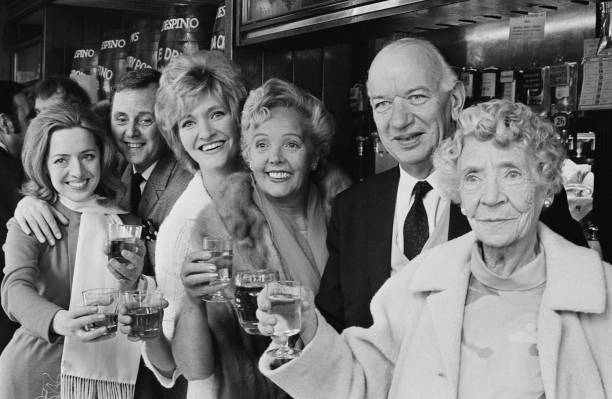
The Dales cast in 1969

On the programme’s demise Jessie Matthews was quoted as saying; “I had a great admiration for Mrs Dale. I could understand why she had such a big following on radio. Now I shall have more time to look around for other work. But it will take time to sink in.” Later, in her autobiography no reason is given for the end of the serial and she reflected : ‘When The Dales came to its untimely end in 1969 I did not feel unduly downcast. I had been playing Mary Dale for six years, but I had guarded against becoming stale by fitting in other jobs both on television and on the stage. Yet it was sad to say goodbye to the company, we felt rather like a family breaking up.’

As for Charles Simon, he said “It has been a very delightful and lucrative job. We have been assured by the BBC that they will offer us plenty of other work”. Leslie Heritage, who played Bob Dale since 1959 said: “As an actor I found the role gave me a great deal of financial security. It did not mean Jaguar cars, but it does mean that when the show ends I won’t starve.”

Original scriptwriter Jonquil Antony, who worked on the drama for 15 years, was of the opinion that “it was about time the programme came off. Some people will be very upset, but they will accept the decision. I can remember when the predecessor to Mrs Dale, The Robinsons, was taken off. There was uproar. But it all died down.”

Jessie Matthews, Charles Simon and 
Dorothy Lane


The axing of The Dales was mentioned in Parliament on 18 April 1969 as part of the discussion on the British Broadcasting Corporation Bill. Liberal MP Peter Bessell had this to say: 

I received a vast number of letters from all over the country supporting my protest, and, although I had anticipated, or at least hoped for, support, I had not dreamt that it would be as widespread, or that The Dales gave so much comfort to the sick and elderly, or that there were so many hundreds, if not thousands, of people in homes and hospitals for whom Mrs. Dale and her family have become a major part of daily life.

But the protests were to no avail and the last episode, number 5,431, aired on Friday 25 April 1969. The final line went to Mrs Dale as she says “One thing that’s never going to change. I shall always worry about you Jim” The following Monday a new kid was on the block with the start of Waggoner’s Walk.  

In 2012 Penelope Keith, herself an avid listener to the serial, spoke to a number of people who’d worked on Mrs Dale’s Diary and The Dales in a programme titled I’m Rather Worried About Jim.

In this programme we hear from radio critic Gillian Reynolds and then Keith Williams who produced The Dales and went on to be head of serials. Producer/directors interviewed are Betty Davies (who’d worked on the programme in the 1950s and 60s) and Jane Morgan who have some lovely gossip about Dorothy Lane who played Mrs Freeman, plus Martin Jenkins and Andrew Sachs who recalls his time directing Jessie Matthews. (7) Actors featured are Shirley Dixon (at least the 5th Jenny Dale), Aline Waites (the 4th Gwen Dale), Peter Baldwin (Corrie’s Derek Wilton) who was a member of the BBC Drama Rep, Elizabeth Proud (Rosie, who famously burnt Mrs Dale’s diary), Gordon Griffin (grandson Billy Owen), Jean Trent (Lois Jackson) and Jim McManus (garage owner Pat Hill). (8). Studio manager Enyd Williams, later a radio drama director, remembers having to create the effect of Mrs Freeman’s cat Captain throwing up. Series writer Jill Hyem recalls the script conferences. (9) I’m Rather Worried About Jim was produced by Angela Hind and was first broadcast on Monday 16 January 2012.  

(1) The 1966 BBC Handbook states that 3.0m heard the afternoon edition and 3.5m the morning repeat

(2) In fact other actors sometimes had to step in to play Dr or Mrs Dale if even for a week or two. Norman Claridge stood in as Jim Dale in 1959. The part of Mary Dale was also taken by Thea Wells in 1948, Noel Dyson in 1963 and Ruth Dunning in 1966 and 1967  

(3) The Dales never did settle in the new town and later moved to a rambling old house in Wells Street in the old town area of Exton 

(4) The Dales really seemed to enjoy holidays beyond the reach of most Light Programme listeners. My perusal of programme synopses shows they also visited Belgium, France, Ireland, Italy, Malta and ‘Arabia’

(5) Apparently, like her fictional counterpart Ellis Powell kept a diary and it was serialised in The People after her death

(6) By the mid-60s the BBC Drama Repertory Company employed 40 full-time members plus an additional four for English by Radio, six for schools productions, nine for The Archers and four for The Dales. Whilst some members, such as Mary Wimbush, Peter Tuddenham, Timothy West and Diana Olsson had named parts in Radio Times cast lists, the billings often included the wording ‘Other parts played by members of the BBC Drama Repertory Company’

(7) Others who produced The Dales and went to make their name elsewhere include Wyn Knowles (editor of Woman’s Hour 1971-83), Patrick Dromgoole (TV producer and director) and John Tydeman (renowned radio director and head of radio drama 1986-94)

(8) Some actors who appeared in the serial but are better known for other roles include Hattie Jacques who played Mrs Leathers in 1959, Jack Howarth, Albert Tatlock in Coronation Street, played Mr Maggs for over a decade, Clifford Rose, Kessler in Secret Army, played Cliff Barbour, 15-year old Nigel Havers was one of the many actors to play Billy Owen and Bill Treacher, Arthur Fowler in EastEnders played Sydney Pratt. There was also a brief appearance in 1958 for Nicholas Parsons filling in as Bob Dale and for many episodes in the mid-60s Derek Nimmo was Jago Peters, one of Gwen’s boyfriends. 

(9) Other script writers for The Dales included Ray Rigby who went on to write the award-winning screenplay for The Hill, former Dixon of Dock Green writer Rex Edwards and actor Jeffrey Segal who you may recall as Arthur Perkins in TV’s Rentaghost

This is the second in a short series of posts marking the launch of the BBC Light Programme 80 years ago.  

Saturday, 19 April 2025

On the Front Line with the Robinsons


Before the Archers, before the Nashs and Tysons, and even before the Dales, there was one radio family that had millions of listeners tuning into their wireless sets each day – and that was the Robinson family. To find out who they were and why they came to be on air we have to go back to the Second World War.

As part of the war effort the BBC had split its Overseas Services into five divisions, one of which was the North American Service (NAS). Seconded to that service were a number of American and Canadian broadcasters. Heading the service was Maurice Gorham, who’d transferred over after editing the Radio Times for eight years, and had spent some time Stateside studying their broadcasting experience.

To appeal to their North American audience the service had “so far as radio technique is concerned [be]...presented in a different way”. A drama serial was seen as one way of providing a distinctive schedule as well as aiming to generate North American support for the British war effort.

It was Ernie Bushnell, seconded to the BBC from the Canadian Broadcasting Corporation, who first floated the idea of having what he termed “a family life serial” (the term ‘soap opera’ was not used) and that it would “have to be a specially written script dealing with the daily doings of the average British family, particularly in war time”.

Hearing of the proposed serial it was writer Alan Melville (who’d been working as a BBC producer in Aberdeen and Glasgow before joining the NAS in London) that expressed an interest in developing and writing it. To help give him a steer on what North American audiences were used to, Bushnell had brought over some tapes of US soaps and by March 1941 the programme was ready to go into production, its title Front Line Family. The serial would be described, in the words of the London Calling billing as ‘the adventures of the British Family Robinson in Wartime London’. A later press report explained further: ‘It tells the adventures day by day of the London family Robinson, the father, the mother, their grown-up children, friends, neighbours and tradesmen, and gives overseas listeners a vivid idea of what a typical London family experiences under war conditions’.  

Front Line Family was broadcast six days a week (there was no episode on Sundays and it was later reduced to five days a week) with the first episode airing on 27 April 1941. Melville wrote all the episodes for the first year and a half himself, just over 400 of them, writing one each evening and then rehearsing and recording it the following morning. They were recorded three weeks in advance of transmission with each episode airing twice a day.

This rather prosaic description of the programme’s genesis is at odds with the story that Melville often told in that he had the idea for the drama whilst having dinner with Bushnell during a heavy London air-raid. Apparently they had to duck for cover under the dining table several times during the meal. In his autobiography, Merely Melville he takes full credit for the idea: “in an unguarded moment I suggested to the Powers that Be that it might not be a bad idea to put on the North American Service a daily soap opera about a London family Taking It. The Powers, after some dithering, agreed and said I could have a go for six weeks only, and to watch the budget.”

What Melville doesn’t mention in his recollections was the earlier BBC series The English Family Robinson. First broadcast in 1938, and again in 1940, it told the everyday story of Charles and Clara Robinson and their three children Joan (20), Peter (19) and John (13). It was written by comedy actress and writer Mabel Constanduros and her nephew Denis, with Mabel taking the part of Clara and Ralph Truman as Charles. A Radio Times introductory article references that this type of drama is typically American: ‘It is not often that British listeners have the chance to really get acquainted with a set of characters on the air. The serial feature, which is the backbone of American radio, has made few and fleeting appearances here’. It goes on to say that The English Family Robinson ‘are as near to real people as you can expect on the radio.’ However, with just six episodes in 1938 and three in 1940 it’s really more of an earlier sitcom than a radio soap. The Robinson family continued their lives after the radio series when Mabel and Denis wrote the characters into the 1943 stage play Acacia Avenue (a name that would become synonymous with an everyday middle-class suburban street) that toured throughout the 1940s and a 1945 film titled 29 Acacia Avenue.

The actors behind The Robinson Family are revealed in this
photo from 4 May 1946 (Manchester Evening News)

The Robinson family, Mum, Dad and their three offspring lived at 88 Ashleigh Road. The cast of Front Line Family weren’t credited on air but included Burnley-born variety singer and actor Ernest Butcher who played Yorkshireman John Robinson and Scottish actress Nell Ballantyne was Helen Robinson, whose exclamations of “what I’d give for a nice cup of tea” became something of a catchphrase. Then there was Paul Martin (later John Dodsworth) as elder son Dick who served with the Auxiliary Fire Service, Tony Halfpenny as the younger son Andy, Nancy Nevison as the daughter Kay (a part later played by Gabrielle Blunt) and Dulcie Gray as the daughter-in-law who, when she wanted to leave the programme for a theatre engagement, was written out as being pregnant. The part of Mary, Andy’s wife, was eventually taken by Margaret Long. Others in the cast included Wilfrid Fletcher as Mr Bowker, Beatrice Varley as Mrs Williams, Charles Lamb as Freddy Williams, Dorothy Smith as Maggie Mackenzie, Gladys Young as a family friend plus Judith Fellows, John McLaren and Alec Ross.

Others who appeared in Front Line Family and found post-war acting fame were Harry Fowler who played a young lad called Charlie Williams who was always getting into trouble and worrying that the war would end before he was old enough to fly a bomber; Joy Shelton, co-starring as PC Archibald Berkeley-Willoughby’s girlfriend Joan in The Adventures of PC 49, and Jean Anderson, best remembered as Mary Hammond in BBC tv’s The Brothers.

Each episode would end with a cliff-hanger explained Melville: “usually a bomb coming down on what was obviously going to be a direct hit (it wasn’t) or the news that Mrs Robinson’s sister’s semi-detached had been hit by an incendiary and was a raging inferno with Mrs Robinson’s sister trapped in the upstairs bedroom or that young Andy Robinson in Fighter Command had been reported shot down over enemy territory.”   

The serial was proving so successful that by late 1941 it was also carried by the Pacific and African Services as well as on the General Overseas Service (now the World Service) itself. It was possible for short-wave listeners in the UK to tune in, which many did. It was also re-broadcast by radio stations in Canada though not, it seems, by any in the USA. 

By May 1942 the BBC noted that Front Line Family “seems to have created more general interest than any other programme except the news, the talks by Priestley and Wickham Steed and possibly Newsreel”. There’s a story that when a BBC official visited Field Marshall Montgomery’s caravan, Monty’s first words were: “I’ve a bone to pick with you. Why have you changed the time of The Robinsons so that we can’t hear them?” 

It was also reported that during the war two American women were interned in Italy and wrote to the BBC: “As enemy aliens in an enemy land we risked the death penalty over four years in order to listen to Front Line Family. Even when bombs were falling and shells whistling overhead, we never missed a single instalment.”

Remarkably two episodes of Front Line Family have survived (they were recorded on discs at the time). A clip from an episode is on BBC Sounds under History of the BBC, however that full episode can be found under the World Service Audio webpage maintained by Sean Saunders and taken from tapes donated by former World Service broadcaster, the late Andrew Piper. In the episode from 13 June 1941 (the BBC website is wrong on two counts: the date is not 4 July 1941 and the station is not the National Programme) a German fighter plane crash lands whilst John and Andy are on their way home, there are some other domestic scenes in which we hear the rest of the family and finally there’s one of the cliff-hangers that Melville mentions. In a second episode, number 59, from 4 July 1941 the story is all about Andy who has started his RAF training – he would later become a Squadron Leader.

The first Radio Times billing for the serial
on the Light Programme 30 July 1945

The end of hostilities could have also spelled the end of the Front Line Family, but it was to enjoy a post-war civilian existence. This decision didn’t enjoy the full support of everyone in the BBC. Famously the Head of Drama, Val Gielgud, was against such “ludicrous”’ American style serials which he saw as ”the lowest common denominator” and that it diverted production staff and time away from more worthy productions. In an internal memo he wrote that: “Front Line Family, as it stands, is not a programme fit for any home service” and concluded that “we shall be creating a Frankenstein monster whose influence upon programmes will be bad, though its popularity may be immediately good”.

But Gielgud was overruled by the man who had originally commissioned it, Maurice Gorham, who was now the controller of the new Light Programme and wanted a regular drama serial in its schedules. So on Monday 30 July 1945, the second day of broadcasting on the Light Programme, the drama continued in an early afternoon slot five days a week with much the same cast as before and now billed as The Robinson Family. It would also continue to be heard on the General Overseas Service. 

Much like the wartime broadcasts the cast of The Robinson Family was not widely advertised on air or in print, the Radio Times, for instance, never published a cast list. One can only assume this stems from Val Gielgud who wrote in a memo to Gorham: “When you consider that the type of actors employed will be those of about the third rank – for no-one above that would accept an engagement of this kind – it is clear that they will see themselves provided with a comfortable livelihood for which, ultimately, they will be able to demand salaries equivalent, for example, to the best people in our Repertory.”

However, I have traced a few names of those who appeared in the serial including Shelagh Kennedy as the Irish maid Biddy Sullivan, Dick’s wife Connie was played by Joyce Heron, Janet Barrow as Aunt Maud, Olwen Brookes as Mrs Blair plus Susan Scott, Thea Wells and John Carol. The narrator of The Robinson Family was Douglas Burbidge and in later episodes Ellis Powell appeared as Mrs Williams, both would go on to star in Mrs Dale’s Diary as Jim and Mary Dale.   

By March 1946 Front Line Family and The Robinson Family had jointly clocked up 1,300 episodes. On 23 July of that year the characters of Mr and Mrs Robinson made an appearance on television in a broadcast from Alexandra Palace in which a Ministry of Food official talked about bread rationing and ration books. Mr and Mrs Robinson were there to ask the official about the food coupons. In one episode Sir Malcolm Sargent is supposed to have made an anonymous appearance

The afternoon audience was over 3.5 million, with the loyal listeners welcoming the Robinsons as friends: “A crisis in the family brings advice in the next post. An injury to some member of the family brings sympathetic letters and telephone calls. When Mrs Robinson was ill once, there were extremists who wired threats of reprisals if she was allowed to die.” (Daily Express 29.4.46)

From 31 March 1947 the title was changed to just The Robinsons by which time the drama department had created a separate division to handle drama serials (Dick Barton-Special Agent having started the previous October).

Very few script writers, of which there were about 15 in total, get credited in the pages of the Radio Times but they included Ronald Gow, Adrian Thomas A.W. Colley, Lesley Wilson, Ted Willis and Jonquli Antony. Both Willis and Antony would write for Mrs Dale’s Diary. Joan Littlewood, of Theatre Workshop fame, provided scripts. In her autobiography it gets the briefest of mentions: “Marjorie (BBC producer Marjorie Banks) managed to get me a temporary pass. We wrote a series between us, Front Line Family, precursor of today’ soaps.”

By October 1947 the BBC revealed that The Robinsons would be coming off air at the end of the year. It appears that tensions regarding the production – the continuing battle between Drama department and the Light Programme management – rather than a drop in listeners led to its demise. It was ironic then that its replacement, Mrs Dale’s Diary, was yet another domestic drama that would ultimately run for 21 years.

And so, after seven years, on Christmas Eve 1947, The Robinsons were heard celebrating their last Christmas. There were protests, if a little muted, with the BBC receiving just over 200 letters in the January mourning the loss.

But that wasn’t quite the end of the Robinson family saga as, in 1948, Jonquil Antony and Lesley Wilson wrote a follow-up novel The Robinson Family. Later that year Antony also wrote a stage version of The Robinson Family that had a short run with Nell Ballantyne in the cast. It was revived in August 1949 in Belfast and then toured English theatres through until the following January. This touring version starred Hylton Allen and Renee Kelly as Mr and Mrs Richardson. And with that the Robinsons disappeared into post-war oblivion.  

Friday, 24 January 2025

Churchill and the BBC


When Winston Churchill died on 24 January 1965 the BBC went into full obit mode, a special Radio Times supplement printed and plans made to broadcast the state funeral on Saturday 30th (1) But the relationship between the former Prime Minister and the Corporation had always been problematic to say the least, even during their ‘finest hour’ in World War II.

The antagonism stemmed from, on one hand, Churchill’s belief that the Government should be able to commandeer the BBC to broadcast whatever messages the Government decreed and, on the other, the BBC’s (both as a company and a corporation) battle to retain its hard-won independence. A continuing story of our times, of course. 

During the war Churchill was intent on clipping the wings of the BBC and issued a memo that stated that “the Ministry of Information will take full day-to-day editorial control of the BBC and will be responsible for both initiative and censorship.”  Back in 1933 he told the Commons that “these well-meaning gentlemen of the British Broadcasting Corporation have absolutely no qualification and no claim to represent British public opinion.”

But the first run-in between the politician and the BBC was during the nine-day General Strike of May 1926 when it fell to managing director John Reith to ward off any takeover.

David Low cartoon on the General Strike

The BBC was only dragged into the political mire of the General Strike because the printing of all newspapers, save for The Times, had come to a halt and both the government and the TUC were keen to put forward their side of the argument. The government, under the premiership of Stanley Baldwin, saw the dissemination of news and official communiqués as falling to the BBC and its own hastily produced newspaper, The British Gazette. Meanwhile, the TUC produced The British Worker, the ‘official strike news bulletin’.

Baldwin had given the job of editing The British Gazette to his then Chancellor, Winston Churchill, a former journalist himself, of course, as a war correspondent for a number of newspapers around the turn of the century. Churchill viewed the strike as some form of Bolshevik revolution and was “prepared to resort to extreme measures” to put it down.    

One positive outcome for the BBC was the dropping, albeit temporary, of the requirement to only broadcast evening news bulletins, so as not to adversely affect newspaper circulation. During the strike bulletins went out at 10 am, 1 pm, 4 pm, 7 pm and 9.30pm each day. (2) The news, put together by a hastily formed team, was sourced from Reuters and from the Admiralty and many of the bulletins were read by Reith himself, his deputy, Rear-Admiral Charles Carpendale and chief engineer Peter Eckersley. It is claimed that senior management went on air as the announcers sounded ‘nervous’, though announcer Stuart Hibberd claims that is was just due to the increased frequency and length of each bulletin. Reith himself was at the microphone both when the strike was officially announced and when it was called off.     

Whilst Churchill was keen to invoke the emergency provisions on the BBC, this was not the opinion of the majority of the Government, including Baldwin who was more emollient. In a meeting with the Reith, Baldwin and John Davidson (Deputy Chief Civil Commissioner acting as vice-chairman of the Emergency Committee and liaison between the PM, Churchill and the BBC) Reith noted in his diary that the PM “said he entirely agreed with us that it would be far better to leave the BBC with a considerable measure of autonomy and independence. He was most pleasant.”


The General Strike and the battle lines between Churchill and Reith have been explored in three dramas, one for the stage and two radio productions. The most recent radio programme to explore the working relationship between the two men is the 2022 Drama on 3 production Churchill versus Reith. Aware that most of the main protagonists that lock horns are male, writer Mike Harris decided to give Reith’s trusted secretary Isobel Shields (played by Emily Pithon) a voice and make her the narrator, “because secretary’s know everything”. This helps to lend lightness and humour to what would otherwise be a dry subject. There is also focus on Labour MP Ellen Wilkinson, ‘Red Ellen’ (played by Helen O’Hara) who, writing in the Radio Times in late May 1926, accused the BBC of causing “pain and indignation” and that she “felt like asking the Postmaster-General for my licence fee back”. She might well have added #DefundtheBBC! Playing Reith is Tom Goodman-Hill whilst Christian McKay is Churchill. That end sequence with Reith quoting Blake’s Jerusalem is not poetic licence, this did happen on the night of 12th May, Reith offered thanks to God for ending the strike and, on the BBC’s role said “we hope your confidence in and goodwill to us have not suffered. We have laboured under certain difficulties, the full story of which may be told someday.”

Churchill versus Reith can be found on BBC Sounds here.

Photo credit Manuel Harlan

At London’s Donmar Warehouse in the summer of 2023 there was a production of Jack Thorne’s When Winston Went to War with the Wireless. This starred Adrian Scarborough as Churchill, Stephen Campbell Moore as Reith and, in a piece of gender-blind casting, the late Haydn Gwynne as Baldwin. Much like Churchill versus Reith we get glimpses of the men behind the story in scenes with their respective spouses and mention of Reith’s earlier infatuation with the young Charlie Bowser. It’s mainly set at the BBC’s HQ at Savoy Hill (and an impressive set by all accounts with various sound effects and microphones visible at the back of the stage) with the drama and news bulletins interspersed with variety acts of the day. No recordings exist but you can hear the cast, crew and author speaking about When Winston Went to War with the Wireless on the Donmar Warehouse YouTube channel.

The second radio offering is from the 1990 BBC Radio 4 six-part drama series The Churchill Years written by David Wheeler. The series focused on “six turning points in his career” and in this fourth episode it’s the General Strike. The emphasis is more on events rather than personalities with the story starting with discussions between Baldwin and the mineworkers - “Not a penny off the pay, not a second on the day” – and rallying speeches from the likes of Labour leader Ramsey MacDonald (Hugh Fraser). Churchill is charged with setting up The British Gazette which, in the eyes of the PM “puts him in a corner and stops him doing worse things” whilst Reith has a microphone set up at his Barton Street residence so that he can broadcast at a moment’s notice. Baldwin’s speech for which Reith famously wrote the final words about not compromising for “the safety and security of the British constitution” were broadcast from Reith’s study.

 Amongst the illustrious cast are Nigel Davenport as Baldwin and John Moffatt as Chamberlain. Taking on the role of Reith is the wonderful Graham Crowden (an actor who was just a couple of weeks older than the BBC itself).  Doing his best, if rather distracting, Churchill impression is Daniel Massey. He told the Radio Times “I remember hearing him on the radio during the blackout when I was about 7 or 8 – it was like a vitamin injection”. And on getting the rumbling tones right: “the voice has become a bit of a cliché though Churchill didn’t talk in clichés but in wonderfully rounded sentences that reflected his imagination and vision.

Episode 4 of The Churchill Years titled Class Wars was first broadcast on Wednesday 28 March 1990 and repeated on Sunday 1 April 1990. It was directed by Louise Purslow.

You can hear more about the BBC and the General Strike in Nick Robinson’s series Battle for the Airwaves.   

(1) The funeral was broadcast on BBC1, the Home Service, the Light Programme, the Third Programme and the General Overseas Service. Read more about the BBC tv coverage on the History of the BBC pages. The radio commentary for the funeral service is on the Internet Archive here. 

(2) After the strike the bulletins returned to their normal times for 7pm and 10pm. They were moved forward to 6.30 pm and 9.00 pm in early 1927 when the BBC was now Corporation. News was part of the Talks Department until December 1929 and again between February 1932 and August 1934 when it finally became a separate department under its first editor Professor John Coatman.    

Thursday, 26 December 2024

Home Service Day 1964


This coming Saturday (28 December) BBC Radio 4 Extra is going to party like its 1964. For day only, all the programmes between 6am and 10pm are what you would’ve heard on the BBC Home Service in December 1964. Most are getting their first repeat broadcast in sixty years.

Guiding listeners through the day will be Wes Butters. Of the Home Service Day he says:

“It’s an extraordinary privilege to take the helm of BBC Radio 4 Extra for Home Service Day! This is not just any regular Saturday; it’s an opportunity to step back in time and relive the magic of Christmas 1964. The schedule is a treasure trove of radio history, featuring a comic operetta that includes an early performance from Dame Patricia Routledge, a drama starring the acclaimed Shakespearean actor Sir Donald Wolfit, and an anarchic comedy by my hero Spike Milligan, alongside an up-and-coming Barry Humphries! We’ve rooted around in all the nooks and crannies in the BBC Archive to uncover lots of hidden gems, and pieced together a day that will truly capture the spirit of Christmas exactly 60 years ago."


The day starts with the comic operetta The Duenna. The three part operetta by Richard Brinsley Sheridan was first performed in 1775 and had been revived in 1924. It was updated and adapted in the 1950s by musical theatre writer Julian Slade, best known for Salad Days (1954), and theatre director Lionel Harris and it’s their version that’s used here. Producer Peter Bryant thought that rather than perform it in the studio it would be best recorded before an invited audience at the Camden Theatre. Amongst the cast are Patricia Routledge, Andrew Sachs and Denis Quilley. Music is performed by the Sinfonia of London conducted by Marcus Dods with the John McCarthy Singers (stalwarts of many Friday Night is Music Night concerts). The Duenna was broadcast at 8pm on Christmas Eve 1964.


The Silver King
is based on the 1882 Victorian melodrama by Henry Arthur Jones and Henry Herman that tells of a gambler who, after losing all his money, escapes to America.  The play had been broadcast on BBC radio three times previously: in December 1930, June 1945 and in December 1954. That ’54 production had starred the actor-manager Donald Wolfit in the lead as Wilfred Denver, a role he reprised in this 1964 production. The play was produced for radio again in December 1991 with John Duttine as Denver. The Silver King was broadcast in the Afternoon Theatre slot at 3.15pm on Monday 28 December 1964 though the recording survives as it was issued by BBC Transcription Services under their World Theatre titles.   


Next up is comedy from Spike Milligan in The GPO Show. This has been repeated before in December 2014 as part of a lost comedy gems season on 4 Extra. As I wrote then: 
the Radio Times unhelpfully describes it as follows: “Spike Milligan takes a benevolent but distinctly Milligoonish look at the work of that mighty institution the British Post Office. In fact he braves the hallowed precincts of Mount Pleasant itself, to report the merry, festive scene. With the stalwart shape of Harry Secombe and John Bluthal, to name but six, he will be giving listeners a seasonal view of Operation Mailbag in full swing.”  The GPO Show was recorded just five days before transmission and by then the Post Office had objected to the title on the grounds that GPO was a registered trademark so it was hastily changed to The Grand Piano Orchestra Show. The script, in part, was a re-working of an earlier Goon Show from 1954 titled The History of Communications.  
The GPO Show was first broadcast after the Queen’s message at 1.10pm on Christmas Day 1964.


We Don’t Often Lose a Boffin
was a comedy written by actor and writer John Graham. John was in 100s of radio plays and series including the role of Roddy MacKenzie in The Dales. You’ll likely hear him in repeats of The Men from the Ministry. The ‘boffin’ in question is top government scientist Dr Grebe played by Patrick Barr. Playing the ‘top brass’ at M.I.5 is Frederick Treves and at Whitehall its John Graham himself. This play was an Afternoon Theatre production broadcast at 3.00pm on 23 December 1964.

Radio 4 Extra then schedules a couple of Sherlock Holmes mysteries starring Carleton Hobbs and Norman Shelley as Holmes and Watson.  In 1964 both these stories, The Three Garridebs and The Norwood Builder, had first been heard on the Light Programme in September but did get a Home Service repeat in December. They’ve been heard on 4 Extra a number of times before.


For fans of Henry Cecil’s Brothers in Law – the 1970s radio versions starring Richard Briers have been aired many times on 4 Extra – there’s an adaptation of his 1961 novel  Daughters in Law. The plot summary reads: ‘Major Claude Buttonstep has two sons who fall in love with a judge's attractive twin daughters - one is a barrister and the other a solicitor. But Major Buttonstep, normally a mild, kindly rural Squire, has a pathological aversion to lawyers’. It stars Cecil Parker as the major and Naunton Wayne as Mr Trotter. The daughters are played by Gudrun Ure (tv’s Super Gran) and Diana Olsson (a long term member of the BBC dram rep). This production of Daughters in Law was first broadcast in Saturday-Night Theatre on 2 September 1961 but qualifies for this repeat as it was heard again on the Home Service at 2.30pm on Sunday 27 December 1964.      


Although we inevitably associate Johnny Morris with Animal Magic he had an even longer radio career of over four decades as a storyteller, narrator and panellist. His longest running series was the travelogue Johnny’s Jaunt that ran from 1954 to 1975. At first Johnny and his travelling companions George and Leslie would visit areas of Great Britain but by 1958 they were off around the world. These fifteen minute talks were produced by Brian Patten (a Bristol-based producer not to be confused with the Merseyside poet) and it is he that produced this Christmas broadcast of Knock Up Ginger. The unlikely subject is doors with “childhood memories of doors he has faced, knocked on – and swiftly run away from. Knock Up Ginger was first broadcast at 9.40pm on Tuesday 22 December 1964. 

As well as these programmes Wes will also be playing other archive clips from 1964 including some from the daily afternoon magazine show Home this Afternoon  which had started in March that year and the daily topical programme This Time of Day. There are also new interviews with Dame Patricia Routledge and Spike’s daughter Jane Milligan.

The Home Service Day programmes will be broadcast on Saturday between 6am and 2pm and then again between 2pm and 10pm. They will be available on BBC Sounds for 30 days, except for the Sherlock Holmes programmes that are available all the time.

Whilst BBC Sounds has the programmes available most of Wes’s links are missing, as are the interviews and extra archive clips. To rectify this here’s some of what isn’t online.

Firstly the interview with Dame Patricia Routledge:

Secondly the interview with Jane Milligan:

Thirdly Scottish comedian Jack Radcliffe talking to Howard Lockhart about ‘the art of making the season festive’ taken from Home this Afternoon. This comes from a Scottish produced edition broadcast on Friday 1 January 1965: 


And finally author Laurie Lee talks about Christmas in a recording taken from This Time of Day on 21 December 1964.

Sunday, 10 March 2024

An Everyday Story of an Omnibus Edition


As any BBC Radio 4 controller knows, you ‘refresh’ the schedules at your peril. And what’s more, to tinker with The Archers is sure to incur the wrath of any dyed-in-the-wool Ambridge fan. Cue the letters in green ink and emails fired off to Feedback.

But this is exactly what Radio 4 controller Mohit Bakaya is doing from next month as the Sunday omnibus edition of The Archers is shifted by an hour to the later start time of 11am. Taking its place after Broadcasting House is an extended one hour Desert Island Discs. As a sop to listeners whose Sunday morning routines will now be in disarray the omnibus edition will be available online at midnight, presumably so that Archers listeners can play it out for themselves just after Paddy O’Connell has signed off.

To be fair the omnibus edition has been at 10am on Sundays for the last 26 years. It was moved forward by 15 minutes in April 1998 under the controllership of James Boyle. He’d gain himself something of a reputation as schedule meddler -in-chief, changing the time of the weekday editions of The Archers from 1.40pm to 2pm, dropping the repeat of the Friday edition (reinstated in the new changes) and adding a Sunday evening edition.  Boyle also extended Today, changed the start time of Woman’s Hour lopped 10 minutes off The World at One and dropped the likes of Kaleidoscope (for Front Row), Week Ending, Sport on 4 and Breakaway. Interestingly Desert Island Discs also moved from 12.15pm to 11.15am where it also has remained until next month.     

But surely The Archers omnibus edition has always been on a Sunday morning? Well, no it hasn’t, as this dip into the schedules of Radio 4, the Light Programme and the Home Service will demonstrate.

7.30 pm on Saturday

Well that surprised you. Yes, when the omnibus editions first started on 5 January 1952 – a year after the programme had first been nationally broadcast – it was on a Saturday night. In 1952 it was on the Light Programme so followed programmes such as Sports Report, Jazz Club and Radio Newsreel.

4.00 pm on Sunday

From 26 July 1953 the omnibus moves to Sunday. Why? Well I’ll come to that.

7.30 pm on Saturday

Yes even Light Programme controller Kenneth Adam liked to move the radio furniture now and then as the omnibus is back to Saturday night by the end of September 1953. That same week saw the start of Friday Night is Music Night, also recently in the news as it re-appears on Radio 3.

9.10 am on Sunday

Listeners can, in July, August and September 1954, now ‘have breakfast with The Archers’. But what’s behind this Saturday night/Sunday morning swapping? Well it coincides with the summer Proms concerts. In the 1950s the Proms were not the exclusive preserve of the Third Programme and would also be broadcast on the Light and the Home Service. This summer pattern continues in 1955.

7.30 pm on Saturday

This remains the usual slot apart from when the Proms are on in 1955. The Sunday morning versions start at 9.10 am and run for 50 minutes rather than the usual one hour so actually there’s a bit of editing going on here to make the omnibus version fit the timeslot.  

8.00 pm on Saturday

It’s moved on by half-an-hour from 1 October 1955. In the summer of 1956 it again pops up on Sunday, this time at 3.15 pm. In mid July 1957 it temporarily moves to Sundays at 9.10 am.

12.15 pm on Saturday

For some reason, between 28 September and 30 November 1957, the omnibus is now heard on the Home Service on Saturday lunchtime, again in a truncated form. The weekday editions remain on the Light Programme.

9.45 am on Sunday

Finally, from 8 December 1957, the omnibus edition ends up on Sundays where it has remained ever since. Back in 1957 on the Light Programme it was followed at 10.30 am by Easy Beat, so it remains very much edited down from the regular weekday broadcasts.

9.32 am on Sunday  

On 1 January 1961 it moves back a few minutes and is now just under an hour long so presumably we’re now getting the full weekly story. It follows Chapel in the Valley and a two-minute news bulletin at 9.30 am.

9.30 am on Sunday

From 30 August 1964 the Home Service takes the Sunday morning omnibus and, as it happens, Chapel in the Valley. Meanwhile over on the Light they have The Record Show with Geoffrey Wheeler followed by Easy Beat. The fact that Radio Caroline, with its all day pop programmes, had started earlier that year is purely coincidental surely!

Meanwhile from 14 December 1964 the Home Service starts to repeat the previous day’s Light Programme broadcast. From Monday 2 January 1967 the Home Service broadcast all editions of The Archers .The Home Service becomes BBC Radio 4 on 30 September of that year.


6.15 pm on Sunday

In 1976 Ian McIntyre is appointed as the new controller of Radio 4 and a year later, from 2 October 1977 he causes major consternation by moving The Archers omnibus to Sunday evening at 6.15 pm; at the same time dislodging Letter from America from Sunday morning to lunchtime. Listeners complain in droves. Correspondents to the Radio Times were not happy: ‘I feel like weeping...the most disastrous change of all” (Renee Obard, Salisbury) and ‘change for the sake of change has no appeal’ (S.C. Russell, Bolton). Even the offering of a quadraphonic stereo transmission – for the first omnibus edition at any rate – failed to impress: ‘the pleasure afforded to a few listeners of hearing The Archers in stereo and quad must surely be outweighed by the discomfort caused to those who, like myself, are now denied the pleasure of listening at all, albeit in humble mono’ (R. Collingwood, Camberley)   

The incoming Director General Ian Trethowan tells McIntyre to think again. Bizarrely someone protests by nailing both an abusive letter and a kipper to the door of McIntyre’s son’s room at his Cambridge college. BBC Governor Lady Seota complains that it has “up-ended her life”. Eventually after increasing pressure from listeners and the governors McIntrye relents and the omnibus programme reverts back to Sunday mornings from July 1979.

10.15 on Sunday

This becomes the new time for the omnibus edition for the next 19 years. Returning to Sunday morning on 1 July 1979 it is preceded by Letter from America (which had already been moved back to Sunday morning) and the Morning Service and followed by Weekend Woman’s Hour, back on air after been dropped in late 1974.


10.00 on Sunday

On 19 April 1998 there are changes to Radio 4 Sunday morning’s schedule as mentioned above. At 9 am we get a brand new programmes Broadcasting House in which ‘Eddie Mair presents a fresh approach to news’ followed by The Archers now 15 minutes earlier and also 15 minutes longer. And that is how things have remained until now.  

Related Posts Plugin for WordPress, Blogger...