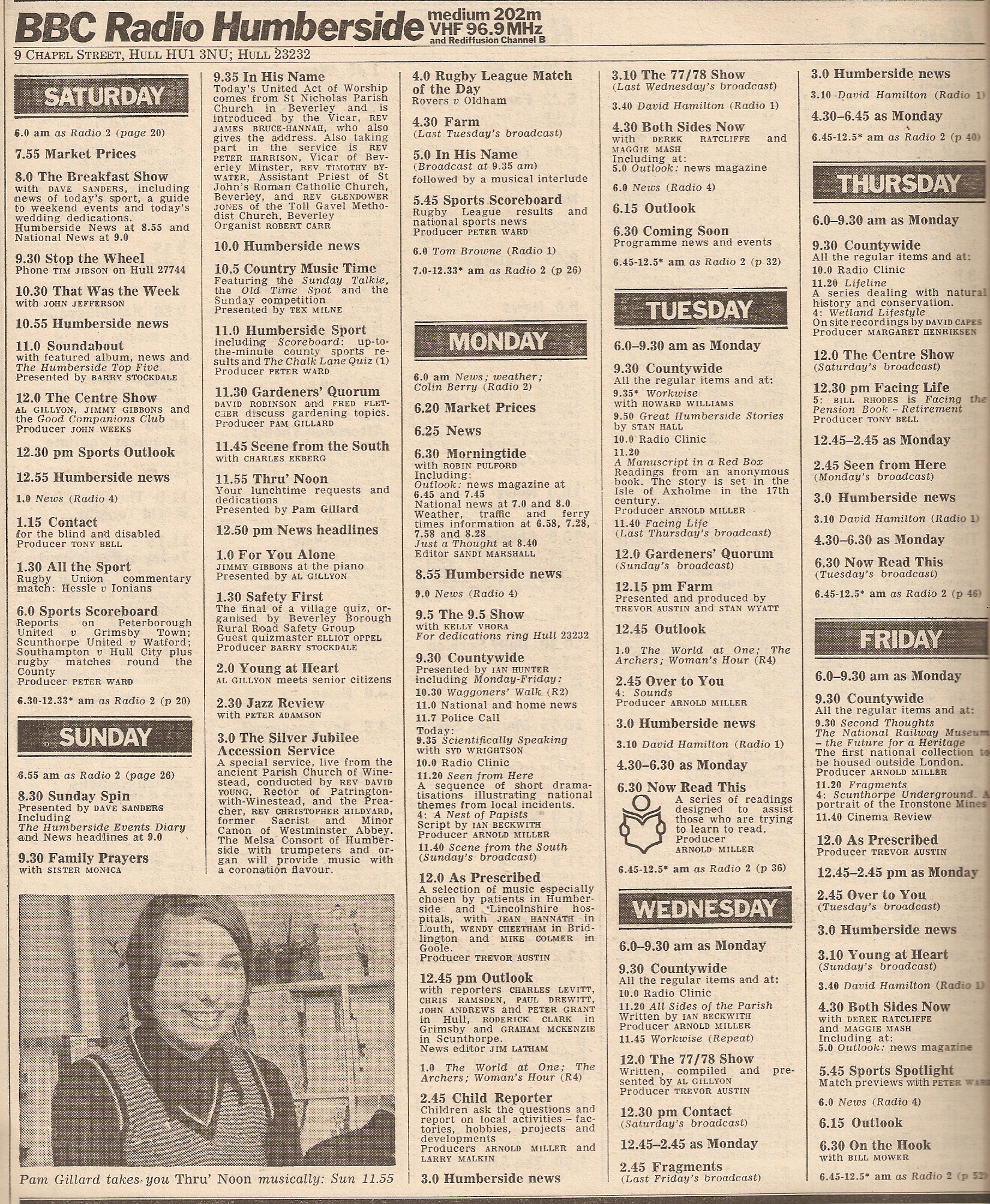
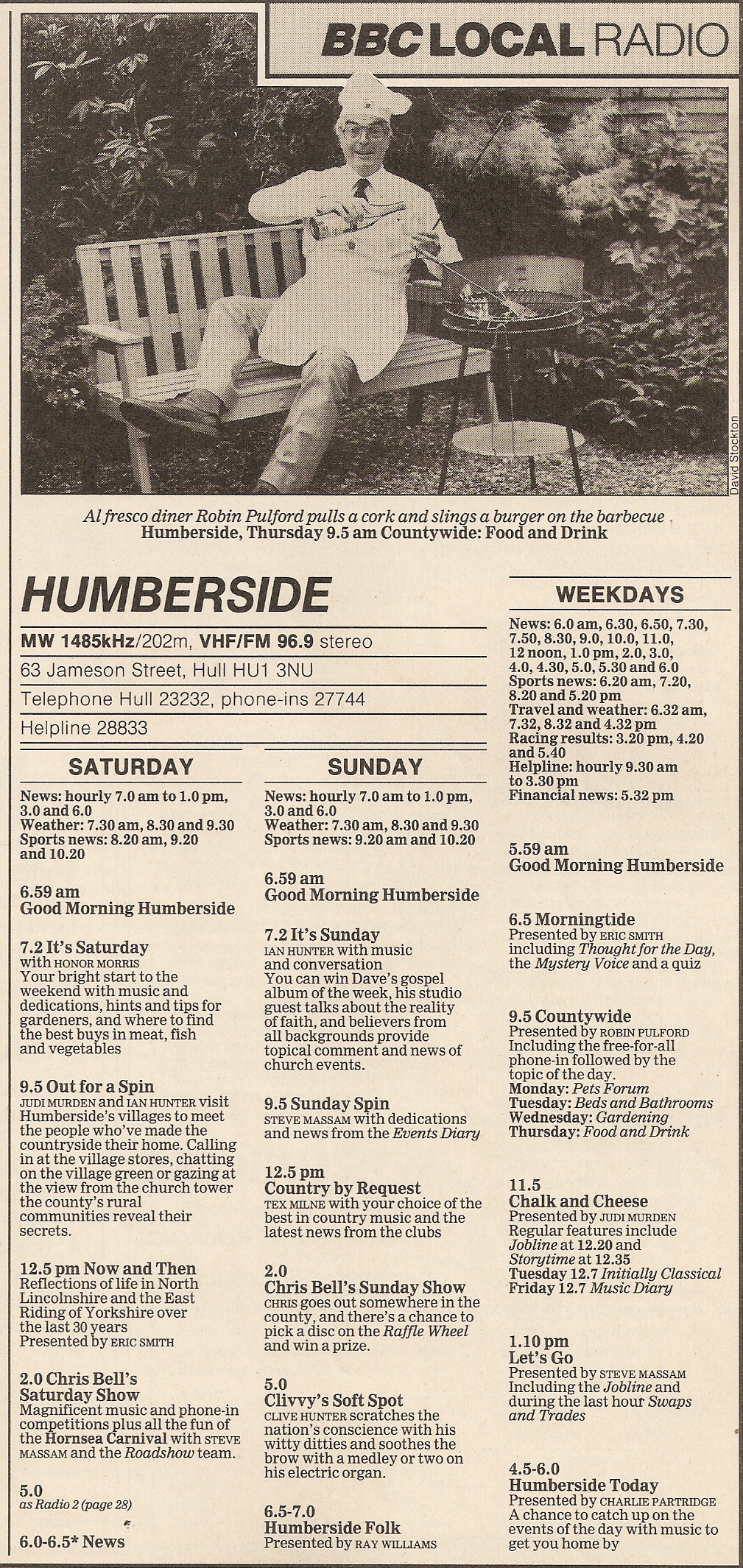
.bmp)
He was Mr Radio 2 for four decades, the warm, trusted ever-present voice who read thousands of news bulletins and presented hundreds of music programmes. He deputised for many of the other DJs on the network. His technical skills and perfectionism meant he was often the link back at Broadcasting House through dozens of OBs, playing in the records and filling when the line went down. He spoke for the UK jury for 25 years of Eurovision Song Contests. His music knowledge and vast collection of LPs and singles informed his later local radio shows. He was Colin Berry, whose death was announced earlier this month.
All the many
tributes to Colin mention his long service on BBC Radio 2 and his Eurovision
connection but his radio career started in the days of the offshore pirates.
Here’s a look back at Colin’s radio career.
Colin Berry
was born on 29 January 1946 (sharing his birthday with his long-time friend
Tony Blackburn who was born three years earlier) in Welwyn Garden City, one of the 'Brocket babies' born at Brocket Hall, and
educated at the Wembley Grammar School. His first ‘broadcasts’ had an audience
of just two, his mum and dad. Young Colin fixed up the Ferguson
radiogram at the family home in Kenton so that he could play in the discs and whatever he’d taped off the
Light Programme and introduce them.
His first
job was working at one of the stores supplied by his father’s company – Cecil Berry
was a director of Allied Suppliers – but young Colin was desperate to get into
radio or television. Through a family friend he got his break at the London
offices of Granada TV slotting adverts into commercial breaks when he was
just 17. He then joined Westward TV also working on commercials and selling
airtime when an opportunity came up to work on the admin side at Radio
Caroline.

Colin joined Radio Caroline in 1964 as an Assistant Traffic Manager but after a few months he was asked to make a tape recording ‘for fun’ that led to him compiling (by recording the Light Programme news) and reading news bulletins and joining some DJs on their shows. He appeared on air as Robin Berry as fellow DJ Colin Nicol was also on the station at that time and management didn’t want two Colin’s on air.
In 1965 he
started recording commercials, such as the Weetabix Partners in Profit
promotions, and made some personal appearances around Britain to “get better
known”. “I used to get a lot of fan mail which rather surprised me, and even
had a few proposals of marriage.”
With the
closure of most of the pirates in 1967 Colin joined Yorkshire Television as an admin
assistant at their London office in Portland Place, though it was not a happy
time for him as he was sacked for some mistake he’d apparently made but which
management refused to tell him exactly what it was.
 |
| Colin in his club DJ days (Surrey Mirror 1 May 1970) |
In the late 1960s he was juggling a number of roles: volunteering at the Radio Harrow hospital radio and working one or two nights a week as a DJ at the Starlite Ballroom, Greenford and the 100 Club on Oxford Street. He would also DJ at Crawley’s Starlight Ballroom and the Birds Nest in Harrow, where a fellow DJ was Tony Barnfield who, a few years later, was also a BBC broadcaster and would present features on some of Colin’s overnight Radio 2 shows.
At the same
time he’d also made the acquaintance of some folk in the radio and music
business and it was thanks to BBC broadcaster Roger Moffat that he got a job as
a music plugger. His employer was the music publishing firm of Campbell
Connelly (started by the song writing partnership of James Campbell and
Reginald Connelly) and apparently he was responsible for getting Mouldy Old Dough to the top of the
charts. So now you know who to blame!
Whilst still
working for Campbell Connelly he freelanced as a summer relief announcer at HTV
in 1971 and in 1972 at BBC Radio Medway (now Radio Kent). At Medway he took
over the Saturday afternoon show Out and
About from Simon Dee. Colin covered the music side whilst sports editor
George Pixley looked after the sport. Due to his weekday work at a music publisher
he had access to all the new releases which helped him build the show for which
he had complete musical freedom. (It also gave him access to both commercial
and non-commercial records that would help build up his home library that he
would often dip into for his BBC Three Counties radio shows). He even had his
own custom jingles recorded with the help of Rod Lucas, who at the time was
producer of Medway’s Teen Scene. Rod
would later provide some drop-ins for Colin at Radio 2.
In 1973 an opportunity came along to join the BBC at Broadcasting House in the Trailer Unit for Radios 1 and 2 under Presentation Editor Jimmy Kingsbury. Kingsbury was looking for a new voice following the loss of Tony Myatt to Capital Radio. As well as writing and recording trailers the job also offered a position on the rota of presenters of Night Ride (midnight to 2 a.m. on both Radio 2 and Radio 1). It was Noel Edmonds that mentioned the vacancy to Colin over lunch one day, and encouraged him to audition; Noel had started at the BBC doing a similar job.
Colin’s
first Night Ride was scheduled for
Saturday 29 September 1973 but when his boss, Jimmy Kingsbury, phoned in sick
for his shift on the Wednesday night/Thursday morning show he ended up been
thrown in at the deep end and doing that one first.
Shortly
after, Colin left the Trailer Unit to become a full-time announcer and
newsreader. During the 1970s and 1980s the work of the Radio 2 announcers was
quite varied. There was the reading of news bulletins on both stations, where
Colin would develop a more punchier approach to reading for the Radio 1
bulletins on the half-hour. Evenings and weekends meant live continuity links
between programmes as well as recording trailers and attending comedy show and
panel game recordings to provide the opening and closing announcements.
 |
| Posing with way too many cups of BBC tea for Night Ride 17 May 1974 |
Many announcers would also host live shows such as Night Ride, Music Through Midnight and The Late Show as well as programmes featuring one of the radio orchestras. Colin was particularly adept at the live shows, so much so, that when Simon Bates left the Early Show it was Colin that took over (for two years) from January 1976, so starting a long association with that time of day. These 6 to 7 a.m. Early Shows were carried on both Radio 1 and Radio 2, with Colin being the warm-up man for either Noel Edmonds or Terry Wogan (who was wont to refer to Colin as 'Wallace Beery'), depending on who you switched over to after the 7 o’clock pips. Most of the BBC local radio stations also carried part of the show so the audience ran into millions.
There’s a
flavour of what these Early Shows sounded like in this sequence.
It was in
1977 that Colin also started his long association with all things European.
That was the year he first acted as spokesman for the UK jury at the Eurovision Song Contest, a role he held,
apart from in 1980 and 1998, through until 2002. Based down at Television
Centre he would start off with the usual “London Calling, here are the results
of the United Kingdom jury”, though it wouldn’t be until the 1994 contest that
the world eventually saw the Berry visage when results were first delivered to
camera.
 |
| His first in-vision appearance as UK jury spokesperson in 1994. Colin's favourite Eurovision song was Take Me to You Heaven, the winning Swedish entry by Charlotte Nilsson in 1999 |
In 2012 Colin told me how things were organised behind the scenes for the song contest: “On the day of broadcast the jury were assembled at Television Centre were they would watch the afternoon full dress rehearsal and there was a chance for them to hear any of the songs again if they wished. In the 70s and 80s the London end was under the control of Light Entertainment Organiser Tony James ...[who] was a great ambassador for the BBC and did everything with great finesse. He made sure that the jury members were well looked after, that all the introductions were made, providing a waitress-service dinner and having studio tours during breaks. When Tony’s team left in the 90s it was all clipboards and vouchers for the BBC canteen.”
During the
contest itself Colin also had a monitor and a lip-microphone should “Wogan’s
line vanish and there was a need for me to continue commentary. It never
happened, but got within thirty seconds of it one year.”
He went on
to say that “when it came to announcing the UK decision there was an agreed
script but as the years passed I deviated a bit to make it less formal. Others
did too eventually, but they tended to overdo it sometimes, building up the
part”.
The BBC did
acknowledge Colin’s 25 years in the spokesperson role and so threw him a lunch
and presented him with a BBC inscribed microphone but at the same time they let
it be known that changes were planned for the following year (as it transpired
in the form of Lorraine Kelly) and that he’d no longer be required. This was
despite supportive words from the King of Eurovision Terry Wogan who started
his after-lunch speech by saying "I don't know why you’re getting rid of
yer man....if it ain't broke why mend it?"
YouTube user
ESC Clarinet Moon has compiled this video of Colin’s appearances in the Song
Contest voting.
Meanwhile,
back on Radio 2 Colin maintained the European link by presenting the Europe
music programmes (Europe 78, Europe 79 etc. ending in 1982) and
taking over as main host of European Pop
Jury. European Pop Jury, which
had been running at intervals since 1965, featured pop juries in several
countries passing verdict on the latest pop releases from each nation in a
Europe-wide hook-up. David Gell presented the London end (pre-recorded at the Paris
Theatre, Lower Regent Street and later the Radio Theatre at Broadcasting House)
until he went back to his native Canada in 1977 when Andy Cartledge, Nick Page
and Don Durbridge all had a go at it. Producer Mel House auditioned them plus
David Allan and Colin to permanently take over the job with Colin getting the
gig until it all ended in December 1983.

Radio 2 had planned to switch over to 24 hours broadcasting in November 1978 but in the event, due to industrial action, it was postponed until the following January. By then it was Colin who was going to kick things off in the early hours of Sunday 28 January with a four hour stint. He’d spent the previous week popping into other people’s shows to promote the new service and during Ray Moore’s Saturday night show was on hand to chat to Ray and link up with BBC2 viewers.
You and the Night and the Music was run on a shoestring. All the
presenters were staff announcers on a daily presenting rota and there was,
according to Colin “a mere ten minutes of commercial needletime. The shows were
full of foreign recordings and studio sessions. Musicians Union restrictions
were hard on music lovers in them there days!” To further pad out the shows
pre-recorded features were also dropped in. Colin presented YATNAM, as it became known, at intervals
until November 1983.
All this
time Colin continued to read news bulletins as he felt he didn’t want to lose
the skill. He was also recording a weekly Golden
Days show for BFBS radio and music shows for Inflight Prodcutions Ltd. At
Radio 2 he was the backstop during many outside broadcasts, playing in the
discs, reading any traffic reports and just been on standby if the line went
down, whether it was an afternoon at the races or the JY prog coming from
Rhodesia or Toyko. This was also the time when if a main Radio 2 presenter was
off they could often call on one of the announcers to cover, which he did for
Terry Wogan, Ray Moore, David Hamilton, Charlie Chester and others. The only
bit of broadcasting he regretted not doing was reading the classified football
results on a Saturday afternoon.
In this
montage we hear Colin across the years on Radio 2 (and Radio 1).
One of
Colin’s best mates was fellow broadcaster Ray Moore, whose shows often followed
Colin’s or who would cover each other programmes in what Ray termed as a ‘Box
and Cox’ arrangement. In his
autobiography Ray recalls that he first met Colin in the late 60s “when he was
a young record plugger who regularly turned up at The George at lunchtime
wearing a baggy pink suit, a very daring number even for those liberated
times.”
 |
| Colin and Ray |
When Colin married Sandra Barker in the summer of 1981 their honeymoon was in Corfu. Ray takes up the story: “Our good friend Colin Berry had married, inappropriately enough on Independence Day, and had invited the two of us to go on honeymoon with him and his wife Sandra. It seemed a bizarre idea at first but, given that the four of us were far from strangers, it began to look quite logical. The episode took on a rather less rosy dimension when, after five days away, I became semi-housebound thanks to a boating accident”.
.jpg) |
| The Face behind the Voice in 2009 |
According to the 1983 edition of Who’s Who in Radio Colin’s likes were motoring, walking and a good pint of real ale. His dislikes: traffic jams, bad timekeepers and pressurised beer. In later editions the real ale was still there but now with added likes of the Isle of Wight, Victoria Wood and oysters with ‘most folk music’ and cricket on the negative side.
On a
personal note I’d been listening to Colin since the days when I first started
recording programmes and clips off the radio in early 1976. Tuning in to Radio
1 or Radio 2 before 6 a.m. it was either dead air or test tones until he came
on with the early show. When I started writing this blog in late 2010 Colin was
one of the people I contacted and, fortunately, he responded. He was always
very helpful in assisting me to identify voices from the past and freely
answered questions on programmes and broadcasters. We swapped airchecks and I
was only too pleased to provide audio for one of his local radio specials on
pirate radio. I was fortunate to meet Colin back in 2015 for a long lunch at
the Bree Louise pub (since demolished). He was concerned that I’d spot him (of
course I did) saying “hopefully you will recognise me.. a good bit more hair missing
since the last photo”. I joked that I’d carry a rolled-up issue of the Radio Times, and I did indeed pop into
WH Smiths at Euston for a copy. We enjoyed a long chat over a pie and several
pints of real ale (naturally). We’d planned to meet up again in 2018 but for
one reason or another it didn’t happen.
As the Daily Telegraph obituary says: ‘Switching
between the soothing, unforced tones of a presenter, and then the authoritative
ones of a newsreader, Berry was skilled at creating the necessary intimate
connection with the listener.’ As someone has commented to me “he had his own
built-in compression”. Apparently amongst Colin’s regular listeners were the
Kray twins with Reggie telling the News
of the World: “We both love to listen to Radio 2. We’ve learned to
appreciate another side of life. One of my favourites is Colin Berry of Radio 2...he’s
a nice fellah.”
Away from
the radio studio Colin made only occasional forays onto television. Aside from
those Eurovision duties he appeared on The
Generation Game, Blankety Blank, Bargain Hunt and Supermarket Sweep, both of these with Tony Blackburn, and just one
appearance on Top of the Pops
alongside Peter Powell on 30 October 1980.
.jpg) |
| Colin in the Radio 2 studio sometime in the 1980s. He claimed to able to work those faders and knobs blindfold so frequently was he on air |
Colin continued to present shows on Radio 2 throughout the 80s and 90s, mostly late night or early morning shifts. “The only trouble with early shows”, he said, “is that they get earlier!” He hosted the weekday early show, with a 4 a.m. start, from 1984 to May 1988 and the weekend version in 1993 and 1994. Meanwhile, overnight, he was one of the presenters of Night Ride between 1989 and 1995. Colin’s last billed Radio 2 show was on 31 March 1995, but it wasn’t actually the last. Fast forward to 2012 when Richard Allinson was doing a weekend 3 to 6 am slot and Colin was on late news-reading duty when one weekend Richard doesn’t make it to the studio and it ends up with Colin doing an impromptu fill-in.
 |
| Enjoying a real ale with Dave Cash |
Colin retired from the BBC in 2006 but remained on the books as a freelance newsreader on Radio 2 until September 2012. By this time the plan was for broadcast journalists to read the news on the station, as they did on 6 Music and increasingly overnight on Radio 2. Colin’s final bulletin was at 3 a.m. on 8 September 2012 and with “and that is likely to be it from me” he signed off for the last time, just shy of 39 years of news-reading.
Meanwhile,
over on BBC Three Counties Radio Colin was settling in for some regular weekend
music programmes. He’d already appeared on 3CR in 2004 and in 2008 until early 2009
he was on the Saturday night late show. From April 2009 until July 2010 he presented
a three-hour early evening show known as The
Saturday Club. Both these programmes were also carried on other stations
across the eastern counties to give a fairly substantial audience. From 2011
until 2019 Colin continued to work for the station covering for Richard
Spendlove on his Saturday night programme many times as well as occasional
specials he called A Little Light Music,
one on Eurovision songs (of course), one on pirate radio and, in the last
couple of years, mining a seam of one hit wonders.
From 26
December 2014 here’s Colin remembering the days of the offshore pirates.
Those 3CR
shows were a real mix of musical genres and styles. Colin had a penchant for
light music and library music so often his only source for these, and some rare
pop 45s that he played, were from his own vinyl collection. He was concerned
that the BBC would, in a computerised ViLoR studio setting, still support the
use of record players and his liking for dubbing stuff off onto mini-disc (I
once sent him a pack of blanks MDs to keep him stocked up), especially after
the move to new studios in Dunstable in 2015.
Colin’s
final radio programme, again on one hit wonders, was broadcast on BBC Three
Counties Radio on 25 December 2019. The pandemic the following year, and
changes to BBC local schedules as a result, greatly decreased the opportunity
for further occasional shows.
For about
three years Colin had been unwell and was diagnosed with Lewy body dementia. He
died on Wednesday 16 April. He is survived by Sandra and their children
Marina and Jonathan.
In 2012 I
edited together this short sequence of Colin on the radio over 50 years.
Colin Berry
1946-2025