It's sad how, in the last couple of years, some of the links
in the chain that tether Radio 2 to its old Light Programme counterpart have
finally broken. Sir Terry Wogan, Sir Jimmy Young, Desmond Carrington and Brian Matthew all no longer with us.
Only Friday Night is Music Night remains the last true bastion of that post-war service,
bringing "music for everyone" for the last 60-odd years. Programmes
like Listen to the Band and The Organist Entertains sound like they
should have been on the Light but are mere striplings of forty-ish years of age.
In this documentary from BBC Four's Time Shift series Whatever Happened to Radio 2?concentrates on those specialist music shows
which serve the old Light Programme audience. The programme looks at Radio 2
from the audience perspective and includes the inevitable contribution from
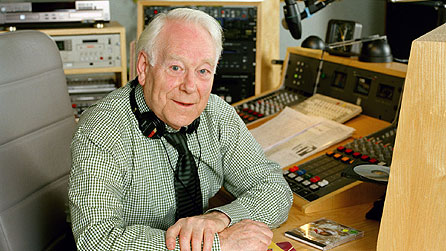
Gillian Reynolds. There's an emotional Desmond Carrington in his studio
"at home in Scotland" talking about the bond with his listeners, the theatre
organ enthusiasts flocking to see Nigel Ogden and the continued support for
brass band music with Frank Renton and folk music with Mike Harding. There's a
typically humorous performance from Humphrey Lyttelton and it closes with a
coach load of pensioners attending a live performance of Friday Night is Music Night.
Whatever
Happened to Radio 2? was first broadcast on 5 October 2007.
My abiding memory of the death of Diana, Princess of Wales
twenty years ago this Thursday, is the almost surreal way the country was in
limbo for a week following the tragic events in Paris. Half the country was in
mourning for a woman they'd never met while the other half were bemused by their
reaction. Mind you that didn't stop cynical old me recording some of the radio
output on that Sunday as broadcasters tried to come to terms with the news and
how to handle the death of a royal for which there'd been no rehearsals.
I didn't start recording earlier enough on Sunday 31 August
1997 to hear how the news was broken to the waking nation. Here's what I did commit to tape. By 10 am Radio 1 was
already using back-to-back ambient music - some of the tracks are listed below
- interspersed with announcements from Mark Goodier and extended news reports
here with Richard Evans.
Many commercial radio stations came together to take IRN's
bulletins and played instrumental tracks. I'm sure they featured more than just
Kenny Gee's Songbird but that's all I
recorded and have heard since on other recordings. This segment starts at 11.30
am and was taken from Viking Radio.
Radio 2 dropped its morning schedule (Good Morning Sunday remained but shifted to 9 am) and under normal
circumstances would have aired a pre-recorded Desmond Carrington show at 1 pm.
Des and producer Dave Alyott convinced controller Jim Moir that they could
handle a live show from their home studio with an appropriate playlist. This
recording starts with an extended 12-minute news bulletin read by Paul
Leighton.
At 39 minutes its back to Radio 1 and at 4 pm listeners would've expected to
hear the UK Top 40 but both the BBC
and the Network Chart from Capital were cancelled as a mark of respect. At the
start of this recording Lisa I'Anson introduces Tina Ritchie with a 3-minute
bulletin and then an announcement from Mark Goodier.
Both Radio 4 and 5 live combined resources throughout the
day. This news special with Charlie Lee Potter and Allan Robb was broadcast at
5 pm.
Following the week of almost suspended animation, that and
the clamouring for a public display of grief from the royal family, the funeral
occupied most of the airtime on Saturday 6 September from 8.30 am. This is part
of the BBC coverage carried across all stations. The announcer is David Miles
and commentating in this clip are James Naughtie and Chris Stuart.
There are other off-air recordings from 31 August 1997
available online. Radio Tapes has airchecks from CBS and ABC in the States plus
the BBC World Service as relayed by Minnesota Public Radio KNGA.
This webpage recreates the original MHP Pick of the
Continuity Announcements page with reinstated audio and looks at the timeline
mainly from a TV perspective.
In this blog post Matthew Rudd recalls working overnight at
Viking FM as the news broke.
Radio 1's
playlist on 31 August 1997 included:
The Last
Stand - Aloof
The Tones - Nova Nova
Culture
Clash - Sacred Spirit
After Life -
Blue Bar
Pressure
Drop - Dusk
Pat Metheny
- Sueno Con Mexico
Sabres of
Paradise - Haunted Dancehall
Ryuichi
Sakamoto - Merry Xmas Mr Lawrence
Apollo 440 -
Stealth Mass in FM
Giorgio
Moroder - Love's Theme from Midnight Express
Few radio shows feature both Al Bowlly and ZZ Top on their
playlist, but Desmond Carrington's The
Music Goes Round was such a show, a Radio 2 Friday night fixture for twelve
years. Prior to that Desmond had hosted the Sunday lunchtime All Time Greats from 1981 to 2004 with a
music selection, chosen by listeners, that could be equally diverse, even
though it did tend to veer towards easy listening and the nostalgic. That 36
year run of weekly music shows finally came to a dignified and poignant end in
October 2016 when ill-health forced Desmond to finally hung up his headphones.
Desmond Herbert Carrington was born and raised in Bromley
where he attended the County Grammar School. Perhaps sensing that his future
was in the arts his first job was as an office boy at Macmillan's the
publishers for 18/- a week. But his calling was acting and his first
professional role was as a Cockney schoolboy in Goodbye Mr Chips at the Theatre Royal, Nottingham. He then secured
regular repertory work with the Penge Court Players.
In the early years of the Second World War Desmond joined
the army, serving in the Royal West Kent Regiment, initially posted to Northern
Ireland before serving out in India and Burma. Here he got his first
opportunity to broadcast by opening up Rangoon Radio after the Japanese army
had left. By 1946 he was serving as a commissioned officer out of Colombo in
Ceylon and managed to wangle a job at the new forces station Radio SEAC (South
Eastern Asia Command). Based in a palm grove some 15 miles outside Colombo
the coverage was immense, taking in
India, East Africa, Australia, New Zealand, Indo-Chine, Japan, the Pacific and
the west coast of the States. On the team with Carrington were David Jacobs -
they would remain firm friends thereafter - McDonald Hobley, Charles Chilton
and Alexander Moyes.
On demob Desmond knocked on the door of the BBC but they
sent him away telling him that he was not of "sufficient promise" for
them to offer him a job. However he would eventually secure a post as part of
the BBC Drama Repertory company where he worked across a range of schools
broadcasts and drama productions such as Children's
Hour, Paul Temple and Mrs Dales Diary.
In parallel to his acting career Desmond pursued his other
great passion of cinema by carving out something of a specialism as an adapter
of film screenplays for radio broadcast. He'd presented some film programmes on
Radio SEAC and back in Britain he'd come up with the idea of recording the
soundtrack from the film projector using a sound mirror and a tape recorder.
With the agreement of the film companies he then used the edited highlights
from the recording to form a radio programme. He took the idea to both Radio Luxembourg
where the scenes would be linked together by Wilfrid Thomas in a series titled Movie Magazine. Later Desmond himself
would present a number of shows for the station that included film soundtracks
as well as interviews and film scores in programmes such as Hollywood Calling and the sponsored Alka-Seltzer Movie Parade. He continued
to appear on Luxembourg into the mid-50s.
Meanwhile back at the BBC that same idea of film adaptations
were featured in a number of programmes including Picture Parade (1948) and Sunday
Cinema (1949-50). Desmond returned to cinema related work at the BBC when
he and Spencer Hale (both pictured below) compiled and presented the Stargazing segment -basically star interviews with accompanying
film clips - and then the quiz segment Sounds
Familiar of the long-running film magazine Merry- Go-Round (Light Programme 1956-60)
Desmond's big break finally came in 1958 when he got a
telephone call from a colleague who was now producing Emergency Ward Ten asking if he'd like to play the part of the son
of a patient. Desmond leapt at the chance to do some live television over three
months. His performance was deemed a success and he was invited back to play
the part of a doctor - the part of Dr Chris Anderson. He remained in the show
until 1964 appearing in over 200 episodes.
Of his time on Emergency
Ward 10 Desmond would later recall the problems of having to memorise
"some appallingly difficult and long medical terms, Then I had the bright idea of writing them on the
inside of the sink as we were always scrubbing up for the operations on the
shows. During rehearsal, it worked fine, as there was no running water in the
sinks. When it came to the live transmission I watched in horror as my medical
terms were washed away as I started to scrub up. There was nothing for it but
to improvise".
Ironically it was Desmond's TV fame that led to his future
career as a disc jockey. In 1962 he was invited to compere Housewives' Choice for a fortnight whilst he was still appearing as
Dr Anderson and, as the Radio Times
billing adds, also appearing on stage in Doctor
in the House at Streatham Hill Theatre. He got repeat bookings on Housewives' Choice for the remainder of
its run between 1963 and 1967. In 1963 he was playing music from stage and
screen on the Light Programme's Twelve
O'Clock Spin. For the second half of 1964 it was more songs from the
musicals in Record Showtime with the Radio Times billing helpfully informing
us that he was appearing in Wanted on
Voyage at the Grand Theatre, Leeds - by now he'd just left Emergency Ward 10. The following year it
was a back to the world of film in Music
from the Movies, a series scripted by Movie-Go-Round's
Peter Haigh and produced by announcer Robin Boyle (a second series, produced by
Tony Luke followed in 1966). And, in case you were wondering, Des was now in Face to Face at the Marlowe Theatre in Canterbury.
Throughout 1966 Desmond could be heard every weekend hosting
Open House with "records of
assorted speeds, sizes, and styles to suit people with assorted tastes".
In 1967 he was back with more Music from
the Movies, this time working with the future radio comedy producer Richard
Willcox. There seemed to be no room for Desmond on Radio 2 when it replaced the
Light in September 1967 but in 1968 he was back adapting film soundtracks with
Spencer Hale for Radio 4's Disney Time
that included Mary Poppins, Dumbo and Bambi. Finally, from December 1968, and running until September
1972, Desmond had a daily show on Radio 2 playing the latest releases in Album Time. Aside from three appearances
in charge of After Seven in 1973
there was radio silence for the next eight years.
Desmond was invited back into the Radio 2 fold in early 1981
to introduce a series of shows featuring The
Magic of Stanley Black (other programmes would also feature Mantovani,
Ronnie Aldrich and Robert Farnon, John Gregory, Geoff Love and John Fox). He
owed his return to producer Paul Walters who, Paul reminded him on their first
meeting, had swung the boom on some of those old Emergency Ward 10 broadcasts at the ATV's Highbury studios.
The success of the Magic
of... shows led to an invitation to present the Sunday morning All Time Greats. Desmond expected it to
run for a month or so but after the first recording producer Jack Dabbs told
him, "well that's your pension, Desmond". He was right, it ran for 23
years!
In October 2011 Desmond gave listeners to The Music Goes Round and Round an
opportunity to hear again the first edition of All Time Greats. Although the BBC hadn't kept a copy, Desmond had.
Initially just an hour in duration, All Time Greats was extended to 90 minutes and then two, and for a
while three, hours and settled into what was more or less the old Family Favourites slot. It was a record
request show too so anything went, but as Desmond told the Radio Times in October 1985, the music choice was often vintage:
"It's the listeners' programme, not mine. They choose
the records". He gets about 500 suggestions a week requesting favourites
pieces and reckons some 6,000 records have been chosen by Radio 2 listeners
over the past four years. "Some people misquote the title as Old-Time Greats but it's certainly not
that. We can play records right up to the present day, though I admit that most
requests are for music from the 50s backwards. Most requested record? Without a
doubt Glen Miller's Moonlight Serenade.
Bunny Berigan's I can't get started
is a close second.
Still acting in the late 80s as evidenced by
this Radio Times article 17 January 1987
In August 2004 network controller Lesley Douglas decided to
have a re-shuffle and the Sunday lunchtime All
Time Greats came to an end. In this broadcast from 8 August 2004 Des tells
his listeners that the decision was not his, "and I should like to make
that clear".
In 1995 Dave Alyott and Desmond formed Foldback Media to
produce the shows for the BBC
The follow-up series, The
Music Goes Round, now on a Tuesday evening, was the same eclectic mix
condensed into an hour with each show adopting a theme for all or part of that
hour. Come April 2010 Desmond moved to Friday nights where he remained until
last year. For many years he'd been broadcasting from his home studio but by
now the show's opening was always the memorable "Evening all from home in
Perthshire, Scotland". Home being near Dunning where he lived with
producer and long-time partner Dave Aylott and, often curled up at Des's feet
during the show, cat Golden Paws Sam.
In 2013 Desmond spoke to Tim Blackmore about his radio
career in a Radio Talk podcast for
the Radio Academy.
In May 2016 Desmond celebrated his 90th birthday with this
special edition of The Music Goes Round.
Golden Paws Sam taking it easy
What listeners didn't know. and for a while neither did
Radio 2 management, was that Desmond's health was failing as he was battling
with cancer and Alzheimer's disease. In December 2015 he'd suffered a second
heart failure but was back at the microphone a few days later. However in
October 2016 he announced that after 70 years on the air he was reluctantly
having to "hang up my headphones" and say "enough is
enough". Here is that final show from 28 October.
Yesterday, on the day Radio 2 had already scheduled a tribute to Desmond, it was announced that he'd died. The voice of a true radio
all time great silenced.
Next month Desmond Carrington celebrates 30 years of his weekly show on Radio 2. Not the same weekly show mind you. From 1981 to 2004 it was the Sunday lunchtime show All Time Greats before he was ‘demoted’ initially to Tuesday evening and then Fridays presenting The Music Goes Round.
Desmond first got in front of the microphone in 1946 on Radio SEAC (South Eastern Asia Command) at its HQ in a palm grove just outside Colombo, Ceylon. His fellow broadcasters were David Jacobs, McDonald Hobley (later one of the first in-vision announcers for the BBC), Charles Chilton (renowned BBC producer who would go on to create Journey Into Space) and Alexander Moyes (who became an actor). Quite a team!
After demobilisation Desmond returned to acting on stage, on film and on the radio. However, he became best known for his performance on ITV’s twice-weekly hospital drama Emergency Ward 10 playing Dr Chris Anderson
Many of his radio appearances in the 50s and 60s were film-related: in the late 50s he presented a Sounds Familiar quiz as part of the Light Programme’s Movie-Go-Round and in 1966-7 he was also on the BBC with Music from the Movies as well as Open House (nothing to do with the Pete Murray series). Desmond broadcast and produced many shows for Radio Luxembourg including Calling the Stars that featured film soundtracks.
Like many broadcasters, actors and musicians Desmond appeared on Housewives' Choice and he was also on the rota of presenters who hosted Roundabout – the drivetime show on the Light and Radio 2 – and Radio 2’s Album Time in 1969 and 1970.
But it wasn’t until October 1981 that Desmond got a regular radio show, although initially it he was contracted for 3 months. In the event All Time Greats ran for nearly 23 years. The show was a mix of modern and classic pop music, show tunes, orchestral pieces and comedy records that worked well in its Sunday Family Favourites slot; indeed the first producer, Jack Dabbs, had worked on that programme back in the late 60s/early 70s.
First of all back to 1984 and this extract from All Time Greats broadcast on Sunday 24 June:
On 29 August 2004 the final All Time Greats was aired. Desmond was obviously not happy about this and neither were his loyal listeners. The following week Elaine Page’s new show started. This is a recording of that final show with Desmond’s emotional sign-off.
The following Tuesday a new weekly series The Music Goes Round started. By now Desmond’s show was an independent production that he broadcast from his home in Perthshire. Here’s the first half of the initial show from 31 August 2004: