This post should be subtitled The Sound of Silence. When this week's Jamie Cullum's Radio 2 show was unexpectedly truncated - a beginning
and an end but seemingly the middle section had dropped down a digital black
hole - and the 'emergency tape' kicked in it didn't go unnoticed; social media
and the fact that it's the biggest station in the UK saw to that. [The full pre-recorded version of Jamie's show is no online]
The use of playout automation and voice-tracking have long
been a feature of radio station output and, for the most part, work seamlessly
so listeners shouldn't be able to spot the difference. But when Radio 2 adopted
the VCS Autoplayer in September 2012 for a while it was a case of 'mind the
gap'.
Radio 2 was aiming to make efficiencies and the use of
automation was noticeable in the evening and weekend programming when, one
assumes, technical staff were thin on the ground. Most of the early teething
problems involved the junctions out of news bulletins with the next programmes fired
off at exactly three minutes past the hour cutting off newsreaders in their
prime.
The network's problems were compounded when in January 2013
two programmes played out at the same time with Michael Ball and Russell
Davies's show both simultaneously competing for about 15 minutes of airtime.
Later that year, in October, we got two Bob Harris's for the price of one when
the end of BST seemed to send the system haywire.
Here are a few example I collected at the time.
Note the jokey but rather pointed comment from Richard
Allinson "normal service ... well that went out the window ages ago"
was made around the time in 2012 when the old team of newsreaders was phased
out and the automation came in.
The news at 1:10 is very odd. This is Susan Rae, on 23
September 2012, presumably reading the 2-minute 11.00 pm Radio 4 bulletin but
on Radio 2! Hence we get a full minute of silence before the trailer kicks in.
At 6:19 we get part of the infamous Bob Harris show from 27
October 2013 with two parts being played out at once.
At 8:24 it's the Ball/Davies cock-up.
And finally at 12:49 from 22 June 2015 Jeremy Vine signing
off and Steve Wright loving a technical fault.
Needless to say Feedback
picked up on all the drop -outs. On 28 September 2012 they dealt with one
minute silence the previous Sunday night which was blamed on an "internal
broadcast circuit" plus other losses of lines on Any Questions? and Today.
The 1 February 2013 edition called Radio
2 controller Bob Shennan to account who puts it down to 'human error'.
Having a moan about the BBC seems to be something of a
national pastime. The corporation itself has long sought criticism, and praise,
for its own output from TV viewers on Points
of View (1961-71/79 to date). In this post I turn my attention to the radio
equivalents.
Listeners to the BBC World Service were first invited to
send in their letters to Hugh Tattersall when Letterbox was launched in 1965. By 1974 former The World This Weekend and You
and Yours reporter Margaret Howard was welcoming the correspondence. The Letterbox theme (Handel?) and
Margaret's warm voice became familiar to listeners worldwide for just over a decade. When World Service bosses cancelled Letterbox in April 1986
the programme's correspondents were far from happy. "It's our forum"
and we're "one big family of
world-wide listeners" they protested.
Here is that final edition of Letterboxfrom 25 April 1986. BBC Sounds has four editions
from the archive available to listen to again.
In the event the World Service did bring back a listeners'
correspondence show almost a year later. In May 1987 the legendary Paddy Feeny
was in the hot seat for Write On.
Shorter, snappier and often calling BBC producers and bosses to account the
programme continued with Dilly Barlow and others until 2006.
The World Service website has this second edition with Paddy
from 13 May 1987.
In 23 March 2006 Write
On was itself given the chop to be replaced by Over to You, which continues to this day. The last edition of Write On, presented by Penny Vine, is
also online here.
The earliest available edition of Over to You - by now well and truly in the social media age,
there's no mention of writing in - is from 20 April 2006. The presenter is
Rajan Datar.
On the domestic side BBC Radio 4 has been airing listener's
grievances on Feedback since 1979 but
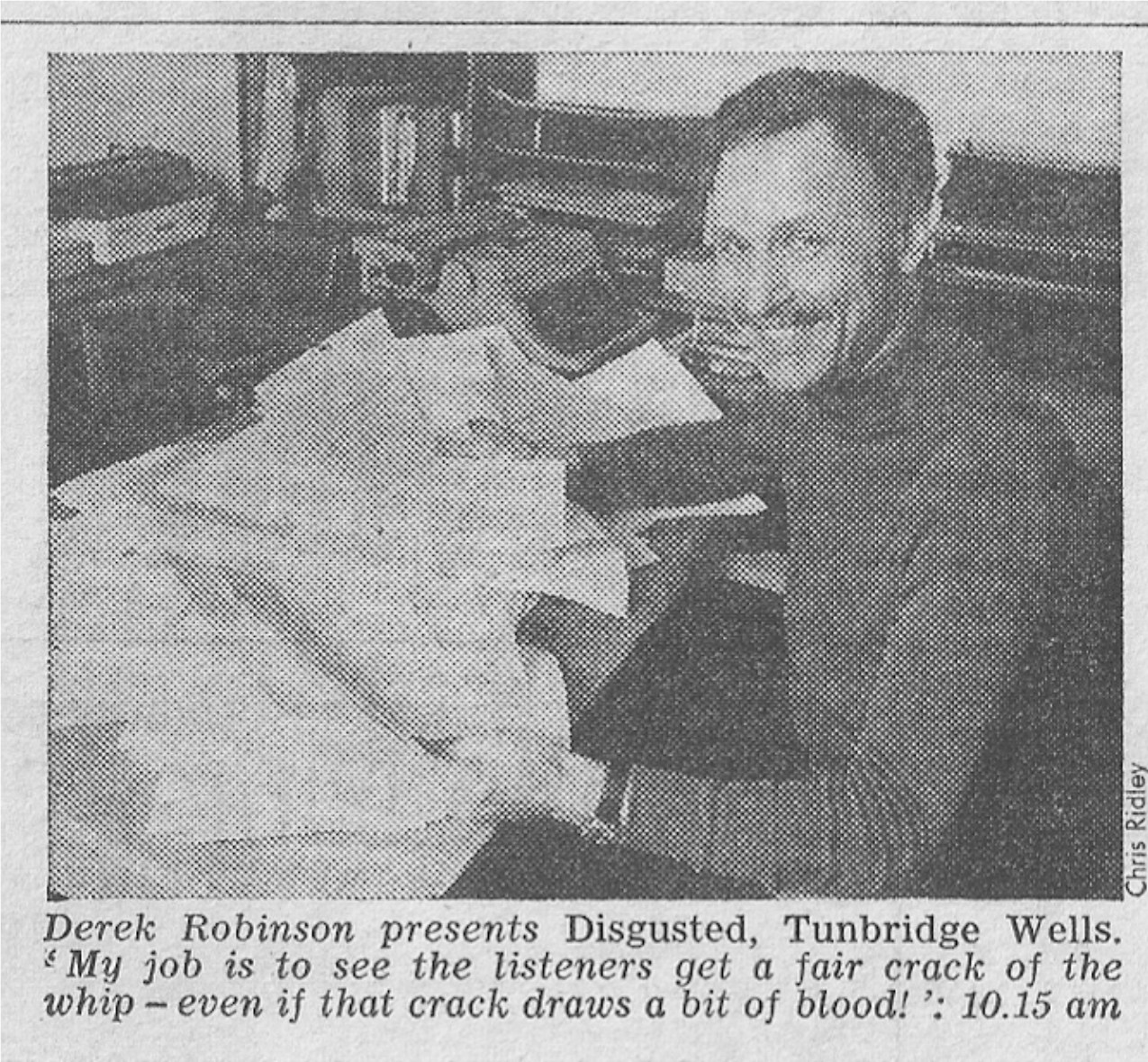
before that was Disgusted, Tunbridge
Wells - a title that surely smacked of the Home Counties, you could almost
hear Middle England dipping their nibs. Disgusted,
Tunbridge Wells ran for nine months between February and November 1978 with
the network controller Ian McIntyre hoping that fierce criticism "might
have the tonic effect on complacent producers." The programme was dropped
among accusations that presenter Derek Robinson betrayed too much
"crusading egomania."
This edition, kindly sent to me by Richard Tucker, dates from
Sunday 29 October 1978 and aims its sights on A Word in Edgeways, Any
Questions? Radio 3 music policy and the "personality cult" of
news presenters, with Peter Woon, head of news and current affairs, answering
the criticisms.
The following year Feedback
offered listeners the opportunity to send in their bouquets and brickbats
though the programme aimed "as much to inform the audience about
broadcasting matters as to provide an opportunity for airing criticism".
Regular Feedback presenters
have included Tom Vernon, Colin Semper, Susan Marling, Chris Dunkley and the
present incumbent Roger Bolton.
Rewind to 10 March 1985 for this edition of Feedback with Colin Semper. Up for
consideration are such minutiae as the use of "what" and Susan Rae's
accent to the "blasphemy" of The
Wordmiths at Gorsemere and that perennial issue of the licence fee.
There are
two indisputable facts about Tom Vernon. One, he was a fat man. Two, he rode a
bicycle. That combination gave Tom a number of hugely popular series on radio
and on television as he explored the highways and byways across France and
around the world.
It all
started with the Radio 4 series that first aired in late 1979, Fat Man on a Bicycle, billed as “Being
the ponderous peddling of Tom Vernon from Muswell Hill to the Mediterranean and
what befell him in the land of the French” His broadcasting style was,
according to radio historian David Hendy, “humorous, gentle and idiosyncratic
in a way that seemed perfectly natural to most Radio Four listeners”.
Fat Man on a Bicycle, Radio Times 13 December 1979
Tom Vernon
was born in London in 1939 and would go first into teaching and then PR. At the
same time he was performing, apparently “moonlighting as a period-costumed
minstrel” and writing music.The
song-writing somehow led to occasional appearances on the Today programme where overnight he’d write a song about a current
news story for broadcast the next day.
He was the
first presenter on BBC Radio London’s breakfast show Rush Hour when the station launched in 1970. Indeed he was
inadvertently the first voice on air when the engineers accidently put out his
rehearsals during test transmissions. As
you’ll hear in the audio clips below Tom also found time to write the Radio
London Song. He also presented In Concert
alongside Michael Oliver in a programme that offered classical music, comment
and criticism and a look at London life in A
Better Place to Live.
At Radio
London he would also read entire Victorian novels on the air, presumably they
had plenty of time to fill. This included the whole of Pickwick Papers which he delivered in 50 episodes and acting 150
different voices, mixing in his own music and sound effects. “I was a one-man
epic,” he recalled. That same rich voice would later go on to record
Dial-a-Santa for the GPO.
The first edition of Feedback 1 April 1979.
Regular hosts after Tom have been Colin Semper,
Chris Dunkley, Roger Bolton and Andrea Catherwood
Joining
Radio 4 he was a producer and presenter for the nightly arts strand Kaleidoscope and a contributor to the
review of weekly magazines programme News
Stand. From April 1979 he became the first presenter of Feedback, the “bouquets and brickbats”
programme that took over from the short-lived Disgusted, Tunbridge Wells.Tom remained with Feedback for
four years.
Here’s Tom
Vernon with an edition of Feedback from
10 April 1981 where the burning topic is local and regional radio.
The idea for
a cycle journey across France had its genesis many months before when he’d
bought a second-hand bike at his local Oxfam shop for a fiver. Nicknamed The
Black Pudding – “it was exceedingly heavy and acted as a vehicle for a great
deal of fat” – it remained little used until one day when he was carless he hopped
on it to go shopping, pretty soon he was cycling into the BBC and back.
It was in
July 1979, now on a slimline Evans bicycle, that he set out set off from London
across the Channel and down to La Grande Motte.“Le gros type à vélo”, his
T-shirt proclaimed. Amongst his possession was a mini-Nagra tape recorder
whilst his producer Joy Hatwood followed by car with a large stereo tape
machine to help create their radio verité.Explaining the impetus for the series Tom wrote: “A radio broadcaster is
among the most detached of all. He lives under fluorescent tubes in a
windowless studio, and handles words and ideas on little pieces of magnetic
tape. The temptation is strong to become
more and more a processor of substitute reality, and not very different from a
transistor in his tape machine. I wondered: Is there still a world out there
you can touch?”
Fat Man in Italy, Radio Times 1980
The first
series proved very popular and led to a further four on radio and eight TV
series for the BBC, ITV and Channel 4.
In the 1990s
Tom and his second wife retired to rural France, in the Cévennes. He died last month of a heart attack, aged 74.
In this
audio sequence you’ll hear Tom singing his Radio London song and talking about
the early days of the station. There are clips from Fat Man on a Bicycle and reminiscences from radio producer Jenny de
Yong, who worked on some of the later series.
Tom Vernon
1939-2013
Guide to the Fat Man radio series
Fat Man on a Bicycle
6 part
series from 13 December 1979 Fat Man in Italy
6 part
series from 8 December 1980 Fat Man Out
4 part
series from 24 June 1981 visiting Helston, Rochester, Appleby, Grantham Fat Man at Work
6 part
series from 26 May 1983 Fat Man on a Roman Road
8 part
series from 21 August 1983 – a trip from Exeter to Edinburgh
Audio comes
from Mike Brown’s Transdiffusion article on station launches and Radio 4’s Last Word broadcast on 20 September
2013.
Edit February 2025: When I first wrote this post I said "sadly I have no copies of Tom’s radio series in my archive but surely they should be accorded a repeat on Radio 4 or Radio 4 Extra". Well no repeat of any of Tom's programmes was forthcoming but, thanks to a contact in Western Australia, I did receive copies of Fat Man on a Bicycle. I intend to upload them to YouTube very soon.