Friday, 6 January 2012

Radio Lives - Bob Holness

The sad news of the death of Bob Holness has been announced today. Bob was a regular radio broadcaster from the 60s through to the 90s and, of course, the host of Blockbusters.

Bob’s radio career started in his native South Africa, though the family had returned back to the UK just after his birth, with his first job being in 1955 as a radio actor. As trivia fans will know he played James Bond in an adaptation of Moonraker. He transferred into presentation and DJ work before moving back to Britain in 1961 where he joined Granada TV working of World In Action and hosting Junior Criss Cross Quiz. At the same time he was DJ'ing from the London studios of Radio Luxembourg.

By the mid-60s Bob was working on BBC radio.  On the Light Programme he popped up on Housewives’ Choice, Newly Pressed, Swingalong, Playtime and Roundabout. Over on the Home Service he was one of the presenters of the regional news programme South-East, working alongside Tim Gudgin and Paddy Feeny.
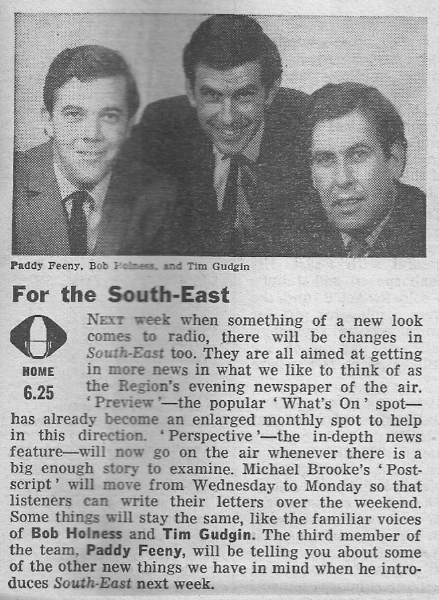
Radio Times 28 September 1967
When Radio 1 and Radio 2 started in September 1967 Bob was on air in the first week as a regular host of the Late Night Extra, and he continued to work on the show until 1974.

Radio Times 3 October 1967
Between 1975 and 1985 Bob was one half  of the famous LBC partnership with Douglas Cameron on the daily AM news magazine.  Originally at LBC on the afternoon Newswatch, Bob teamed up with Douglas following the departure of Clive Roslin. You can hear a tribute to Bob’s time on AM is this feature compiled by Geoff Lumley 


It was during this time that Bob also became a teatime favourite on Central TV’s Blockbusters - “Can I have a P please Bob?” and the Blockbusters hand jive surely ensuring his place in TV history.  I posted a short clip of Blockbusters  on my You Tube channel last year.

London Calling April 1981
Back on the radio Bob was heard every week on the BBC World Service with the request show Anything Goes that ran from the mid 70s to the late 90s, prior to that he also presented Date with a Disc. In 1985 he returned to the Radio 2 to front shows with the BBC Radio Orchestra and sitting in for holidaying DJs such as Desmond Carrington and Derek Jameson.


In the early 1990s Bob had a live Saturday night entertainment show Bob Holness Requests the Pleasure. Here’s his show from 4 January 1992 with guests John Dankworth, Don Maclean, George Melly, Madeline Bell and the Max Harris Orchestra. This recording amply demonstrates Bob's warm, easy-going style.


Bob Holness 1928-2012


Thursday, 5 January 2012

Another Stroll Down Waggoners’ Walk

Time for another trip to Hampstead to meet the inhabitants of Waggoners’ Walk.

The daily series was first broadcast by BBC Radio 2 back in April 1969 as a replacement for long-running The Dales (formerly Mrs Dale’s Diary).  Although meant to be a bit more hip and happening than its predecessor, the Radio Times for that week, went to great lengths to assure listeners that the new serial’s setting was familiarly suburban.

Far from being a vast impersonal spread of urbanisation the greater part of London is still divided into hundreds of separate communities which, despite the fact that they are so closely crowded by their neighbours, preserve an atmosphere which is as individual as that of a country village. Many of them indeed were villages-as some of the older buildings and the eccentric street plans testify so eloquently. Some have retained enough of their old character to have become tourist attractions in their own right. But the majority are not quite so picturesque, and their atmosphere is only appreciated by those who live there.
One of the latter is Waggoners’ Walk. (You won’t find it on any street map.) It’s small as communities go-really only the cul-de-sac which is the Walk itself, and one or two hundred yards in each direction along the road which crosses the entrance to the Walk, in an unplanned sort of way. Beyond these very strict limits-well, one is simply somewhere else, even if the street signs and postal authorities don’t cater for such subtle distinctions.
There have been a good many changes since the eighteenth century, when the sturdy man who gave the Walk its name used to pause on their journey uphill towards Hampstead to fresh their horses at the trough, and themselves at the inn-to which also they gave their name. The inn is now the oub, and has been modernised. Architects in the nineteenth and twentieth centutries have added variety to the Georgian terraces, each according to his own vision and resources. Social revolution has turned the biggest houses into small flats for the young and lowly paid, and the old mews cottages into luxury flats for the very wealthy. In these things, the Walk has much in common with its neighbours. Perhaps, after all, it is not the buildings but the people who live in them, that give an area its particular character.
The article’s writer Richard Imison  goes on to describe the residents of the Walk:
As in most areas of this kind, the inhabitants are not all Londoners by birth. Many of them are really quite recent arrivals, coming from all parts of the country, for different reasons, to make their home near the centre of the city. This perhaps explains the attractive individuality of so small a community.
Perhaps it also explains why they find it difficult to give clear directions on how to get to the Walk itself. The new arrival may well lose himself on the way (even in the short walk from the station, for the roads are complicated) but once there he will soon find himself amongst friends.

In the same edition of the Radio Times producer Keith Williams introduces us to the characters that live in the flats in the corner house on Waggoners’ Walk.


In this initial scene from the first programme entitled Moving Pictures (very early episodes were given a title) you'll hear sisters Lynn Dixon (Judy Franklin) and Tracey Dixon (Rosalind Adams) along with their flatmate Barbara Watling (Heather Stoney).


Daily Express
29 Feb 1980
Waggoners’ Walk was dropped at fairly short notice as part of the financial cutbacks that the BBC had to make in 1980 – aiming to save £130m over two years. At the time actor Basil Moss, who played Peter Tyson, and others on the cast, were taken aback by the decision to axe the programme, claiming to have only heard of the decision on the radio news.

So from the last couple of weeks of the series here are four more episodes of ‘Waggs’ together with the last ever episode previously posted by me in November 2010. 


Do you have any copies of Waggoners’ Walk? If so please contact me.

You can hear more about Mrs Dales' Diary in the Radio 4 programme I'm Rather Worried About Jim on Monday 16 January 2012.

Read more about the axing of Waggoners' Walk on 80s Actual

Edited 13 January 2012. Thanks to Dave R.

Sunday, 25 December 2011

Christmas is Covered

#AdventCalendar
From Random Radio Jottings a Happy Christmas to all my readers. Thank you for your continued support. For the last three weeks over on Facebook and Twitter I've been taking you back to Christmases past. Here are those Christmas Radio Times covers, and more, again. Back in 2012.  

Friday, 23 December 2011

You're Surrounded - Experiments in Quadraphonic Sound

In the week that the BBC is broadcasting the Festival of Nine Lessons and Carols in High Definition Surround Sound I’m reminded of the experiment with quadraphonic sound back in the mid 1970s.

In April 1977 the Radio Times advised listeners how to set up their hi-fi equipment to hear the quad broadcasts during the year long experiment. The system used existing stereo transmissions but required the purchase of either a quadraphonic decoder or a second amp and set of speakers.

Assuming you managed to get yourself wired for sound you could hear Proms concerts, Radio 1 In Concert, a production of The Tempest and the BBC Radio Orchestra in glorious surround sound. That Christmas the Festival of Nine Lessons and Carols was also a quad transmission.   

Across the 1977 festive season you could also enjoy quad broadcasts of Alan Freeman’s Saturday afternoon rock show, a production of As You Like It, Cliff Richard In Concert and on Radio 1 Jonathan King Rules.  Recordings played in quad on the Radio 1 shows were preceded by this effect.


Writing in the Radio Times in May 1977 Director of Programmes Douglas Muggeridge accepted that “few people will be able to take full advantage of the quadraphonic transmissions at the outset of the experiment.” The cost to the BBC was estimated at £10,000 to £15,000. Listeners also complained that the corporation needed to extend its stereo network first before embarking on the broadcasts. Remember that at the time the provision of stereo VHF was still not complete and that Radio 1 still shared VHF frequencies with Radio 2.

So, 34 years later, plug your PC into your surround sound system and plonk your headphones on and listen to these version of the Christmas concert provided on the Radio 3 blog.

Read more about quad here or download the BBC’s 1977 research paper on the subject here.

Christmas Bells

For many years the peal of bells on Christmas morning provided the start to the day’s broadcasting.  This is no longer the case. So let me take you back to Christmas 1977 and Paddy O’ Byrne opening up both Radio 1 and Radio 2 with the bells of the Church of the Nativity in Bethlehem. You’ll also hear the start of John Dunn says Happy Christmas.


And from the days when Radio 4 had a half-hour Christmas morning programme called Christmas Bells this recording, taken from a poor quality tape, features veteran broadcaster and commentator Robert Hudson. The programme was broadcast in 1983. Christmas Bells was last broadcast in 1986.

Wednesday, 21 December 2011

1976 Again


In contrast to the relaxed presenting style of Tom Browne in the 1976 Remembered post here’s another slice of ’76, this time with Alan Freeman. This is an edited version of Pick of the Pops as broadcast on Radio 1 on 6 December 1992. 


Tuesday, 20 December 2011

1976 Remembered

I don’t know if you’ve been watching the BBC Four repeats of Top of the Pops this year. The repeats started with shows from 1976, the first year in which there is a more complete archive of programmes. I know if may not be the best year musically speaking. It certainly seemed to have more than its fair share of novelty acts and one-hit wonders. But it’s the year that I started to buy singles and when I really got into music and radio. So for me it’s a great year!

I don’t actually remember the first record I bought, but one of the first was the hit song of the summer, Don’t Go Breaking My Heart by Elton John and Kiki Dee. I still have the record.


I started recording songs from the chart show with my little tape recorder, at that time presented by Tom Browne, back in 1975 but in the following year I was consistently listening to the charts and keeping the records that I liked. On 2 January 1977 I recorded the rundown of the best selling twenty singles of 1976. My recording has one link and the countdown missing but I’ve reinstated these from another source as well as adding Tom’s closing announcement. Preceding the show is a short trail that was heard during the week.

So let’s go back in time (frighteningly its 35 years ago) as Tom Browne goes on air at 6 p.m. As for Elton and Kiki, they made it to number two.


I was very much into following the singles charts at that time and for a while wrote out the weekly chart positions. I’ve long since thrown or lost those pieces of paper but I have found a handful of charts that I actually went to the trouble of typing up, here’s one from July 1976. Back in 1976 Tom Browne only played the Top 20 on Sunday but when the chart was announced on the Tuesday, at the time during Paul Burnett’s lunchtime show, you got the Top 30.


Related Posts Plugin for WordPress, Blogger...