Alan Dedicoat - aka Deadly for any TOGs reading this - the
voice of BBC Radio 2, completes his last news-reading shift this Friday.
His is the voice of the daytime bulletins, delivered with
such clarity and assurance. He’s also the first voice you hear when that emergency
tape kicks in, an increasingly common experience of late.But after 28 years with the station Alan is,
as they inevitably say, ‘hanging up his headphones’. At least as far as Radio 2
is concerned that is. His ‘Voice of the Balls’, Strictly and Children in Need
work continues as before.
Alan joined the station in 1987 from BBC local radio, Birmingham
(later WM) and then Devon, as a newsreader and continuity announcer. Back then
newsreaders were also expected to take a turn on some of Radio 2’s music shows
such as Nightride and The Early Show. As the presenting and continuity
work was phased out Alan would become the station’s senior newsreader but
continued to provide some of the pre-recorded station links and announcements.
In late 2012 a number of long-serving newsreaders left Radio 2 and Alan became the
last survivor of the old-school newsreader/announcers.
In this montage you’ll hear Alan reading the news, providing
station information, hosting The Early
Show, enjoying some banter with Terry Wogan and Paul Walters and confessing
all (well not quite) on Simon Mayo Drivetime.
Image a world in which you could get “all your music and
videos online without ever leaving your home”. I know. It’ll never happen!!
This vast explosion of change in cyberspace and
interactivity was on the horizon when BBC Radio 1 presented their Interactive Radio Night in March 1995.Twenty years ago cutting edge was a CD-ROM and
the concept on sending an email was still a novelty.
Guiding listeners through the technology are Evening Session presenters Jo Whiley and
Steve Lamacq, with help from “space cadet” William Franklyn.
The three-hour show, that went out on Sunday 26 March 1995,
is here condensed into a 45-minute slice.
Incidentally the web address of “http://www.bbcnc.org.uk/online/radiointeract/”
no longer works.
In the wake of the early 60s satire boom you’d have been
hard pressed to find anything on BBC radio that poked fun at the establishment
or, Radio Newsreel apart, dissected
the week’s news.
The saviour came in the unlikely guise of Nicholas Parsons.
In 1964 Parsons and writer Alistair Foot, who’d worked with Nicholas on The Arthur Haynes Show, worked up a
format for a show they called Listen to
this Space. “We were going to quote from named newspapers, send up the
politicians of the day with impersonations”, recalls Nicholas.
The idea got the green light from Roy Rich, Head of Radio
Light Entertainment, and was assigned to established BBC producer Bill Worsley.
The pilot was co-written with Anthony Marriott with a cast comprising Denise
Bryer (aka Mrs Parsons) and Roger Delgado with songs by Libby Morris and music
from the Tony Osborne Trio.
The story goes that the pilot was not a resounding success,
even the producer thought a full series unlikely. Apparently a tape of the show
found its way to Director General Hugh Carleton-Greene who, seeing its
potential, gave it the nod.
Listen to this Space
finally aired on the Home Service on 23 April 1965 with the only cast change
being the replacement of Delgado, who was unavailable for the series, for Bob
Todd. With Denise providing the female voices, Nicholas was more than adept at
covering the male impressions, though he was joined in later series by Peter
Goodwright and Barry Cryer, who put in a fine performance mimicking Harold
Wilson.
Other cast members in subsequent series were actor David
Cumming and former BBC announcer Ronald Fletcher who, being something of an old
ham, took part in the comedy proceedings much like he’d done on Breakfast with Braden and would go on to
do in Stop the World.
Though now largely forgotten and, of course, like all
topical shows never having had a repeat, Listen
to this Space proved popular and ran for four series, plus a 1968 follow-up
Follow this Space. By all accounts
the ‘Establishment’ loved it with Nicholas Parsons receiving invitations to
visit the House of Commons from MPs that followed the show. In 1967 the Variety
Club honoured him with the Radio
Personality of the Year award.
To give you a flavour of what Listen to this Space sounded like here are extracts from second and
fourth series together with an introduction by Nicholas taken from BBC Radio
7/4 Extra edition of the Comedy
Controller that contained the only known repeat (other than the in-series
repeats on the Light Programme/Radio 2) of the show. The combination of gags,
impersonations and comic songs is redolent of the later News Huddlines (more of which soon).
And before I leave the sixties there’s another
long-forgotten and, more than likely, completely wiped series that took a
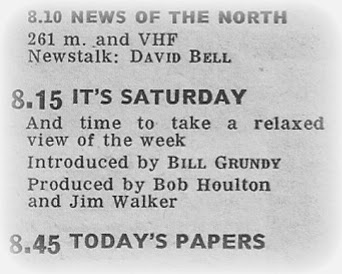
sideways look at the week’s news: It’s
Saturday.Starting in June 1967 this
was a Home Service/Radio 4 programme that aired in the Northern region only on
Saturday morning between 8.15 and 8.45 (later 8.20 to 8.45 am) whilst the most
of the country enjoyed From Our Own
Correspondent.
The original host was James Hogg, at the time a Look North presenter and later on Nationwide. By 1969 he’d been succeeded
by Bill Grundy, who’d been mainly at Granada TV, though he had done some radio
work, on the North Home Service Sport
Spotlight and representing the North on Round
Britain Quiz for example.
It’s Saturday was
noted for its “irreverent attitude to the news and to public figures” and remained
a Radio 4 fixture until 1973. However it gained some notoriety in October 1970
during the Tory Party conference in Blackpool when it featured items that
angered BBC bosses and led to the ‘resignation’ of Grundy, singer-songwriter
Alex Glasgow, freelance producer/announcer Jim Walker and reporter David
Bean.
The man in charge of operations in Manchester, Grahame
Miller (Head of Programmes, North) was unhappy with an announcement that went
“Bill Grundy has just been to Blackpool, where apparently a group of people
have taken a week off to hold a conference to condemn absenteeism.” There was also reference to delegates “rolling
over like dogs waiting to be tickled” when Sir Alec Douglas-Home spoke. Finally
Alex Glasgow sang a satirical song about selling arms to South Africa: “I’m
going to sell a little bomb to South Africa. Just a teeny-weeny bomb to South
Africa…”
Programme producer Barbara MacDonald was told to “restrict
the political content”. Alex Glasgow was unhappy about being “pre-censored” and
Bill Grundy was “appalled”. “It’s
Saturday was”, he said, “acerbic about both main political parties. To try
to treat it in this way is to knock all the life out of an extra-ordinarily
lively programme”. It’s unclear why the Corporation chose that moment to
administer a rap over the knuckles but at the time the press noted a recent
letter in the Daily Telegraph from
Tory MP Harold Soref who described the programme as “sneering”, “vitriolic” and
a type of “public filth.”
It’s Saturday ran
for another three years with various presenters: Stuart Hall, Michael Winstanley,
the programmes’ former producer Bob Houlton, newspaper editor Barry Askew and
finally Tony Eccles.
Listen to the Space
All first broadcast on Friday night on the Home Service (later
Radio 4) with a repeat on Sunday on the Light Programme (later Radio 2)
Series 1: 11 episodes 23 April to 2 July 1965 (14 May edition
not broadcast though a LP edition was scheduled for 16 May and listed as a
repeat) Series 2: 13 episodes 26 November 1965 to 18 February 1966 Series 3: 20 episodes 23 September 1966 to 3 February 1967 Series 4: 13 episodes 22 September 1967 to 15 December 1967
Follow this Space Series 1: 13 episodes 11 October 1968 to 3 January 1969
(Radio 4)
With thanks to Dave Rhodes for alerting me to the existence
of It’s Saturday.
McDougall joined the Corporation in 1948 after serving in the Intelligence Corps and seeing active service in Italy. A year later, at the age of 28, he became the youngest foreign correspondent the BBC had ever appointed when he was posted to the Paris office.
He went on to file an estimated 1200 reports for Radio 4 and World Service from more than 40 countries across four continents, enjoying long-term postings to Vienna, Berlin, Africa, the Far East, Belgrade, Bonn and Brussels.
On reaching 60, he took on the role of editor and presenter of Radio 3's Six Continents, which examined news from the communist world and the Middle East, remaining with the programme for seven years.
Finally retiring from the BBC in 1988 after 40 years, McDougall became a tutor and lecturer at Oxford University, specialising in Russian politics and history.
In fact Ariel is probably way understating the number of reports he filed, the number is nearer 14,000.
Six Continents was introduced in September 1979 as part of a Radio 3 schedule shake-up by incoming controller Ian McIntyre, something of a departure for the mainly music based network. The idea was to provide news analysis of world events based on output from the BBC’s Monitoring Service.
Writing about the programme for the Radio Times in 1979, Mike Phillips recalled that “the Monitoring Service began at the start of the war years as part of the BBC’s war effort and has recently seen its 40th birthday. At Caversham there are over 100 monitors listening to the output of radio stations broadcasting in over 40 languages. The BBC World Service, the Foreign Office and as number of newspapers and commercial agencies use the product of Caversham’s work but so far there’s been no regular service direct to the public”.
Six Continents ran on Radio 3 until 1987 with Angus McDermid sharing presenting duties in later years. This edition comes from Wednesday 16 April 1986 and Ian McDougall examines the Libyan crisis, nuclear testing, the Philippines, India, world terrorism, Ethiopia and Soviet life.
There are no recordings from the foreign radio broadcasts, the extracts here are read by Clifford Norgate, Sean Barrett and Susan Denny. The producer is Adam Raphael who, I assume, is the journalist who at the time was political editor for The Observer. (I assume incorrectly, see comment below).
Local TV services have met with, it’s fair to say, mixed
fortunes. The service in Birmingham, for instance, had an abortive start when
City TV collapsed before launch. Picking up that licence is a consortium headed
by Chris Perry and Kaleidoscope TV, names that will be familiar to anyone who’s
read about the recovery of ‘missing believed wiped’ TV archives.
And the radio connection? Well I mention this because
amongst the shows on Big Centre TV, launching this coming Saturday, is a chat
show fronted by veteran broadcaster David Hamilton. Whilst there’s no discernible
local connection the first show sees ‘Diddy’ David having a nostalgic trip down
memory lane with his old DJ chums Ed Stewart and Pete Murray. There’s more about
the recording of that show here. Future guests include Jona Lewie, Jackie
Trent, P.J. Proby, Tony Christie, Jane Rossington and Madeline Smith.
Imagine being able to fashion a radio time-travelling device
that can receive your favourite show from the past or being able to listen
again to an historic broadcast (and no I’m not talking about 4 Extra!)
OK, so it probably wouldn’t be BBC Radio 2 on 18 February
1985. As far as I know nothing earth-shatteringly significant happened that
day. But, for no real apparent reason, thirty years ago I decided to stick some
tapes in my cassette recorder and capture that days output, well a large chunk
of it.
This is your chance to hear again how the station sounded in
the mid-80s, from Night Ride to Round Midnight, stopping off at the JY
show, John Dunn’s Mystery Voice and
all points in between. Here's a quick rundown of the day in jingle form and the full Radio Times schedule.
These are the technical bits: I’m posting the clips on my
YouTube channel just to ensure a wider audience. I’ve chopped out most of the
commercial music tracks in order to avoid any copyright notices. So far this
seems to have worked, though for some reason listeners in Germany may not be
able to hear all the programmes, sorry Germany.
I’ll be posting the shows online during the day of the 18
February 2015 at the same time as their original start time – although to avoid
staying up all night Peter Dickson and Colin Berry’s show will be available on
Tuesday night. Each time a programme is added I’ll update this blog post, send
a Tweet and update my Facebook page. All times in GMT of course.
Unfortunately I didn’t record every show that day. So you
won’t hear the specialist music shows with Alan Dell and Humph, the
mid-afternoon sequence Music All the Way
or that evening’s Star Sound Special.However, elsewhere on this blog you can read
about and hear Alan Dell, Humphrey Lyttelton and Music All the Way. Also the quality of the audio is variable, this is nothing to do with my FM reception at the time but more the fact I used budget tapes.
Kicking things off at 1 a.m. was Peter Dickson with a
suitably jokey start to Nightride.
Peter took care of the overnight shifts alternating with either Bill Rennells
or Charles Nove. Lack of needletime meant we still had doses of the Radio
Orchestra, the Brian Lemon Trio and so on. Making the first of two appearances
that day is John Fogerty, whose new album Centrefield
had just been released, although Peter seems not to know the former lead singer
of Creedence Clearwater Revival. There’s a also a talk from Barney Lawrence –
anyone know who he is? This kind of (mildly) comical talk was still a feature
of Nightride just as they had been on
You and the Night and the Music.
Following Nightride
was a repeat of the previous day’s Two’s
Best with John Dunn, demonstrating that the current overnight repeat policy
is nothing new. Sadly I didn’t record this programme.
At the time the king of the early shows was Colin Berry
who’d had early starts, on and off, since January 1976. Getting up before dawn
every day must have been taking its toll as Colin reports he’s practically
wrecked the studio and nearly garrotted himself with his headphone lead. Note
also a mention of changes that evening on BBC TV, he’s referring to a new BBC1
globe and the launch of EastEnders.
Listen out too for a news summary from David Bellan.
At 6 a.m. enter the still much missed Ray Moore. Ray’s on
form this morning, witness that lovely intro into the Shakin’ Stevens track
There’s also mention of the announcers over on Radio 3 with Tarmac Rigby and Miss
Hughes who’s apparently “gone into tax exile”. Towards the end of this
recording catch Bill Rennells voicing a trail for Gloria’s show later that day
and her special guest David Cassidy – more on that to follow.
It’s “hello chums” from Ken Bruce on the Radio 2 breakfast
show. Perhaps it should have been the Late,
Late Breakfast Show as Ken didn’t go on-air until 8.05 am. At the time of
this recording he’d been presenting the programme for just six weeks. Punctuating
proceedings are Steve Madden reading the news and Pause for Thought with the Rev Roger Royle. Listeners to Radio 2’s
current morning output will notice how much calmer it all was thirty years ago;
no shouting, no whooping, no laughing acolytes and no-one else to read the
traffic news.
The matters on Jimmy Young’s agenda at 10.30 are the
Falklands, the miners, school dinners and Winter Fuel Allowances. In this
extract he interviews SNP MP Gordon Wilson about his Cold Climate Allowance
Bill and Peter Smith of teachers’ union AMMA about school kids supposedly
having ‘chips with everything’. In contrast to Jeremy Vine’s show no listeners
appeared on the programme to voice their opinions, all the feedback from “the
listener” is read out by Jim himself. “Bye for now!”
“Hello there!” It’s amazing to think that Radio 2 took an
hour out each lunchtime for David Jacobs to play “our kind of music”. Much as I
love the music he played it really did seem like the station was stepping back
to the days of the Light Programme, even including a track by Frank
Chacksfield, a regular on the Light.
As a reminder that Radio 2 used to have women presenters during
the day on weekdays here’s Gloria Hunniford with an edited version of her
90-minute show. Promised guest David Cassidy is a no-show, having backed out at
12 noon due to a “contractual difficulty”, so instead its Bonnie Langford!
Glo’s second guest is author John Byrne Cooke, son of Alistair Cooke.
From 3.30 pm it’s as if Radio 2 had a short interlude and
put up the audio equivalent of the test card whilst Music All the Way was on. This was a 30-minute sequence of music on
record and BBC sessions. I didn’t record the programme for 18 February but you
can hear an edition from February 1986 here. Of Music All the Way former Radio 2 presenter and announcer Charles
Nove commented: “An odd
little duty, that one, which involved heading for one of Broadcasting House's
least popular studios (bit of lashup, no windows, dodgy ventilation etc) and
doing the live top and tail for this, and playing in the music, ‘supervised’ by
the BBC's most panicky producer and a bored engineer. Overmanning? Never!”
In all the recordings so far you’ll have heard very little new music, and certainly nothing that would trouble the charts. That’s why David Hamilton’s show was such a breath of fresh air, and rightly dubbed “the music show”. There’s also plenty of listener interaction and prizes available in The Music Game and Spot the Intro.
The
reigning monarch of drivetime for an eon was John Dunn. The show’s mix of
music, topical interviews and a quiz – in this case the long-running Mystery Voice competition – is still the
template for today’s Radio 2 offering. Providing the programme rundown at the
end of this recording is John Marsh.
There
are no recordings of Alan Dell’s double bill of the Dance Band Days and the Big
Band Era but you can hear other editions here. Nor did I tape Humphrey
Lyttelton with The Best of Jazz but
there’s plenty of Humph here. And again I inexplicably failed to record Star Sound Special in which John Benson
featured the music of Nelson Riddle. But what you can hear again is the third
edition of a new panel game, and the second dose that day of David Hamilton, in
Some of These Days. The premise of
the programme was to answer questions about news, events, TV shows and music
that happened on that day in history. On the panel are Peter Jones, Sheila
Tracy, Fiona Fullerton and Barry Cryer.
Closing
proceedings for the day is Brian Matthew with the daily arts and music show Round Midnight, at this point more than
halfway through its 12 year run.Brian’s
guests are Patrick Marr and James Roose-Evans talking about the revival of
George Axelrod’s play The Seven Year Itch
and author Nickolai Tolstoy plugging his latest book The Quest for Merlin.
Talk Radio, the UK’s third commercial radio station,
officially launched on this day in 1995. Its programme director Jeremy Scott
promised a “provocative, opinionated and confrontational approach”, though
listeners may have heard little of that in the opening offering from Sean
Bolger and Samantha Meah. Perhaps it was all a little too early in the morning.
The third national licence, following the award of the first
two to Classic FM and Virgin, had been advertised in November 1993 as a
“predominantly speech” station, which the Radio Authority deemed to be 51% in
any three hours. Six bids were received with Talk Radio offering an aggressive
£3.82m.Others in the running were
Newstalk UK £2.75m, Apollo Radio £2.27m, LBC £2m, First National Entertainment
Radio £1.54m and Jim Black Broadcasting with £1.04m.Talk Radio’s bid had the
backing of the US group Emmis Broadcasting who ran radio stations in Los
Angeles, New York and Chicago, plus Australian based Prime Television and
Hambro Bank.
The launch line-up included a number of well-known radio
(and TV) voices such as Scott Chisholm, Vanessa Feltz, Anna Raeburn, Terry
Christian, Jeremy Beadle, Tommy Boyd, Dr David Starkey and Kiss FM ‘shock jock’
Caesar the Geezer. But MD John Aumonier promised that the shock jock tactics so
beloved of US talk radio and employed by the likes of Howard Stern and Rush
Limbaugh would not be part of his station’s output. “Number one, the market
does not want it. Two the regulatory authority would not allow it.” However he
did promise to shake up the cosy image of speech radio in the UK and that the
station’s style would be “profoundly shocking” but not offensive. This is a short clip taken from a test transmission on 12 February 1995.
Though the official launch date was given as Valentine’s Day
1995, the station snuck in early on the evening of the 13th with a three-hour
show from Caesar the Geezer at 10 pm. and then an hour of Wild Al Kelly. From 2
am Talk Radio resumed test transmissions until the 6 am official launch.
Providing the tongue-in check quasi-BBC announcements was
actor Jonathan Kydd - Talk Radio was transmitting on what had been Radio 1’s
medium wave frequencies – over Graham de Wilde’s KPM library music composition The Unknown Warrior. The opening news
bulletin was read by Sophie Decker, if memory serves she’d previously been part
of Radio 1’s Newsbeat team, before
leading into The Dish with Bolger and
Meah, a show described as “unremittingly dreadful” by the Daily Telegraph’s Gillian Reynolds.
Later that day, at 7pm, the station offered The Rude Awakening with Carol McGiffin
and Moz Dee, That programme title – and Talk Radio loved its programme titles
in the early days – was a little misleading for an evening show. The reason
stems from an eleventh-hour change of heart when test runs of the breakfast
show with McGiffin and Dee proved just too rude and just three days before
launch it was swapped with Bolger and Meah’s show.
Here’s Talk Radio’s launch programme schedule:
Monday-Friday
0100 Wild Al Kelly & Mike Hanson
0600 The Dish with Samantha Meah and
Sean Bolger
1000 UK Today with Scott Chisholm
1300 Anna Raeburn
1500 Boyd Up with Tommy Boyd
1900 The Rude Awakening with Carol
McGiffin and Maurice Dee
2200 Caesar The Geezer
Saturday
0100 Something For The Weekend with
Nick Miller
0600 Maurice Dee
1000 Dr. David Starkey
1300 Sound Advice with Gary Jacobs
1500 Books People Read with David Freeman
1700 World's Biggest Quiz with Dale
Winton
1900 Janet's Planet with Janet
Gershlick
2200 The Other Side with Ronnie
Barbour
Sunday
0100 Something For The Weekend with
Nick Miller
0600 Dangerous Dan Erlich
1000 She'll Be Wearing Pink Pyjamas with
Vanessa Feltz
1300 Nancy Roberts
1500 Success with Sue Plumtree
1600 Gary Newbon
1900 Terry Christian
2200 Jeremy Beadle
One name missing from the line-up but at the time already
floated as a possible recruit was Steve Wright. Speaking to the Radio Times his agent Jo Gurnett denied
this: “Steve has no plans to join Talk Radio”. But he’d resigned from Radio 1
just 2 or 3 weeks earlier and had, it transpired, spent four months negotiating
with the station. Steve joined nine months later.
Talk Radio UK faced a turbulent first year on air. A failure
to draw in sufficient advertisers compounded with the large licence bid led to considerable
losses and an early management shake-up. On air the shock jock tactics of
certain DJs – fifteen complaints were upheld by the Radio Authority in the
first three weeks alone - meant a number had been dropped by the end of the
year. First to be yanked off the air was Wild Al Kelly, his co-presenter Mike
Hanson talking to the Independent in
April wouldn’t be drawn on the reason why “but let slip it was something about
fish.” Kelly was initially replaced by Chad Benson, working on overnights
alongside Hanson, before both were replaced by Ian Collins. Others falling by
the wayside were Terry Christian and, just 48 hours later, Caesar the Geezer.
By the Autumn 1995 Samantha Meah, Dale Winton, Janet Gershlick
and Sue Plumtree had also gone and from October there was a refreshed more
news-based line-up that included some old hands: James Whale, Mike Dickin, Jonny
Gould, Sandy Warr with First Report, Trevor
McDonald with a Sunday morning political show, Simon Bates and Jonathan King.
In November Wrighty eventually came on board. Once again the listening figures
failed to hit the mark and Bates and King had left the station by the following
March.
There’s a whole stack
of Talk Radio UK off-air recordings uploaded onto YouTube by user dpro73 (link
here) including a recording of the station launch that’s way longer than the
one I made, but nothing from Bates or King and only one instance of Steve
Wright so here are three recordings from my own archive.
Firstly from 2 October 1995 it’s Breakfast with Bates with Simon Bates, of course, and discussion
about the extra-marital activities of Princess Diana. The news headlines are read
by Sandy Warr.
Following Simon that day was Jonathan King complete with his
Entertainment USA theme tune.
And finally from 6 January 1996 it’s the Saturday morning Steve Wright’s Talk Show. With Steve is Georgey
Spanswick and his old Radio 1 chum Richard Easter. The guests are
former Rugby league player Brian Moore, who years later would go on to present
on Talk Radio’s successor talksport, Les Dennis, Jon Culshaw and John Carter, best known for Holiday and Wish You Were Here.