This week BBC Radio 4 is broadcasting the 5-part dramatised
account of the story of pre-war BBC Talks Director Hilda Matheson and her working
relationship with Director-General, John Reith, and the censorship of a talk by
writer and politician Harold Nicolson in
The Battle of Savoy Hill.
Matheson was effectively head-hunted by Reith in September
1926 to front the Talks Department, the first woman to be appointed to a senior
role at the BBC. During her brief 5-year
tenure she effectively set the template for speech radio on authored talks (a
style of broadcasts that has now all but disappeared with the exception of
Radio 3’s The Essay), news and
political coverage and debate and discussions on literature, history, social
conditions, home economics, farming and so on. The Week in Westminster, started by Matheson in 1929 and still
heard today, albeit under a much changed format on Saturday mornings, remains a
testament to her pioneering work. Broadcasting, she saw as “a means of
enlarging the frontiers of human interest and consciousness, of widening
personal experience, of shrinking the earth’s surface.”
It was Matheson’s entrée into the life of London’s cultural
and intellectual elite that helped secure her BBC employment; she’d first
encountered Reith at an event in March 1926. During World War I she worked for
the secret service – recruited at Oxford where she’d been a home student, as
women weren’t yet recognised as bona fide students at that time - where she was
posted to Rome. She left her role as political secretary to Nancy Astor MP to
take up her job with the BBC, then based at Savoy Hill. Lady Astor would, in
time, contribute to some of the early editions of The Week in Westminster.
The nature of speech radio was still being developed under
Matheson and she was keen to get the key thinkers and doers of the time to
speak to the nation, to help shape the way that scripted talks were written for
the medium and how they would best be delivered to sound both natural and
authoritative without being stilted and lecturing. Her remit also included adult
education and news, when the small news section created under Education moved
to Talks in 1927. Matheson would commission Philip Macer-Wright, formerly of
the Westminster Gazette, to report on
how news presentation could be improved at a time when the BBC was still
relying on re-writing Reuters-provided bulletins.
One aspect of Hilda’s
life that the puritanical Reith would surely have objected to – although
apparently it was something of an open secret at Savoy Hill - was her
relationship with author Vita Sackville-West. She’d met Sackville-West in
December 1928 when she came into the studios to speak with Hugh Walpole on the
subject of The Modern Woman (though
she had already broadcast some talks earlier in the 1928 on poetry and her
travels in the Middle East). Correspondence from Hilda to Vita, of which almost
100 letters survive, also feature in The
Battle of Savoy Hill.
By 1930 Matheson’s working relationship with John Reith was
already somewhat fractious particularly with regard to any subject or speaker
regarded as ‘controversial’, with the DG naturally erring on the conservative
side. This all came to a head in late 1931over the series
The New Spirit in Literature (twelve talks broadcast on the
National Programme Sept-Dec 1931) in which Vita’s husband Harold Nicholson had
been invited to speak. Reith and Director of Programmes
Roger Eckersley wanted
no mention of D.H. Lawrence and James Joyce. Nicholson threatened to pull out
“pointing out the ludicrous nature of a programme on modern literature without
reference to these two defining authors”.
A compromise was reached but Matheson felt severely undermined and
tendered her resignation.
What is also interesting, certainly from a current
perspective, is that Matheson’s resignation was also seen as useful to Reith
and the BBC over perceived left-wing bias in some of the talks’ subject matter
and choice of speakers. The October 1931 General Election had led to the
formation of a National Government under Ramsey MacDonald but the bulk of its
support came from the Tories and there was growing criticism of the BBC in the
right-wing press. Thus her leaving the Corporation helped Reith to be seen to
be stamping out any perceived left-wing bias.
After leaving the BBC Hilda continued to be involved in
radio. Nancy Astor tried to persuade her to become a BBC Governor but she
declined. Instead she became a radio critic and columnist for The Observer and Weekend Review, wrote a book on the subject (Broadcasting , Thomas Butterworth Ltd, 1933) and at the outbreak of
World War II became the Director of the JBC (Joint Broadcasting Committee)
founded to “promote international understanding
by means of broadcasting”. She also worked for Baron Hailey in 1937-38 on
producing The African Survey, eventually
taking over the bulk of the work, for which she received an OBE. By now she was
living with the poet Dorothy Wellesley – her relationship with Sackville-West
had ended in 1931. Diagnosed with Graves’ disease Hilda did not survive an
operation to remove part of her thyroid gland and she died in October 1940 aged
just 52.
The BBC marked her passing in the annual BBC Handbook adding
that “it was her zeal, and her ability to impart it to the wide circle of her
acquaintance, that started broadcast talks and discussions, and began that
process of bringing to the microphone the celebrity, the expert, the thinker,
and the man-in- the-street which has continued since in ever-widening circles”.
Until just a few years ago Hilda Matheson’s pioneering role
in radio broadcasting was largely overlooked. The 6’6” frame of John Reith
tends to loom large over the pre-war BBC narrative. In 2018-2019 the BBC ran
the Hilda Matheson Woman into Leadership regional development programme. Just
last month even MI5 recognised her role in that organisation and with the BBC
as part of their LGBT+ History Month events.

The Battle of Savoy Hill written by Jill Waters is broadcast on Monday to Friday this week on
BBC Radio 4 at 12.04 and repeated at 22.45 and then available to listen again
on BBC Sounds. Hilda Matheson is played by Romola Garai, Vita Sackville-West by
Nancy Carroll, John Reith by Derek Riddell, Harold Nicholson and R.S. Lambert (a
producer in the Adult Education section and the first editor of The Listener) by Richard Goulding and
Lionel Fielden (a Talks producer) by Simon Paisley Day. The narrator is Clare Higgins. The Battle of Savoy Hill was created by Jill Waters of The Waters Company who retain the rights for the series.
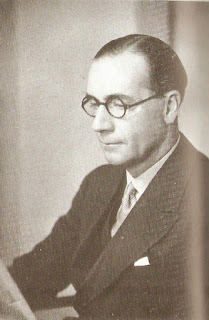
Hilda Matheson 1888-1940
Notes:
(1) When Hilda joined the BBC as a Talks Assistant (i.e.
producer) in September 1926 the Talks division was part of the Education
Department under the stewardship of John Stobart but was hived off in January
1927 under Hilda’s management. Broadcast talks were an early feature of BBC
schedules with the first given on 23 December 1922 and the second on 27 January
1923 on the unlikely subject of How to
catch a tiger.
(2) The changes in
the structure of the Talks department and the role of Education and News are
too lengthy and involved to reiterate here. For more on this early BBC history
see The History of Broadcasting in the
United Kingdom, Volume II: The Golden Age of Wireless 1927-1939 by Asa
Briggs and A Social History of British
Broadcasting, Volume I 1922-1939 by Paddy Scannell and David Cardiff.
(3) Hilda Matheson’s successor as Director of Talks was her
deputy Charles Siepmann. He was followed in 1936 by Richard Maconachie and in
1941 by George Barnes (later the first controller of the Third Programme and a
couple of years later as the grandly titled Director of the Spoken Word which
included the Talks division). Succeeding Barnes in 1946 was R.A. (Tony) Rendall
and following his retirement on ill health grounds was Mary Somerville from
1950 to 1956. Former talks producer John Green was Controller, Talks (Sound)
from 1956 to 1961 when it was merged with Current Affairs Talks under the
management of J.A. Camacho. In 1972 it moved again to become part of Talks and
Documentaries headed by George Fischer. Under Director-General John Birt it was
finally subsumed into the mighty News and Current Affairs Directorate in 1987.
The External Services also had an Overseas Talks department and a separate
European Talks Department.
(4) To read more about Hilda Matheson there are a couple of
excellent books. Stoker: the Life of
Hilda Matheson is a biography written by Michael Carney whilst Kate
Murphy’s Behind the Wireless looks at
the role of women at the BBC in the pre-war years. There’s also the
fictionalised story of plucky BBC secretary turned Talks producer Maisie
Musgrave as told in Radio Girls by
Sarah-Jane Stratford in which Reith and Matheson are main characters.