On Monday the BBC celebrates 100 years since its first radio
broadcast on 14 November 1922.
Making the opening announcement on station 2LO was Director
of Programmes Arthur Burrows who wrote: “November 14, 1922, was the day chosen
to commence British broadcasting in the official sense. It was the day of the
declaration of polls in connection with the General Election, and the news for
that evening consisted in the main of election results. The next day the
Birmingham station, 5IT, began to operate, and within a week 2ZY had also
joined in the work. The London station continued in my charge (Mr Jeffries
arranging the musical programmes and sharing in the pleasures of the children’s
hour). Birmingham fortunately secured the direction of Mr Percy Edgar, already
well known in the Midlands, and Metropolitan Vickers appointed to the
Manchester station Mr K.A. Wright, a young graduate of Sheffield, who, since
his earliest days with the firm, had shown a keen interest in music and its
propagation by wireless. One cannot look back upon those early days without a
smile.”
To mark the BBC’s centenary I’ve produced this sound montage
100 Years of BBC Radio in 100 History.
Roughly chronological in order it’s my selection of some memorable voices and
programmes designed to show something of the breadth of the radio services. I
hope you enjoy it.
You’ll hear some broadcasters who make more than one
appearance but see if you can spot who appears most often, on seven different
clips throughout the sequence.
Here’s the version with accompanying pictures.
The selection of early clips was, of course, limited by
what’s survived from that period. Most of my audio for the first half century
comes from compilation records issued by the BBC (for their 50th and
75th), documentary programmes about BBC history I’ve recorded over
the last 40+ years and repeats, often on Radio 4 Extra. Those 1920s clips you
here were all recreated for the May 1932 programme The End of Savoy Hill produced by Lance Sieveking. Much of what you
hear from the mid-70s onwards was recorded by me at the time or may come from
recordings kindly donated since starting this blog.
Inevitably as soon as I’d edited the ‘final’ final version I
remembered all the stuff I’d missed out. No “I’m rather worried about Jim” or “Give
‘em the money Barney”, no Noel’s funny phone calls, no reports from foreign
correspondents (other than wartime), the role of the European Service during the Cold War. I could
go on. Summarising local radio or what the BBC calls ‘the Nations’ was
impossible; they all just get seven minutes. The wonderful World Service has
been reduced to two minutes.
I first started work on this project after completing my
BBC90 montage, saving clips away in a separate folder. Most made the cut, some
just didn’t fit or no longer felt appropriate or interesting. Serious editing,
sequence by sequence, started in February and altogether I’ve used nearly 700
different bits of audio (including jingles). I reckon about 20% of material was
also in the BBC90 celebration. Thanks go again to Andy Howells who helped with
some BBC90 material in 2012 and to Aircheck Downloads who tracked down a couple
of DJ jingles for me that appear in one of the Radio 1 sequences.
Three Plus One was
one of those comedy shows that filled in the summer recess when Week Ending was off-air. The title of
this sketch show reflects the cast make-up: three women and one man. It
appeared in the summer of 1982 for just six episodes after a one-off Easter
show that year and was never heard again. Until now.
The ‘three’ were:
Denise Coffey - established comic actress and the real star
of the show. Best known on TV for Do Not
Adjust Your Set and on radio for The
Next Programme Follows Almost Immediately and The Burkiss Way (amongst dozens of credits).
Alison Steadman - at the time perhaps best known for her TV
appearances in Mike Leigh’s Nuts in May and
Abigail’s Party but on radio recent
work on Eddie Braden’s The Show with Ten
Legs and on The News Huddlines.
Susan Denekar – a relative unknown performer who has a
number of tv and theatre acting roles to her credit but appears to have done no
other radio work. She sings the comic songs in this series.
The ‘one’ was the token man David Jackson Young. A comedy
writer and performer he had been involved with the Radio Active team and was one of the writers for Three Plus One.
In the pilot programme broadcast on 9 April 1982 the ‘three’
are Denise, Alison and Emma Thompson, whilst the ‘one’ is Nicholas le Prevost.
Emma had already co-starred in a previous summer show whilst Week Ending was on a break. This was the
rather more successful Injury Time in
1980 and again in 1981, that also came back for a Tuesday night series in the
summer of 1982. Emma wrote a sketch for the sixth episode of Three Plus One.
The series was produced by Jan Ravens, another Cambridge
Footlights alumni, who was a radio Light Entertainment producer in 1982/83
working on shows such as Week Ending
and The Law Game.
Robert Ottaway previews the series for the Radio Times
An episode of Three Plus One is being broadcast on BBC Radio 4 Extra today (seems to be episode
2) as part of its Lost Gems archive offerings. To supplement that repeat I’ve dug around in
my box of tapes to turn up another show from the series. I kept all six shows
though as I used cheap tapes for these recordings the quality isn’t great.
In the fifth episode the focus is on performances at the
Edinburgh Fringe, a subject familiar to most of the cast and writers. There’s a
stellar list of contributors to the script: Eddie Canfor-Dumas (TV scriptwriter
and novelist), Janey Preger (mainly a TV scriptwriter including Angels, No Frills, Coronation Street
and later on The Archers), David Kind
(Punch Line, Naked Video, Hale and Pace
and Spitting Image), Sandi Toksvig
(at the time on ITV’s No 73), Nick
Symons (who would also co-write with Sandi for Radio 4’s Cat’s Whsikers and TV’s Kin
of the Castle) and Robin Sieger (later a BBC TV executive and now a leading
motivational ‘guru’).
There’s a common thread linking the other writers with all
of them working on shows such as Week
Ending, The News Huddlines, Three of a Kind, Carrott’s Lib, The Lenny
Henry Show and Spitting Image.
They are Andrea Solomons, James Hendrie, Bob Sinfield, Guy Jenkin and Ian
Hislop.
In this episode the song is written by American lyricist
Fran Landesman
Does Three Plus One
stand the test of time some 40 years later? I’ll leave you to decide based on
these recordings.
Three Plus One
Pilot (title Three
Plus One on 4) 9 April 1982
Episodes 1 – 6 Fridays 2235-2300 30 July – 3 September 1982
Radio may have its nobility whether it’s Tony ‘Your Royal
Ruler’ Prince, Emperor Rosko or The Baron. But seventy years ago UK radio had
the real thing, a broadcasting Princess whose career lasted thirty years but is
now largely forgotten.
For many years Princess Indira Devi Kaur of Kapurthala
reported to a worldwide audience on the proceedings in the House of Commons; at
the time she was often the only woman in the Press Gallery. Later, during the
1950s and 60s, she would regularly provide a monthly commentary on the
happenings at Westminster for the domestic audience of Woman’s Hour.
Maharajkumari Indira Devi was born on 26 February 1912 to
Maharaja Paramjit Singh and Maharani Brinda of Kapurthala in what was then
known as East Punjab. It was not exactly an ordinary Indian upbringing. As a
young girl she lived in a replica Palace of Versailles.“My grandfather built it. He admired the
French one so much that he had an exact replica made in Karpurthala.
Grandfather was the last of the old-time Maharajahs.”
Despite this exotic upbringing Indira, perhaps fearing she
would be forced into a loveless arranged marriage like that of her parents, ran
away from home in 1935 and left for Britain, only her sisters Princesses
Sushila and Ourmilla knowing of her plans. In London she studied at the Royal
Academy of Dramatic Art with the notion of becoming a movie star. She did
briefly work for Alexander Korda at London Films who had her in mind as the
next Merle Oberon. That failed to go anywhere but she gained some useful experience as a film extra,
modelling, at least two theatre productions and an appearance on pre-war television
on an edition of Picture Page.
When World War II broke out Princess Indira initially did
her bit by driving ambulances for St John’s Ambulance but soon joined the BBC,
at first as an interpreter, “in the department that translates letters in
peculiar tongues. It was terribly boring”. By 1941 as part of the Indian
section of the Eastern Services based at 200 Oxford Street (where George Orwell
also worked as a Talks Producer), she began to make her first broadcasts in
Hindustani on the programme Hello Punja,
a programme aimed at members of the British Indian Army based in the Middle East
and the Med. She also made her first broadcasts on the Home Service on the
subject of Indian culture.
The Radio Princess, as she soon became known, also started
to broadcast in English (initially on the Eastern Services but post-war on the
General Overseas Service) in a programme known as The Debate Continues. Starting in 1941 this was a weekly 15 minute report
on news from the House of Commons for the BBC’s international audience and ran
on the GOS until the 1950s (exact date unknown to me).
For the London Calling
magazine in December 1953 Indira made this contribution to a feature on Stories Behind the Broadcast.
Between 1954 and 1964 she would make regular reports for Woman’s Hour on the Light Programme in The Month in Parliament, later billed as
Parliamentary Notebook, Parliamentary Diary or Impressions from Parliament.
By the mid-60s Indira had moved to Ibiza but she continued
to record occasional contributions for Woman’s
Hour on her life on the island until her last broadcast in 1967. Little is
known of her life at this time other than that she ran a bar, quite a contrast
to her upbringing in the Indian Versailles. Indira died on 1 September 1979.
You can hear and see The Radio Princess in this 1941 film
documentary 19 Metre Band
The standing joke is that his last name is Afternoon such is
his long tenure on national radio in the mid-afternoon. A large percentage of
listeners won’t be able to recall a time when Steve Wright wasn’t on in the
afternoon as he’s made that his radio home for 35 of the last 40 years.
But all that is about to come to end this coming week as Wrighty
steps down (or is gently pushed depending on how you read it) from BBC Radio
2’s afternoon show and Scott Mills finally makes a permanent move over to Wogan
House.
In this blog post I’m posting a selection of Steve’s shows
on Radio 1 and Radio 2 from the last four decades.
Steve Wright's biog in 1988
Steve’s radio career is well documented so I won’t go into
too much detail. After a number of jobs from telephone engineer, insurance
agent and club singer he moved into journalism on a local paper and then at
LBC. His first broadcasts were on the Belgium-based pirate station Radio
Atlantis (do any recordings exist?). In 1976 Steve joined Radio 210 at its
launch with some pun-laden programme titles such as Wright On and, in partnership with Mike Read, The Read and Wright Show. See the Radio 210 website for more on
this.
In 1979 it was off to Luxembourg for a brief spell on 208.
Some audio of his time is on this Luxy website.
By January 1980 Steve had been signed up by the BBC and took
over the Saturday night slot from Peter Powell. He presented his first Top of the Pops a month later. Moving to
Saturday mornings later that year he picked numerous holiday cover shifts,
including the breakfast show, before berthing in the afternoon show slot, then
1530-1700, on 5 October 1981 where he stayed for the next 12 years.This was the
era of ‘The Afternoon Boys’(later ‘the posse’), “I’m all right, you all
right?”, “Get some therapy”, True Stories
and the Celebrity Trivia Quiz.
Characters such as Damian the Social Worker, Sid the Manager (“hello boy!),
Gervais the Hairdresser and Mr Angry from Purley (the voice of TO Dave Wernham
who also played Dave Doubledecks) would pop into the studio or be on the phone.
Steve was instrumental in bringing the zoo format to British radio. Frequent
visits to the States provided much of the inspiration with the likes of Scott
Shannon and the Morning Zoo on Z100 and The Greaseman on WWDC.
Putting the record Wright (Radio Times 1 October 1983)
From the summer of 1982 Steve was part of the Radio 1 Roadshow and this is the first
25 minutes of his show from Morecambe on 5 August. There’s chance for you to
have a go at Bits ‘n’ Pieces.
Here’s part of the afternoon show from Monday 2 May 1983.
It’s a Bank Holiday so we get the show in super stereo on VHF (Radio 1
‘borrowing’ Radio 2 FM frequencies for the afternoon) but we don’t get many of
the regular features. There’s some Showbiz
Gossip, a stupidly simple Celebrity
Trivia Quiz and Tommy Vance advertising the virtues of Stench. And if you thought that Steve’s habit of singing over the end of a record is a recent
trait you’ll realise he’s been doing it for decades.
Although this next recording from 18 February 1985 lasts
only 16 minutes we get bags of characters and catchphrases plus an extra dose
of Mezzoforte’s Surprise into the Showbiz Gossip.
Another Bank Holiday show on FM, this time Easter Monday 8
April 1985 as Gary Davies hands over to Wrighty. It’sa heavily edited recording but listen out for
Mr Angry, Laura’s Second Love, Where in the World?, a non PC The Boss
(“yes Sir, Mr Wright”), loads of Ruth McCrum (“You’re listening to Steve
Wright, the guy who has the perfect body for radio”) and Andy Peebles trailing
the charity football match of Radio 1 vs BBC Radio Sheffield. By now the show
template and the production values that made the show sound ‘big’ and that
would endure for the next four decades is set. Canned applause, themes and
music beds, custom jingles (by AJ Productions), interruptions from characters, portentous
announcements (here voiced by Simon Bates), lots of teasers, bags of features
and repeating the news headlines even though they’ve been on the last bulletin.
The music is almost secondary, Steve hardly ever introduces or back annos a
track.
Early on in this sequence of recordings from Radio 1’s big
FM switch-on on 1 September 1988 is about 20 minutes of Wright. Listen out for
Sid the Manager, Adam West and John Bole (voiced by Peter Dickson, part of the
Steve Wright repertory company at that time along with Phil Cornwell and Gavin
MCoy) sounding not unlike political correspondent John Cole.
Forward on to 1991 for this recording from 1 July of another
afternoon show “extending the boundaries of radio”. We hear the end of Gary
Davies’s lunchtime show before Steve. Keep an ear out for the Hopeless the
Weather Girl and guest posse member Chris Eubank. The newsreader is Alistair
Sandford.
For Radio 1’s 25th anniversary Steve was in a
reflective mood so there are loads of old comedy bits including the shooting of
Mr Angry plus guests Smashey and Nicey, Dame Edna Everage, Spike Milligan,
Richard Madeley and Judy Finnigan, Bruce Forsyth, Steven Wright, Danny Baker,
John Major, John Smith, Mel Gibson, Clive Anderson and Sylvester Stallone.
Steve's Kind of Day (Radio Times 8 January 1994)
The last Radio 1 afternoon show aired on 24 December 1993.
In January 1994 he was at the helm of the breakfast show with some of the old
posse who were now Richard Easter, Julie De Rohan, producer Mic Wilkoyc, production
assistant Nicky Hack and Ione Brown “the new dynamic breakfast posse”. Regular
characters included Voiceover Man Peter Dickson and The Newsagent (“scuse me”).
In this recording from 25 March 1994 the features include Star Trek sketches and Amazing But True (that would become Factoids
on Radio 2). On news reading duty is Peter Bowes.
Steve’s spell on Radio 1’s breakfast show was brief, just 15
months. He was unhappy with the changes at the station as part of Matthew
Bannister’s new broomand it seems that
he was also not happy with the breakfast slot as it allowed him little show
prep time during the day; the afternoon show gave him the time to prepare and
do any pre-records etc. Plus there was a Saturday morning show on Talk Radio in
the offing and he also acted as a consultant for the GWR Group, visiting the stations
and offering encouragement and support to their staff.
Here’s Steve on Talk Radio on 6 January 1996 with Richard
Easter and Georgey Spanswick. His guests are Jon Culshaw, Les Dennis, rugby
union player Brian Moore and John Carter.
In March 1996 Steve was recruited back into the BBC fold by
the new Radio 2 controller Jim Moir. He presented three shows: Sunday Love Songs (modelled on Gerald
Harper’s old show Sunday Affair on
Capital) , still running, of course, a Saturday morning show between 10 and 1
bearing a striking resemblance to his Talk Radio stuff and, at intervals in
1996, 1997 and 1998 Steve Wright at the
Movies (later re-titled The Steve
Wright Picture Show).
With Steve on the Saturday shows were the Talk Radio team of
Richard and Georgey. There’s less mucking about on these shows, the main focus
is on the guests. This recording dates from 4 April 1998 and in the studio with
Steve is novelist Jackie Collins. By now Georgey has gone back up to Yorkshire
TV and its Liza Tarbuck in the studio.
From later in 1998 the guests are Griff Rhys Jones, Dick
Francis, Robin Gibb and on the phone Noel Edmonds, though sadly he gets cut off
in his prime as my tape ran out. Liza is
off on her holidays. The newsreader is Colin Berry. Recorded on 5
September.
It was back to weekday afternoons from 5 July 1999 when
Steve was moved to replace Ed Stewart. And he’s been there ever since. This is
the era of the Big Quiz, the Non-Stop Oldies, the Old Woman, Factoids, Ask Elvis (my favourite feature) and Serious Jockin’ (with no g). Steve’s sidekicks are, no surprise
here, Richard Easter and Janey Lee Grace, newly signed to the station from
Virgin Radio. Before long Richard was off to Celador to write scripts for Who Want’s to Be a Millionaire? and in
came Tim Smith. In this recording of the Big Show from 26 October 1999 the guests are journalist
Matthew Parris and Shania Twain. Reading the news is Fran Godfrey, with the
travel Pippa Sparkes and the sport Bob Ballard. As it did for many years the
show ends with last chords of Wichita
Lineman.
In January 1999 Steve was signed up to host a weekly show on
the BBC World Service titled Wright
Around the World. It replaced long-running popular shows A Jolly Good Show and Anything Goes. A mix of music, comedy, letters
and dedications, a mystery voice, an entertainment quiz and a Pen Pal feature
it ran until October 2003. This recording dates from around the 22 August 2002.
The final piece of audio, for the time being, is the
afternoon show from 23 May 2008. With Steve is Tim Smith and his guests are
Jack Bruce, Piers Morgan (sorry!) and Terry Wogan who previews the Eurovision
Song Contest taking place the following day in Belgrade. You’ll also hear Sally
Traffic, sports guy Jonny Saunders and Ricky Salmon reading the news.
Steve Wright in the Afternoon 1981-93, 1999-2022
“Love the Show”
Postscript:
Before the final afternoon show Steve issued a statement (full text here) which tantalisingly dangles the carrot that this is "our last SWITA for a while." Will he be back? Here's that final Radio 2 show.
Last Saturday (6th of August) Mark Chapman
introduced BBC Radio 5 live’s Sports
Report with these words: “We have
full commentary of Everton against Chelsea at 5.30, so we have 25 minutes to
get all of today’s results, and reports and reaction from as many players and
managers as we can. We’ll round up the other sport that’s happened today away
from the football. You can also find every single result on the BBC sport
website from today as well as detailed coverage of your team”.
Here’s that edition of Sports
Report.
And that was it. With no forewarning and no other
announcement a 70 year tradition of having the classified football results read
out by an announcer (or former announcer) had come to an end. Whilst plenty of people realised what had
happened there was no immediate social media storm and apparently no overnight
complaints were made to the BBC. By Sunday a couple of sports journalists had
picked up on the story and within a couple of days listeners, sports pundits
and former sports presenters were all decrying
the decision of the BBC and likening it to “cultural vandalism” (Jim
White in the Daily Telegraph).
Writing for The Times,
Henry Winter concluded "By wanting to be in touch with a youth market that
mainly doesn’t listen to sports radio, BBC executives have shown themselves out
of touch with the millions who still wish to listen to the classified football
results"
In a warm glow of nostalgia many people lamented the dropping
of reading of the results and waxed lyrical about leaving the game with their
dad, returning to the car and clicking on the radio just in time to hear Out of the Blue coming out of the
speaker and James Alexander Gordon reading the results as only he could.
Goodness knows how many people experience that today. By the time they’ve left
the stadium they’re probably up-to-date on all the other scores in their team’s
league and how their second team have done.
To be fair during Sports
Report Chappers did give all the results, albeit at intervals during the
programme and at a fair old pace. Forced to retrospectively justify the
decision the BBC said that “with the addition of the 5.30pm live Premier League
match to our coverage, Sports Report has
been condensed into a shorter programme.” Whilst true, the Everton vs Chelsea
coverage did kick-off at 5.30, there have been many previous instances where
the programme was cut to 30 minutes, such as the 2009-10 season, but the
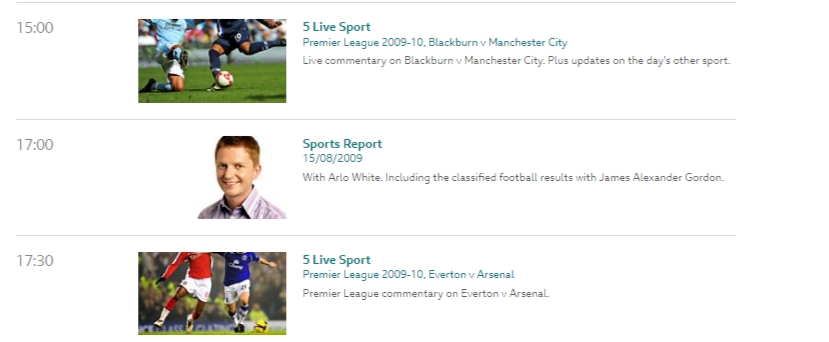
results were still read by JAG (see schedule from 15 August 2009 above). I wouldn’t be surprised if they’d made the
decision some time ago and that the evening fixtures provided the perfect
excuse.
The BBC statement went on to say that “we will still offer a
comprehensive goal service throughout the day on air and on the BBC Sport
website as well as Final Score on BBC
One. We would like to thank everyone who has read the classified football
results on 5 Live over the years.” A statement that assumes that the audience
possess smart phones or are otherwise hooked up to their IT, when a fair number
will have neither, and then tells them that they can switch on the TV to get
the full results. Surely 5 live should be servicing their listeners and not
encouraging them to go elsewhere.
The BBC’s own goal gave the commercial radio sector the
opportunity to remind listeners that they still provided a reading of the
classified football results. talkSPORT said “hear them always with us”. Over at
LBC News managing editor Tim John announced “we already broadcast the football
scorecard, so will be making a change to our schedule to ensure that football
fans have the option of listening live to the Classified Football Results at
17.05 every Saturday afternoon during the season."
Here’s Colin Besley reading the results on LBC News.
Meanwhile on talkSPORT’s GameDay
Live, rising to the occasion Adrian Durham prefaced the results like this:
“We’re at the point where talkSPORT gives the football pyramid beyond the
Premier League the respect that it deserves. Where the result of Manchester
City is given the same time and prominence of Gloucester City. Where we honour
the traditions of football that brought generations together in cars and
kitchens across the country for decades and decades”.
Alan Lambourn, reading the results on Sky Sports started by
saying “welcome to any former radio listeners”.
During the week many reports erroneously stated that only
three people had read the results on BBC radio since the early 50s. Quite
plainly this was nonsense but I’m guessing stems from the over-simplification
of the history of Sports Report on
Wikipedia which just lists John Webster, James Alexander Gordon and Charlotte
Green. Though they were the main readers there were weeks were they weren’t
available or on holiday and there was at least a two or three year gap between
Webster’s retirement and JAG taking over.
Others who read the results in the 50s/60s include staff
announcers Robin Boyle, John Hobday, John Wing, Colin Doran and Jimmy
Kinsgbury. Jimmy became the chief announcer and took over when John Webster
stepped down in late 1970. Other staff announcers reading the results in the
1970s included Simon Bates, David Bellan and Len Jackson. In about 1973 James
Alexander Gordon became the main reader until 2013 but others did cover for him
including Tim Gudgin and Paul Leighton. Charlotte Green took over in 2013 but
when she was absent the results were read by others including Kevin Howells, Bob
Ballard (he told me that he read it once “probably the most nervous I’ve ever
been on the wireless”), Delyth Lloyd and Katherine Downes.
Special mention should also go to producer
Audrey Adams who joined the BBC in 1983 and has looked after the Classified
Footballs Result for decades.
Some 55 years after the Marine,
&c., Broadcasting (Offences) Act 1967 came into effect it’s great to
see that radio producers are still doffing their collective caps to the
pioneers of offshore pirate radio.
This Friday Absolute Radio 60s will become Absolute Radio
Pirates for the day (10 am to 10 pm, with the full 8-hour sequence broadcast twice). Taking part are two original pirate jocks,
Tony Blackburn and Johnnie Walker. There are archive recordings of Kenny
Everett and Tommy Vance with the last Radio London FAB 40. We’ll hear from
Susan Calvert, daughter of Reg Calvert who was at the centre of the infamous
Radio City incident. David Lloyd provides an historical perspective, whilst Tim
Blackmore, Leona Graham and Shaun Keavney talk about the influence of the
pirate stations. Adding a more up-to-date spin are Jordan and Perri from KISS
Breakfast who look at more recent land-based pirate radio stations. Zeb Soanes
will be reading some news bulletins from the original offshore pirate era.
Absolute Radio Pirates has been part-funded by the Audio
Content Fund and is produced for unsual by Laura Grimshaw, formerly of Radio 4
Extra.Absolute Radio Content Director
Paul Sylvester said “Modern radio wouldn’t exist without these titans of
broadcasting who introduced British audiences to the likes of The Beatles, The
Rolling Stones and Aretha Franklin. We’re proud to pay tribute in a typically
unique Absolute Radio way, disrupting the airwaves with an incredible
soundtrack, legendary voices, compelling archive and the recreation of vintage
news bulletins and ad-breaks.”
You can hear Absolute Radio Pirates on the Absolute Radio 60s website here. I've also uploaded to Mixcloud with edits for adverts.
Not unsurprisingly Boom Radio is acknowledging the events of
the 1960s and they have changed their schedule for Sunday 14 August. Making
another appearance is Johnnie Walker and John Peters plays that final FAB 40.Boom
regular Roger Day talks about his time at Swinging Radio England, Caroline and
RNI. In the evening it’s the return of DLT, his first radio appearance since his
time on United DJs and ends with Cardboard Shoes (just why did Radio Norfolk
end Keith’s Sunday night shows?). “We
know this era really chimes with our listeners,” commented Boom Content
Director Paul Robey. “The day is a chance to celebrate the influence of what
happened back then on the radio we hear today.”
Audio of some of the above programmes will appear on this
page in due course.
Between 10 am and noon Johnnie Walker presented this show from his home studio in Dorset.
From noon John Peters played records from the final Radio London FAB 40 singles rundown. This final chart rundown was played by Tommy Vance on 6 August 1967.
At 2pm Roger Day beamed in from his home in Spain to recall his time on air and play some of his favourite records from the time. He marks the time at 3pm when back on 14 August 1967 Radio London went off air for the last time.
At 6pm DLT was back to talk about his time on the pirate stations and recalls a jam session with Bobby Vee.
And finally at 9pm Keith Skues introduced an hour of pirate stories, featuring Paul Burnett, Johnnie Walker, Tony Blackburn, Colin Berry, Roger Day, Tom Edwards and Nick Bailey.
Marks in his Diary
was a star vehicle for Alfred Marks, one of the old school of British comedy
actors who'd come up through the Armed Services/Windmill Theatre route. The
set-up was that Marks would be reading through the events of the week from his
dairy which would lead to various comedy sketches and comic songs. Supporting him in the first series were David
Jason (still very much a regular radio voice on Week Ending, The
Impressionists and The Jason
Explanation), Miriam Margoyles and doctor turned comedian Rob Buckman.
Alfred Marks was 'discovered' as a radio star in 1946 in the
series Beginners Please and got his
first regular radio gig alongside Peter Sellers and Benny Hill in Starlight Hour. He continued to appear
in Starlight Hour in the early 1950s
as well as the usual guest spots on Music
Hall, Worker's Playtime, Variety Bandbox and Show Band Show. He got joint star billing with singer Anne Shelton
in Double Top, with comedy lines supplied
by Sid Colin.
Diaries featured in the early 50s Home Service show Home at Eight which included a feature
called Mrs Doom's Diary, a spoof on
the hugely popular Mrs Dales' Diary,
in which Hermoine Gingold was Mrs Doom and Alfred Marks her doom-laden husband
Edmond. In the first series their son was played by one Richard Attenborough.
Work in the theatre, films and tv followed and when ITV
started Alfred became one of its earliest faces thanks to the series Alfred Marks Times (1956-61). He was
back on the radio in the late 60s/early 70s as an occasional panellist on Does the Team Think? and in 1972 Frank
Muir chose him to read out some of the comedy lines and poems for the anthology
series Frank Muir Goes Into... This
ran at intervals until 1991.
Scripts for Marks in
his Diary were supplied by relative newcomers including Laurie Rowley (The News Huddlines) and Terry
Ravenscroft (who'd been writing for Ken Dodd and Les Dawson) joined by some
rising Oxbridge stars Jimmy Mulville, Rory McGrath and Clive Anderson. The
series producer is Griff Rhys Jones, already with two years of radio LE
experience under his belt mainly on Week
Ending.
The music was by David Firman, at the time already providing
the musical support on Week Ending.
and perhaps best known. certainly on the telly, for his work with Victoria Wood
A further two series of Marks
in his Diary followed in 1980 for which Miriam was replaced by Judy Carne
(the ex-Laugh-Inactress who'd recently returned to the UK)
and Rob Buckman by Hugh Thomas. For the final series in 1981 Miriam was back
with support from Hugh and now Fred Harris or Chris Emmett. Taking over as
producer was Jonathan James-Moore.
Here's the first edition of Marks in his Diary as it was broadcast on BBC Radio 2 on the
afternoon of 1 July 1979.
From a couple of weeks later the third edition as heard on
15 July 1979. To my knowledge, other than the in-week repeats, neither of these
programmes have been heard since.
Series 1: 1 July 1979 - 19 August 1979 (8 episodes)
Series 2: 16 March 1980 - 1 June 1980 (12 episodes)
Series 3: 15 November 1981 - 3 January 1982 (8 episodes)


.jpg)




.jpg)
.jpg)
