Showing posts with label Radio Sport. Show all posts

Saturday, 17 May 2025

Questions of Sport


Questions on sport are always a part of any general knowledge quiz but radio has, with just a couple of minor exceptions, pretty much stayed away sports-based quiz shows for the last 30 years. Meanwhile, on the telly you could watch, at least until recently, A Question of Sport or A League of their Own, though the BBC offering had long since strayed from anything approaching a serious quiz and Sky’s show was likened to A Question of Sport without sports questions. 

From the 1960s through to the 1990s radio regularly posed sports questions in Sporting Chance, Brain of Sport, Games People Play and a pre-tv version of They Thinks It’s All Over. Of more recent vintage, and those minor exceptions I mentioned above, are a talkSPORT Sports Quiz and even some radio editions of A Question of Sport, both broadcast during the Covid pandemic.

In the 1940s and 50s there were occasional sports quizzes on BBC radio such as the wartime Captain Cuttle’s Sports Quiz during Ack-Ack, Beer-Beer (the magazine for the Anti-Aircraft, Balloon Barrage and Searchlight Units), youngsters competing in Children’s Hour quizzes or The Younger Generation Under 20 Parade, this with Rex Alston as question master. The Welsh Home Service put sporting questions to teams in Sports Forum (1953-54) and although the Scottish Home Service also broadcast what was billed as Sport Quiz (1950-52) this turns out to be a “weekly feature in which experts answer questions on sport put to them by members of a studio audience”.

Some serious sports quizzing starts to appear in the autumn of 1957 when Sports Report (Light Programme) broadcasts an Inter-Regional Quiz; this pits a team of BBC national sports commentators against regional sports reporter colleagues. But it was Welsh broadcasting legend and producer Alun Williams who developed the idea of sports clubs competing in a knockout quiz. Going out on the Welsh Home Service in late 1957/early 1958 was Top of the League. This saw football supporters clubs talking part in a Top of the Form fashion, with the recording made at two venues and the team and a quizmaster at each. Posing the questions were Alun himself and Ifor Rees. This was followed by another Welsh Home Service series, again devised by Alun, called Make Your Mark. For the first series in 1958 the slant was towards the game of rugby with members of rugby clubs answering questions ‘on the laws of the game, its personalities, their own club and general sport.’ For the second 1959-60 series both rugby and football clubs competed, this time dealing with ‘questions of a general sporting nature’. Joining Alun as question master for Make Your Mark was Cliff Morgan.  Cliff also hosted a TV version of the quiz in 1959/60 as part of the weekly Welsh Sports Parade.   

Sporting Chance 24 June 1968

On national radio the first regular sports quiz was the Light Programme show Sporting Chance (1960-74). The original chairperson was Brian Johnston and it was devised by Michael Tuke-Hastings (who later would also come up with the Treble Chance quiz). Initially an inter-town quiz, later series were also inter-services and from 1963 invited teams played against a resident team made up of commentators and sports journalists.  Setting the questions was cricketer and scorer Roy Webber who, following his death in 1962, was succeeded in the role by two more Test Match Special statisticians:  Arthur Wrigley and, from 1967, Bill Frindall.

The 1964 series of Sporting Chance had the resident team of Maurice Edelston, Peter West and Alun Williams playing against a team of four boys representing a school (with the supposition, no doubt, that no girls would be interested in sport). Rounds included ‘I’ll Always Remember’ in which well-known sports persons recalls a highlight of their career, a ‘Guess the Year Round’ and a ‘Spot the Mistake’ in which a commentator makes one deliberate mistake. The questions were in the main confined to ‘Rugger, Soccer, Cricket, Athletics, Swimming, Boxing and Lawn Tennis’ but apparently, according to Frindall, horse racing was ‘‘for some unfathomable reason considered unsuitable”.   

Both Sporting Chance, and Brain of Sport that followed, took their quizzing seriously probably because both were produced by the Sport and OB department. Michael Tuke-Hastings was, from 1957 to 1972, the producer of Test Match Special which may explain the reason he approached cricket scorers to set the questions. Other producers of Sporting Chance included Geoff Dobson and John Fenton who both directed the Sports Service on Network Three (later Radio 3) and Sport on 2.   

A question from the Brain of Sport 1980 quiz book 

Sporting Chance
was followed by Brain of Sport (1975-89) with heats and a grand final and questions split between general and specialist rounds. The programmes were recorded at sports clubs and social clubs around the country. Again devised by Michael Tuke-Hastings it was chaired by Peter Jones and this time writing the questions was Chris Rhys. Chris was a rugby player turned freelance journalist who wrote over 20 books on sport, including some Brain of Sport quiz books, and also researched ITV’s response to A Question of Sport, Sporting Triangles. After Tuke-Hastings stepped aside from production duties it fell to Paul Garside, Patricia Ewing, Richard Maddock, Caroline Elliott, Joanne Watson, Pat Thornton and Gill Pulsford.  

The 13 champions of Brain of Sport are listed on the UK Game Shows website and there’s a rare recording of a 1984 edition on the Ye Olde Sports Videos channel on YouTube. There were also occasional Brain of Sport Challenge specials were, much like the Sporting Chance days, finalists would take on three sports commentators

Games People Play (Radio 2 1975-78) was a more light-hearted affair, produced by Richard Willcox of the Light Entertainment department, It was billed as testing the knowledge of ‘well-known stars of entertainment and sport’. So, for instance, on the first show it was Mike and Bernie Winters, Graham Hill and Bob Wilson. Other appearing in the first series included Eric Morecambe, Bernard Cribbins, David Hamilton, Pete Murray, Chris Brasher, Henry Cooper, Graham Hill, Fred Trueman and Barry John. Asking the questions this time was Peter West.  


Before its went over to BBC1 They Think It’s All Over enjoyed a short life on BBC Radio 5 (1992-4). It was created by comedy writers Bill Matthews and Simon Bullivant, both of whom had started writing for Week Ending. Chairing proceedings was Des Lynam and as team captains were Rory McGrath, who went on to be a regular on the TV version, and, getting the opportunity to try out his commentator impressions, Rory Bremner.   

From the second series comes this edition that was broadcast on Radio 5 on 21 February 1993, though my recording is of the Radio 4 repeat on 17 July. Des gets the first big laugh of the show with “Meet a man whose rich vocal talents are adored by millions. (short pause) Good evening”. The guest players in this edition are Steve Davis and Roger Black.  

Which brings me to Game, Set and Match and yet another series with Chris Rhys setting the questions. If this one usually slips under the sports quiz radar that’s because it aired on the BBC World Service. Chairing this was World Service sports stalwart Paddy Feeny (so I find myself writing about Paddy for the second time this year). I’ve little information about the programme other than it ran for 20 editions over three series in 1993, 1994 and 1995. This recording comes from the third series (I can’t date it precisely) and facing the questions are hurdler Kriss Akabusi (you’ll recognise the laugh), hockey player Simon Mason, rower Steve Redgrave and squash player Peter Nicol. Keeping the score is Louise Friend, extracts are read by announcer John Stone and the producer is Gillian Grey.     

Game, Set and Match

Series 1: 7 episodes August and September 1993

Series 2: 6 episodes August and September 1994 

Series 3: 7 episodes in April and May 1995.

Sporting Chance with Brian Johnston, then John Snagge, John Arlott , Alun Williams, Max Robertson and Peter Jones . BBC Light Programme (with repeats on the Sports Service of Network Three) and BBC Radio2 from 16 January 1960 to 16 June 1969 over 10 series. It returned as Quiz on 2 as part of Sport on 2 November 1973 to January 1974 with Peter Jones as questionmaster. Reverted back to Sporting Chance November to December 1974 again with Peter Jones and again during Saturday afternoon’s Sport on 2.

Brain of Sport with Peter Jones. BBC Radio 2 November 1975 to December 1989 over 13 series. The first series was broadcast as part of Sport on 2. 

Games People Play chaired by Peter West. 39 programmes over four series on BBC Radio 2 between 4 September 1975 and 22 September 1978.


The Matchplay Quiz
was a junior sports quiz chaired by Paul McDowell. BBC Radio 2 for one series 8 August to 26 September 1987.

They Think It’s All Over with Desmond Lynam and team captains Rory Bremner and Rory McGrath. BBC Radio 5 6 episodes 21 February to 27 March 1992 then 8 episodes 14 February to 4 April 1993 plus two Christmas specials with guests Brian Johnston and John Motson December 1993/January 1994.

 talkSPORT Sports Quiz March to September 2020 with Darren Bent and Laura Woods or Faye Carruthers or Lynsay Hipgrave

A Question of Sport with Mark Chapman, Matt Dawson and Phil Tufnell 4 April to 13 June 2020 plus 24 December 2020.

If you have any recordings of the other quizzes I’ve mentioned that you’d like to donate I’d love to hear from you. Also if you happen to have any copies of London Calling or BBC Worldwide from the mid-90s please do get in touch.  

And the answers to the Brain of Sport 'Who are they?' questions are: Sebastian Coe, Hallamshire Harriers, Alberto Jantuorena (Cuba) and Zurich


Sunday, 14 August 2022

East Fife 4 Forfar 5

Last Saturday (6th of August) Mark Chapman introduced BBC Radio 5 live’s Sports Report with these words:  “We have full commentary of Everton against Chelsea at 5.30, so we have 25 minutes to get all of today’s results, and reports and reaction from as many players and managers as we can. We’ll round up the other sport that’s happened today away from the football. You can also find every single result on the BBC sport website from today as well as detailed coverage of your team”.

Here’s that edition of Sports Report.

And that was it. With no forewarning and no other announcement a 70 year tradition of having the classified football results read out by an announcer (or former announcer) had come to an end.  Whilst plenty of people realised what had happened there was no immediate social media storm and apparently no overnight complaints were made to the BBC. By Sunday a couple of sports journalists had picked up on the story and within a couple of days listeners, sports pundits and former sports presenters were all decrying  the decision of the BBC and likening it to “cultural vandalism” (Jim White in the Daily Telegraph).

Writing for The Times, Henry Winter concluded "By wanting to be in touch with a youth market that mainly doesn’t listen to sports radio, BBC executives have shown themselves out of touch with the millions who still wish to listen to the classified football results"

In a warm glow of nostalgia many people lamented the dropping of reading of the results and waxed lyrical about leaving the game with their dad, returning to the car and clicking on the radio just in time to hear Out of the Blue coming out of the speaker and James Alexander Gordon reading the results as only he could. Goodness knows how many people experience that today. By the time they’ve left the stadium they’re probably up-to-date on all the other scores in their team’s league and how their second team have done.  


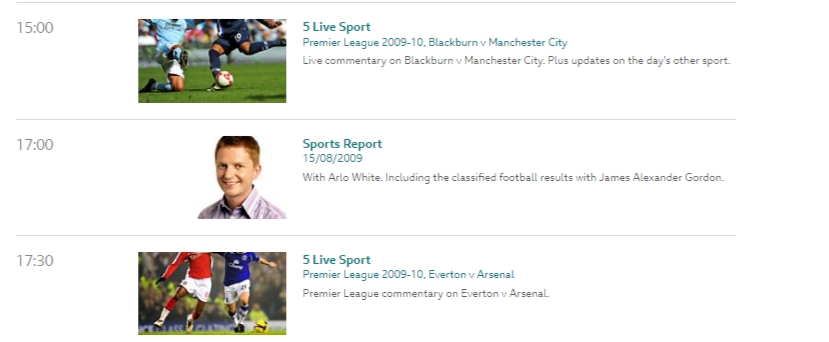
To be fair during Sports Report Chappers did give all the results, albeit at intervals during the programme and at a fair old pace. Forced to retrospectively justify the decision the BBC said that “with the addition of the 5.30pm live Premier League match to our coverage, Sports Report has been condensed into a shorter programme.” Whilst true, the Everton vs Chelsea coverage did kick-off at 5.30, there have been many previous instances where the programme was cut to 30 minutes, such as the 2009-10 season, but the results were still read by JAG (see schedule from 15 August 2009 above). I wouldn’t be surprised if they’d made the decision some time ago and that the evening fixtures provided the perfect excuse.   

The BBC statement went on to say that “we will still offer a comprehensive goal service throughout the day on air and on the BBC Sport website as well as Final Score on BBC One. We would like to thank everyone who has read the classified football results on 5 Live over the years.” A statement that assumes that the audience possess smart phones or are otherwise hooked up to their IT, when a fair number will have neither, and then tells them that they can switch on the TV to get the full results. Surely 5 live should be servicing their listeners and not encouraging them to go elsewhere.  


The BBC’s own goal gave the commercial radio sector the opportunity to remind listeners that they still provided a reading of the classified football results. talkSPORT said “hear them always with us”. Over at LBC News managing editor Tim John announced “we already broadcast the football scorecard, so will be making a change to our schedule to ensure that football fans have the option of listening live to the Classified Football Results at 17.05 every Saturday afternoon during the season."

Here’s Colin Besley reading the results on LBC News.

Meanwhile on talkSPORT’s GameDay Live, rising to the occasion Adrian Durham prefaced the results like this: “We’re at the point where talkSPORT gives the football pyramid beyond the Premier League the respect that it deserves. Where the result of Manchester City is given the same time and prominence of Gloucester City. Where we honour the traditions of football that brought generations together in cars and kitchens across the country for decades and decades”.

Alan Lambourn, reading the results on Sky Sports started by saying “welcome to any former radio listeners”.


During the week many reports erroneously stated that only three people had read the results on BBC radio since the early 50s. Quite plainly this was nonsense but I’m guessing stems from the over-simplification of the history of Sports Report on Wikipedia which just lists John Webster, James Alexander Gordon and Charlotte Green. Though they were the main readers there were weeks were they weren’t available or on holiday and there was at least a two or three year gap between Webster’s retirement and JAG taking over.

Others who read the results in the 50s/60s include staff announcers Robin Boyle, John Hobday, John Wing, Colin Doran and Jimmy Kinsgbury. Jimmy became the chief announcer and took over when John Webster stepped down in late 1970. Other staff announcers reading the results in the 1970s included Simon Bates, David Bellan and Len Jackson. In about 1973 James Alexander Gordon became the main reader until 2013 but others did cover for him including Tim Gudgin and Paul Leighton. Charlotte Green took over in 2013 but when she was absent the results were read by others including Kevin Howells, Bob Ballard (he told me that he read it once “probably the most nervous I’ve ever been on the wireless”), Delyth Lloyd and Katherine Downes.

Special mention should also go to producer Audrey Adams who joined the BBC in 1983 and has looked after the Classified Footballs Result for decades.     

Saturday, 4 June 2022

This is the Derby and this is the race


In this post its back 61 years to a beautiful early summer’s day at Epsom Downs for the 181st running of the Derby Stakes.

The first radio commentary on The Derby was on 1 June 1927 with George Allison setting the scene and race commentary from Geoffrey Gilbey, a racing journalist who’d worked for the Sunday Express as ‘Tattenham’, the Racing Specialist and, from 1927, as ‘Larry Lynx’ in The People. 

The following year Bob Lyle (always billed as R.C. Lyle) , racing correspondent for The Times, read the race – won by Felstead with Harry Wragg riding. Lyle continued to cover the Derby until 1937 when Geoffrey Gilbey was back, this time assisted by his younger brother, also a racing journalist, Quintin Gilbey.

For twenty years the BBC’s main racing commentator was Raymond Glendenning, the moustachioed fast-speaking (measured at clocking up 300 words a minute) all-rounder who also covered football, tennis and boxing. He called his first Epsom Derby in 1940, following a couple of years with Thomas Woodrooffe (he of ‘the Fleet’s Lit up’ fame) at the microphone. Glendenning was assisted by a number of other broadcasters and racing journalists including Wilfrid Taylor, Claude Harrison, Roger Mortimer, Frank More O’Ferrall, Tony Cooke (who went on the join ITV as their first racing commentator) and Peter O’Sullevan, who would, of course, become BBC TV’s voice of racing.   


The commentator for the 1961 Derby was Peter Bromley, for four decades the voice of racing on BBC radio. Bromley had been involved in racing since the early 50s, first as an assistant trainer and amateur jockey and then from 1955 as a course commentator (working for British Racecourse Amplifying and Recording Company, now known as Racetech) at a time when it was still a novel occupation.  He worked as a paddock commentator for ITV before moving to BBC television as third man to Peter O’Sullevan and Clive Graham.

In 1959 he took up the new post as BBC Racing Correspondent split between tv and radio. Radio, in particular Sports Report, wasn’t that keen to use him as editor Angus Mackay favoured ex-print journalists. Bromley recalled one run in with Mackay when he was asked to do a one and a half minute piece on the Gold Cup. However, Peter thought that Wednesday’s Champion Hurdle race provided what he and his producer, Tony Preston, thought was a newsworthy item as it had been won by a one-eyed horse and an amateur jockey. His report began with a 20 second mention of this before going onto the Gold Cup. Getting torn off a strip for departing from his brief he sent a memo to Mackay that pointed out: (a) I was convinced that there was a news story in the Champions Hurdle, (b) I suggested the 20 seconds to the producer before the programme, who accepted it, (c) I did not over –run and (d) I did tip the winner of the Gold Cup. His reply from Angus simply read (a) We weren’t, (b) He didn’t, (c) You’re not expected to and (d) You are expected to.

Radio did relent and within a year Glendenning had retired from racing commentary (though he continued to cover football until early 1964) and Peter was offered the position of BBC Radio Racing Correspondent starting in early 1961 providing the main commentary on the 50 or so races per annum as well as sports news reports, previews and reviews.         

Bromley’s first Classic was the Grand National that March and by the time the Derby came along he’d already covered the likes of the 1.000 and 2,000 Guineas, Royal Ascot and Goodwood. Helping Peter at that time, reading the starting prices (something the BBC had shied away from until ITV started reporting on the betting in 1958) and reviewing the race was Roger Mortimer. For 29 years (1947-75) he was the racing correspondent of the Sunday Times and continued to broadcast alongside Peter until 1971. The other voice, down at the paddock, is that of Michael Seth-Smith. Michael was also a course commentator but during the 60s and 70s (and as late as 1985) was BBC radio’s second racing commentator.      

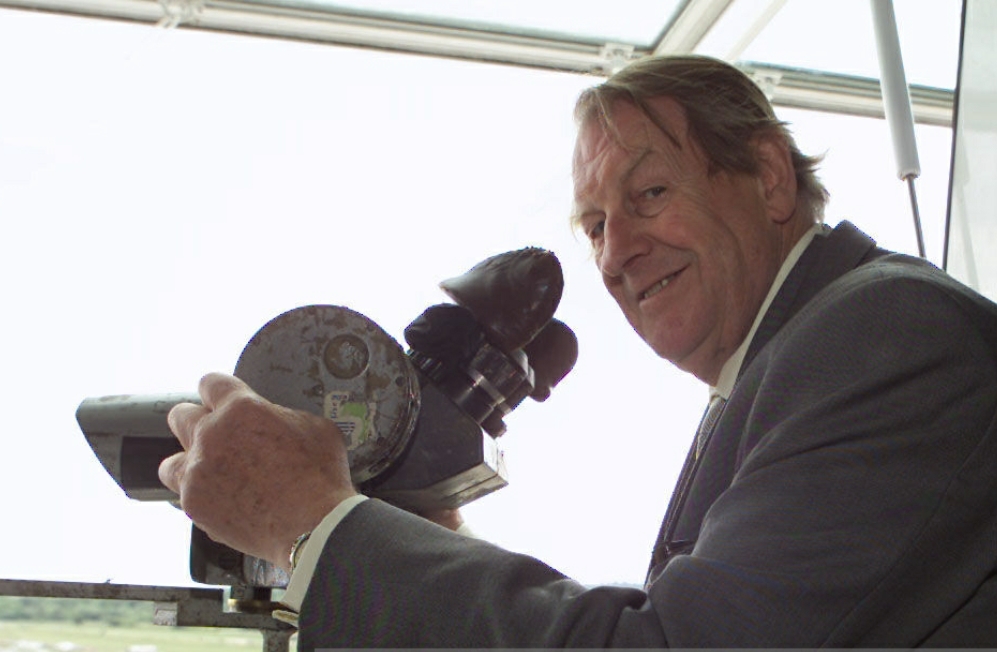
By the 1970s Bromley was commentating on over 200 races a year, all viewed through his pair of German binoculars, a relic of the Second World War. By the time of his retirement in 2001, following that year’s running of the Derby, he’d commentated on over 200 Classics and 10,000 races. He died two years later in June 2003, just four days before the running of the Derby.    

Back to 1961 and radio coverage of the Derby was slotted into the schedule on the Light Programme between Woman’s Hour and Music While You Work on Wednesday 31 May. This is typical of the sports scheduling at the time which, aside from Saturdays or Test Match Special, had to jostle for position amongst the music shows, comedy and magazine programmes.  The continuity announcer introducing the coverage is Bryan Martin.   

Note how formal this coverage now seems to modern ears. Just the voices of the three broadcasters, no interviews with owners or jockeys, no real sense of atmosphere, no colour.

As to the race itself there was a very full field of 28 horses with Moutiers as 5-1 favourite, whilst the eventual winner, Psidium started at 66-1. He ran the first half of the race at the back of the field and it was only in the last furlong when French jockey Roger Poincelet pulled Psidium to the outside, that it made a finishing burst to the line winning by 2 lengths. The horse was trained at Newmarket by Harry Wragg, by a neat coincidence the jockey on that second broadcast Derby 33 years earlier.

Once again this recording was made by the late Eric Bartington and I extend my thanks to Gerad de Roo who rescued it and passed it to me.

The title of this post comes from the poem The Derby by Henry Birtles.


Sunday, 7 January 2018

Sports Report Turns 70

In January 2013 I wrote about Sports Report and Saturday afternoon sports coverage. This month we've now hit the 70th anniversary of that venerable radio institution which has prompted me to have a dig around in my archive and uncover past anniversary editions.

I've previously posted the 40th anniversary edition of Sport on 2 with Peter Jones but this is now uploaded to YouTube.  


For the 50th anniversary there was a special edition of Sport on Five with Ian Payne. It seems I only kept the Sports Report sequence which was pretty much business as usual though there are some reminiscences from Cliff Morgan towards the end.   


On 3 January 2008 Mark Saggers presented a special edition of 5 live Sport to mark the 60th. With Mark thoughout the programme are Des Lynam and the late James Alexander Gordon. You'll also hear Mark Pougatch, Mark Clemmit, the Grimethorpe Colliery Band, Jenny Pitman, Ian Payne, Cornelious Lysaght, Sir Henry Cooper, Sheena Mackay, Pat Nevin, Pat Murphy, Stuart Hall, Tony Adamson, Eleanor Oldroyd, Stuart Jones, Jimmy Armfield and Mike Ingham.  


As for the 70th anniversary last Friday (5th) on 5 live Daily Chris Warburton gathered together some familiar voices, speaking to Mark Pougatch, John Murray, Jim Rosenthal, and producer Mark Williams.

The recording then shifts to Saturday (6th) with the start of 5 live Sport on FA Cup Third Round day presented by Mark Chapman and then Sports Report, just a 30-minute edition to allow for commentary on the evening match between Norwich City and Chelsea. 

Friday, 27 January 2017

The Commentating Captain

Ninety years ago this month the first live sports commentary was broadcast by the BBC. That "first broadcast description", as the BBC Hand Book described it, was on the rugby match between England and Wales at Twickenham. The commentator was Captain H.B.T. Wakelam. But who was Captain Wakelam and how come he was given that task of covering that match. And, as it was the first ever such broadcast (at least on this side of the Atlantic) how did he know what to do? The answers can be found in Wakelam's 1938 autobiography Half-Time "The Mike and Me".

Firstly a brief biographical portrait. Henry Blythe Thornhill Wakelam, known as Teddy, was born in 1893 in Herefordshire were his father was the County Engineer, a very keen all-round sportsman and "an extremely good shot". The family moved to London when his father was appointed to a job in Middlesex. Young Teddy was educated at the Middleton School in Bognor where he was sent as a boarder. Here he developed his love for playing sport; he'd go on to play rugby, cricket, football, hockey and tennis which stood him in good stead years later when he was asked to commentate on a range of sports for the BBC.  He continued his education firstly at Marlborough College, Wiltshire and then Pembroke College, Cambridge where he initially studied medicine but due to "a very distinct aversion from corpse dissecting" switched to history. While at Pembroke he played rugby for a number of clubs before joining Harlequins for whom he turned out on many occasions over three years up until the war. Indeed he was so busy on the sporting field that he feared he was spreading himself too thinly: "I think ... that I attempted too much in those days. Four days a week I was playing either rugger or hockey for Pembroke, and my Saturdays were also fully taken up playing either for the Varsity at one of other game, or for the Quins. Perhaps had I concentrated more I might have been successful."    

On the outbreak of World War One, Teddy was accepted as a 2nd Lieutenant in the Royal Fusiliers; by 1917 he'd been promoted to Captain of the 96th A.A. Section. He saw service in France, Gallipoli, Egypt and Palestine. After the war there was a period of post-war liaison work for the Army in Poland and Germany and he started to play rugby again, initially for the Public Schools Services and then for a reformed Harlequins where he'd eventually captain the team. He gained employment with the contractors and building firm John Mowlem & Co, mainly working on contracts for the London County Council. In 1922 he married Vera Greenhill, the following year they had their only child Elizabeth. By 1924 Wakelam was forced to retire playing rugby due to a knee injury but he very much remained part of the sport as well as taking on duties as a Wimbledon umpire.   


Meanwhile over at Savoy Hill the British Broadcasting Company had become a Corporation on 1 January 1927 and gained some additional rights to broadcast reports of sporting events, rights that the press had previously jealously guarded. The BBC had already decided to introduce the type of live commentary that American radio was doing and it was on the lookout for possible commentators, broadcasters who would be pioneers in the field. On 7 January the Director of Entertainment, Roger Eckersley, issued a memo to Station Directors expounded on the subject, suggesting that the person giving the running commentaries "probably will be difficult to find, as he should have the journalistic instinct, a decent voice, a sound communicable knowledge of the subject, and the power to make listeners feel as though they were present at the event". 

Asking around the name of Teddy Wakelam came to the BBC's attention, especially useful as the first commentary game was to be a rugby match. Such were the hurried and last minute arrangements that the commentary, on 15 January 1927, was not billed in the Radio Times. Wakelam's autobiography takes up the story at this point in some detail and I've reproduced a few paragraphs of it below.  
The other players in this story are Lance Sieveking who joined the BBC in April 1926 with special responsibilities for topical talks and news. He'd recently returned from a trip to the States to witness how US radio covered baseball matches. He later work mainly in drama, producing and script editing for both BBC radio and TV. Wakelam's number two was a chap called Charles Lapworth who seemed to have no obvious connection to rugby. He was a former editor of the Daily Herald and had worked at other newspapers both in the UK and the USA. This was his one and only appearance as Wakelam's sidekick. The reference to "a St Dunstan's man" is the home for the blind for ex-servicemen and women, now known as Blind Veterans UK. 

"One afternoon I was sitting at my table working out some details of a tender, when my telephone rang. An unknown voice at the other end then asked me if I was the same Wakelam who had played Rugger for the Harlequins, and upon my saying 'Yes' went on to inform me that the owner of it was an official of the British Broadcasting Corporation, who would much like to see me at once on an urgent matter.

Turning up at the arranged meeting-place, I was welcomed by Lance Sieveking, the gentleman in question, who thereupon explained to me the reason for his call. Briefly it was this. Since the BBC in January 1927 had become a national institution, its scope had become considerably wider, and it had been decided to follow a recent American innovation, and to put out running commentaries on important sporting events. It was proposed a start should be made with the Rugby International at Twickenham, between England and Wales, on January 15, and would I be prepared to undergo there and then a studio microphone test in order to see if my voice was suitable, and then, should such prove to be the case, to take part in an actual field trial to be held the next day on the Guy's Hospital Ground at Honor Oak Park? On the principle of 'try anything once,' and also with the confined conviction that if an American could do it I could, I agreed, and duly passed the 'Mike' test. The next day, three days before the actual match, together with Sieveking, a man called Lapworth, who had the vast knowledge of the American film world. and two other competitors, I went down to the Guy's ground as arranged, but alas, something had gone wrong, and no engineers or microphones turned up! This was a bad start; but things grew even worse when eventually we did find them, in Greenwich Park, watching a game between Blackheath Wednesday and the Royal Naval College, Greenwich, for no sooner had they started to get their elaborate and fearsome-looking gear when up came a large and very important park-keeper, full of righteous indignation, and we departed sadder but considerably wiser men. By this time it was too late to seek other fields, so we were asked by a most apologetic Sieveking to parade again the next day, if a match could be found upon which we could give a try-out. There proved to be one at the Old Deer Park, Richmond, an inter-schoolboy affair, where the same party again assembled, and after the lines and so on had been run out and fixed up, we started on our 'dummy run.' After it was over, Sieveking came up to me, and asked me if I would have shot at doing the match as proposed. I agreed, subject, of course, to suitable financial remuneration, a point upon which both of us very naturally were quite at sea. That, however, was put aside for the moment, and we set out straightaway for Twickenham to examine the selected position and to study the arrangements.   
Arriving at Twickenham, Sieveking and I were met by Commander Cooper, an old and valued friend of mine, and together we examined our perch, which was a somewhat rickety-looking hut mounted on a scaffold platform at the end of the then single-decker West Stand, in the south-west corner. Here the engineers were hard at work wiring up and installing the microphones, and we for our own part worked out in detail our proposed plan of campaign. here the first squared plan of the field came into being, the facsimile of which so often nowadays is printed for the benefit of listeners in the Radio Times, and here was put up a notice for our own particular benefit, a notice which, printed in large red letters, was 'DON'T SWEAR' (not that I any more than the rest of my fellow-men am addicted to the use of strong language, but sometime, watching Rugger, one is apt to get carried away!). The order of the seating was also decided upon, and Sieveking finally was struck with a most brilliant idea, which was to prove of the utmost worth to me on the day. He decided to get hold of a St Dunstan's man who, before his terrible misfortune, had been a keen Rugger follower, and to invite him to sit just in front of the open window of the box so that I could talk as if explaining the game directly to him, and so perhaps lose some of my very natural stage-fright. Having fixed these and other small details, we returned to town, and duly reassembled n the site an hour or so before the game on the fateful day. Then I learnt that Charles Lapworth should be my 'No. 2,' or, as someone immediately and appropriately remarked my 'Dr Watson.' In many ways he was very well suited to his job, for he was the personification of cool and calm collectedness, though his knowledge of the actual game itself was rather limited. In fact, the only football he really knew at all was the American game, as one of his remarks was to prove.

Ten minutes before the kick-off, we came on the air, Sieveking first to give the atmosphere, reading out the now familiar copyright notice and doing the introductions, and then a somewhat shy and diffident me, to give out the details of the game and the names of those taking part in it. On the stroke of the appointed time, the match was started, and we were off. Straightway I forgot all my nervousness and stage-fright, all my previously and arduously collected phrases, and all the, as I thought, snappy and pithy expressions which I had anxiously culled from the leading sporting writers of the day. I was so wrapped up in following the flight and fortunes of that ball, and so desperately keen to keep my St Dunstan's man fully informed, that I raced away like a maniac and then and there, I think, got into the habit which I still maintain is essential) of being just a fraction ahead of the actual game. By that I mean the necessity of starting to speak of a man as passing just as he is shaping to pass, a poor description and example to illustrate my point, but nevertheless a correct one, for it is actually the truth.

My memories of the actual game itself that day are, I am afraid, very vague indeed, in fact I do believe when it was over that I could recall one single football incident, though I do remember some of the gap-filling remarks which are, of course, essential when play is temporarily held up for this or that reason.   
Once Lapworth, doing a hero's work in all conscience, said to me in one of these pauses, 'Do they always play with an oval ball?' a remark which may to any Rugger player appear ludicrous, but it reminded me that many of my audience were not familiar with the game, and so helped me to keep away from being too technical (a most serious fault). Again, he said, after one of the Englishmen had been hurt, and had to leave the field, 'Who will they send on instead?' another apparent bloomer, but a chance for me to fill in b y saying that the practice of replacements had not so far (and I sincerely hope never will) become part of the Rugby football creed. And so, back to earth, and tempting my Celtic fervour, with Sieveking's commanding hand sometimes waving me back when I crowded on to the mike and so was in danger of blasting, and with the 'Don't swear' notice ever before my eyes, I got somehow to half-time. and a welcome breathing-space, filled in by atmosphere from the outside mike, and a few more remarks from Sieveking.
Hereabouts I am popularly supposed to have remarked, sotto voce (which of course makes no difference), 'What about having a drink?' but if such was the case, I have no recollection of it, and prefer to treat it as a canard.
In five minutes we were off again, and though towards the end I do recall becoming rather breathless and hoarse, my general memory of the second half is as blank as that of the first.

The press response to Wakelam's commentary was mixed: "Some were definitely hostile, talking about quick-fire football and even quick-fire comedians, being obviously and decidedly against such an innovation, which perhaps might tell against their circulation. Some were inclined to be a bit haughty and to damn with faint praise, and I must have gone through the whole gamut of a leading actor's sensations after a 'first night' until I opened the pages of The Times and read a most delightful little bit by Bernard Darwin ... (who) went on to say in his own inimitable way that he supposed that in the course of time all sports and leading outdoor events would be so reported."

The listening public was more positive though there was a letter of complaint from the wife of a Welsh ex-international who dubbed Wakelam a plague and a menace "for her husband had got so excited listening-in that he had started playing himself and had smashed up most of her sitting-room furniture".

Those first early experiments with running commentaries set the tone and style for what was to follow. The St Dunstan's man who'd sat in front of Wakelam observed "It seemed to me that you were just talking to me, and to me only, and just as if you were telling me something in an ordinary conversation." Wakelam  went on to list four basic rules which have stood the test of time:

The first: Simplicity - Use ordinary everyday sentences. Don't be too technical. Don't be too facetious. BE NATURAL.
The second: Continuity - Keep going as well as you can, without padding up with too much uninteresting and dry material. Wander away very occasionally on to something which is only remotely connected with the game, such as a helicopter overhead, or an outstanding figure in the crowd (it helps the atmosphere). Work in sympathy with your No. 2, and thus avoid double talking. BE CLEAR.
The third: Praise but don't criticise. BE FAIR.
The fourth: Know your man - 'Eye and brain' I have tried to explain, but the second and more important part of this fourth rule can be summed up in two words: BE FRIENDLY.

The BBC viewed Wakelam's commentary as a success and offered him a contract to cover a further ten events, in the event he remained with the BBC for another 12 years. For his next rugby match his No.2 was former Welsh international Rhys Thomas 'Rusty' Gabe, though, Wakelam notes "I am afraid we were guilty of a good deal of overlapping".

Next Wakelam was asked to do the first football commentary. Although he knew the game his knowledge of current players was lacking so he wrote a note to one of the team managers only to receive this unhelpful reply on a postcard: "Dear Sir, as you have been chosen to broadcast this match, presumably you already know all about the players".
In February 1927 Wakelam participated in what was a bizarre piece of experimental commentary. The match was a rugby international between Wales and France and he was asked if he could intersperse some short pieces in French for the benefit if listeners in France. Although he did speak a little of the language he set about looking up all the rugby terms and expressions in French that he could find. By a stroke of luck when he arrived at the hotel in Swansea, prior to the broadcast, he was greeted by a French businessman resident in the town who agreed to sit next to him in the commentary box and write down some of the salient features of play in colloquial French.

Commentaries on other sports followed. As he'd played a little tennis and was a part-time umpire at Wimbledon he was asked to cover the Championship games in the summer of 1927 (alongside another military-styled chap, Colonel R.H. Brand). Commentating on the men's semi-finals he recounts another incident that still occasionally affects live sports coverage, getting cut-off at a crucial stage in the match. At two sets a piece and six games to five in the final set the match was on a knife edge. "I made some kind of remark about a desperate prospective finish and how terribly exciting and thrilling it was. I was not destined to put that finish over though, for when the score reached 30-15, my companion touched me on the shoulder and held up his hand for silence. In his beautifully modulated and honey-toned voice he then gave out the announcement: We are leaving here now and going over to the Girls' Friendly Society Concert at the Albert Hall." Wakelam apparently "felt like throwing the mike through the window"


Cricket commentary followed on 6 August 1927 with the County Championship match between Surrey and Middlesex. Wakelam immediately encountered a perennial problem for cricket commentators when he recalled that batsman "Andy Sandham was holding the fort, perhaps one of the best men possible in such a case but the rate of scoring, from a broadcasting point of view, was the most distressing, and the high spots and desperately exciting incidents upon which we had gaily dwelt beforehand were absolutely non-existent". 

Finally another piece of bizarre broadcasting occurred when the BBC covered the 1929 FA Cup Final. The Corporation had been unable to get permission to provide a proper commentary of the Portsmouth Town vs Bolton Wanderers match so it was just billed as "Eye Witness Accounts". In practice this meant that the BBC rented a flat near the ground to install all the microphones and other equipment. They then purchased eight tickets for the eight reporters who would cover the game, each of them witnessing their allotted 15 minutes of play and then leaving the stadium and running at full speed to the flat and relaying what they had seen from their notes for about nine or ten minutes. Gramophone records were on hand to fill any gaps with music. One of the team had been a cross-country runner so his dispatch was given without him sounding breathless. Another, P.W. Adams, marred his report by talking about "Mr So-and-so then passed to Mr Someone-else". And finally an older member of the team, Tommy Usher, arrived a "trifle distressed" and told the audience that "Chelsea have scored", presumably momentarily mislead by the fact that Portsmouth were playing in blue.  One writer later described the coverage as "the most humorous item on the BBC programme of 1929."

As well as radio Teddy Wakelam also provided some of the first 'sight commentaries' when BBC TV covered Wimbledon in 1937. In addition he appeared on some of the pre-war Monthly Sports Bulletins broadcast from Alexandra Palace as well as writing on rugby for The Morning Post and providing commentaries for British Movietone News. He continued to work for BBC radio until early 1940 (as far as billings in the Radio Times are concerned). Post-war the biographical details are very sketchy though he continued to write about his beloved rugby and in 1954 published Harlequin Story. He died in July 1963 aged 70.     

Here's Teddy Wakelam in action:


Sources:
Half-Time 'the Mike and Me' by H.B.T. Wakelam (Thomas Nelson & Sons, 1938)
The History of Broadcasting in the United Kingdom: Volume 1 The Birth of Broadcasting by Asa Briggs (OUP, 1995)
The History of Broadcasting in the United Kingdom: Volume 2 The Golden Age of Wireless by Asa Briggs (OUP, 1995)

Monday, 2 January 2017

And now the classified football results

Ahead of this evening's classified football results on Sports Report I'm briefly going back to January 1969 when Liverpool and Leeds topped Division 1.

Sports Report, then running as part of the Sports Service on Radio 3, was beginning its 21st year on air and was still produced by its founding father Angus Mackay. "He is the brains and heart of the show. The man behind the microphone who leads and guides and inspires and cajoles".   

Taking a look behind the scenes of Sports Report in 1969 was Harry Brown writing in the January edition of Football League Review. I'm grateful to John Flitter who kindly scanned these pages for me.


Eagle-eyed readers will spot that the photos on page 17 have been transposed; the set starting with Vincent Duggleby are actually at the bottom of the page and vice-versa.

Read my history of Sports Report on It’s five o’clock. Time for Sports Report

Saturday, 30 July 2016

"But he's not given it"

Today as we recall the sporting events of fifty years ago and BBC radio celebrates the 1966 World Cup here's the view from one of the radio commentary team on duty that day, Brian Moore. Brian was BBC radio's football correspondent from 1963 to 1968 before heading off to ITV. This is part of what he wrote in 1987 for the book Sports Report: 40 Years of the Best:  

That July day, I remember, I shared one of those heavy-duty radio microphones - they used to wrap themselves around your jaws like a cross between a dog muzzle and something you would expect to find in a war-time Lancaster over Berlin - with Alan Clarke of the fruity voice and northern authority and Maurice Edelstein, renowned for his scholarly summaries.

We took it in turns to do 15-minute bursts of commentary that afternoon, and I was addressing the eccentrics who had found their way to a television screen when Hurst scored that crucial and much-debated third goal. 'I thought that hit the bar and went in. Maurice Edelston?' 'I'm not certain', added Maurice cautiously -and then 'Yes, it's given, it's given ... England are in the lead.' Rarely, if ever, has a football moment been so carved open, dissected more clinically or argued about more passionately, notwithstanding that little matter of an Argentine handball in Mexico 20 years later.

I do recall slipping into Broadcasting House on my way to Wembley that day to pick up some bits and pieces and finding a single postcard on my sports room desk. My impact on the listening public was some way from causing headaches for the BBC post room! It was simple addressed: Moore, BBC, London. And the message was simple too: ' You'll never be as good as Raymond Glendenning as long as you live'. A splendid shot in the arm you must admit for any young commentator on his way to his most important assignment.   

Incidentally, when that lunatic decision to take the Horse of the Year Show to Wembley Stadium in 1968 led to the whole pitch being dug up (it took another 20 years for it to recover) I plundered that square yard of turf where Bobby placed the ball, and transplanted it on my lawn in Bromley, Kent. I have since moved on, but one unsuspecting suburban gardener still tends to this day a small stretch of grass on which football history was made. 


The full off-air commentary - it appears that the BBC didn't keep the whole broadcast - has recently turned up. The match was covered by the Sports Service on Network Three, hosted that afternoon by John Dunn. The commentary can be heard here.


Friday, 21 November 2014

Back to Square One


Amongst the tributes paid to the late James Alexander Gordon, who died earlier this year, was that from Radio 5 Live’s John Murray:

He was always so friendly and charming, and interested in what you did. The funny thing is, he didn’t follow a team – he was no great football fan. The one time we went to a match together was in 2007. It was the 80th anniversary of the first football commentary, when a grid was printed in the Radio Times for listeners to follow. To mark the occasion we did a grid commentary together on 5 Live Sports Extra – James was so thrilled to be chosen to read out the numbers of the squares where the ball was. It’s a lovely memory I have of him. He loved being a part of what we did, a part of history of BBC Sport – and he played a very significant part in that history.
 
The 80th anniversary match was in recognition of the first radio commentary on Saturday 22 January 1927 – with Arsenal playing at home to Sheffield United. Commentary on that match came from Teddy Wakelam, but to help listeners follow the play a second, unnamed voice, called out the number of the square in which the ball was currently in play. The numbered grid, the idea of BBC producer Lance Sieveking, was printed in that week’s Radio Times (above). No recordings exist of that match but here’s Wakelam commentating in the 1930s:


The 2007 game again saw Arsenal at home, this time to Manchester United. Introducing proceedings on Sunday 21 January on BBC Radio Five Live was Eleanor Oldroyd. ‘Normal’ commentary on Five Live was by Alan Green whilst the ‘grid’ commentary on Five Live Sports Extra came from John Murray (above) with James Alexander Gordon calling the numbers and summaries from Bob Wilson and, oddly, singer David Gray. Here’s part of that afternoon’s coverage:


Those numbered squares are often cited as the origin of the phrase “back to square one”, but this is by no means certain. After all for one team passing the ball into square one would be moving play forward and not back.

For the record that 1927 game ended as a one all draw. The 2007 result was Arsenal 2, Manchester United 1. And by a fluky coincidence Arsenal play Manchester United this coming weekend. You'd almost think I planned all this!

Friday, 10 October 2014

Tokyo Memories


The opening ceremony of summer Olympics in Tokyo was fifty years ago today. With the distance and time difference involved it was possible for TV viewers in the UK to receives some same-day pictures via the Syncom III satellite over the Pacific.  Late night BBC coverage of an hour or so was in the capable hands of Cliff Michelmore, who also presented a results round-up at teatime. Any daytime programmes, and this was by no means every day, were hosted by Alan Weeks.

In addition to the satellite images TV pictures also took the Polar route where events were taped and flown from Tokyo each night over the Pole to arrive in Hamburg by 7 a.m. That tape was then transmitted over the Eurovision network to member countries and on the Intervision network in Eastern Europe. The BBC team lead by Peter Dimmock consisted of just twenty-five! Five commentators covered all the sports: David Coleman, Max Robertson, Harry Carpenter, Peter West and Frank Bough.

Meanwhile over on BBC radio the sound reached the UK via the Commonwealth cable, Compac, which linked Britain, Australia, and New Zealand via Canada and the Atlantic. Commentary from Japan joined Compac from the trans-Pacific cable. The radio team was a very small affair led by Head of OB Charles Max-Muller alongside three producers, an engineer and a secretary.


Seven commentators looked after the radio coverage: Harold Abraham and Rex Alston covered the athletics, Alun Williams and Pat Besford the swimming, John Snagge the rowing and sailing, Brian Moore the soccer and cycling and Raymond Brookes-Ward the equestrian events.

Radio programmes averaged about two hours a day across the Home, Light and Third, with the lion’s share of the commentary and reports going out on the daytime service of the Third Programme, known as the Third Network. Each day there was an Olympic Report from 8.10 to 9.00 a.m. and an evening round-up from 6.00 to 6.30 p.m.   

Some twenty years after the Games of the XVIII Olympiad the gold-medal winning long-jumper Lynn Davies recalled some key moments in Olympic Memories. You’ll also hear the voices of British athletes Robbie Brightwell, Mary Rand, Anne Packer and Basil Heatley, swimmer Bobbie MacGregor, US athlete Billy Mills, race walker Ken Matthews, and weightlifter Louis Martin.

Olympic Memories: Tokyo 1964 was broadcast on BBC Radio 2 on 25 March 1984. The producer was Emily McMahon.

Monday, 30 June 2014

World Cup 1986, 1990 and 1994


The World Cup returned to Mexico for the 1986 tournament with time difference leading to 7 p.m. and 11 p.m. kick-offs UK time. There was plenty of home nation interest as for the second time running England, Scotland and Northern Ireland all qualified.

Radio 2’s match commentary, all on medium wave, starts with the Group A opener on 31 May: Italy vs Bulgaria. Commentating are Mike Ingham and Peter Jones. Over on BBC1 they precede coverage of the opening ceremony and game with the classic Whatever Happened to the Likely Lads? episode, No Hiding Place. 

On weekdays Radio 2 provides World Cup overnight news at 6.02 a.m., 7.07 and 8.07. There are match reports at 8.02 p.m., 9.02, 12.05 and 1.02 in addition to the normal afternoon Sports Desks at 1.05 p.m., 2.02, 3.02, 4.02, 5.05, 6.02, 6.45 on MW only and 9.55. Also keeping an eye on proceedings in Mexico was Sport on 2, at the time presented by Tony Adamson, and Stuart Hall’s Sunday Sport.

Commentary on the first round matches involving Northern Ireland comes from Mike Ingham and Mark Robson. At the time Mark worked for BBC Northern Ireland and would later move to UTV and then Sky Sports as part of their rugby commentary team. Scotland’s matches were covered by Mike Ingham and Roddy Forsyth with analysis by Denis Law. Print journalist Roddy joined the BBC in 1986 and would become the Scottish Football Correspondent for Radio Sport; he remains a regular on 5 Live’s sports team. 

This is part of a World Cup Special from 3 June 1986. Can anyone identify the theme tune please, it's been bugging me for days and I'm convinced I have a copy of it somewhere. (Edit: It's Aztec Lightning by Heads).


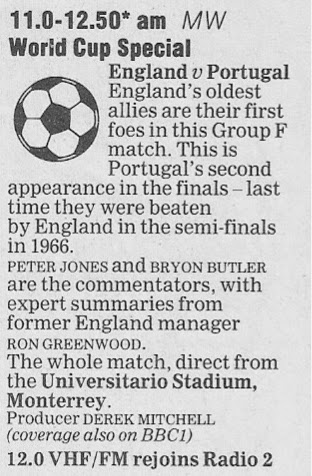
Meanwhile the England matches had commentary from Peter Jones and Bryon Butler with summaries by Ron Greenwood.  Only England progressed to the second round and then onto the quarter-finals before defeat against Argentina and that famous ‘hand of God’ goal. Commentary on the final on 29 June (Argentina vs West Germany) was again a Jones/Butler commentary.


Italia 90 introduced football fans to Nessun Dorma, John Barnes rapping and the pain of an England penalty shootout. It was Radio 2’s final tournament – Radio 5 would take over all the sports coverage from August 1990 though that station didn’t actually get round to handling a World Cup tournament – and as usual it was on medium wave only and confined to home nation matches; this time England, Scotland and the Republic of Ireland. The planned coverage was of the opening game, the semi-finals and the final. With Ireland and England progressing beyond the group stages there was some added quarter-final action too.


Radio 2’s coverage was presented by John Inverdale, who also fronted the Wimbledon programmes when they started, including some joint programmes when the tennis and football overlapped. The Radio Times is a little light on who commentated on which game but the listed team are Mike Ingham, Alan Green, Ron Jones with expert analysis from Denis Law and Ray Clemence.  

With Scotland once again in the running, commentary on those games was also carried on Radio Scotland – can anyone confirm the commentary team? On 16 June there was a clash of 8 p.m. kick-offs so whilst Radio 2 carried England vs Holland, Radio Scotland carried Sweden vs Scotland.

Additional World Cup news, and some commentary, was heard on Sport on 2 with Jon Champion and Sunday Sport with Charles Colville. The Republic of Ireland’s match against Egypt was heard on Sunday Sport for instance.  There was also an extra World Cup Report each evening after the 11 p.m. news.

The final (West Germany vs Argentina) on Sunday 8 July was covered in an extended Wimbledon 90 and World Cup 90 programme from 2 p.m. to about 9 p.m. as the Men’s Singles Final took place that day too.

By the time we get to 1994, Radio 5 Live had arrived – replacing the short-lived Radio 5 - and there was plenty of airtime to fill. Football was more popular than ever due to Sky Sports upping the ante and over on ITV we had the adaptation of the stage play An Evening with Gary Lineker.

The 5 Live coverage was linked by Jon Champion though were it overlapped with Wimbledon we had John Inverdale, or on Tuesday evenings as part of Inside Edge presented by Jonathan Legard. There was also coverage as part of Saturday’s Sport on Five with either Ian Payne or Marcus Buckland and on Sunday Sport with Eleanor Oldroyd. The commentary team in the USA was Mike Ingham, Alan Green, Ron Jones  and Rob Hawthorne. Providing the expert analysis were Mark Lawrenson and David Pleat.

The only ‘local’ interest was the Republic of Ireland so in the first week we also had commentary on Germany vs Bolivia, USA vs Switzerland, Germany vs Spain, Italy vs Norway and Brazil vs Cameroon as well as Ireland’s match against Italy. The final on 17 July (Brazil vs Italy and the first to be decided on penalties) coincided with The Three Tenors Concert from the Dodger Stadium in LA. This was broadcast on both BBC1 and Radio 2.

And that is where I leave the World Cup for the time being. Further posts may follow in four year’s time, assuming we qualify.
Related Posts Plugin for WordPress, Blogger...