Saturday, 11 February 2023

Death at Broadcasting House

The door into 7C was flung open, and Hancock burst into the passage. “Come here, Julian, for God’s sake!” he said. “Quickly. There’s been an accident!”

That accident turns out to be murder. The victim is actor Sidney Parsons, alone in studio 7C and on air at the time. But who amongst the cast and staff is the murderer? This is the opening premise of the story Death at Broadcasting House, filmed in 1934, adapted for radio in 1996 and now this week being read on a Book at Bedtime by Tim McInnerny.


Broadcasting House had been in use just over a year and the suite of studios used for drama productions provided the setting for much of the action. The more technically complex the drama the more studios were used for different acoustics, live musicians and sound effects with the main studio overlooked by a viewing room. The whole production would be mixed and controlled from the dramatic control panel.  So it was two people with a good inside knowledge of the building that came up with the germ of the story whilst on a 16-day holiday in the south of France – dictating the 70,000 words to a BBC secretary. Concocting the mystery were friends and colleagues Val Gielgud, at the time in charge of drama at the BBC and Eric Maschwitz, who often wrote under the name of Holt Marvell, the head of the Variety department.


Most sources say that Death at Broadcasting House was published in 1934, and indeed it was published in book form by Rich & Cowan in February 1934. But it first appeared in serialised form in the pages of the October, November and December issues of Modern Wireless magazine in 1933.

Death at Broadcasting House is a story of professional rivalries, illicit affairs, blackmail, Scotland Yard inspectors, amateur sleuthing, gloves and mystery phone calls. The story opens during a live broadcast of the play The Scarlet Highwayman written by Rodney Fleming. Directing is Julian Caird, the BBC Dramatic Director. At the controls is the Balance and Control Engineer Desmond Hancock. The cast of actors includes Sidney Parsons and the husband and wife team of Leopold and Isabel Dryden. The BBC staff include General Sir Herbert Farquharson (presumably Sir John Reith), Stewart Evans of the Programme Research Department , sound effects man Guy Bannister, studio manager Ian Macdonald and studio attendant Joe Higgins. Called in to investigate is Detective Inspector Simon Spears. (Spears would appear in three further books including The First Television Murder set in the BBC’s studios at Alexandra Palace). 


To add extra realism to both the serialisation and book versions we have copies of internal memos, running orders and studio maps, these closely follow the real Broadcasting House layout. We’re also introduced to a new piece of technology that proves critical in cracking the case, the Blatterphone. These steel tape recording devices were really only in use by the Empire Service as they allowed for the re-broadcast of domestic programmes to the world and for programmes to be transmitted in different time zones without calling broadcasters, actors or musicians back into the studio at all times of the day or night. “We blatterphoned the transmission of The Scarlet Highwaymen and we are transmitting it to the Empire in” – he glances at his wrist-watch – “exactly seven minutes’ time.”

The book enjoyed, according to Gielgud, “considerable success” and thought that a film version would be “a copper-bottomed commercial proposition”. Eventually they found a willing producer in Hugh Perceval at the newly formed Phoenix Films. It was filmed over 29 days at the Wembley Park Studios in North London (later used by Associated-Rediffusion and LWT before becoming Fountain Studios and closing in 2017) at a cost of £18,000. Getting a general release in November 1934 it would gross £90,000 at the box office. A shorter five reel version was also issued, presumably to run as a second feature, with cuts to the cameo appearances and all the songs to achieve a 42 minute running time (as against the 75 minutes of the eight reel version). 

One of the dramatic control panels at Broadcasting House.
Photo copyright BBC.

The film was able to pretty accurately portray the Art Deco interior of Broadcasting House with its maze of studios and the dramatic control panel.  The ‘death’ occurs in studio 7C. This really was a studio used by the drama department. It was a speech small studio (19’x19’) and had a totally dead acoustic. 7C was later combined into the larger two-storey drama studio 6A.   

According to Gielgud “expenditure was very sensibly allotted rather to the settings than to the cast.” Gielgud appeared in the film, effectively playing himself, as Julian Caird. The only real stars of the day were Ian Hunter who played the (renamed) Inspector Gregory and Austin Trevor as Leopold Dryden. Donald Wolfit, yet to start his famous touring company, played Parsons and a young Jack Hawkins was Evans. This being a thirties film it was almost obligatory to have at least one song and dance routine and this film offered two, including an early performance from American singing star Elisabeth Welch. Radio stars of the day also make cameo appearances including comedian Gillie Potter and journalist Vernon Bartlett.  


The film adopts a lighter tone than the source material, Basil Mason was tasked with writing the screenplay, and it benefits from the production design of R. Holmes Paul and the photography of Austrian émigré Günther Krampf, whose films included the expressionist horror classic Nosferatu (though he was uncredited). Halliwell described the film as an “intriguing little murder mystery with an unusual background”. Elizabeth Welch was less enamoured with it: "It was so awful that I told everybody they should have left Broadcasting House out of the title and released it as Death!” It is the Broadcasting House setting that provides the real interest rather than the plotting and the performances.

Surprisingly the film doesn’t appear to have been shown on television until nearly four decades later. It finally aired on 3 September 1982 – which isI when I first saw it – on BBC2 as part of a season of films marking the BBC’s 60th. That seems to have been its only BBC showing, and perhaps it’s only terrestrial tv showing, unless you know otherwise.

However, the film hasn’t been completely forgotten. In recent years the wonderful Talking Pictures TV have given it the occasional run and in 2013 Network issued it on DVD. A Blu-Ray edition was issued in 2020. At one time it was on YouTube but at the time of writing, it can be found on Arhive.org.


Although BBC television never gave Death at Broadcasting House a second showing, BBC radio did revisit it in 1996 as a Saturday Playhouse production on Radio 4 as part of a Cinema 100 season. The play, running at 86 minutes, was adapted by crime writer Sue Rodwell – she would later adapt some of Ted Willis’s Dixon of Dock Green scripts for the radio. Appearing as Julian Caird is John Moffat (radio’s Hercule Piorot) and there’s a star-studded cast: Peter Sallis (Inspector), Graham Crowden (Director General), Jeremy Clyde (Fleming), Roger May (Bannister), Bill Nighy (getting all indignant as Dryden), Diana Quick (Isabel), Julian Glover (Evans) and Nicky Henson (DS Ring). The great thing about this version is that it was recorded in drama studio 6A where the majority of the studio action is set in the original story. This programme has been repeated a couple of times on Radio 4 Extra. You can, at the time of writing, find it on YouTube. Bill Nighy would come across another corpse at Broadcasting House in the 2008 Charles Paris series Dead Side of the Mic.


Back in the present, this week on Radio 4 we get another chance to hear the story, as abridged by Lucy Ellis and read by Tim McInnerny. It can be heard in the Book at Bedtime slot Monday to Friday at 22.45 and will be available on BBC Sounds.

Staying with radio drama history for the moment its worth picking out a couple of programmes that go out today (Saturday). Comedy for Danger (also sometimes just called Danger) by Richard Hughes was, for many years, regarded as the first play written for radio to be broadcast by the BBC. It was part of an evening of plays produced by Nigel Playfair broadcast by 2LO on 15 January 1924. This short play was set in a mining quarry and the Radio Times suggested that listeners” might well sit in darkness to correspond with the play’s setting, which will also be in the darkness of a mine.” A 1973 re-recording of Danger is repeated for the first time since 1973 today on 4 Extra. Produced by Raymond Raikes it stars Christopher Good, Carol Marsh and Carleton Hobbs. It was originally heard on Radio 3 on 1 October 1973 under the Stereo Drama strand. [The first play written for radio was broadcast just over a year earlier by 2LO on Christmas Eve 1922. The Truth About Father Christmas was written by Phyliss Twigg]. 

Taking inspiration from Danger is a new drama called Danger 2023 by Michael Symmons Roberts. Here the lights go out on a party visiting a remote 'doomsday' bank deep under the desert containing a vast collection of historical and cultural data about our lives. It’s the Saturday afternoon drama on Radio 4.   

The story of how Danger came to be made was told in last year’s play A Leap in the Dark which is on BBC Sounds. It does, however, contain a number of factual errors that will make any radio or drama historian wince.

About the Authors:

Eric Maschwitz


Eric Maschwitz had a CV that one can only marvel at (pun intended). He was a songwriter and scriptwriter often using the nom de plume of Holt Marvell and is best known for A Nightingale Sang in Berkeley Square and These Foolish Things and the screenplay of Goodbye, Mr Chip s (1939) for which he has a co-writing credit. He’d worked as a freelance writer for the Hutchinson’s magazine group. In 1924 he wrote the best-selling novel A Taste of Honey a year before he married actress Hermoine Gingold.  He started at the BBC in 1926 in the Outside Broadcasts department. From September 1927 he’d been the acting and then permanent editor of the Radio Times. With the creation of a separate Variety Department in 1933 Eric was offered the head of department.  There he introduced a number of well known programmes such as In Town Tonight, the Scrapbook series as well as opening a new base for variety shows across Langham Place at St George’s Hall.

He and Val Gielgud were already firm friends before working together at the Radio Times. On air Maschwitz contributed to many broadcasts under Gielgud’s department or direct production. Those programmes included talks, plays (including an adaptation of Rupert of Hentzau and Compton Mackenzie’s Carnival), musicals and the romantic operetta Good Night Vienna!   

Maschwitz was Director of Variety for four years until June 1937 when he left for Hollywood to work for MGM after they’d offered to buy the film rights for his musical Balalaika and a writing contract more than ten times his BBC salary. During the war he was recruited by the intelligence services (SIS, SOE and the Army’s Intelligence Corps).  He was assigned to the British Security Coordination (others included Roald Dahl, Noel Cowerd and Cedric Belfrage, brother of BBC newsreader Bruce Belfrage) where he was head of the forgery section running Station M (M for Maschwitz) in a Toronto suburb. In 1942 as a Major (later Lieutenant-Colonel) he was head of a War Office Broadcasting Section in the Army Directorate of Welfare and Education where he was instrumental in setting up the Field Broadcasting Unit. He moved to the Political Warfare Executive preparing propaganda leaflets from the secret HQ in Woburn Abbey. At the end of the war he helped requisition Hamburg’s Musikhalle as the first HQ for the British Forces Network (later the BFBS).                

Post-war he was Chairman of the Songwriters' Guild of Great Britain which at times put him at loggerheads with his old employer. On the broadcast of popular music programmes he decried they were “flooded with ready-made and degraded American successes” whilst variety shows were all “hectic talk and semi-hysterical laughter.” Nonetheless he rejoined the BBC in 1958 as Head of Light Entertainment, Television and then in 1962 under a special contract as advisor with the title Special Duties (Programmes). He left the Corporation in 1963 to work for commercial rivals Associated Rediffusion as a producer of special projects as well as the comedy series Our Man at St. Mark's. 

Eric Maschwitz 1901-1969

Val Gielgud


Val Gielgud spent most of his working life involved in drama production and was the department head for a remarkable 35 years. He’d started at the BBC in 1928 as an assistant at the Radio Times under Maschwitz’s editorship, though he’d already appeared on air delivering a number of talks. He was an “out of work actor” before joining the Corporation and got the job without an interview, the old boy’s network coming into play as he knew both Maschwitz and the BBC’s head of publicity Gladstone Murray. He worked on the editorial pages including the letter’s page and later admitted to writing a number of letters under various names complaining bitterly about radio drama.

He helped with some of the BBC’s amateur theatrical productions in which even the austere John Reith took part. During rehearsals for the comedy Tilly of Bloomsbury, in which Reith played a drunken broker’s man, Gielgud rebuked him for being late. This actually helped Gielgud’s job prospects when in 1929 they were looking for a new department head. “This fellow Gielgud will do. If he can be rude to me, he ought to be able to tell a lot of actors what to do.” The job was as Productions Director, a wide-ranging brief that included drama as well as the revue and vaudeville section.

By 1933, following the move from Savoy Hill into Broadcasting House the previous year, Gielgud wanted to concentrate on drama “without troubling himself with ukulele players and comedians” so was appointed Director of Features and Drama, with Variety hived off to his chum Maschwitz. Here he set about helping forge a new style of radio drama mixing standard works by the likes of Ibsen, Chekov, Noel Cowerd, Edgar Wallace, Somerset Maughan, and, of course, Shakespeare with more experimental work. He was particularly keen to encourage new writing for radio and declared “the future of broadcast drama lies with authors who are prepared to write directly for the microphone”. (Early 30s drama was often billed as “written for the microphone”). His books How to Write Broadcast Plays and the later The Right Way to Radio Playwriting were standard references for any aspiring radio dramatists. When television came along he was also involved in that, including the first experimental drama production of Pirandello’s The Man with the Flower in his Mouth, broadcast simultaneously on the National Programme and the Baird television transmission in July 1930.    

He still occasionally worked with Eric Maschwitz on programmes such as the ambitious broadcasts over four nights live from Hungary in Night Falls in Budapest (1935). He would direct his rather more famous brother John on three occasions: The Importance of Being Earnest (1936), The Great Ship (1943) and for the Third Programme in 1959 Oedipus at Colonus.

Gielgud was also a prolific writer of both radio plays – such as Exiles, Red Tabs and Mr Pratt’s Waterloo – and novels, usually thrillers. His books, written over a period of about 40 years included series featuring Anthony Havilland and Inspector Gregory Pellew. 

At the start of World War II the drama department was evacuated first to Wood Norton and then to Manchester though difficulties in getting artists to go north meant they eventually moved back to London, occupying studios at Maida Vale. During the war the Saturday Night Theatre strand started (Gielgud would produce over 30 of them), the Drama Repertory Company was re-formed and there were the beginnings of drama series rather than one off productions such as Appointment with Fear in which Gielgud would collaborate with John Dickson Carr.

After the war when the television service re-started Gielgud also had tv drama within his remit, not something he relished and in 1952 he was back to radio with the title Head of Drama (Sound).

One of the post-war developments was the daily serial, notably Mrs Dale’s Diary and The Archers. Gielgud dismissed both, especially the former which he though “sociologically corrupting” as it encouraged “mediocrity of mind” among listeners. Millions listened to both. At the same time he eschewed the avant-garde of the 1950s so he increasingly left the production of such drama to others.    

Looking at his contribution to the BBC, Hannah Khalil wrote (in 2013) of Gielgud’s many contradictions: “he claimed to want to move away from theatre-style productions on radio, but was from a theatre background; he pushed the boundaries and experimented with the form, and yet he was more at home with Shakespeare than he was with contemporary writing; he recognized that radio was for the masses, but he loathed soap operas or anything too populist”.

Gielgud retired from the BBC in 1963, passing over the drama baton to Martin Esslin. 

Val Gielgud 1900-1981

With thanks to Roger Beckwith

This post was edited in December 2025

Sunday, 1 January 2023

By Strauss – New Year in Vienna


Whether you’re starting the morning all bright-eyed and bushy-tailed or nursing a Hogmanay hangover there’s no finer way to usher in the New Year than a with a Strauss waltz. This morning’s New Year concert from Vienna, now in its eighth decade, offers its usual menu of marches, polkas and waltzes from the opulent Musikverein in Vienna’s first district. It’s been a staple of New Year’s Day broadcasts in the UK for 64 years.

The early wartime concerts – the first was on New Year’s Eve 1939 – were tainted by their Nazi associations. Post-war the concerts were re-invented under concertmaster Willi Boskovsky who conducted on 25 occasions between 1955 and 1979.

Broadcasts of the concert are hosted by Austria’s ORF and relayed worldwide via the EBU to over 90 countries.  The BBC has been broadcasting the concert since it was first televised in 1959. The programme was always a recorded version shown later on the 1st until 1987 when it started to be shown live, though there was a one year hiatus in 1982.From 2003 BBC Four broadcast an evening highlights version; this moved to BBC Two in 2019, but it’s back on Four this year.     

BBC Radio was a little slower to pick up the concert but has been broadcasting it live every year since 1972. (It had first been broadcast by Austrian radio in 1953).It’s always, I’d you’d expect, on Radio 3 though with one exception; in 1995 it appeared on Radio 2 instead. There had been a couple of earlier radio broadcasts. In 1966, on 2nd January, the Light Programme carried highlights of the New Year’s Eve concert and a few days later more excerpts were heard on the Home Service. In 1969 there was live coverage on Radio 4 and then highlights over on Radio 2 during Sam Costa’s lunchtime show.   

Remarkably only five people have introduced the concert for BBC tv and radio over the last six decades. First was Lionel Salter a former conductor turned BBC administrator and at the time was Head of Music Productions, Television. In 1964 for one year only, it was the turn of Antony Hopkins, musician and Talking About Music presenter. The microphone then passed to Richard Baker who introduced the concert for an incredible 30 years. Richard’s last Vienna duty was on that 1995 Radio 2 broadcast. Here’s Richard Baker saying Grüß Gott to listeners in 1992.

In 1996 former King’s Singer turned broadcaster Brian Kay took up the gig. Since 2011 Petroc Trelawny has been doing the honours throwing himself into the part by tracking down a second-hand Loden coat and black fedora “so I’d look suitably Third Man-ish”. This year Petroc is back in Vienna after two years of providing the commentary from London (at the Olympic Park studios) due to Covid restrictions.    

To get you in a suitably Viennese mood from a year ago comes this programme in which Moira Stuart celebrates the music of Vienna and of the Strauss family. Moira Stuart’s Viennese Concert was broadcast on Classic FM on 1 January 2022. 

Wednesday, 28 December 2022

Auntie through the Looking Glass


One final nod to the BBC’s centenary year with this programme, broadcast back in 1997 to mark the 75th anniversary.

In Auntie through the Looking Glass Jeremy Nicholas looks at how the BBC has been portrayed in popular culture from films, novels, poems, songs, cartoons and even cigarette cards. We hear about Death at Broadcasting House and The Killing of Sister George and meet novelist Penelope Fitzgerald. There are poems from D.H. Lawrence and Alfred Noyes, a song from Robert Wyatt and a Week Ending sketch.

This nostalgia-fest does tend to focus on pre-war wireless so there’s the usual comic songs: Little Miss Bouncer (Flotsam and Jetsam), We Can’t Let You Broadcast That (Norman Long) and We’re Frightfully BBC (The Western Brothers). But you’ll also hear some less familiar tunes: Auntie Aggie of the BBC by Scottish comedian Tommy Lorne and a couple of songs from the 1938 Herbert Farjeon revue Nine Sharp called Thank God for the BBC and, remarkably, There’s Never Been a Baddie at the BBC.  

Auntie through the Looking Glass was broadcast on Saturday 18 October 1997 on BBC Radio 4. The readers aren’t credited but one is certainly Jon Glover. The producer is Sue Foster. 

Nine Sharp was a 1938/39 revue for the Little Theatre production company with book and lyrics by Herbert Farjeon and music by Walter Leigh. Part One of the revue included Thank God for the BBC. The cast was Berry Ann Davies as Mother, Michael Anthony as Father, Peggy Willoughby as Daughter, Eric Hoy as Crooner, Eric Anderson as 1st Orator, Gordon Little as 2nd Orator, George Benson as Captain Snaggers (surely based on announcer John Snagge) and the Director, Hermione Baddeley as Miss Bennett, Cyril Ritchard as Vaudeville Eric and Ronald Waters as Radio Val (radio drama producer Val Gielgud?) 

Sunday, 18 December 2022

From the Empire to the World


Ninety years ago tomorrow (19 December) the BBC began to broadcast to the world, or at least those parts of it that were coloured red on the map, as the Director General John Reith opened the Empire Service. In this post I look at the early history of the BBC’s overseas broadcasting, dip into some back issues of London Calling and present some programmes that have celebrated the history of the service.    

From studio 3B in the recently opened Broadcasting House at 9.30 am on Saturday 19 December 1932, Reith broadcast to whoever was listening in on their shortwave radios in Australia, New Zealand and Borneo. (1) In his live opening announcement Reith talked about how this was a significant occasion in the history of the British Empire. He continued: “There must be a few in any civilised country who have yet to realise that broadcasting is a development with which the future must reckon and reckon seriously. The more consideration given to it today, the more experience gained, the more it will be realised that here is an instrument of almost incalculable importance in the social and political life of the community. Its influence will more and more be felt in the daily life of the individual, in almost every sphere of human activity, in affairs national and international.” “As to programmes”, he added (in an oft-quoted sentence), they “will neither be very interesting nor very good”.

This was not false modesty on Reith’s part. The broadcasts were an experiment but seemed, at least in the early days, to mainly consist of music played from records, interspersed with talks and ending with a news bulletin.  A listener in Bermuda, used to hearing other broadcasts from the States and Continental Europe wrote to say the programmes were “inferior”, whilst a listener in Canada was of the opinion that it was “feeble, asinine and hopeless for words.”  Not surprising when you consider that the Empire Service only had a staff of six and a weekly programme allowance of £10.(2)

Reith and BBC Chairman J.H. Whitley formally
opened the Empire Service.

Reith had to make that opening address a further four times – “I was very bored with it” he confessed in his diary - at 2.30, 6.30 and 8.30pm and 1 am the next morning  as transmissions to different parts of the world started. First to India, Burma and the Federated Malay States, secondly to South Africa and West Africa, next West Africa and the islands in the Atlantic and finally Canada, West Indies and Pacific islands.(3)

The Director-General had been keen to extend broadcasting across the globe for almost five years but hit resistance from the Government as to how it should be funded – an eternal area of disagreement and compromise throughout the history of the Corporation’s overseas broadcasting. In the end the BBC was to foot the bill for the £40,000 shortwave station at the existing Daventry site. (4)

What did cement the reputation of the Empire Service was the Christmas Day message from King George V whose broadcast was heard across the world, as well as the National and Regional Programme. “Through one of the marvels of modern science, I am enabled, this Christmas Day, to speak to all my peoples throughout the Empire”, began the King’s speech, written for him by Rudyard Kipling. The royal broadcast at just after 3pm followed an hour of Christmas greetings to and from British “wherever they may be” in All the World Over.  

All the Empire Service programmes were in English and were seen as a way of linking together all the Brits scattered around the Empire. And it was essentially a White British audience; the BBC Year Books of the time contain a table showing the population of each country in each zone together with the “white population”. Even so the General Overseas Service (as the English speaking radio service became known) continued in this vein throughout the 40s and 50s combining as it did a mix of programmes selected from the domestic services (the National and Regional Programmes, and later the Home Service and Light Programme), together with specifically produced fayre.

Within a couple of years of its launch daily broadcasts were up to 16 hours a day and would include music (light classics, popular and dance music, jazz and variety), major events including sports commentaries, some talks and, most popular of all news and the chimes of Big Ben. By 1934 the BBC had established an Empire Orchestra of some 21 players with specially negotiated contracts to allow for late-night and early morning playing, to account for live broadcasts to different time zones. To allow for less reliance on the Home news team, there was a separate news editor working with three sub-editors and the beginnings of a Transcription Service providing pre-recorded programmes for sale to overseas stations seen as “a valuable supplement to the direct Empire Service” (more on that below).   

Whilst the impetus for the Empire Service came from the BBC it was political events in Europe that drove the move into broadcasting in other languages. During the Second Italo-Ethiopian War in 1935/36 the Fascist government in Italy set up a radio station in Bari, southern Italy, that included anti-British broadcasts in Arabic aimed at Egypt and Palestine where there was a strong British interest. In the meantime the Ullswater Committee on broadcasting (reporting in 1936) concluded that it was happy to see “the appropriate use of other languages other than English.” Protracted discussions between the BBC, the Foreign Office and the Colonial Office basically came down to funding and news values, the Corporation not wishing to be seen as merely a propaganda arm of the UK government. The funding compromise was an annual grant-in-aid (later on a 3-year rolling basis) that was the main source of the External Services income until April 2014. This did mean that the Government of the day was also able to dictate the language services that the BBC should provide and, for many years, the number of hours for each service.

The BBC’s Arabic Service launched on 3 January 1938 although not without incident (5). A Latin American service, seen as a counter to Italian and German broadcasts to that part of the globe, followed on 15 March with 15-minute transmissions in Spanish and Portuguese.

The extension of radio services in French, German and Italian came about more or less by chance at the time of the Munich crisis of September 1938. With minimum preparation the Foreign Office asked the BBC to broadcast in those languages the text of a speech being given by Prime Minister Neville Chamberlain. The speech was at 8pm. The BBC was asked to translate it and re-broadcast it only two hours beforehand. In the Voices Out of the Air documentary below, Leonard Miall relates the confusion that occurred behind the scenes as the BBC tried to track down people to simultaneously translate Chamberlain’s speech including the German cartoonist Walter Goetz who was dragged away from a cocktail party having never broadcast before. After that daily news bulletins in the three languages continued and by the following summer they had become consolidated into a European Service.

World War II saw an increase in the hours of the Empire Servicer and a significant boost to the number and duration of language broadcasts: from nine languages over 44 hours a week in September 1939 to 40 languages over 230 hours in December 1941. That wartime expansion led to a split on the BBC worldwide broadcast administration between the Overseas Service and the European Service, which would be the first to move into Bush House.(6)  The Overseas Service included the Empire Service (with five divisions: Pacific, Eastern, African, North American, and British Forces) plus the Near East Service and the Latin American Service. (7)        


It was during World War II that a piece of music was first used that would, for six decades signify to listeners the world over that they were tuned into the BBC. That music was Lilliburlero. The old marching tune had been used as the theme for a 1942 Forces Programme broadcast Into Battle about the fighting spirit of Britain. The following year it was used as an interval signal by the Chinese Service. It was then appropriated by the General Overseas Service from 21 November 1943 to precede the news. It came about as part of an attempt by the BBC to help listeners identify which service they were tuned into. What was known as the Red network (Pacific, African and North American) used the notes B-B-C played on a celeste as an interval signal and Heart of Oak to precede the news. The Green network (the GOS) used Bow Bells and Lilliburlero. (8)     

In 1949 a Memorandum to the 1949 Broadcasting Committee described the BBC’s Overseas output as: First “which is exemplified by the general overseas services in English, is the provision for large and small British communities overseas of what amounts to a Home service from Britain”. Second “programmes directed at foreign countries” and finally “a third kind, not great in quantity but nevertheless important, consisting of programmes addressed to nations or groups within the Empire whose background and language are other than English”.     

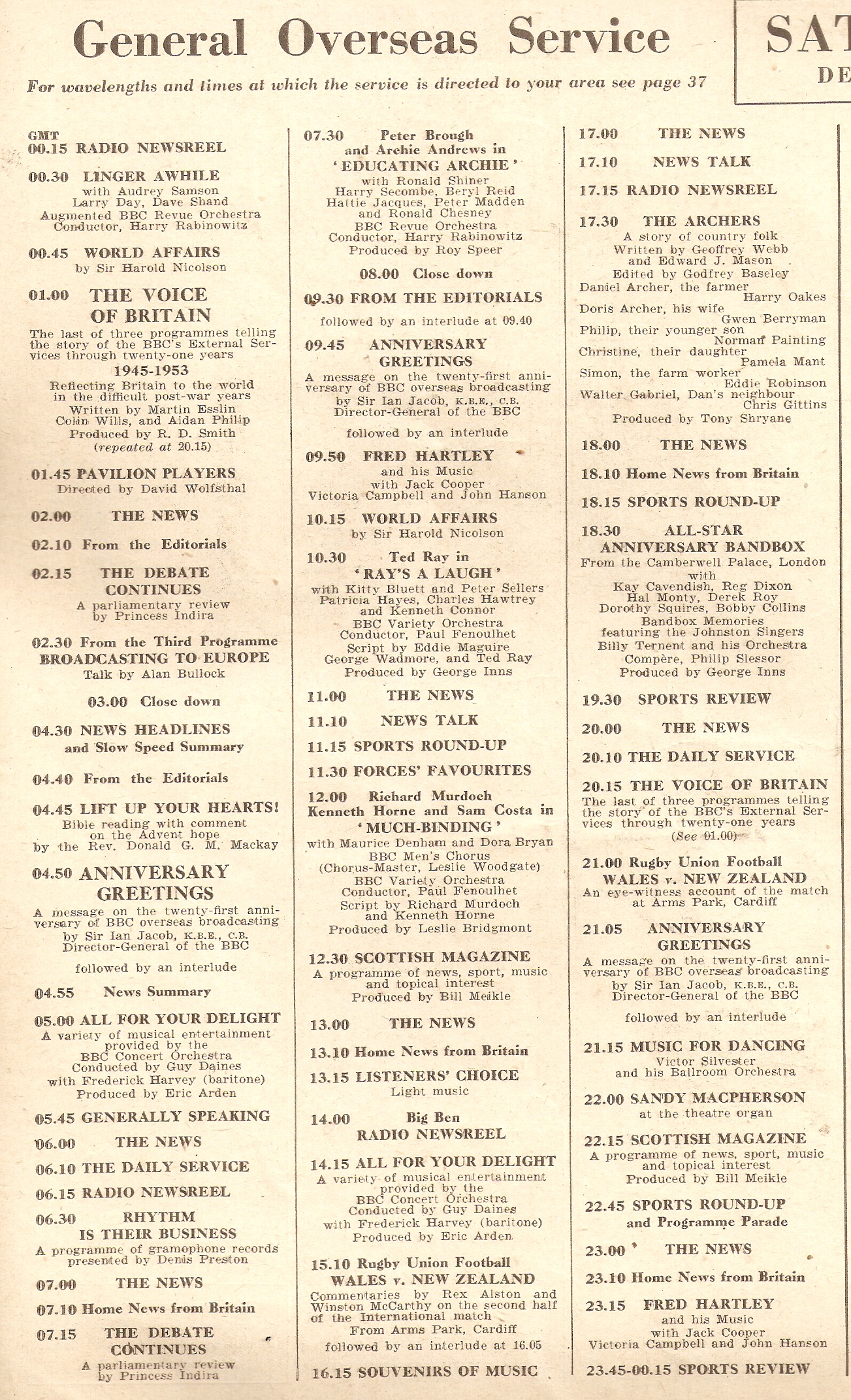
Dipping into the London Calling listings for the 21st anniversary of Overseas Broadcasting here’s what was on offer on the General Overseas Service for 19 December 1953:

You’ll spot some familiar programmes, Educating Archie, Much-Binding, The Archers etc. that were made for domestic audiences. I reckon at least ten programmes were also carried by the Home Service, Light Programme and even the Third Programme, including the rugby union commentary. Of course there are some anniversary specials with greetings from the Director General, Sir Ian Jacob, and the last of three features The Voice of Britain. Giving a talk on World Affairs is former diplomat and MP Harold Nicholson who’d been a regular broadcaster on both the domestic and overseas services, sometimes not without controversy (see blog post on Hilda Matheson). The Radio Princess, Princess Indira was making her usual parliamentary review in The Debate Continues. The inclusion of The Archers was not wholly welcomed by all listeners. A 1955 survey showed that recent exiles liked it but those who had not heard it back home were critical and “declared it unsuitable for overseas listeners or said it was wrong to present what they thought was an unfortunate picture of domestic life in England”. By the end of the decade it was dropped though not without an inevitable petition to have it re-instated. “How can the world’s agriculturalists keep up to date with the news of Ambridge”. (9)     

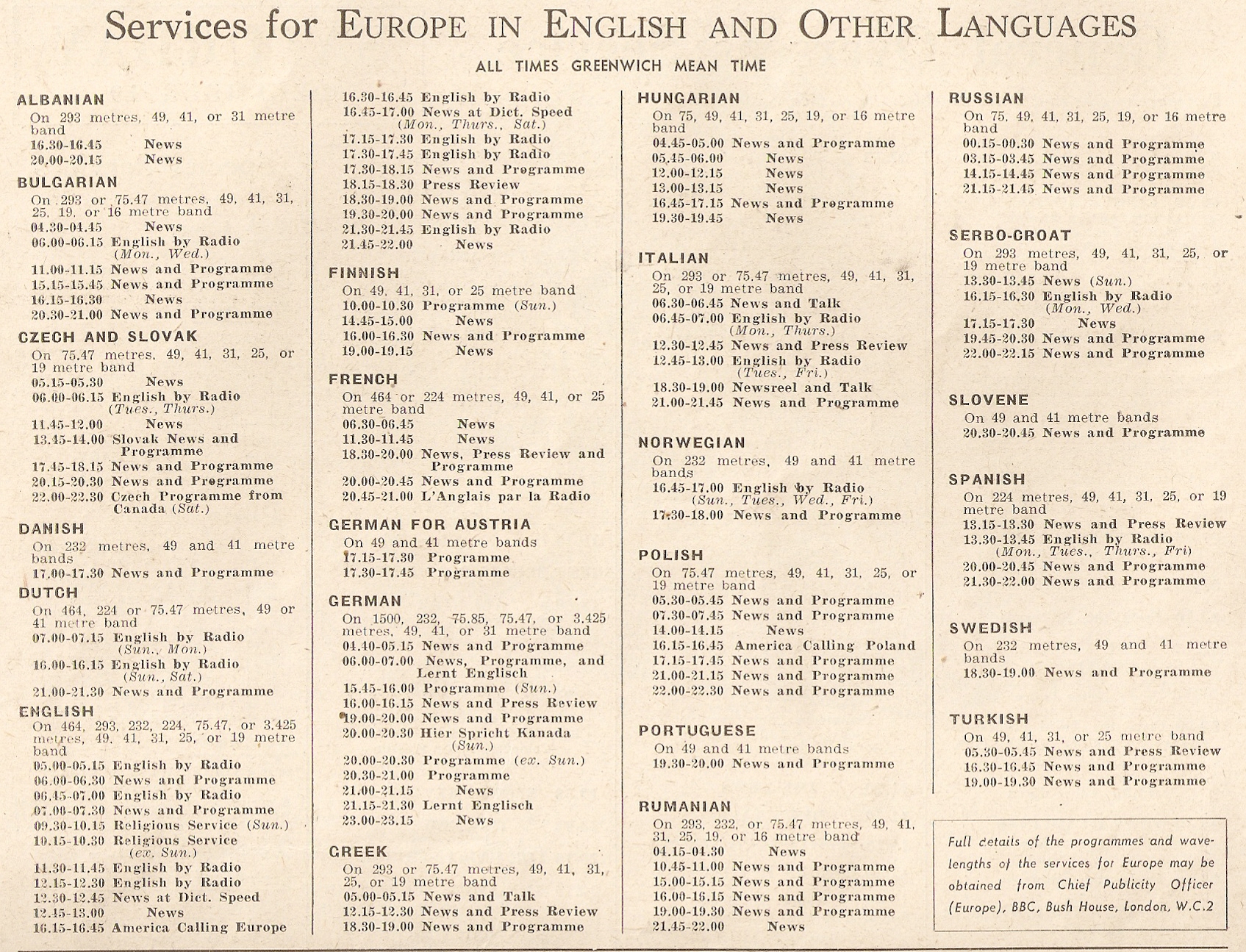
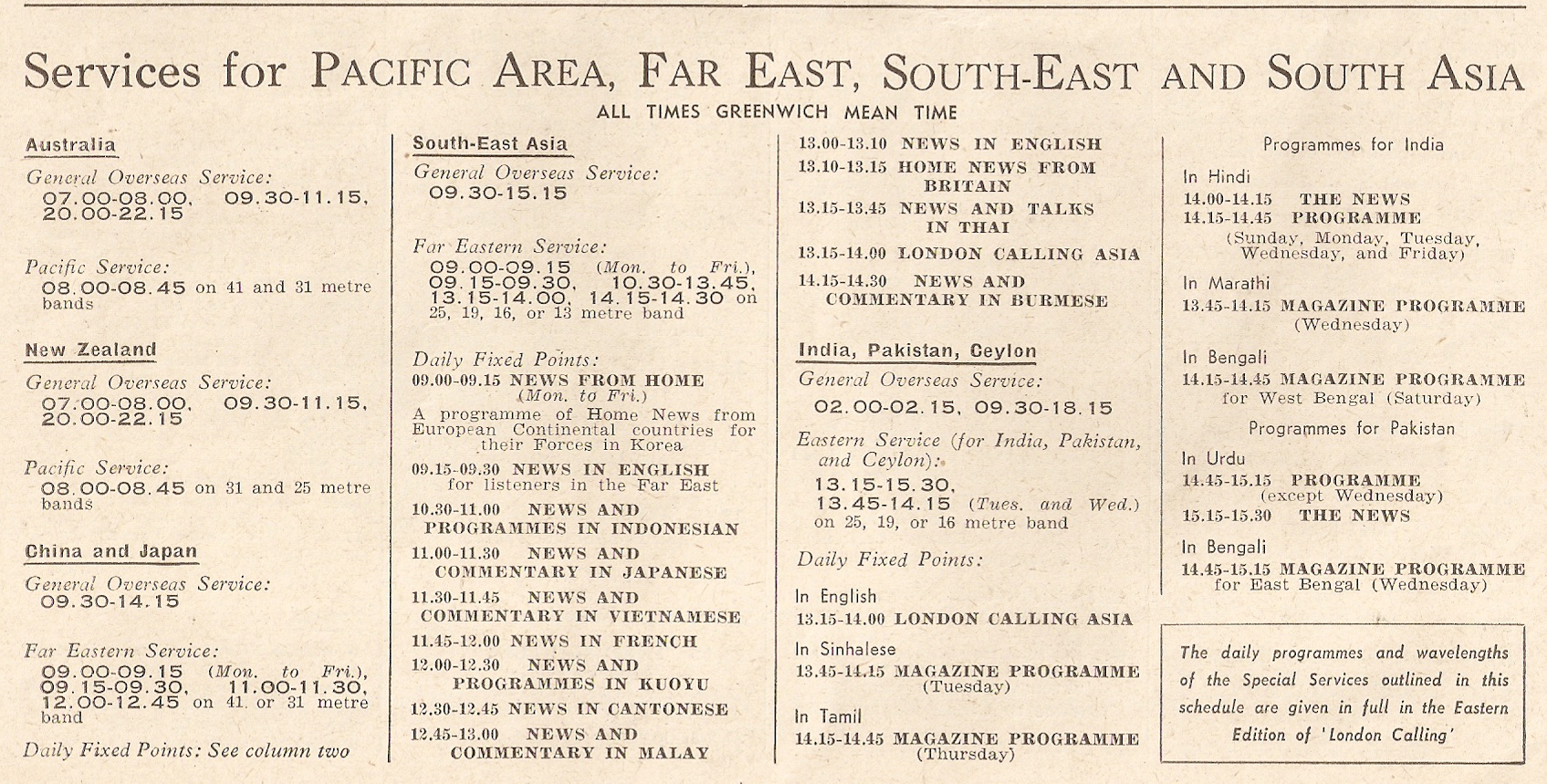
In this Western edition of London Calling we also get a glimpse into what was being beamed to specific regions of the globe. Note the English by Radio programme, a service the BBC introduced in 1942 and the use of “Calling” in titles. During the week there was also Calling the West Indies, Calling the Falkland Islands and Calling Mauritius.   

This section lists the programmes for Europe in English and the vernacular services. Of these languages the BBC now only provides Russian (online), Turkish and Serbian (online). There’s also a French language service for Africa and a Portuguese service for Latin America.

Further afield the offerings for the Pacific and Asia:

In 1959 Martin Esslin gave this talk about the first 21 years of the European Service. Martin had joined the European Service during the war as a German talks producer. He’d go on to be Head of Radio Drama.

For the External Services the 1950s could, in the view of Mansell, be described as a “period of decline and lost opportunities”. There has cumulative cuts in grant-in-aid since 1949, cuts in staff and language services, and transmitters and aerials that really needed replacing or modernising.   

From 1958, under the newly appointed Head, Bob Gregson, the General Overseas Service made the gradual shift away from focussing on a service for the Briton abroad (“audiences in the Commonwealth, to British Forces, and to British communities overseas” per the BBC Handbook) to one that would also cater for those for whom English was a second language. This was in part a response to technology changes and the increase in listening on transistor radios and in part a reaction to the changing post-war geopolitical situation with the decolonisation of the Empire and the Suez crisis (10).

The 1960s would be “the decade of Africa” with the creation of a separate African Service and, later in the decade, the building of a new Ascension Island relay station to help shortwave coverage to West Africa (as well as to South America).  Internally all the remaining services finally moved into Bush House in late 1957 and there was also to be less dependence on programmes from the domestic services. “We can no longer be merely an image of the Home Service or Light Programme”, said Gregson. In May 1965 the name of the service itself changed. It was no longer just catering for the Empire (or the Commonwealth) but the world. So, in May 1965, it became the BBC World Service. (11)

Under Gregson’s tenure there was also a “radical shift of emphasis to news, comment and the background discussion of world affairs”. Some long-running programmes starting in the era included the Saturday afternoon sports magazine Saturday Special (1959) with PaddyFeeny (changing to Sportsworld in late 1987), the “radio shop window for British industry" New Ideas (1958),  Focus on Africa (1960), Topical Tapes for rebroadcast by stations worldwide (1962),The World Today, Commentary, Science in Action (1964), Letterbox (1965), Outlook (1966) and World Radio Club (1967). To reflect the change in emphasis Home News from Britain was renamed News About Britain.   

Back to London Calling and this time the edition that coincides with the BBC’s 50th anniversary in November 1972.


Although news has been the backbone of the World Service, from the mid-60s to the early2000s it has always carried a full range of other programmes.

Drama: plays, sometimes under umbrella titles such as Modern English Theatre, Theatre of the Air, Globe Theatre or Plays of the Week with many of them directed by the award-winning Gordon House. Drama serials some of which have found their way onto Radio 4 Extra (The Toff and Down Payment on Death are recent examples). Even a soap set in a west London health centre called Westway.

Script cover for a recording of a 1966
production of The Masters (BW)

Music: request shows like Records Round the World and Anything Goes with Bob Holness. Pop music in Pop Club, A Jolly Good Show, Top Twenty and Multitrack. Rock music in Rock Salad with Tommy Vance. Jazz in shows with Humphrey Lyttelton or Steve Race and Jazz for the Asking with Peter Clayton (later Malcolm Laycock). Classical music in The Pleasure’s Yours with Gordon Clyde and Classical Record Review with Edward Greenfield. Any number of Radio 1 and Radio 2 DJs had shows including John Peel, Brian Matthew, Paul Burnett, John Dunn, Gloria Hunniford, Andy Kershaw, Ken Bruce and Steve Wright. 

The presenters of Records Round the World pictured in 1969.
Back l-r Sarah Ward, Don Moss, Colin Hamilton, Adrian Love
Front l-r Gordon Clyde, Maggie Clews, Elizabeth London
Chairing is Paddy Feeny

Arts: magazine shows such as The Lively Arts, Theatre Call, Book Choice, Focus on Film and the long-running Meridian.

And before this list gets too long some other programmes have included The Merchant Navy Programme which was replaced by Seven Seas, the quiz Take It or Leave It with Michael Aspel, The Farming World, Waveguide, Network UK and Omnibus. 

For the 50th anniversary of the External Services in 1982 it was not only a special cover for London Calling but also a very rare event, a Radio Times cover. The accompanying article by Frances Donnelly helped promote the BBC1 documentary (shown on 8 December 1982) Hang On, I’ll Just Speak to the World, the title coming from announcer Keith Bosley as he addresses the camera and realises he has a programme junction to announce. You’ll find the documentary on YouTube uploaded by the producer Jenny Barraclough.   


The BBC also issued an LP This is London narrated by Leo McKern. This was adapted from the World Service programme Voices Out of the Air. It’s on the World Service website under yet another title 50Years of Broadcasting to the World.

I’ve no recordings marking the 60th anniversary (if you do please contact me) but here are a few pages from the last ever edition of London Calling from October 1992. The following month it became part of the BBC Worldwide magazine. 


For the 70th anniversary the World Service went to Table Mountain near Cape Town for 14 hours of live broadcasting presented by Heather Payton and Ben Malor. The location was significant as it was the site of an early Empire Service link up with the African Broadcasting Company for a “descriptive commentary by the Johannesburg Station Director of the panorama from the summit of the mountain” on 6 March 1933.    

On 21 December 2002 the celebrations were reviewed in this edition of Pick of the World.  The This is London programmes mentioned in this programme are also online here.

In 2012 for the 80th anniversary the celebrations were moved forward to February as the World Service was now getting ready to pack up at Bush House and move into the redeveloped Broadcasting House. On 29 February a number of programmes were broadcast from the courtyard at Bush House. Some of these, including Outlook, World Have Your Say, World Business Report and the live news meeting are online.  

Here are a couple of programmes from that day that are not available. First from 1000 GMT World Update with Dan Damon. Dan presented this programme for 17 years but left the BBC in 2021 to become an Ordained Minister for the Church of Wales. 

From 1600 GMT World Briefing with Oliver Conway.

It’s a low-key affair for this year’s 90th anniversary, perhaps not surprising as the BBC is yet again under the financial cosh and there are major cuts planned for the language services, including the end of linear broadcasts for the Arabic service. The Documentary with Nick Rankin, listener’s programme memories on Over to You and a couple of editions of Witness History about Una Marson and broadcasting during the Cold War seem to be the token offerings.  


There are two other services whose history is inextricably linked with the Empire Service, and its later incarnations, that of the Monitoring Service and the Transcription Services. The monitoring of foreign radio broadcasts started on an informal level in 1937 with particular interest as to what was coming from Italy and Nazi Germany. In the summer of 1939 the Ministry of Information asked the BBC to undertake wartime monitoring and the service was set up with a base at Wood Norton. Initially heading the service was Malcolm Frost of the BBC’s Overseas Intelligence Department (originally set up in 1937 to conduct audience research in countries that the Empire Service was broadcasting to) later to become the Director of the Monitoring Service. The service moved to Caversham Park in April 1943 where it would remain until just over four years ago, moving into New Broadcasting House. You can read more detail about the early days of the Monitoring Service on Chris Greenway’s blog here.   


As the Empire Service often had to broadcast the same programme to different parts of the world at different times it became an early adopter of recording the original transmission for repeating during the day; what were initially called ‘bottled’ programmes (a term coined by the BBC’s first Chief Engineer Peter Eckersley, though he’d left by the time the Empire Service launched). These bottled programmes were either cut on discs (with a playing time of between 5 and 9 minutes) or recorded using the Blattnerphone system.  At the same time the BBC was also looking at providing radio stations around the world with a selection of its programmes on disc. This would in part overcome some of the issues with shortwave listening, help negate other station’s pirating BBC output and to generate income (albeit broadcasters were charged a nominal fee for the discs).


In July 1932 the BBC announced its intention to supplement the proposed Empire Service with recorded programmes. “These programmes, which will be produced with all the available artistic resources of the BBC, are to be recorded on discs and circulated to all stations overseas which subscribe to the service”.  The advantages were: “the original programmes will be available for broadcasting at any time, and will be received by the local listener at perfect quality”. 

The first set of discs offered by the BBC included Cakes and Ale, a programme of old English songs and choruses; Lily Morris, Bransby Williams and Charles Coburn in vaudeville, with Henry Hall’s Dance Orchestra; a dramatised biography of Christopher Wren; a programme of traditional Scottish music; Postman’s Knock, a British musical comedy written by Claude Hulbert; A.J. Alan telling a story; A Pageant of English Life from 1812 to 1933; a Children’s Hour programme. Orders were placed from New Zealand, Australia, India, Ceylon, Kenya, South Africa and Southern Rhodesia. A second batch of discs was issued in 1934 and the Transcription Service was underway under the leadership of Malcolm Frost as Head of the Empire Press Section (he was also the post-war General Manager of the BBC Transcription Services).

Complications arose at the start of World War II when the Foreign Office set up its own Joint Broadcasting Committee (the director was the BBC’s ex-Head of Talks Hilda Matheson) to provide British recorded programmes of a propaganda nature to radio stations. The BBC was concerned that listeners may not be able to distinguish between its own and JBC programmes but by October 1941 the services were merged as London Transcription Services. By the end of the war it was distributing programmes in nineteen languages to over 500 stations.


In 1946 the LTS became BBC Transcription Services and was based at St Hilda’s (a former convent) at the back of the Maida Vale studios. Programmes on offer were either specially recorded for TS or selected from existing programmes broadcast on the domestic or external services. They covered the full range of drama (the World Theatre series was particularly successful), comedy, talks, concerts and musical performances, documentaries, schools programmes and English by Radio. TS would either pick selected episodes from a series to be issued on disc or perhaps take the whole series – this has since been invaluable for repeats on BBC Radio 4 Extra were gaps in Sound Archives holdings can be filled using TS disc copies. Programmes recorded exclusively for TS included the long-running Top of the Pops presented by Brian Matthew and Pop Profiles (now both highly sought after by collectors) and the Vintage Goons series (1957-58).They also had a mobile recording unit available for concerts, including The Proms, and music festivals. 

In 1964 Transcription Services moved to Kensington House in Shepherd’s Bush were it was part of Overseas Regional Services (English), giving the Head of service the acronym H.O.R.S.E. By the early 1990s all the masters were moved to Bush House and eventually would find their way into Sound Archives, though with a great deal of catalogue information missing. (12) BBC Radio International now provides a similar service of licensing programmes for re-broadcast around the world.    

(1) The BBC had already dabbled with shortwave broadcasting setting up experimental station G5SW at the Marconi works in Chelmsford, with the first major transmission to Australia on 11 November 1927, By November 1928 the transmitter was in poor condition and breakdowns were frequent but trial broadcasts seem to have continued into 1931. Testing at the Daventry station had started on 14 November 1932 exactly 10 years to the day since the BBC’s first broadcast.

(2) Within months the allowance had increased to £100 a week and by the end of 1933 it was £200.

(3) Reith wasn’t the first voice heard on the Empire Service; that fell to announcer William Shewen who started with “This is London calling the Australian zone through the British Empire Broadcasting Service at Daventry”. Shewen was the only staff announcer for a while but by 1937 they had a team of five working in shifts and where necessary sleeping over in one of the two bedrooms provided in Broadcasting House. Other pre-war announcers, mostly ex-military types,included Robert Dougall (later best known as a BBC tv newsreader), Pat Butler,  former Talks Assistant H.P.K.Pooley, Hugh Venables, Robin Duff (later a BBC War Correspondent) and Duncan Carse (the voice of Dick Barton, Special Agent 1946-51).   

(4) The Empire Service site at Daventry included the main station building with a transmitter hall, control rooms and offices plus five aerial array zones, one for each of the geographic areas. Shortwave transmitting capacity was increased at the start of World War II at Clevedon near Bristol, and Rampisham Down in Dorset.

(5) The first Arabic new broadcast on that opening day has been described as “the most famous and perhaps the most controversial in the history of the Service”. It included the item “Another Arab from Palestine was executed by hanging at Acre this morning by order of the military court. He was arrested during recent riots in the Hebron mountains and was found to possess a rifle and some ammunition.”  This seemingly innocuous factual report sent shock waves though the Arab world and the Foreign Office. “Is the BBC bound to broadcast to the Empire the execution of every Arab in Palestine?” asked Rex Leaper, Head of the Foreign Office News department and responsible for liaison with the Corporation. . The BBC took the stance that as the item had been featured in an Empire Service bulletin it could see no reason for not including it in the Arabic news. 

(6) The wartime overseas services found themselves scattered around bases in London and over in Worcestershire. When land mines damaged Broadcasting House in December 1940 members of the European Service were re-housed at Maida Vale before moving to Bush House in March 1941. The Maida Vale studios themselves took a hit in May 1941. Other bases were, at various times, at Wood Norton and also the nearby Abbey Manor, Aldenham House in Elstree, and Bedford College in Regents Park. I wrote about the studios at 200 Oxford Street in July 2017.  


(7) The wartime changes to the Overseas Services are a little complicated. In November 1939 the Empire Service was modified “so as to make it virtually a World Service”, though the name Empire Service seems to have continued. In late 1942 it became known as the General Overseas Service. In February 1944 it merged with the Forces Programme to become the General Forces Programme meaning it was also available in the UK on the medium wave (see announcement in the Radio Times above). For home listeners the GFP was replaced by the Light Programme in July 1945 but continued on shortwave for troops outside N-W Europe. The old General Overseas Service title was back in 1947.According to the 1946 BBC Year Book “the BBC has always regarded the General Forces Programme as being contained within the General Overseas Service”.

Photo BW

(8) The colour coding of the networks persisted into the 1990s when Bush House still had a Green continuity studio. The European Service used the V for victory drum beats.

(9) That wasn't quite the end of The Archers for overseas listeners as in 1959 the Transcription Service offered slightly edited versions of the omnibus editions. A stash of these discs, 2,670 episodes were 'discovered' in 2003 and that story was told in Ambridge in the Decade of Love. 

(10) In July 1956 the Government had established a Committee on Overseas Broadcasting against a background of growing Foreign Office unease over the External Services budget. The Suez Crisis that October was “the point at which the strategic reassessment of the overseas services of the BBC became fused with the problems of Britain’s evaporating influence in the Middle East...” (Webb)

(11) The new name came not from the BBC but was included in the report of the Rapp Committee’s 1964 report on “the methods and effectiveness of the External Services”. Amongst the many recommendations on language services and relay stations was the term BBC World Service which would have “more meaning to the new audiences of English speakers around the Globe”. The World Service started broadcasting around the clock in 1968.  

(12) The Transcription Service masters included 16" discs, 1/4" tape and DATs. They were moved from Bush House in c. 2006 to the TV/Film archive in Windmill Road and then relocated to the new BBC Archives facility at Perivale in 2011. 

Further reading and listening:

In this blog post I have only dipped a toe into the history of the BBC’s External Services. As well as consulting back issues of London Calling, BBC Year books and the Asa Briggs volumes I have also referred to (and some quotes are taken from):

Let Truth Be Told by Gerard Mansell (Weidenfeld & Nicholson, 1982)

A Skyful of Freedom by Andrew Walker (Broadside Books, 1992)

What did you do in the War, Auntie? By Tom Hickman (BBC Books, 1995)

London Calling by Alban Webb (Bloomsbury, 2014)

BBC World Service by Gordon Johnston & Emma Robertson (Palgrave Macmillan, 2019)

I should also mention Broadcasting Empire: The BBC and the British World, 1922-1970 by Simon Potter (OUP, 2012) though I’ve yet to find a physical copy that isn’t available for about £100.  

For more on the history of Lillibullero there's this edition of Meridian from December 1998. 

You can hear Reith's opening Empire Service broadcast on the British Library website. 

Thanks also to Andy Finney and Simon Rooks for some additional information and to Barry Warr for the illustrations BW.

Thursday, 15 December 2022

Another Chance to Hear


Listening to BBC Radio 4 Extra can sometimes feel like they’re just playing Hancock’s Half-Hour and Round the Horne on a loop for the last two decades. But aside from these “much-loved” comedy gems the station has a well-deserved reputation for digging deeper into the BBC’s archives and airing lesser-known comedies, dramas and readings. Indeed this coming weekend we have the first broadcast in nearly 70 years of an edition of Life with the Lyons and an Afternoon Theatre drama from 1974 that’s not had a repeat since 1977.

Despite pulling in an audience of 1.8 million (and hitting a high of 2.1m in 2015) Radio 4 Extra is now on radio’s death row. In May of this year DG Tim Davie announced that 4 Extra would (at some as yet undetermined date but certainly not in the next three years) stop broadcasting “on linear”. 

Today the station is twenty years old. It was launched in a flurry of digital radio expansion in 2002 alongside the new services of 5 live Sports Extra, 6 Music and 1Xtra and the Asian Network going national on DAB.

Initially called just BBC7 a press release in November 2002 promised: “A great mix of entertainment with the best of BBC comedy, drama and books as well as a brand new daily live kids' radio show, BBC 7 is the fifth BBC digital radio station to launch this year and completes the BBC's digital radio portfolio”.  

Here’s an early promo for the station:

Broadcasting 18 hours a day (7am-1 am) BBC7 was zoned with six hours of comedy (Comedy Hour, Classic Comedy, Comedy Zone and The Comedy Club), a drama zone, crime and thriller strand, science fiction and horror in The Seventh Dimension and four hours of children’s programmes. Of those ‘zones’ just The Comedy Club and The 7thDimension remain. It started broadcasting around the clock from January 2004.


The station underwent a subtle name change in October 2008 to BBC Radio 7 (using just BBC7 was deemed confusing and people thought it was a tv service) followed by a re-launch in April 2011 as BBC Radio 4 Extra.

The original BBC 7 head of programmes Mary Kalemkerian described her job like this:

I am entrusted with the BBC's heritage and I have to select what will go out on the air, but it is not just like a jukebox where you pluck a token out and put something on. I have to make sure the rights are cleared, as the BBC doesn't own half of its archive. So I work a lot with agents and also look at ways of polishing up these radio jewels by repackaging programmes to make them more accessible to a younger audience. I also commission some new programmes – quite a bit of contemporary comedy.

In addition to mining the archives or taking narrative repeats of Radio 4 comedy shows the station has often commissioned its own programmes, albeit a relatively small amount. Its 2007 service licence included a commitment to at least 10 hours of new comedy a year and 20 hours of new drama, though this was later amended to “some” new comedy and drama. It was also expected to contribute to BBC radio’s target of 10% of new commissions to go to the independent sector.


Original commissions include the Saturday morning 3-hour features, The Comedy Controller, Ambridge Extra, dramas such as Trueman and Bailey, The Comedy Club interviews and a number of comedy series, the most successful of which was Newsjack.

Broadcast between 2009 and 2021 Newsjack had six main presenters over its 24 series run: Miles Jupp, Justin Edwards, Romesh Ranganathan, Nish Kumar, Angela Barnes and Kiri Pritchard-McLean. It offered an Open Door policy in which members of the public could email in their sketches and one-liners. These submissions plus sketches from the staff writers are then knocked into shape by the script editor and producers. For this edition from the sixth series in 2012 Newsjack received 675 emails and 27 writing credits were given of which 21 were non-commissioned writers. With Justin Edwards are Pippa Evans, Lewis Macleod and Nadia Kamil.    

BBC Radio 7 also had a large commitment to broadcast children’s programming, at one point at least 1,400 hours a year, later reduced to 350 hours when it became 4 Extra. This was mainly the pre-school series The Little Toe Show (later CBeebies on BBC Radio 7) and for older children The Big Toe Radio Show (later known as Big Toe Books). When they ended in 2011 there was just an hour of kid’s programmes now titled The 4 O’Clock Show and presented by Mel Giedroyc. This in turn was pulled in March 2015, justifiably as it only attracted  5,900 10-14 year olds and had an average listener age of 60.   

Adopting a magazine style format, The 4 O’Clock Show was something of a pick ‘n’ mix affair with some clips taken from elsewhere on Radio 4’s output. Based on the evidence of this recording from 12 March 2015 it’s not hard to see why it got the chop. Here Mel introduces Dick and Dom investigating How Dangerous is Your School with the help of students and staff at the Cardinal Wiseman School in Greenford, London. There’s an extract from Saturday Live about life on a farm, more science, this time out in space, with Stuart Henderson from Radio 4’s Questions, Questions and musician Pete Roe on restoring and playing harmoniums. There’s an interview with actor Ron Ely (of Tarzan fame, yes, really) and Gabriel Quigley reads from Roddy Doyle’s A Greyhound of a Girl. Oh, and Mel reveals what’s inside her big bag.

Radio 4 Extra doesn’t broadcast live (with a couple of exceptions) but is built in advance from a number of pre-recorded elements. Obviously there’s the programmes themselves and then the separate links for The Comedy Club and The 7th Dimension. All the continuity elements – intros, outros, top of the hour junctions, trailers and promotions and station imaging (from Mcasso) – are added to the playout system. If a programme goes out more than once a day the same intros/outros are used.

Those live broadcast exceptions are, back in the days of BBC7/BBC Radio 7, the weekday editions of The Big Toe Radio Show, originally presented by Kirsten O’Brien and Jez Edwards. The only other instance I’m aware of is for an hour on 14 November 2012 when Jim Lee provided the live continuity around the all station link-up for Radio Reunited as part of the BBC’s 90th anniversary.   

Here’s part of Jim's ‘live’ continuity:

When BBC7 started presenters or announcers would be associated with different strands of the station’s output. This changed from 2010 when the same continuity announcer was heard throughout the day (with the exception of The Comedy Club and The 7th Dimension).

In 2014 Feedback’s Roger Bolton visited 4 Extra and spoke to Commissioning Editor Caroline Raphael, announcer Joanna Pinnock and producer Nick St George.

The continuity announcers are either current or former Radio 4 announcers plus a small number of voiceover folk who just provide 4 Extra continuity. The 4 Extra day runs from 6.00 am to 5.59 am and the announcers record two 24-hour days in one session. Back in 2019 one of the station’s most regular voices, Alan Smith, told me how it all works:

About 3 weeks before transmission, the programmes appear in the 4Extra schedule in the order they’ll be played-out. It’s at this point that announcers can listen to the programmes to get a feel for them. We don’t listen all the way through; we hear just enough to get a sense of what’s going on. Our listening is supplemented by written information which is held in the programme database. This database is a fantastic resource as it contains a plot summary of every programme together with its transmission history, cast & crew details and any contentious/sensitive factors which need to be flagged up.

Then the writing process begins! All of us who present on 4Extra write our own scripts, so everything you hear us say on air is information taken from the database that’s given a personal twist in our own style. It takes two working days to write two 24-hour on-air days. We all have different amounts of time committed to 4Extra – in my case I do two 24-hour on-air days every five weeks; some presenters do a bit more, some a bit less.

Then, about 10 days before transmission, its recording day when we go to the studio with the producer, armed with our completed scripts. This part of the process is super-efficient as we simply record all the individual links we’ve written, one after the other, plus the promos and trails. It takes about three hours to record the two 24-hour days. The announcers then leave the producer to put all the links into the schedule and build the final on-air audio.

In this sequence you’ll hear a number of familiar voices introducing the programmes on BBC Radio 7 and 4 Extra. In order you’ll hear Zeb Soanes, Steve Urquhart, Wes Butters, Neil Sleat, Debbie Russ, Luke Tuddenham, David Miles, Alan Smith, Penny Haslam, Joanna Pinnock, Jim Lee, Chris Berrow, Alex Riley, Kathy Clugston, Susan Rae, Amanda Litherland, Toby Hadoke, Nick Briggs, Andrew O'Neil, Arthur Smith and Jon Holmes.

BBC7 presenters/announcers included Joanna Pinnock, Penny Haslam, Jim Lee, Alex Riley, Michaela Saunders, Phil Williams, Richard Bacon, Kevin Greening, Etholle George, Alan Smith, Helen Aitken, Kerry McCarthy and Alex Riley.

Radio 4 Extra announcers include or have included Joanna Pinnock (there from the start in 2002), Alan Smith, Jim Lee, Wes Butters (the station’s “bit of rough” according to a recent Radio Times profile, who’s been on since 2009), Susan Rae, Kathy Clugston, Rory Morrison, Zeb Soanes, David Miles, Neil Sleat, Luke Tuddenham, Debbie Russ, Chris Berrow, Amanda Litherland and Steve Urquhart.  

The 7th Dimension presenters have included Toby Hadoke, Nick Briggs, Natalie Haynes, Andrew O’Neil and Nicola Walker.

The Comedy Club introductions and interviews have been looked after by Arthur Smith, Jon Holmes, Jake Yapp, Jessica Fostekew, Paul Garner, Angela Barnes, Laura Lexx, Rob Deering, Jade Adams, Cariad Lloyd, Sarah Campbell, Harriet Kemsley, Diane Morgan, Iain Lee, Tom Wrigglesworth, Tiff Stevenson, Lou Conran, Isy Suttie and Thom Tuck.

With thanks to Alan Smith and Chris Aldridge.   

Postscript: Well wouldn't you know it. After saying how few shows on Radio 4 Extra are live, one appears in 2023. In January Jake Yapp's Unwinding started a 20 programme run live on weekday evenings between 7 and 10 pm. 


Related Posts Plugin for WordPress, Blogger...