I guess we'd all rather forget 2020 so in this post I'm
going back a little further for the annual reviews.
To kick off, just 30 years ago it's the annual wrap-up of
the news as seen through the eyes of the Week
Ending team. It was a year dominated by the end of the Thatcher
administration and the Gulf War. Taking part are Sally Grace, David Tate, Bill
Wallis and Jon Glover. Also featured in the repeated sketches are Russell
Davies, Royce Mills, Chris Emmett, John Baddeley, Neil Caple, Ian Ashpitel and
Alistair McGowan. Year Ending was
first broadcast on 28 December 1990.
Quote...Unquote is
now in its 44th year and for the few years always had a Christmas special. The
edition I've unearthed is from Christmas Day 1980 with the panel of P.D. James,
Dick Vosburgh, Brian Johnston and Sue McGregor. As usual Nigel Rees is posing
the questions. Reading the quotations is veteran announcer Ronald Fletcher.
The station started life as Radio Medway broadcasting on
97.0 MHz VHF (and on Rediffusion Channel B in Maidstone) from studios on
Chatham's High Street. Test transmissions could be heard earlier in December
1970 broadcasting Radio 1's programmes interspersed with local news bulletins
and the occasional music show. Recordings of some of these tests have survived
hidden amongst the Radio 1 archive material that was taped at the time.
Most of the BBC local
stations opened with a word from the manager or some local dignitary but not Radio
Medway. It went to town with a gala night introduced by Henry Hall (he of Here's to the Next Time with the BBC
Dance Orchestra fame), a soundscape of the Medway, a community sing-a-long, a
classical concert and a link-up with Radio 2.
Station manager Harold Rogers - a producer with 30 years
experience on both the Home Service and Light Programme - obviously called in a
few favours to pull together the opening Gala
97. Alongside Henry Hall there was Peter Brough and Archie Andrews, Frank
Chacksfield, Georgie Fame, Bruce Forsyth, David Kossoff, Vera Lynn, Tessie
O'Shea, Dorothy Squires and Wout Steenhuis. A number of national BBC staff
appeared too: Frank Gillard, Tony Blackburn, Alan Dell, Franklin Engelmann,
Roger Moffat, Ray Moore, Keith Skues and Bruce Wyndham. The station's programme
organiser was Denis Lewell, also a former Light Programme/Radio 2 producer, who
had at one time worked with both Henry Hall and Peter Brough
The Medway - a
picture in words and sound of our river, the port and the townships along its
banks - was presented by Trevor Taylor, one of the station's news team. Trevor
would go on to be a network radio producer and for many years produced Gardeners' Question Time.
Sing Along With Us
featured Reg Simpson at the organ and was produced by Geoff Leonard. Geoff's
radio experience was all behind the scenes. He'd joined the BBC as a junior
engineer in 1941 in the Birmingham control room, later at 200 Oxford Street, a
Studio Manager for the Features department and attachments to TV presentation,
TV news and the BFN as a producer before the move to Radio Leeds as a production
assistant and then engineer. Geoff was at Medway from 1970 until his retirement
in 1980. He died in 2004.
Medway's star name and host of the breakfast show was Jimmy
Mack. Greenock-born Mack worked as a sales rep for an insurance company whilst
helping out at the Edinburgh Hospital Radio Service which led to him joining
the team on the LV Comet disc jockeying on the pirate Radio Scotland. Following
the closure of most of the offshore stations he worked for the BBC in Glasgow as
well as making occasional appearances on Radio
1 Club and welcoming Radio 1 and Radio 2 listeners into 1970 on Night Ride (co-produced by Harold
Rogers). He moved down to Kent in 1970 for the launch of Radio Medway where he
was the breakfast guy for six years and then on the mid-morning show for
another two. He headed back north in 1979 to join BBC Radio Scotland, taking
over the mid-morning show from Tom Ferrie. Jimmy also appeared on Radio 2
introducing shows with the Scottish Radio Orchestra and on BBC TV, STV and
Grampian. Joining the newly launched Clyde 2 in 1990 he remained with the
station for the next fourteen years, initially at breakfast (for 8 years) and
then early evenings, weekend breakfast and lastly a Saturday night show. Jimmy
died in 2004.
The first post-launch Radio
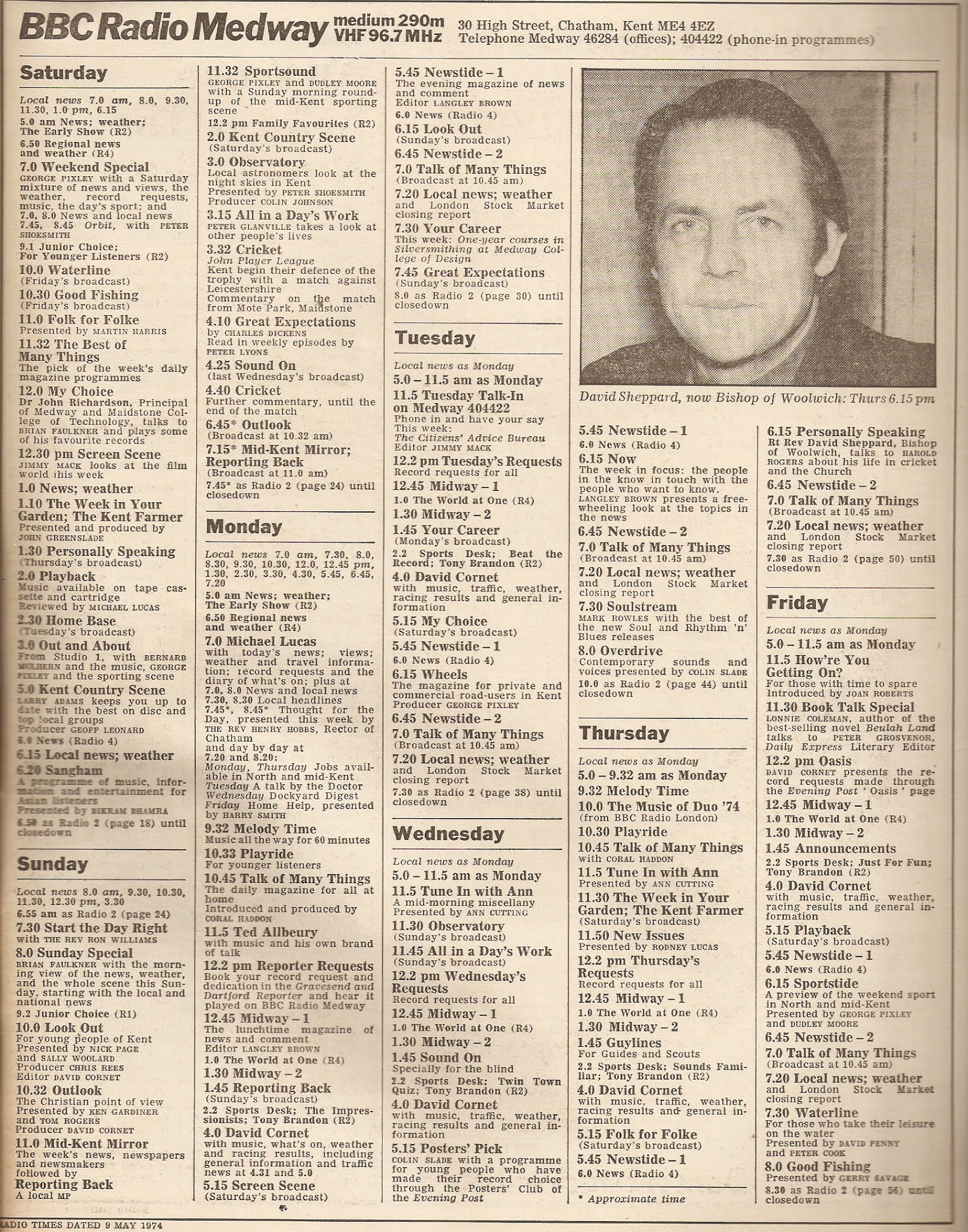
Times schedule I've got dates from the week commencing 11 May 1974.
No Jimmy Mack this week, presumably taking a week off.
Looking after things at breakfast was Michael Lucas (is this the same Michael
Lucas who would eventually head up Channel Television?). Michael also presented
Playback on Saturday afternoons which
reviewed the new releases on that cutting edge of technology, audio cassettes
and cartridges.
On weekdays we have an hour of melodic music - later that
year the station would join Radio 2 at this time - and Playride, their version of Listen
with Mother. The magazine show Talk
of Many Things presumably didn't talk about that many things as it lasted
just 15 minutes. The presenter, Coral Haddon, was a one-time regular
contributor to Radio 4's Home This
Afternoon.
The programme at 11.05 on Monday's is fascinating as its
presented by Ted Allbeury. If you know your offshore radio history you'll know
Ted's name. He was the former British intelligence officer who set up an
advertising agency and then got involved in running the sweet music station Radio
390 from the Red Sands Fort. His company, Estuary Radio Ltd, was successfully
prosecuted under the 1949 Wireless Telegraphy Act. Allbeury went on to manage
Britain Radio, renaming it Radio 355 until the Marine Offences Act came into
force in the summer of 1967. By the time he was on Radio Medway he'd already
written his first novel and went on to write over 40 spy stories and thrillers
until his death in 2005. In 1979 Allbeury appeared on Desert Island Discs.
The station's lunchtime bulletins, Midway, and teatime bulletins, Newstide,
were under the editorship of Langley Brown. Brown had long been a print
journalist, starting off in his native Yorkshire on the Halifax Daily Courier. In the 1960s he moved abroad to join the Rhodesia Herald in Salisbury, then later
the Central Africa Post and Times of Zambia. He gained some radio experience
with the Rhodesian Federal Broadcasting Corporation and Zambia Broadcasting
Corporation. Brown became the news editor at Medway when it started. One of his
programme ideas was the monthly M2KA,
devised for and presented by Kent County Constabulary. This recording dates from December 1976.
Notoriously Langley Brown was briefly suspended from his job
following a complaint to the DG that he'd referred on air to PM Margaret
Thatcher as an Ice Matron and mentioned that yet again she'd refused to do an
interview with the BBC despite it having been cleared locally with her campaign
team. He retired from BBC Radio Kent in 1986 and died in 2018.
Extract from 1977 BBC booklet Serving Neighbourhood and Nation
At 4pm on weekdays it
was David Cornet who was on the station for nearly 20 years, in later years on
at weekend with David Cornet's Weekend
and Home in Kent. He joined Radio 3
in 1990 as a presenter and announcer and was still reading the news on the
station until about 3 years ago.
Brian Faulkner, listed here for Sunday Special, stayed with Radio Kent until the late 80s. He
joined the BBC after founding Hospital Radio Medway in 1970.
Presenting what was possibly radio's only answer to The Sky at Night called Observatory was Peter Shoesmith. Quite
how local astronomers looked at the night sky in sound only is unclear. Peter
was a former tv announcer (both BBC and ITV) who would be a familiar voice on
the BBC World Service throughout the 1970s as a newsreader and announcer. Fellow
World Service announcer George Eason also appeared on Radio Medway.
Medway's sports coverage, such as Weekend Special and Out and
About, was under the control of sports editor George Pixley who was with
the station for about a decade. Co-presenting Sportsround with George on Sunday morning was Dudley Moore, not to
be confused with one half of Pete 'n' Dud.
You'll spot the name of Colin Slade on a couple of
programmes: Poster's Pick and the
rock show Overdrive. Young Colin had
got the job after initially hanging round the station making tea and doing tape
reclamation. He'd studied at the Medway and Maidstone College of Technology and
helped out at the local hospital radio. "My first broadcast came about
because of a duff transmitter valve which put Radio Medway off the air,
resulting in an hour's precious needletime in hand. I asked to do a one-off
rock show to use up the needletime. That one show became a series that ran for
over three yearand was really
responsible for my broadcasting career". Colin joined Radio Hallam in 1974
in time becoming the Presentation Controller. He was then at Classic Gold,
Planet Rock and Exeter FM until (albeit temporarily) leaving broadcasting in
2010. He's now a Devon County Councillor and Mayor of Tiverton. Unable to keep
away from radio Colin now has a Sunday afternoon show on Radio Exe.
There were a few Medway broadcasters who made it onto national
radio. Colin Berry was with the station in the early 70s before joining the
promotionsteam at Radio 1 and then in
September 1973 the presentation team at Radio 2.
Barbara Sturgeon joined in 1983 after winning a DJ
competition on the station the previous year. She remained with Kent until 2004
except for the period from January 1992 to December 1993 when she hosted Radio
2's weekend breakfast shows.
Sports commentator Bob Ballard joined the station in 1983
presenting the Saturday afternoon sports coverage Out and About as well as the weekday drivetime show. From Kent he
moved on to Radio York, GLR, Sheffield and the local radio sports unit in
London. From 1997 to 2012 Bob worked a sports reporter and commentator for
Radio 5 live, since then he's worked freelance as RHB Productions Ltd and for talkSport.
Mohit Dutta, better known as Mo Dutta, joined Radio Kent in
1991 before Radio 2 beckoned in 1995 and where, for the next 14 years he
presented the weekend early show.
Jazz broadcaster Helen Mayhew had worked at Radio Devon
before shifting over to Kent in the late 80s. Helen joined Jazz FM when it
started in 1990 and took over from Sheila Tracy on Radio 2's Big Band Special as well as presenting
Radio 3's Jazz Line-Up (both 2004 and
2006). Currently Helen can be heard on Jazz FM's Late Night Jazz.
Making the move from Radio 2 to Radio Kent was Don
Durbridge. A Radio 2 announcer and presenter from 1974 Don had a couple of
spells in Kent in the early 80s and again 1988-92. Read more about Don in my 2012 blog post.
Nick Page, shown above in 1974 schedules as a co-presenter
of the programme for "young people of Kent" Look Out would move to LBC, Radio Wales and then Radio 2 from 1979
to 1992.
Pat Marsh (Photo credit Alison Morton)
Radio Kent's longest-serving presenter is Pat Marsh who
joined the station in 1984. Pat's interest in radio started in hospital radio
in Dulwich then working providing shows for stores in central London and as a
DJ on a cruise ship. Sending an audition tape to Radio Kent's manager Clive
Lawrence he got some holiday cover for John Thurston and in time was given a
Saturday morning show. That show continued until 1992 but by 1986 he was also
on weekday mid-mornings and has continued to present a daily show ever since.
More on Pat's website here.
Here's another 1974 schedule this time for the week
commencing 2 November. There are some small schedule changes that mainly
include the reliance on BBC Radio London to act as a sustaining service. So we
get Richard Vaughan in the afternoons, Robbie Vincent in the evening and some
of their specialist music shows such as Breakthrough
and All that Jazz.
On Saturday mornings Teen
Scene the producer is credited as Rodney Lucas. Rod was with the station
for about 15 years and in July 1983 had the distinction of being the last voice
on Radio Medway and the first on Radio Kent. He's worked for numerous radio
stations, BBC and commercial and his Best Smooth Jazz shows are syndicated
worldwide. He founded The Radio School and the news agency Broadcast News.
Other broadcasters who have appeared on BBC Radios Medway
and Kent over the years include (and this list is by no means exhaustive so
additions are welcome):
Peter Glanville: an education producer later on Radio
Norfolk
John Thurston: with the station mid-70s to mid-80s before
moving to Radio Norfolk.
Howard Leader: actor and broadcaster on Essex Radio from
1983 and then Invicta, Radio Kent and Radio Lincolnshire from 2000.
Clare McDonnell: co-presented the breakfast show with John
Warnett 2010-2014. Previously on GLR, 6 Music and currently on 5 live.
John Warnett: on the station for 31 years, 23 of those on
weekday breakfast, before retiring in October. Here's the last hour of his show
on 24 October.
Dave Brown: on Medway/Kent 1980-87 presenting a number of
programmes but best known for a night time soul show which had grown out of the
earlier The Disco Scene. Also on
Orwell, Saxon, Invicta and Vibe FM. Latterly on Solar Radio. Part of one of Dave's show from 1982 is here on Soundcloud.
Kevin Steele: with the station throughout the 1980s with a
long run on the weekday breakfast show.
Ian McGregor: with Kent 1988-97. Also on Channel Travel
Radio and since 2000 the MD of Just Talking Communications marketing and PR
agency.
Andy Garland (pictured above): joined as a broadcast assistant in 1994.
Presented the Sunday night youth show The
Alternative but is best known for Sunday
Gardening in the late 90s and again from 2007.
Dominic King: born in Kent he worked for a number of
commercial stations in the south east before joining the station as a
newsreader in 2001.
Erika North: with Radio Kent since 2014 having previously
appeared on Heart (1995-2014) and winning a Sony Award for her breakfast show.
Also on Classic Gold breakfast with Tony Blackburn.
Dave Cash: broadcasting legend Dave (pirate Radio London,
Radio 1, Capital, Radio West, Invicta, Capital Gold etc) joined in 1999
presenting Dave Cash Country and The Dave Cash Countdown until his sudden
death in 2016.
Roger Day: another ex-pirate DJ (also UBN, Piccadilly,
Invicta etc) who was on Radio Kent from 2007 with his evening shows networked
across the south east. Programmes dropped as part of the schedule shake-up
earlier this year. Currently broadcasts from his studio in Spain on Caroline
Flashback and Delux Radio.
Daryl Denham: first on Radio Kent 1994-95 before moving to
Hallam. Later on Heart, Virgin, Century, Real Radio, Smooth before coming back
to Kent in 2015.
Julia George: mid-morning show presenter since 2010.
Matt Davison: sports presenter on Saturday afternoon coverage The Sports Hub 1995-2013.
Sean Rowley: Guilty Pleasures founder formerly on BBC Radio
London before starting Saturday night The
Joy of Music shows in 2009 which ended earlier this year.
Some other voices heard on Radio Kent include Dave Austin, Graham Cooke, Julie First, Bill Dod and Jonathan Witchell.
Looking for present ideas for the radio enthusiast in your
life or wanting to drop hints to your loved ones about what to buy you this
Christmas, then here are some book suggestions published in the last few
months.
A number of radio personalities have taken the opportunity
of Covid-19 lockdown to finish their autobiographies and these have caught my
eye.
Hey Hi Hello: Five Decades of Pop Culture from Britain's First Female
DJ by Annie Nightingale
The queen of Radio 1 celebrated fifty years on the station
this year. Here she tells us about her 60s forays into journalism and
broadcasting, her break into Radio 1 and the stars and musicians she's met
along the way, from the Beatles to Billie Eilish.
Last month Annie spoke to Nick Grimshaw about her career and
favourite music. She speaks to Zoe Ball on Radio 2 later this month.
Voiceover Man by Peter Dickson
Self-confessed "announcer guy, voice of God, gob on a
stick, vocal prostitute" offers this frank and funny review of his radio and
voiceover career.
Here's Peter talking toJenny Kleeman and Luke Jones on Times Radio in September.
Kid Jensen: For the Record by David Jensen
From Jensen's Dimensions and the Rhythm Pals to the Network
Chart and the Flashback 40 the Kid has been on the radio for five decades. More
recently David has been battling with Parkinson's disease and a share of the
proceeds from each sale will go the Parkinson's UK.Available from Little Wing Books.
The Kid spoke to Steve Wright this week.
Commercial Radio Daze by David Hamilton
David has already written about his time on the nation's
favourite in The Golden Days of Radio One
and this latest volume takes the story further and recalls some of the dozens
of other stations that Diddy has appeared on. Initially only available for
Kindle its now out as a paperback from Ashwater Press.
Earlier this year David spoke to Alan Jarvie about his
book.
Re-Run the Fun: My Life as Pat Sharp by Pat Sharp
Don't be misled into thinking that this is Pat's
autobiography, it only bears a passing resemblance to what actually happened
purporting to be an 'untrue' book.
Last month Pat, by the sounds of it sitting in his bathroom, spoke to
Chris Moyles on Radio X.
Life's What You Make It by Phillip Schofield
Although better known for the Broom Cupboard and This Morning the Schofe was on the radio
in New Zealand and enjoyed a four year stint on Radio 1 (1988-92) including achieving
his ambition of hosting the roadshow from Newquay where he'd grown up and
watched the show as a teenager.
Phillip spoke to Chris Moyles in October.
Utterly Brilliant!:My Life's Journey by Timmy Mallett
Before the madness of TV-am's Wacaday, Timmy on the Tranny had started on BBC Radio Oxford then
Centre Radio and up to Piccadilly. One-time helper on Timmy's show at
Piccadilly Chris Evans (Nobby Nolevel) spoke to Timmy on his Virgin Radio show
back in January. Interview on YouTube here.
Other books from radio folk published this year include:
Why Can’t We All Just
Get Along: Shout Less. Listen More by Iain Dale
The Prime Ministers:
55 Leaders, 55 Authors, 300 Years of History by Iain Dale
How Not To Be Wrong:
The Art of Changing Your Mind by James O'Brien
Finally, if you don't already have a copy then please
consider:
Radio Secrets and Radio Moments both by David Lloyd
Maggie's Ten-Year
Turkey was a Week Ending spin-off
akin to those monthly programmes under the title Two Cheers for... broadcast on the BBC World Service throughout the
eighties and into the nineties. This was a little different though: the
timescale was considerably longer, taking in the decade of Thatcher's
premiership and it was actually compiled as an audio cassette release called Ten Years with Maggie. That tape ran for
over two hours but was trimmed down to just under half-an-hour for broadcast on
the World Service in December 1989 and this Radio 4 broadcast the same week.
The tenth anniversary of Thatcher as PM fell in May 1989 but
it was decided to hold off publication until later in the year as cash in on
pre-Christmas orders. Producer Paul Spencer was disappointed as to what Week Ending material was available in
the Sound Archives so two contract writers, Mark Brissenden and Simon Bullivant,
went off to the Written Archives to dig out some old scripts. This meant
re-recording all the sketches, though this would prove less expensive than
paying fees to various performers had any archive material being used - and one
reason why so few editions of Week Ending
have ever been repeated. It also meant that Sally Grace could provide the voice
of Margaret Thatcher throughout, Sheila Steafel had been doing this back in
1979.
With Sally were long-time regulars David Tate (the voice of
Denis Thatcher in the new linking material), Bill Wallis, Jon Glover and Chris
Emmett.
The script included sketches written by Barry Atkins, Ian
Brown, Mark Burton, David Cohen, James Hendrie, Guy Jenkin, Robert Linford, Ged
Parsons, John O'Farrell, Nick Revell and Pete Sinclair with Mark and Simon
writing the linking scenes. The BBC Radio Collection tape was reissued on CD in
2009. The radio version hasn't been heard for 31 years.
The trimmed down for broadcast version, Maggie's Ten-Year Turkey, was broadcast on the BBC World Service on
three dates in late December and Radio 4 on the 30th. In this recording
announcer Peter Jefferson invites listeners to apply for tickets for Radio 1's The Mary Whitehouse Experience that was
just about to start its third series.
By any stretch of the imagination this blog post is niche. It
concerns a drum ending that lasts just one second. Yes, zip up your radio
anorak for this one.
As you'll no doubt know, back in the days when virtually
every show had a theme tune, Radio 1's Junior
Choice used a version of Morningtown
Ride played by Stan Butcher's Birds 'n' Brass. That theme was first used on
day one of Radio 1 when Junior Choice,
the replacement to the Light Programme's Children's
Favourites, was introduced by Leslie Crowther. Crowther was followed by
Paddy Feeney and then, from February 1968, by Ed Stewart. Stewpot used the
theme for the next 11 years. Here's Leslie Crowther introducing that first
edition followed by the theme in full:
A brief diversion here on Stan Butcher. Butcher, a pianist,
composer and arranger, was born in London in 1920. His first job was for music
publishers Boosey & Hawkes. He taught himself harmony and arranging and
before he was twenty was providing orchestrations for the likes of Bert Ambrose
and Harry Roy. During the war he served in the army and before the end of
hostilities he'd been asked to form a dance band that included amongst its
personnel trombonist Don Lusher and guitarist Jack Toogood. On demob he played
and arranged for bands run by Joe Daniels and Freddy Randall before joining
publishers Campbell Connelly & Co. He wrote and arranged for the likes of
Ted Heath, Cyril Stapleton and Eric Winstone and with Syd Cordell composed the
1959 Eurovison song entry for Pearl Carr and Teddy Johnson,Sing, Little Birdie. In the late 1960s
and early 70s he recorded a number of LPs. Some of these were credited to Stan
Butcher's Birds 'n 'Brass. The 'birds' were singers Barbara Moore and Daphne
Bonney. Barbara would herself carve out a
successful musical career as a singer (she was for a time one of The Ladybirds), composer and arranger. It was she that provided the new arrangement of
Fluff's Pick of the Pops theme At the Sign of the Swinging Cymbal and
wrote Just Like That for Terry Wogan's
Radio 1 afternoon show. Continuing the radio theme connection it was Barbara's
husband Pete that arranged and recorded the version of I Love You Samantha that was used by David Jacobs. Stan Butcher
continued recording in the 1970s and worked with Stan Reynolds and Barbara
Thompson. He died in 1987.
Back to Morningtown
Ride. This was a hugely popular tune when Radio 1 started, it had been the number
two song at the start of 1967, just pipped to the top spot by the Green, Green Grass of Home. The lyrics
telling of children on a night time ride safely delivered to the morning under
the watchful eye of the Sandman had great family appeal. So when Stan Butcher
and producer Monty Babson put together their 1967 album of covers from the
recent 'Hit Parade' called Sayin' Somethin'
Stupid and Other Things, they included Morningtown
Ride. Other tracks included I Was
Kaiser Bill's Batman, Mellow Yellow,
This is My Song and Green, Green Grass of Home. Some extra
tracks composed by Butcher were added such as Pearls for Patricia and, most importantly for this story, a jaunty
little tune called Pig Latin. That
track went like this:
When Junior Choice
came along in September 1967 they ditched the old Children's Favourite theme of Puffing
Billy in favour of something more contemporary, and that was Morningtown Ride. However, theproblem with this recording is that it faded
rather than ended. Junior Choice was
heard on both Radio 1 and Radio 2 so a definite end would give a neat junction
for the two networks to split. On Saturday's the programme ended at 9.55 am
with Crack the Clue following on
Radio 1 and the religious slot Five to
Ten on Radio 2. On Sunday mornings there was a split following at 10.00 am
time signal.
So someone at the BBC, perhaps producer Harry Walters, came
up with the neat idea of borrowing the drum ending from Pig Latin, probably played by session drummer Barry Morgan (he was
credited on Butcher's previous LP) and splicing it onto Morningtown Ride. Neat. Here it is in use by Stewpot in 1979 by
which time the show was on Radio 1 only so there are no pips and it's just a
handover to Tony Blackburn. I've added my own version of how the track was
edited.
But the story doesn't end there as Pig Latin happens to have done double duty as a theme ending, this time for Alan Freeman.
In April 1972 Terry Wogan left his afternoon Radio 1 show to
start his reign as Radio 2's breakfast supremo. That afternoon show was then
given to Fluff alongside his existing Pick
of the Pops chart rundown. Of course it also needed a theme tune and this
time it was back to 1962 for a superb orchestral jazz piece from Quincy Jones, Soul Bossa Nova. Freeman's producer was
Bryan Marriott who had been a regular producer of Jazz Club in the early sixties so it's likely he'd dug this one
out. The track also had the pauses and changes of instrumentation that allowed
Fluff to deliver his introductions and goodbyes in his distinctive staccato
style.
The trouble with Soul
Bossa Nova was, yes you've guessed it, it faded rather than having a
definite end. So out comes Pig Latin again
and hey presto they have an ending, though it has to be said its a rather more
obvious edit. Here's Alan using the theme andhanding over to Rosko in 1973 followed by my own edit to show how they
did it.
With thanks to Tony Worrall who first alerted me to this.
Local radio arrived in Birmingham on 9 November 1970 with
the opening of BBC Radio Birmingham broadcasting from the newly opened
broadcasting centre at Pebble Mill.
Radio services had first started from the city some 48 years
earlier when station 5IT began transmitting. It became the base for the
Midlands regional service (post-war the Midlands Home Service) in 1927 and
moved into new studios at 282 Broad Street. In the mid-50s additional studios
and offices were acquired at 52 Carpenter Road, Edgbaston. Pebble Mill housed
the television studios, with the foyer famously used for Pebble Mill at One, and radio studios for Radio Birmingham and network
programmes. The station also had a shop and information centre at 80 New Street
Radio Birmingham became BBC WM is November 1981 to better
reflect its coverage area and in the summer of 2004 moved into city centre Mailbox
development.
When it launched the station was managed by Jack Johnston a "fiercesome Glaswegian" who'd worked
in the Broad Street newsroom, and his deputy, the programme organiser, Brian
Harris. Jack was succeeded by John Pickles in 1981 (ex Radio Durham, Radio
Oxford and Radio Scotland) and by Tony Inchley in 1987 (ex Radios Stoke,
Manchester and Leicester).
Like many of the new BBC local stations they employed a mix
of experienced and inexperienced hands. But the voice chosen to look after the
breakfast show had zero broadcasting experience. He was Peter Powell a 19-year
old local club DJ who just happened to live next door the secretary of producer
Michael Ford (already a music producer for Birmingham-based shows on the Light
Programme he'd go on to produce the Early
Show and Charlie Chester's show for Radio 2). To his astonishment Powell passed
a couple of auditions and got the job. But by his own admission "I was,
quite frankly, useless". He'd left by the following summer but it did lead
to a try-out on Radio 1 with some Saturday afternoon shows in late 71/early 72
before Radio Luxembourg beckoned.
In fact Peter wasn't the first voice on air. That honour
fell to new born Robert Clifford Joiner who had arrived into the world earlier
that morning to proud parents Valerie and Bob. Young Robert would make an
appearance each year on the anniversary date as the BBC Radio Birmingham baby.
The person who took over from Peter Powell on the breakfast
show, titled On the Move, was Les
Ross. He been with the station from the start co-presenting the Saturday
morning Ross and Henry Show with John
Henry (later Head of Music at Buzz FM). In 1965 Leslie Meakin had already
successfully auditioned for a Mecca ballroom DJ gig, beating Johnnie Walker,
but after leaving school he secured a day job at IBM on Hagley Road and then as
a clerk at Witton Cemetery. He was on Radio Birmingham until the Spring of 1975
by which time he was still hosting the Saturday morning Leslie Ross Show and the weekday mid-morning show.
The launch of commercial rival BRMB in 1974 saw the opening
of the transfer window between the two Birmingham stations. Les Ross
unsuccessfully applied to BRMB in 1974 but would actually end up at Radio Tees
when it started in June 1975. He was encouraged to move by Bob Hopton, a
Birmingham-based network music producer, who was to be the first programme
controller at Tees. Ross did get to BRMB in March 1976 where he stayed until
2002, including four years on sister station Xtra AM, and where for the
majority of the time he presented the breakfast shows. After a spell at Saga he
returned to the BBC (2005-2009), had a few months at Big City Radio and these
days is on Wolverhampton's community station WCRFM.
In 2015 Les returned to BBC WM for two shows as part of
their 45th anniversary Legends Weekend.
In these blog posts I normally include some early Radio Times programme schedules but in
the case of Radio Birmingham the first one I have in my collection is for the
week commencing 12 April 1975.
The station had an early start at 5 am (earlier indeed than
national radio which at this time didn't wake-up until 6 am on Radio 2) with On the Move presented by David Hoare. David
had gained his on-air experience aged just 15 with the Gibraltar Broadcasting
Corporation before coming to the UK in 1974 and working at Radio Birmingham. He
too moved to Radio Tees just a few weeks after this programme schedule was
published. In 1978 he returned to Gibraltar where he continued to work in both
radio and TV and was also ordained as a minister of the Church of England. He
died in 2016.
The breakfast show was Heart
of the Nation with former BFBS Malta presenter John McLeod. Looking after
the Thursday edition is Pete Simpkin. Pete came into broadcasting as an
engineer at Southern TV, ATV and the BBC in Southampton before joining Radio
Birmingham as a station assistant in 1971.
Les Ross was working out his contract on the mid-morning
show. He was followed by the phone-in Morning
Call with Chris Smith (Mon), Derek Dingle (Tues-Wed), Jo Abraham (Thurs)
and Mike Gandon (Fri).
After joining Radio 4 for The World at One and The
Archers (also coming from Pebble Mill of course) the afternoon schedule was
a bit of a mixed bag. On Tuesday and Thursday there was 80 New Street which "discussed topics with local experts and
passers-by". One of the presenters of the arts magazine Showtime (Friday) is Ken Dudeney. Ken
was on the station for over 20 years having previously joined the BBC as a
station manager in London.He presented
a country music show Sounds Country
(Wed) which later became Town and Country
and it was his voice that closed Radio Birmingham and opened BBC WM in 1981.
The station's drivetime show was given the slightly offbeat
title of Home James! All the
presenters took a turn on this show, this week it was Pete Simpkin. In the 80s
the programme was rebadged as the more prosaic Coming Home and Steve Woodhall was its regular presenter.
Extract from 1977 BBC booklet Serving Neighbourhood and Nation
The large Asian population of the West Midlands had a
dedicated programme East in West with
Mohammed Ayyub. Born in Pakistan he moved to the city in 1961. He would co-found
the Oriental Star Agencies record label and by the late 60s was volunteering
for Birmingham Hospital radio. He worked for the BBC between 1971 and 1995
initially on Radio Birmingham and then for the Asian Network when both BBC WM
and Radio Leicester hived off their MW transmitters for part of the time. He
then founded the Asian station Radio XL.
Radio Birmingham's transmission area covered Wolverhampton
and there was a programme for that part of the world called Wulfrun Echo. Here it's presented by
Chris Phipps. Chris was the full-time Wolverhampton reporter based at their
offices in the Grand Theatre. He presented Wulfrun
Echo for seven years and on BBC1 in the Midlands was one of the presenters
of contemporary music show Look Hear!
that was introduced by Toyah Willcox. He moved to Tyne-Tees TV and was one of
the producers on The Tube.
The best known name here must be Jim Rosenthal, for decades
a presenter and commentator for ITV Sport. Jim had joined the station in 1972 from
the Oxford Mail. Initially a news
reporter he was encouraged to cover the sport which for football fans included
the Big Six: Birmingham City, Coventry City, Aston Villa, Wolves, West Brom and
Walsall. Others on Birmingham's sports team included Roger Moody (later a
manager for BBC Sport and then at Sky for 13 years) and Nick Owen (also initially
taken on as a news reporter and later, of course, on ATV, TV-am and Good Morning with Anne and Nick). Jim
moved to the Radio Sports Unit in 1976 working on Sport on 2 before heading off to ITV in 1980. Earlier this year he
spoke to BBC WM's Adrian Goldberg, you can that conversation here.
Presenting Soccer
Special is Norman Wheatley. Norman is better known for presenting folk
music shows: Gentlefolk (1975-78) on
Radio Birmingham, on Mercia Sound in 1980 with Mercia Folk and then a general music show on BRMB (1981-85).
Barry Lankester (photo from Paul R. Jackson's Showreel website)
The most experienced broadcaster on the stationat this time was Barry Lankester. Barry had
joined the BBC in the Midlands in 1955 as a studio manager. During the 1960s he
was an announcer, presenter and newsreader presenting Midlands Today when it started in 1964, compereing Friday Night is Music Night in the days
when they had regional editions and making the 'story so far' announcements at
the beginning of The Archers. At
Radio Birmingham it's his voice you hear on the opening announcements (with
jingles recorded by the Midland Radio Orchestra). Barry would specialise in
music programme production hence his involvement here in Music Room and the Birmingham
Brass competition.
The station's first news editor was print journalist Roger
Clark but he left to join LBC and three years later on BBC Radio Oxford. Following
Roger in the news editor post was Martin Henfield, though this year (1975) he
was to make the move up to Manchester initially as deputy manager, becoming the
manager for five years in 1988. On television he read the news on Look North and later North West Tonight.
Martin's brother Mike also briefly worked for Radio
Birmingham in the Wolverhampton office. A journalist on the Birmingham Post he had a long career in
commercial radio as deputy news editor at BRMB in 1974, news editor at Mercia
Sound in 1980 and then management positions at Radio Wyvern, Red Rose, GWR and
Jazz FM in Manchester.
Others on the news team around this time included Bob
Sinkinson who was the BBC's Midlands Correspondent for many years and Frances
Coverdale who moved on to Midlands Today,
was a BBC national news reader and then presenter of Radio 4's PM.
When there was nothing on the telly on Saturday mornings the
kids could tune into Radio Brum Cluband even send off for their membership badge.
The regular presenters were George Parry and Roger Thomas but they encouraged
the local children to come into the studio and participate. Two kids that did
join the Club were broadcaster Bill Buckley and composer David Lowe. David
would end up freelancing at the station and formed the band Cool Fish with
Samantha Meah who's had two stints on BBC WM, most recently returning in 2019.
Like many of the BBC local stations radio Birmingham
attempted to cater for all music tastes. Shows included Reggae Reggae with Barry Curtis (later at Beacon Radio), Jazz Club with Mike Johnson, Caribbean Corner presented by Dave
Charlesworth and Philip Nanton (now an author and poet resident in Barbados),
progressive music with Malcolm Jay in Heavy
Pressure which would also feature specially recorded sessions made in
Pebble Mill's Studio 2.
Moving on from the mid-70s here are just a taste of some of
the other names that have appeared on Birmingham/WM.
Ed Doolan: Birmingham became Ed's adopted home from 1974
when he joined BRMB, moving to Radio Birmingham six years later. I wrote about
Ed following his death in January 2018.
Nicky Steele: another DJ that made the BRMB to BBC leap in
the 1980s. Moved on to Xtra AM. Died in 2001 aged 53.
Peter York: a former pirate radio jock (Radio City) and club
DJ who was on the station in the late 80s before moving to BBC Radio Oxford.
Malcolm Boyden: print journalist who started broadcasting at
Beacon Radio before moving to WM in 1993. Has also worked at BBC CWR and Radio
Oxford and can currently he heard on BBC Hereford & Worcester.
Tony Butler: a sports broadcaster who has ping-ponged
between BBC and commercial radio in the Midlands for the past half century.
Alastair Yates: spent the greater part of his career as a
newsreader on BBC TV, ITV and Sky News but had started in radio at Radio Derby
before joining Radio Birmingham in 1978 for a mid-morning show.
Alan Dedicoat: was the breakfast show presenter when Radio Birmingham
switched over to BBC WM. Alan had appeared on hospital radio in Birmingham
before joining as a station assistant in 1979. In 1983 he went to Radio Devon
and four years later was at Radio 2 as an announcer and where he stayed as
presenter and newsreader for 28 years.
Stuart Roper: an ex-press photographer before he moved into
radio, initially helping out at Birmingham Hospital Radio and then joining the
BBC in the 1970s as a TO. With Viv Ellis he co-presented the mid-morning The 206 Club in the early to mid-80s.
Viv Ellis: former print journalist she worked at Radio
Birmingham/WM on The 206 Club before
moving into TV production and direction (e.g. Network East, Top Gear
and Pebble Mill at One). From 1990 on
working in a number of production roles for various companies.
Gordon Astley: had two stints at BBC WM in the 90s. His
radio career started at BBC Radio Stoke around 1971. Later at Mercia Sound, Beacon and BBC
Southern Counties.
Andrew Peach: was just a teenager when he got to Pebble Mill
as often as he could (1987-92), helping out Ed Doolan, making trails etc. After
joining Radio Oxford and then Radio Berkshire in 1994 he was back in Birmingham
on BBC WM to host the breakfast show (2008-11). A Radio 2 newsreader from 1998,
also on the World Service and Radio 4 continuity shifts he currently presents
the breakfast show on Radio Berkshire.
Rev Michael Blood: was a religious affairs producer at
Birmingham from 1970 and had a Sunday morning 'god slot' for many years called
A Word in Advance. Also presented other shows, for example in 1981 he was one
of the presenters of the lunchtime Good Company programme. He left the station
in 2005.
Carl Chinn: on BBC WM with a weekday daily show from 1994 to
2013. He has written and lectured extensively on local history.
Paul Franks: joined the station in 1979 and in more recent
years hosted the drivetime show.
The BBC WM schedule for w/c 30 July 1994
Jenny Wilkes: joined from BRMB in 1982 initially presenting
a youth-orientated show Fast Forward. Until earlier this year was presenting a
Sunday afternoon soul show as well as working as an events manager for the BBC but
has recently announced her retirement.
Phil Upton: another ex-BRMB DJ who joined BBC WM in 2006 as
the weekday breakfast presenter. Now on BBC CWR.
Joanne Malin: joined from Central News in 2009 to present a
mid-morning show. Moved back to TV in late 2012 to read the news for Midlands Today.
Caroline Martin: joined in 2012. Her radio career started on
the offshore Radio Caroline in 1986 and then at Contact 94 and a number of
other stations including BRMB and Free.
Graham Torrington: recently retired from radio, Graham
presented his Late Night Graham
Torrington show from 2012-2020. His start in radio came at BRMB and he's also
appeared on Buzz FM, Kix 96, the GWR/GCap network and BBC Radio Bristol.
[At time of publishing I'm still adding to this list]
BBC WM don't have any special programmes planned to mark
their 50 years but back in 2010 Janice Long (who was on the station in the late
2000s) did present this recap of the first 40 years.
This weekend we're mourning the death of Sean Connery. Of
course the plaudits and obits have all focused on his career defining 007 role
but as this is a radio blog I've been looking elsewhere.
Connery's radio appearances were few and far between but
inevitably focused on his films as well as his other passions of golf and
Scottish nationalism. To my knowledge he only made one starring role in a radio
programme and that was in a BBC Radio 3 drama series written by Peter Barnes.
Playwright and screenwriter Peter Barnes had adapted a
number of plays for BBC radio by the time he wrote an original set of monologues
that were broadcast in 1981. Barnes'
People had a glitzy cast that included Alec Guinness, Leo McKern, John
Gielgud and Peggy Ashcroft. Barnes'
People II, a series of duologues appeared in 1984. Barnes' People III with casts of three was heard in 1986 and the
final series More Barnes' People
followed in 1990. Sadly they've not been heard since.
For the first drama of Barnes'
People III, called After the Funeral, director Ian
Cotterell gathered together Sean Connery, Donald Pleasence and John Hurt.
Connery flew in from Spain for the recording, Pleasence jetted in from France
while Hurt "trotted along from Chiswick."
The black comedy centres on a trio of pimps - "upmarket
flesh meddlers" - who are lamenting the passing of Anna "the First
lady of Brotheldom." At the end they honour her memory by clinking glasses
and singing Unforgettable.
The Radio Times had this article about the series written by David Gillard.
Here is that drama not heard since a 1987 repeat. (With
apologies for the sound quality).