Over the last three and a half years I’ve been tracking the
fiftieth anniversaries of the BBC local radio stations, in a series of nineteen
posts from Leicester, Sheffield and Merseyside through to Newcastle, Lancashire
and Humberside. I’ll be picking up the history again in November 2023 for the
half century of BBC Radio Carlisle/Cumbria.
In the meantime here are two wonderful short publicity films
that go behind the scenes at a number of stations a mere forty years ago. Both
are titled Action Stations! – BBC Local Radio
and were directed by Patricia Owtram for the BBC Local Radio Publicity Unit.
The first, with a running time of 20 minutes, dates from
1981 and is narrated by John Saunders. It’s full of images of newsrooms
complete with typewriters, fax machines and Studer tape decks, remote studios,
county shows, youth programming, snow days and local elections.
We see at work Radios Lincolnshire, Medway, Sheffield,
Humberside (with coverage of the opening of the Humber Bridge this week in 1981),
Nottingham, Carlisle (and their farming programme), Bristol (the O Level Show), Leicester, Leeds (with
the Best Pub Pianist competition) and London (with the last ever GLC election).
The second shorter film dates from early 1980 though it
includes footage from 1977 and 1978. Here the emphasis is more on community
involvement and also the BBC Local Radio Parliamentary Unit. We visit the short-lived Radio Taunton (a
Bristol’s emergency news station), Medway, Leicester, Solent, Birmingham,
Bristol and Sheffield. There are no credits for this film but the narrator
sounds like Laure Mayer to me.
See how many familiar faces you can spot in Action Stations! BBC Local Radio.
Question: What's the name of the first Radio 2 pop quiz
presented by Ken Bruce? If you answered Pop
Master then you could be said to be "one quiz out!" The answer is
Pop Score, the quiz that ran from
1972 to 1992 which Ken chaired for the last five series.
Devised by Light Entertainment producer Richard Willcox is
was initially seen as a Radio 1 versus Radio 2 contest (early series were
carried on both stations) with Tony Blackburn captaining the Radio 1 side and
Terry Wogan representing Radio 2. Popping the questions was Pete Murray.
Willcox continued to produce and write all the questions, and indeed do the
audience warm-up, for the first fifteen series until Mark Robson took over
production. By this time Willcoxhad
already brought in a certain Phil 'The Collector' Swern to help set the
questions. Phil had previously attended some of the show's recordings to 'help'
Tony with some of his answers until he was thrown out of the Paris studio a few
shows later.
Early guest stars were a little eclectic to say the least. You can
hardly say it was on trend, more like a decade behind. Many of the musicians
had been sixties hitmakers with virtually no current chart performers taking
part in the early series with perhaps the exception of Lynsey de Paul, Dana, Neil
Sedaka, Long John Baldry and Mike Batt. But Deryck Guyler and Reg Varney?
In time under Willcox's tenure a smaller pool of
contributors was called upon, often appearing on a other radio panel games. For
instance we have actor Patrick Mower (also on The Law Game), singing impressionist Johnny More and Ray Alan (both
on The Impressionists), Lance
Percival (also on Wit's End and Just a Minute) and Duggie Brown (also on
The Name's the Game and Dealing with Daniels). Some folk such as
Tim Rice (also on Just a Minute and Trivia Test Match) really knew their
stuff but generally it was a chance to muck about and the quiz side was never taken
that seriously.
Later series, produced by Robson, Dirk Maggs and Phil Clarke
took things a little more seriously, but only just, with people from the music
business and DJs. Typically a show might include rounds such as continuing to
sing a song after its faded (think of Clue's
Pick Up Song), correcting song titles, identifying song covers or records played backwards, and a final quick-fire
round. Throughout the quiz the chairman would, depending on how many points
they'd scored in the round, read out so many letters of a song title that team's
could guess at any time for bonus points.
The old Blackburn/Wogan rivalary ended in 1977, though they
returned for the 200th edition in 1987. Coming in as team captain for Terry was
David Hamilton and a couple of series later Ray Moore replaced Tony. Ray in
turn would become chairman when Pete left the BBC and after a series of
different captains - Joe Brown, Duggie Brown and Helen Shapiro, who eventually
became a show regular - new boy Ken Bruce was drafted in.
Following Ray's untimely death Ken took over as quizmaster
(Ken was also hosting the Radio 2 general knowledge show The ABC Quiz) and with David off to commercial radio the team
captains settled down to be Helen Shapiro and Alan Freeman.
It all came to an end in April 1992 by which time panel
games were virtually a thing of the paston Radio 2.
Six years later Ken Bruce and Phil Swern, who had both
worked together on Pop Score,put their heads together (together with Ken's then producer Colin Martin) and came up with the
format for Pop Master. The daily
music quiz which stops the country is celebrated tonight in the Radio 2
programme One Year Out-The PopMasterStory and tomorrow sees the second All Day quiz.
Series Details
Question masters:
Pete Murray series 1 to 10.
Ray Moore series 11 to 13
Ken Bruce series 14 to 18
The theme tune used for the majority of Pop Score's run was Chicken
Feathers by film and TV composer Pat Williams from his 1968 album Think. In the last 80s Birdland was used for a while, possibly
the Manhatten Transfer version.
Series 1 Team
captains Tony Blackburn (TB) and Terry Wogan (TW)
24 Oct 1972-6 Feb 1973
Guests: Ken Goodwin, Alan Price, Lynsey de Paul, Kenny
Lynch, Roger Greenaway, Rolf Harris, Peter Noone, Vince Hill, Dana, Roy Castle,
Anita Harris, Georgie Fame, Tim Rice, Lance Percival andTony Brandon
Series 2 TB TW
20 June 1973-20 Mar 1974
Roger Whittaker, Peter Noone, Tony Brandon, Lance Percival,
Wally Whyton, Leslie Crowther, Bob Monkhouse, Mitch Murray, Roy Castle, Dana,
Chris Barber, Joe Brown, Jimmy Tarbuck, Adrienne Posta, David Jacobs, George
Chisholm, Kenneth Williams, Tim Rice, Gerry Marsden, Peter Jones, Deryck
Guyler, June Whitfield, Bernard Cribbins, Johnny Pearson, Matt Monro, Lonnie
Donegan, Rolf Harris, Ron Goodwin, Reg Varney, Eric Idle, Ray Fell, Frankie
Vaughan, Michael Aspel, Diana Dors, Jon Pertwee, Kenny Ball, Neil Sedaka,
Dickie Henderson, Peter Goodwright and Henry Cooper.
Series 3 TB TW
(Paul Burnett covered for TB on two shows and Tim Rice covered for TW on two
shows)
2 Oct 1974-26 Mar 1975 Leslie Crowther, Henry Cooper, Cathy
McGowan, Bob Monkhouse, Joe Brown, Kenny Ball, Ray Alan, Long John Baldry,
Michael Parkinson, Marian Montgomery, Ray Fell, Vince Hill, Clive lea, Tim
Rice, Ronnie Carroll, Matt Monro, Mike Batt, Mitch Murray, Cindy Kent, Roy Castle,
Diana Dors, Norman, Newell, Roger Whittaker, Ray Barrett and Roger Kitter
Series 4 TB TW
30 Oct 1975-22 Jan 1976
Bernard Cribbins, Tim Rice, Diana Dors, Kenny Ball, Roy
Hudd, Ray Alan, George Chisholm, Long John Baldry, Lonnie Donegan, Rolf Harris,
Clive Lea and Johnny Moore
Series 5 TB TW
13 Sept-29 Nov 1976
Leslie Crowther, Diana Dors, Bernard Cribbins, Tim Rice,
Rolf Harris, Charlie Williams, Johnny More, Duggie Brown, Bobby Knutt, Jack
Douglas, Patrick Mower
Series 6 TB TW
1 Sept-17 Nov 1977
Bobby Knutt, Bernard Cribbins, Faith Brown, Derek Griffiths,
Andrew Lloyd Webber, Vince Hill, Duggie Brown, Ray Alan, Johnny More, Patrick
Mower, Dave Evans and Tim Rice (also captain on a couple of shows)
Series 7 TB David
Hamilton (DH)
11 Sept-27 Nov 1978
Lance Percival, Joe Brown, Mike Batt, Clive Lea, Patrick
Mower, Johnny More, Tony Brandon, Bill Oddie, Rolf Harris, Bobby Knutt, Dave
Evans and Tim Rice
Series 8 TB DH
19 May-4 Aug 1980
Dave Dee, Lance Percival, Mike Batt, Vince Hill, Joe Brown,
Tim Rice, Duggie Brown, Bernard Cribbins, Bobby Knutt and Johnny More
An edition of Pop
Score from this series is on Mixcloud here though sadly the last couple of
minutes are missing.
Series 9 DH Ray
Moore (RM)
24 Aug -9 Nov 1981
Faith brown, Johnny More, Duggie Brown, Lance Percival, Rolf
Harris, Tim Rice, Joe Longthorne, Dave Evans, Vince Hill, Acker Bilk and Joe
Brown
Series 10 DH RM
20 June-5 Sep 1983
Helen Shapiro, Acker Bilk, Joe Brown, Vince Hill, Duggie
Brown (also captain on two shows), Patrick Mower, Susan Maughan, Freddie
Garrity and Mike Berry
I've unearthed the 7th programme from this series.
Series 11 DH
(Other captain was either Duggie Brown, Joe Brown or Helen Shapiro)
19 Feb-14 May 1985
Rolf Harris, Mike Berry, Acker Bilk, Helen Shapiro, Clodagh
Rodgers, Susan Maughan, Frank Ifield, and Russ Conway
I've previously posted the 11th programme in this series before
but only recently uploaded it to YouTube
Series 12 DH Ken
Bruce (KB)
15 Mar-24 May 1986
Frank Ifield, Acker Bilk, Duggie Brown, Helen Shapiro,
Lonnie Donegan, Vince Hill, Helen Shapiro, Tim Rice, Des Cluskey, Con Cluskey,
Noddy Holder and Paul Nicholas
Series 13 DH KB
14 Mar-20 June 1987 (includes 200th edition with Pete
Murray, Terry Wogan and Tony Blackburn)
Alvin Stardust, Helen Shapiro, Lynn Sheppard, Denny Laine,
Rick Wakeman, Noddy Holder, Steve Marriott, Acker Bilk, Tim Rice and Frank
Ifield
Series 14 Helen
Shapiro (HS) + either Joe Brown, TB, Adrian Love or Paul Jones (First to be
compiled by Phil Swern)
12 Mar-28 May 1988
Cathy McGowan, Adrian Love, Tony Blackburn, Duggie Brown,
Dave Dee, Gloria Hunniford, Rick Wakeman, Tommy Vance, Noddy Holder, Robbie
Vincent, Tom McGuinness
Series 15 HS +
either Adrian Love or Alan Freeman (AF)
25 Mar-10 June 1989
Duggie Brown, Rick Wakeman, Rolf Harris, Peter Dickson,
Noddy Holder, John Craven, Tim Rice, Alvin Stardust, Paul Jones and Vince Hill
Series 16 HS AF
(Producer Dirk Maggs)
21 Apr-7 July 1990
Janice Long, Adrian Love, Sheila Ferguson, Paul Jones,
Duggie Brown, Stephanie de Sykes, Joe Brown, Rose-Marie, Don Powell, Lyn Paul
and Colin Berry
The first edition of this series is available on Mixcloud
here.
Series 17 HS AF
27 April-15 June 1991
Cheryl Baker, Adrian Love, Wendy Richard, Noddy Holder,
Alvin Stardust, Janice Long, Rose-Marie and Colin Berry
Series 18 HS AF
(Prod Phil Clarke)
28 Feb-17 April 1992
Terry Wogan, Pete Murray, Adrian Love, Lyn Paul, Lynsey de
Paul, Alvin Stardust, Noddy Holder and Rose-Marie
As is typical with virtually all Radio 2 panel shows from
this era they've never been repeated since they ended so if you've got any
recordings of Pop Score please let me
know.
"How well do you know the law? Find out by joining us
for The Law Game. Along with our
celebrity panel you can hear details of law cases and judge which side you
think won. And on the bench as usual presiding over the programme is your chairman
Shaw Taylor."
Back in the day when panel games had a regular place in BBC
Radio 2's schedule The Law Game was
one of the best known and longest-running - 17 series over 16 years. The
premise was straightforward enough: three playlets were acted out by three
members of the BBC's Drama Repertory Company in which matters of the law are
played out in various settings or in court. After chairman Shaw Taylor dings
his bell to end the sketch the celebrity panel have to identify what laws have
been broken and by whom. Team members then bet points, from their starting pot
of 50 points, on the outcome of the case. "It's quite educational, not
just an excuse for three celebrities to fool about", said Shaw Taylor to
the Radio Times in 1985.
The Law Game was devised
by comedy writer Brad Ashton and he wrote all the mini-dramas, offering
injecting the odd comedy line. Ashton had been writing since the mid-1950s on
radio shows such as Show Band Show, London Lights and later series of Life with the Lyons. On TV he wrote for Tommy
Cooper, Dick Emery, Mike and Bernie Winters, Lennie Bennett and Jerry Stevens
and for Little and Large. The format of The
Law Game was perhaps inspired by the guess who committed the crime programme
Guilty Party (1954-62). See John
Arlott blog post.
Shaw Taylor, best known on TV for Police 5, seemed a natural choice as series chairman with a mix of
light-hearted authority. He was not unfamiliar in this type of role having
presented a number of ATV game shows in the late 1950s/early 1960s when
commercial television was devouring as many US formats as it could get through.
On Radio 2 in the 1970s he also chaired The
78 Show and Pros and Cons, more
of which later.
The Law Game first
aired on Radio 2 in September 1976. The celebrity panel usually featured at
least one actor together with journalists, broadcasters and comics, though not
as many as today's panel games are stuffed with. Favoured panellists were
Claire Rayner, Denise Coffey and Nerys Hughes. Produced by the Light
Entertainment department initially under the guidance of Richard Willcox,
though over the years several young producers who went on to bigger things got
a chance to work on the show including the late Danny Greenstone, Paul
Mayhew-Archer, Richard Edis, Jan Ravens, Andy Aliffe, Dan Patterson, Lissa
Evans, Sioned William, Sarah Smith and Caroline Leddy.
The Law Game hasn't
been repeated since it ended nearly 30 years ago so here's an opportunity to
hear a couple more (in addition to the two I've already uploaded to YouTube in
2015 and 2020.
From 23 November 1981 this edition has a panel of Diane
Keen, John Junkin and Lance Percival. Acting out the scenes are Miranda Forbes,
Nicholas Courtney (so one for Doctor Who
fans)and Ronald Herdman.
From the following year, 19 July 1982, we have Sandra
Dickinson, Matthew Kelly and Fred Housego sitting in judgement. The actors are
Steve Hodson, Miranda Forbes and Vincent Brimble.
The other Brad Ashton creation was Pros and Cons. In fact it started the year before The Law Game but had a shorter run, just
seven series over eight years. A number of the cons were experienced by Brad
himself, including one in the 1982 edition below. Many others came from
contacts he'd made at Scotland Yard. Writing in the Radio Times in 1980 he admitted that "I get strange looks when
I tell people that my hobby is collecting confidence tricks. So far I've got
340 and used 144 of them in the sketches aimed as fooling the panel." His
interest began on a trip to new York in 1956. "I was a prototype for all
innocents abroad. The airport cab driver circled the whole of New York State to
get me to my hotel just two miles away. He was about to do a lap of honour when
I recognised a store we'd passed three times."
The format of Pros and
Cons was the same as The Law Game,
three short sketches played out with enough clues to help or mislead the three
celebrities on the panel to identify the con, the person(s) doing the conning
and the person(s) being conned. The panellists were a pretty mixed bunch (see
series details below) but included a fair number of personalities from the
sister show. The series producers
included some very experienced BBC hands such as Alistair Scott-Johnson of The Navy Lark fame, Ian Fenner and
Trafford Whitelock, as well as Ros Bartlett, Jamie Rix and Richard Edis.
In this edition from 17 November 1980 the sleuths are Claire
Rayner, David Jason and Roy Hudd. The repertory company are Rowena Roberts,
John Church and Trevor Cooper.
The second recording comes from 24 February 1982. The
panellists here are Kenny Everett (that week's Radio Times cover star), Stephanie Turner (at the time known for
her lead role in cop drama Juliet Bravo)
and Derek Nimmo. Acting out the scenes are Adrian Egan, Miranda Forbes and
George Parsons.
The Law Game Series Guide
Series 1: 22
September-27 October 1976
Diana Dors, Pete Murray, Leslie Randall, Rachel
Heyhoe-Flint, Patrick Mower and Bob Wilson
Series 2: 30 March-27
April 1977
Margaret Howard, Francis Matthews, Pete Murray, Rachel
Heyhoe-Flint, Barry Norman, Claire Rayner, James Burke and Patrick Mower
Series 3: 30 November
1977-4 January 1978
Claire Rayner, Francis Matthews, Dr Magnus Pyke, Rachel
Heyhoe -Flint, Patrick Mower, Leslie Randall, Henry Cooper, William Franklyn
and Anoushka Hempel
Series 4: 4 December
1978-15 January 1979(no tx 25 December
1978)
Claire Rayner, Francis Matthews, Peter Purves, Shirley Anne
Field, James Burke, Dr Magnus Pyke, Diana Dors, Russell Davies and Patrick Mower
Series 5: 7
January-18 February 1980 (no tx 4 February)
John Junkin, Aimi Macdonald, James Burke, Peter Purves,
Diane Keen, William Franklyn, Lance Percival, Shirley Anne Field and Francis
Matthews
Series 6: 20
January-24 March 1981
Julia McKenzie, David Jason, Andrew Sachs, Liza Goddard,
John Junkin, Lance Percival, Judy Carne, Graeme Garden, Don Maclean, Patricia
Hayes, Tim Brooke-Taylor, Frank Windsor, Nyree Dawn Porter, Ray Alan and Duggie
Brown
Series 7: 16 November
1981-11 January 1982 (no tx 28 December)
Diane Keen, John Junkin, Lance Percival, Stephanie Turner,
William Franklyn, Alfred Marks, Joyce Blair, Patrick Mower, Matthew Kelly,
Diana Dors, Lionel Blair and Glyn Worsnip
Series 8: 19 July-6
September 1982
Sandra Dickinson, Matthew Kelly, Fred Housego, Janet Street
Porter, Nigel Dempster, Wendy Richard, Patrick Moore, Denise Coffey,
Christopher Biggins, Rob Buckman, John Peel and Paddy O'Byrne
Programmes listed on BBC Genome in 1983 are repeats of
series 7 and 8
Series 9: 12 March-30
April 1985
Christopher Biggins, Denise Coffey, Patrick Moore, Bill
Oddie, Aimi Macdonald, Ian Lavender, Stubby Kaye, Bettine Le Beau, Andrew
Sachs, Gyles Brandreth, Katie Boyle and Dr Magnus Pyke
Series 10: 4 March-6
May 1986
Barry Took, Patricia Hodge, Steve Jones, William Franklyn,
Jean Rook, Nigel Rees, David Hamilton, Anna Carteret, Martin Jarvis, Mark
Curry, Toni Arthur, Chris Serle, Iain Johnstone, June Whitfield and Christopher
Biggins
Series 11: 28 April-7
July 1987 (no tx 26 May)
Ian McCaskill, Pat Coombs, Peter Jones, Jimmy Perry, Claire
Rayner, Steve Jones, Denise Coffey, Colin Baker, Brian Johnston, Stephen Fry,
Anna Raeburn, Morwenna Banks, Neil Mullarkey, John Junkin, Patrick Moore and Su
Pollard
Series 12: 5 January-23
February 1988
Nerys Hughes, Kenneth Williams, Ian McCaskill, Brian
Johnston, Denise Coffey, Derek Nimmo, Stephen Fry, Patricia Hodge, John Gordon
Sinclair, Alfred Marks, June Whitfield and Alan Titchmarsh
Series 13: 21
November 1988-23 January 1989
Barry Cryer, Ian Hislop, Nerys Hughes, Denise Coffey, Alan
Titchmarsh, Susan Rae, Sally Burton, Graeme Garden, Trevor McDonald, Martin
Jarvis, Ian McCaskill, Claire Rayner, John Gordon Sinclair and Alfred
Marks
Series 14: 3
October-21 November 1989
Lynda Bellingham, Duggie Brown, Bob Holness, Joe Brown,
Barry Cryer, Claire Rayner, Sue Cook, Chris Emmett, Nerys Hughes, Polly James,
Wendy Richard and Tim Brooke-Taylor
Series 15: 14
November 1990-9 January 1991
Mark Steel, Jenny Eclair, Barry Cryer, Rob Newman, Tony
Slattery, Claire Rayner, Bob Downes, Nerys Hughes, Denise Coffey, Barbara
Windsor, Wendy Richard and Graham Garden
Series 16: 24
September-12 November 1991
Michael Melia. Cynthia Payne, Craig Charles, Emlyn Hughes,
Helen Atkinson-Wood, Geoffrey Durham, Lesley Joseph, Ken Livingstone, Neil
Mullarkey, Susie Blake, Frances Edmonds and Craig Ferguson
Series 17: 9
September-4 November 1992 (no tx 14 October)
Anna Raeburn, Peter Jones, Paul Ross, Bill Pertwee, Denise
Coffey, Bill Tidy, Fred Housego, Jan Leeming, Chris Dunkley, Miles Kington,
Sandi Toksvig and Chris Stuart
Pros and Cons Series
Guide
Series 1: 24 July-28
August 1975
Marj Proops, Pete Murray, Sydney Tafler, Bettine Le Beau,
Leslie Randall, Fred Trueman, Eleanor Summerfield, Tony Brandon, Sheridan
Morley, Norma Ronald, Brian Johnston, Leonard Sachs, Charmain Innes, Percy
Edwards, Alfred Marks, Isobel Barnett, , George Layton and Barry Took
Series 2: 31 December
1975-24 March 1976
Kathleen J. Smith, Sheridan Morley, Ian Wallace, Jessie
Matthews, Brian Johnston, Ned Sherrin, Miriam Karlin, Noel Edmonds, Barry Took,
Eleanor Summerfield, Robert McKenzie, John Julius Norwich, Sheila Van Damm,
Peter Bull, Patrick Moore, Bettine Le Beau, Deryck Guyler, Bill Jupe, Jonathan
Miller, June Whitfield, Fred Trueman, Linda Blanford, George Layton, Wynford
Vaughan-Thomas, Patricia Hayes, Milton Shulman, Michael Bentine, Thora Hird,
Professor Eric Laithwaite, Sydney Tafler, Katie Boyle, Jonathan Aitken, Larry
Adler, Beryl Reid, David Jacobs, Dan Maskell, Marj Proops, Pete Murray and
Leslie Randall
Series 3: 7 July-25
August 1977
Patricia Hayes, Michael Robbins, Jean Rook, George Chisholm,
Pat Coombs, Sheila Scott, Henry Cooper, Jenny Hanley, Yootha Joyce, Keith
Fordyce, Liz Fraser, Claire Rayner, Lionel Blair, Sara Leighton, Aimi
Macdonald, Joyce Blair, John Snagge, Bob Todd, Bettine Le Beau, Patrick Moore,
Marj Proops, Bill Owen, Wendy Richard and Terry Wogan
Series 4: 16 April
1979-9 July 1979
Leslie Phillips, Thora Hird, Paul Jennings, Roy Hudd, Dora
Bryan, Roy Plomley, Peter Jones, Sheila Van Damm, Barry Took, Jack de Manio,
Mirima Karlin, Ian Wallace, Johnny Morris, Mollie Sugden, Barry Cryer, Leslie
Randall, Sheila Hancock, Bill Oddie, Brian Rix, Janet Brown and Terry Wogan
Series 5: 10
November-29 December 1980
Roy Hudd, Claire Rayner, David Jason, Nerys Hughes, Bernard
Cribbins, Francis Matthews, Ray Alan, Lorraine Chase, John Craven, Liza
Goddard, Don Maclean and Ian Lavender
Series 6: 27
January-3 March 1982
Honor Blackman, Terry Wogan, Tony Haygarth, Diana Dors,
Martin Jarvis, Lennie Bennett, Kenny Everett, Stephanie Turner and Derek Nimmo
Series 7: 5 January-9
February 1983
John Junkin, Stephanie Turner, Roger Cook, William Franklin,
Liza Goddard, Garfield Morgan, Jeremy Beadle, Joanna Munro and Matthew Kelly
Fifty years ago today, at 5.50 pm, the last of the BBC's
second tranche of local stations, Radio Derby, came on air.
Broadcasting from the studios at 56 St Helen's Street (and by
my reckoning the only one of the original stations still to be in the same
building five decades later) like all the BBC local stations it was initially
heard on VHF only (on 96.5 MHz), transmitting from Sutton Coldfield some 25
miles away. Medium wave reception on 269 metres (1115 kHz) became possible a
couple of years later when the site at Burnaston Lane was opened, by which time
a VHF/FM relay was also in use on 94.2 MHz.
In common with a number of the other local stations, Radio
Derby had made an impromptu appearance before the official launch date. In this
case it wasn't weather related but was for the breaking story, in late
February, of the bankruptcy of Rolls-Royce, a major employer in the town.
The station's first manager was an old BBC hand. George
Sigsworth had worked for the corporation since the 1950s and was the Midland's
Home Service agricultural correspondent producing programmes such as Farming Today and, in the late 60s, In Your Garden. He was succeeded in the post by John Bright. George's deputy was the
Programme Organiser Roger Matthews (ex-Radio Leicester). The station's first
news editor was Barrie Eccleston a news agency journalist who'd provided the
news for Radio Leicester from Roly Orton's agency. Barrie also worked as a
football commentator and reporter at a time when Derby County was riding under Brian
Clough and then Dave Mackay.
The earliest Radio Times with Radio Derby listings
that I have comes from the week of 18 November 1972. It's the usual mix of
weekday shows concentrated around the key times of breakfast, lunchtime and
teatime/drivetime with Radio 2 and Radio 4 output acting as a sustaining
service in between. Weekends offer more specialist shows, sports coverage and,
like virtually every other local station at the time, a Saturday mornings kids show.
Derby's breakfast show Up and About
was presented by a rota of the presenters, this particular week by Michael
Murray, a former Home Service announcer who'd been part of the launch team at
Radio Leicester in 1967. His voice had opened Radio Derby. The local news bulletins were given the somewhat
Americanised title of Dateline Derby.
The teatime show is Five O'Clock Monday
etc. but a year or so later that too got the 'dateline' treatment with Dateline Monday and so on.
Other presenters included Mike Warr (who a decade later
would be the station manager when Radio Jersey launched), John Stiles (a former
station assistant at Radio Stoke who opened Radio Derby in 1971.He stayed with the station until the early
1990s), Kit Poxon (ex-Radio Nottingham who'd go on to present the Down Your Way type show Kit at Large), David Graham, Jack King, Maureen
Axelrod, Leslie Robinson, Ralph Laing and sports presenter Graham Clarke.
Producing the educational programmes including the daily 5-minutes Nutshell are Peter Legge and Ann Toy.
Moving on a couple of years to this schedule for the week
commencing 28 September 1974 which includes the name Stewart White, who'll be
immediately familiar to viewers of BBC One's Look East which he's presented for the last four decades. Listed
here as the presenter of Up and About,
Derby Country and The 78 Show
he'd joined from Radio Brighton. Stewart would move over to BRMB before joining
ATV (later Central) and then back to the BBC in 1984. On a couple of separate
occasions he's also presented a Saturday morning show on Radio Norfolk.
Another very familiar radio name is that of football
commentator Mike Ingham. Growing up in Belper he'd joined Radio Derby as a
station assistant in 1973 after gaining some hospital radio experience in
Birmingham. Initially presenting music shows, in this week Back Track and Up and Coming,
he switched to sports presenting following the death of Graham Clarke.Mike moved down to London in 1979 to join the
Radio Sport department where he presented Sport
on 2, Sunday Sport and the Sports Desks before becoming a match
commentator and later the football correspondent. He retired in 2014. You can
hear Mike speaking to Radio Derby's Andy Twigge on the BBC website here.
With the local cinema news In the Picture is, I'm guessing, the same Ian Christie who went on
to be a renowned film historian (at the BFI and now Professor of Film and Media
History at Birkbeck, University of London). In 1969 he'd got a job teaching at
the Derby College of Art where he established one of the country's first film
studies courses.
Unusually for many of the BBC local station's at this time
Derby had an evening show Late Night
Derby originally introduced the previous year to provide some late-night
company during the power cuts when the television service was forced to
closedown at 10.30 pm.
Presenting a Saturday morning pop show is Al Kay, the name
that Alastair Yates had adopted at the time. Alastair was running a mobile
disco when he got the chance to try out radio broadcasting when Radio Derby
held a DJ for a Day contest in 1971.
He joined the stations two years later eventually using his real name when he
was offered some speech shows including a time on Up and About. He moved to Pebble Mill in 1978 to work at Radio
Birmingham, Midlands Today and read
the regional news on the Radio 4 VHF opt-out. TV news work followed at
Grampian, Anglia and the newly launched Sky News before long stints at BBC
World and BBC News 24. He retired in 2011 and died suddenly in 2018.
With thanks to Michael Wincott @RadioMerch
Other Derby presenters in the 1970s/early 80s included John
Burton, Simon Shaw, Paul Baird, Arthur Coyne (jazz shows), Canon Noel Vincent
(later a religious programmes producer for BBC radio and TV), Norman Innes, Richard
Else, Richard Sykes, Chris Baird (ex-Radio Trent and one of Derby's
longest-serving presenters until the mid-2000s), Tommy Owen (The 78 Show), Peter Gore, Nigel Dean, Dave
Fern , Neil Everton (also the news editor for a time), Rodney Malcolm, Mike
Robinson, Yvonne Guy, Glen Wright (long-time
presenter of Black Roots), Richard
Dallyn (later IRN Political Correspondent, Radio 5 live and LBC) and Satvinder
Rana (one of the original presenters of Aaj-Kal
when it started in September 1981 and still on air today).
Behind the news from the 1979 Radio Derby magazine (with thanks to David Ballard). In 1989 the station would win a Silver Medal at the International Radio Festival of New York for its coverage of the M1 Kegworth air disaster.
Amongst the news reporters in the 70s were Bob Egginton
(later heading up the BBC's GNS and launching BBC News Online in 1997), Nigel
Kay (later the Corporation's Head of Journalism Development) and Paul Leighton
(later a general presenter before joining Radio 4 and then Radio 2 as a
continuity announcer and newsreader).
Editor Simon Cornes hands over a cheque to the Matlock Red Cross following the final Money Mountain Appeal in 2008. The charity appeal first ran in 1983 and over 25 years raised more than £1m
One of Radio Derby's most unexpected appointments was Terry
Christian, some eight years before The
Word came along. Christian presented the early evening music show Barbed Wireless between 1982 and 1988
picking up two Sony Awards on the way. The BBC Handbook described the show as mixing "music with information about jobs, alternatives to work and suggestions about the sort of things that can constructively fill otherwise empty days". Terry moved back to Manchester to Key 103
and on to television from 1990. Audio from a 1988 edition of the show is on Mixcloud.
One of the Barbed
Wireless team was Kevin Fernihough who also presented the show when
Christian was on leave. Fern moved up to Radio Cumbria for the first of three
spells at the station, in- between appearing on Radio Stoke (twice), Signal
Radio and Century 106. Also on Barbed
Wireless was Devon Daley who years later would produce Trevor Nelson's
shows for Radio 1 and 1Xtra and has presented A Touch of Soul (2007-20) and currently DJ Delights across the East Midlands.
Jumping forward to the week commencing 11 January 1992 where
Ian Skelly is the weekday breakfast show host. Ian started with the BBC in 1984
initially at BBC WM before moving to Radio Shropshire and then Derby but is
best known as a Radio 3 presenter (Essential
Classics and now Afternoon Concert).
On mid-mornings is the late Graham Knight (14 years with the
station, ex-Radio Trent and host of Radio 2's weekend early show 1987-91). Another
former Radio 2 early show presenter was David Yarnall (ex-Beacon, Mercia Sound
and Radio Stoke) here presenting the Saturday morning breakfast show. On
weekdays after lunch with Paul McKenzie the station was still taking Dennis
McCarthy's Afternoon Special,
something it had been simulcasting since 1980.
Amongst the specialist music shows is Folkwaves, a folk music show that ran from 1985 until it was axed
in December 2010. The longest serving presenter was Mick Peat (who died in
January of this year) alongside Bob Hazelwood, Barry Coope and finally Lester
Simpson.
Other voices on Radio Derby over the years have included
Alex Trelinksi (also at Leicester, Nottingham and Humberside), Steve Orme, Ian
Gatford, presenter of Level Out Mark
Sheldon (later at XFM and producer at 6 Music and Radio 2), Colin Gibson
(sports), Graham Richards, Mick Smith (country music shows), Ashley Franklin
(at Derby for 22 years also on Radio Nottingham Stoke and Saga), David Harvey,
Dave King (1985-2011), Aleena Naylor (1999-2021), David Rider, Andy Whittaker
(breakfast show presenter for 13 years followed by 13 years at breakfast on
Radio Nottingham), John Shaw (ex-Radio Trent, also on Radio Nottingham and
Saga), Howard Turner, Canon Donald Macdonald, Tom Price, Nigel Cash, Ian Perry
(currently at Erewash Sound), Julia May-Brown (also on BFBS now freelance
producer), Graham Wright (ex-Trent), John Holmes (perhaps best known for his
time at Radio Nottingham), Gary Andrews, Rob Underwood (also at Radios
Nottingham and Lincolnshire), Frances Finn (now on Radio Nottingham, ordained
as an Anglican minister in 2020), Shane O'Connor (ex-BBC WM later at BBC CWR),
Ed George, Dean Jackson (presenter of The
Beat), Ross Fletcher, Johnny Kinch, Phil Trow (currently at Radio
Manchester), Rev Nicholas Henshall (presenting the Sunday morning religious
show 2004-09), Adrian Lacey, Maria Richmond (now with Radio Lincolnshire), Ed
Dawes, Dave Fletcher, Sally Pepper (see the 2013 Face behind the
voice feature above), Dylan Roys, Mike Carey (Memorable
Moments), Andy Twigge (ex-Trent, Oak FM), Jeff Harris, Ian Skye, James
Watt, Tony Lyman, Richard Spurr, Rob Watts, Dean Pepall, Ed Stagg, Martyn
Williams, Steve Jordan (ex-Lincs FM, Viking, Magic 1161, Century 106, Leicester
Sound, KCFM, Asda FM, Real Radio, Yorkshire Coast and Greatest Hits Network- I
may have missed some!), Chris Coles, Rachel New, (ex-Heart), Donna Alos, Jen
Thomas and Simon Morykin.
Special mention must, of course, go to two Radio Derby
broadcasters who have sadly died in the last few years. In January 2017 Andy
Potter, who been with the station since 1999, announced that he had terminal
cancer. A blue plaque was placed on the studio building in January 2018.
Colin Bloomfield spent 10 years at the station. Suffering
from skin cancer in February 2015 he initiated the Colin Bloomfield Melanoma
Appeal which went on to raise over £150,000. Colin passed away just three
months later aged just 33. In April 2016 the studio complex at St Helen's
Street was named Bloomfield House in his honour.
The BBC World Service programme New Ideas was billed as the "radio shop window for British
industry" with "news of the latest products of particular interest to
the householder and small businessman". A kind of industry fair of the
air.
Running weekly for nearly 40 years the ten-minute programme
played an important role in promoting British business ideas abroad. By the
mid-70s it was generating 12,000 enquiries a year to be dealt with by the small
production team at Bush House that included an Export Liaison Officer. Those
letters were then passed on to the companies who would often report back on an
increase in orders. The BBC Handbooks highlight a number of successes from
water purifiers, brain diagnosis X-ray scanners, maritime survival kits to
asbestos cement cutters, solar energy devices and electronic door chimes.
Though New Ideas
was heard on the English-speaking service of the BBC, other language services
made their own versions with the Japanese one being particularly fruitful. By
the early 1980s the External Services had over 100 programmes in 30 languages
"geared to promoting exports or describing scientific, medical and
technological advances".
New Ideas had
started in 1958 when London Calling
called it "a series in which inventors, manufacturers, business man,
doctors, surgeons, philosophers, technicians and scientists will talk of the
latest inventions, discoveries and projects in their various fields". Over
the years other programmes came along - Science
in Action, Discovery, Health Matters and Global Concerns - that took over the reporting of some of these
themes leaving New Ideas to
concentrate on the marketplace. It was presented by a number of different
broadcasters such as Chris Bickerton (in the example below), Casey Lord, Sarah
Mills and in later years by Andrew Dunn, Peter Goodwin,Roberta Symes (daughter of one-time Tomorrow's World presenter Bob Symes)
and Gareth Mitchell.
In October 1990 New
Ideas was merged with the relative newcomer Tech Talk that had launched in 1987. Now with a doubled
running-time of 20 minutes and keeping its New Ideas title but with the
original element now forming a New
Products part of the programme. Co-producer Chris Westcott explained that
"we want to keep the new Ideas format of going out and about, talking to
people in their workplace and seeing the things being made and used. That's
where it ties in nicely with Tech Talk which has been an out-and-about
engineering technology programme which hasn't concentrated necessarily on
products."
Here from 27 July 1974 is the earliest example of the
programme I know of. It was included in a long sequence of World Service output
sent to me some years ago by Richard Tucker, to whom I offer my thanks. At this
stage it's just a straight read of product information with none of the
reporting that Chris Westcott talks about. The presenter is Chris Bickerton, perhaps
better known as one of the of Focus on Africa team, something he presented
for more than 30 years until his untimely death in 2002.
In this programme, edition number 833, the items are an
acre-meter, an adjustable lawn rake, a portable charging generator and a
plastic holder for use at conferences. At this time New Ideas had a theme, Quite
Contrary, a 1966 KPM library music track by Syd Dale. In this recording the
continuity announcer is Pamela Creighton.
The ideas, it seems, ran out in March 1997 when the
programme was dropped. There are 27 editions from 1996 and 1997 on the BBC
World Service website, though sadly not the final one.
If you have any World Services programmes of any genre and
from any era please contact me.
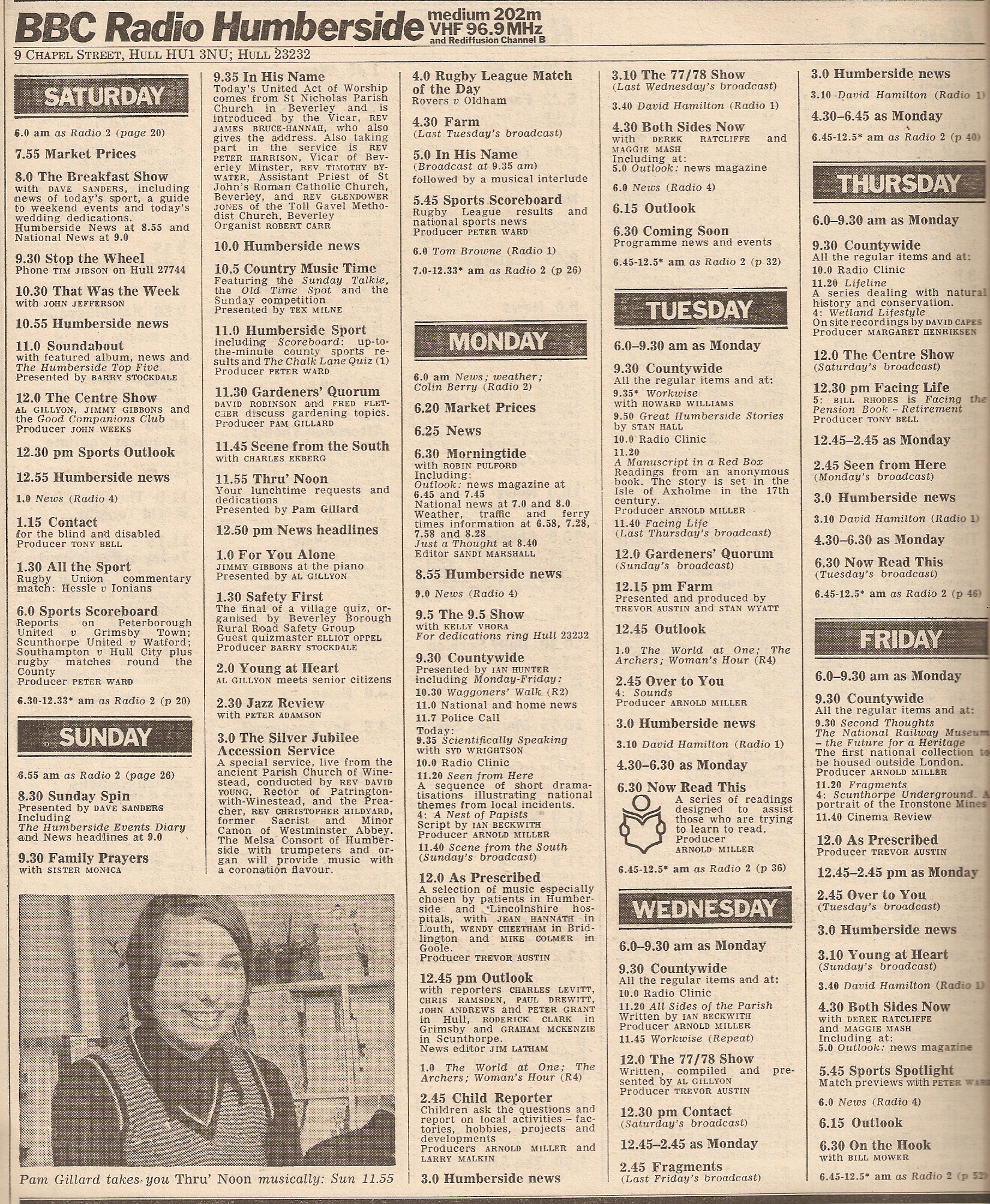
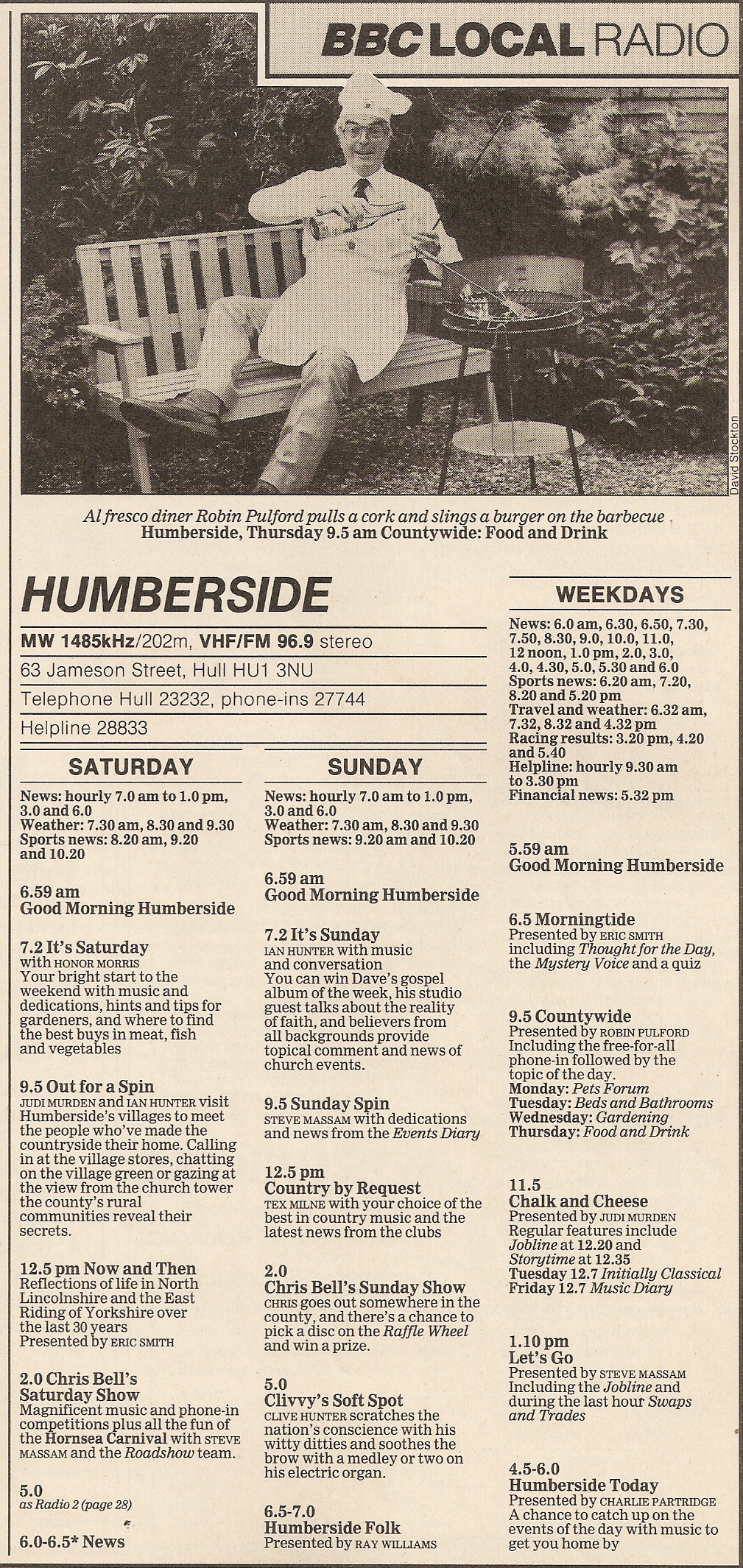
This is a companion
post to 50 Years of BBC Radio Humberside. Whilst researching that post I went
back through my Radio Times archive
to trace the history, people and programmes on the BBC local station. I've
scanned in that many pages that I thought I'd put some of them online.
My collection is pretty complete from 1976 but there are gaps
before that. Nothing from 1973, 1974 or 1975, so if you have an old edition
somewhere in the house please let me know. As you'll see this is a case of the
gradually shrinking schedule, in terms of column inches at least. In the 70s the listings get a full page at the
back of the Radio Times. By the 80s
they share space with neighbouring locals, Lincolnshire, York, Leeds and Sheffield,
depending on the edition. By the 90s up to a dozen stations are spread across
two pages. I've stopped in 2008 as by 2009 all the schedules appear on the BBC website.