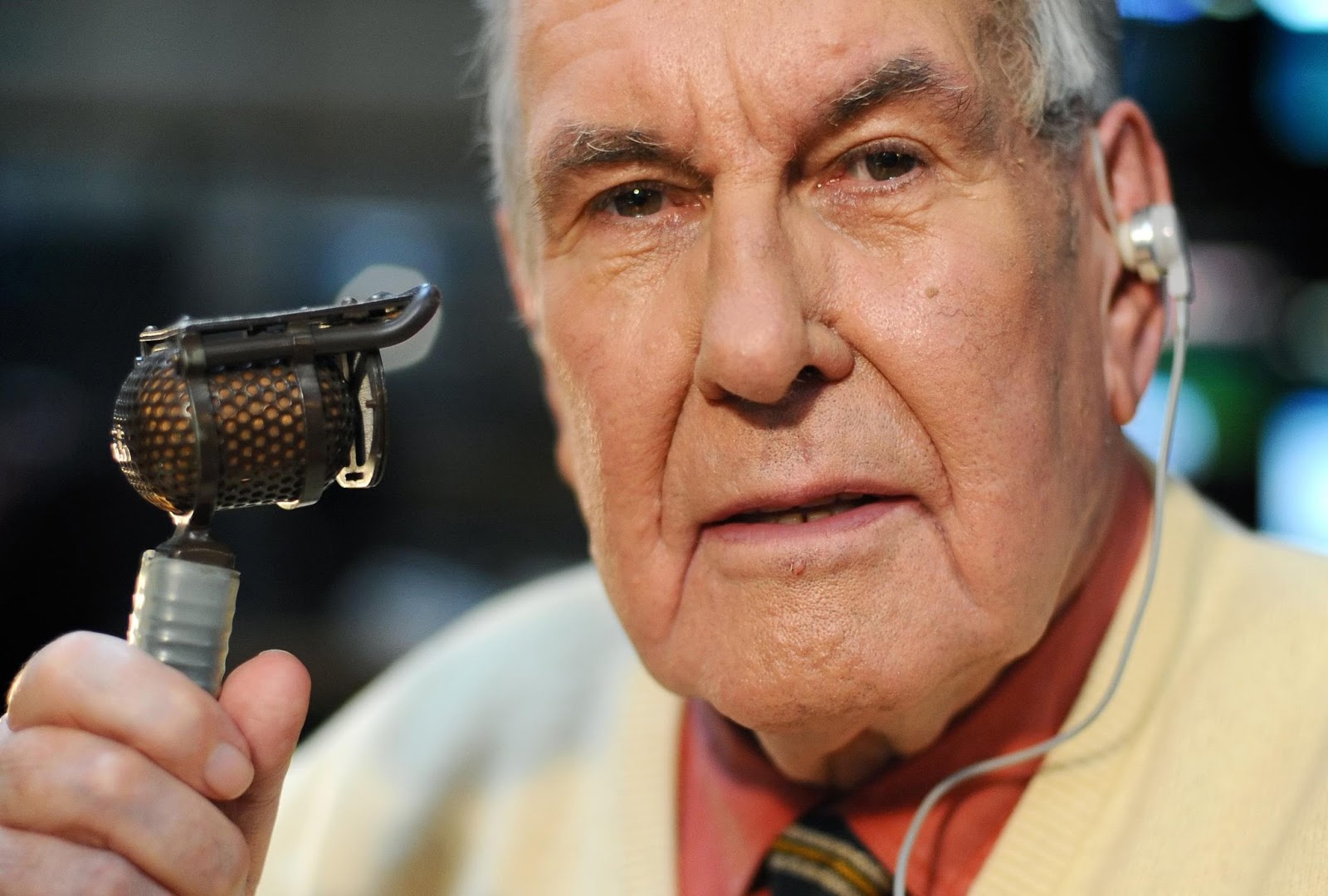
The BBC has announced that Tim Gudgin who reads the football results each week on BBC1’s Final Score is to ‘retire’ on 19 November. Tim has been reading the results since 1995 when it was part of Grandstand. He was associated with that programme since the mid-60s, reading the racing and rugby results back in the days when the hand-written captions used to fly across the screen.
Here’s Tim reading the results and talking to presenter Steve Ryder on Grandstand’s 40th anniversary programme on 10 October 1998.
Tim also features in this BBC2 short film called 4:45 broadcast as part of the 10x10 series on 11 June 2000.
But Tim’s main day job for about 40 years was as a presenter, announcer and newsreader on BBC radio.He long held ambitions to be on the radio but a careers master maintained that “to be a broadcaster, you require a first-class degree.” Tim was educated at Hardy’s School, Dorchester, Bishop Wordsworth’s, Salisbury and Whitgift School in Croydon.
Tim at BFN Hamburg
Tim got his break in broadcasting after he was called up for National Service. Posted to Hohne in Germany he successfully auditioned along with 200 other hopefuls for the job of announcer with the British Forces Network. At the BFN he was trained by Robin Boyle – with whom he would later work with at the BBC - and became involved with the Drama Club, alongside another future BBC man, Don Moss. Working for the BFN in Hamburg and later Trieste Tim presented programmes such as Morning Story and Early Bird.
Returning to civvy street Tim joined the BBC in 1952, first on the European Service and then on both the Light Programme and Home Service and subsequently Radio 2.He hosted a wide variety of programmes such as Music Box, Top of the Form, Midday Spin, Housewives' Choice, Round the Bend, Saturday Night at the Light, News Time, Swingalong, Out and About, Treble Chance, Melody Hour, Radio 2 Top Tunes, The Late Show and You and the Night and the Music.
Radio Times 28 September 1967
Here's a short audio montage of Tim on the Light Programme, Network 3, Radio 4 and Radio 2.
On television he was also chairman of the Square Deal Surf Forum advertisement, the proceeds of which bought him his first brand-new house. Blue Peter viewers may also remember him as the voice of the Bleep and Booster stories.
John Peel first came to prominence in the UK with his post-midnight Perfumed Garden show on pirate Radio London. John was part of Radio 1’s launch team in September 1967 and presented Top Gear on the second day of broadcasting at the fledging station. But what’s this? Before the Marine Offences Act came into force in August 1967 John had already made it back to the mainland in a BBC Home Service feature, Peel’s Progress.
Radio Times 6 June 1967
Peel’s Progress was a short feature in the daily afternoon magazine programme Home this Afternoon. “Each week”, proclaimed the Radio Times, “John Peel talks about people and places he has come across as he walks from Land’s End to John O’Groats.” In actuality this isn't the John Peel. John had left Californian radio station KMEN in February 1967 and had joined Radio London by March. Chances are it was Tory MP William John Peel or, as Robin Carmody suggests, a former BBC scriptwriter of the same name. If you have any further information please let me know.
During John’s career he was increasingly used to introduce or narrate programmes with themes far removed from his usual musical tastes. He’s an example from 1968 which is, however, music-related, The Voice of Pop, looking at pop lyrics and censorship. Here’s how the Radio Times reported on the programme that was first broadcast on Saturday 19 September 1968. Note the appearance in the programme of Elektra Records boss Clive Selwood, who would go on to run Dandelion Records with John, and in the discussion afterwards, Gillian Reynolds then radio critic at The Guardian now of The Daily Telegraph.
In 1988 John provided the opening and closing announcements to a Radio 1 four-part series in which listeners talked “openly about romance, sex and love” in What’s Love Got to Do with It? John’s voice presumably offering reassuring, trusting bookends to the mix of frank vox pops. Here’s part of the second programme called Is That All There Is? Broadcast on 19 September 1988. Warning: thisprogramme includes material of a sexual nature.
By the mid-90s John was presenting and narrating an increasing number of TV programmes. One such was the Channel 4 series Classic Trucks. Here’s an edition from that series about Britain’s post-war buses, Ticket to Ride. One can only assume that John found the early footage of buses in Ipswich of interest as it was just 16 miles down the road from Peel Acres. This programme was first broadcast on 24 January 1995. The recording is of the repeat on 30 April 1996.
And finally, in this random selection, everytime Radio 1 commissioned a new jingle package they recorded a DJ ident for John even though he rarely used them; on the occasions I heard his daily late-night show I can’t ever remember him playing it. So it fell to other DJs to play John’s jingle. Here from 30 March 1978, in a tantalisingly short clip, is Paul Gambaccini sitting for an absent Mr Peel.
This is the sixteenth post in a series looking at the original nineteen ILR stations. This week Radio Orwell.
.
Airdate: 28 October 1975
Still on air?: No. Now part of the Heart group.
Radio Orwell was the first local radio station in East Anglia-the BBC still classed the area as one of their “regions” and Radio Norfolk only went on air in 1980. Orwell operated out of Electric House in the centre of Ipswich.
Here’s the Radio Guide programme listings published in December 1977:
With its base just in from the Suffolk coast it seems natural for Orwell to have had a connection with the old pirate ship stations. Orwell’s ex-pirate was Andy Archer (born Andrew Dawson) whose claim to fame is to be the only DJ to have worked on the offshore stations in the 60s, 70s and 80s. After a brief stint on Radio City in 1965 Andy was in the RAF for a couple of years before going back to sea and working for Radio Caroline, in its post-Marine Offences Act days, working alongside the likes of Johnnie Walker and Roger Day. (A few years later he would become one of the first people to be prosecuted under the Act). In 1970 he got a call from Roger to join the team at Radio Nordsee International (RNI). Just after leaving for Holland he received a telegram offering him holiday relief cover for Dave Cash on Radio 1 – an opportunity he later regretted having missed. Andy would later re-join Caroline and also work on Radio Seagull before going legit and becoming a continuity announcer for Tyne-Tees. From TV it was back to radio and joining the launch team at Orwell.
Throughout the 80s Andy Archer did the rounds of a number of commercial stations – Devonair, the short-lived Centre Radio, County Sound, Invicta Supergold, Mellow 1557 as well as a further period on the re-launched Caroline and a return visit to Orwell. He was also on the original team at North Norfolk Radio in 2003. Inevitably, as with many of the old ILR jocks he started to work for BBC local radio, initially in Suffolk and latterly back in his home county of Norfolk – his final show on the station was in April this year.
The other ex-pirate was Greg Bance although he also had something of an identity crisis whilst working in pirate radio appearing as Roger Scott and Arnold Layne. Greg was on Radios Essex, 270, 390, Caroline South and RNI.But it was as a television continuity announcer that Greg was mainly employed working at most of the ITV stations – Harlech, Anglia, Granada, Tyne Tees, Southern, HTV, ATV and London Weekend.
On the radio Greg was at the United Biscuits Network for a short while. As well as Orwell he was a DJ on Breeze, Beacon, Two Counties and Melody Radio as well as reading news bulletins on IRN.
Orwell’s third pirate was breakfast host Keith Rogers – who also broadcast as Dave Rogers but had been born Ernie White. Keith was also on RNI as well as Radio Atlantis. Back in the UK he worked at Radio City before moving to Ipswich and Radio Orwell. Essex Radio, Breeze and Mercury followed before he dropped out of broadcasting altogether.
Next comes the British Forces Broadcasting Service (BFBS) connection.
Music to Midnight presenter was Patrick Eade. Patrick started in hospital radio on HRI in Ipswich before joining Orwell. In 1982 he was part of the launch team at Wilshire Radio before joining BFBS three years later. With the BFBS Patrick has broadcast around the world; from Germany at the time the Berlin Wall came down, from the Balkans on BFBS Skopje and in the Middle East following the invasion of Kuwait. He still broadcast on BFBS2 and is now Managing Editor, Defence & Welfare.
With Orwell Country two nights a week was Nigel Rennie. He maintained an interest in country music, later picking up a UK Country Music Award in 2002 whilst at BBC Radio Essex. Nigel is currently a presenter and producer for the BFBS in Cyprus, though he is currently posted to Brunei.
Not yet nationally famous as the country’s favourite tv cook Delia Smith was on Orwell each Sunday morning with One Faith. I guess that aside from her cookery and love of Norwich City football club Delia is known for her religious faith. She was christened into the Church of England before converting to Catholicism in her early-20s.
Programme Controller Australian John Wellington, who also made a couple of appearance on-air during the week, had worked at Capital and then Metro Radio before setting up Orwell. He performed a similar role at Essex Radio and Radio Mercury.
Also worthy of mention is Leon Fourie with Tuesday night’s Innovations. Leon had learnt his craft in South Africa on LM Radio (in Lourenco Marques)where he was the first DJ in the country to champion progressive rock. He went on to present a programme on Swazi Music Radio, also called Innovations. In the UK from 1974 to 1989 to returned to his native country where he was a voiceover artiste.
With On the Road, a motoring magazine, was David Cocks, the station’s Head of Sales. David continued to work for Orwell and then Suffolk Group Radio and now holds an executive position at the Tindle Radio Trust.
I can find absolutely no information about Anthea Clarke. If you know anything about her please contact me.
This is the station information published in January 1978:
Back in 1975 Anglia TV featured the opening of Radio Orwell in Switched On in Ipswich. The audio from that programme exists. In this recording you’ll hear Keith Rogers, chairman John Jacob, MD Donald Brooks, John Wellington, Andy Archer, David Cocks, Tim Ewart and Harry Rowell.
This picture features some of Orwell’s on air team in 1975 - Harry Rowell. Kate Glass, Greg Bance, Keith Rogers & Andy Archer. Harry had been at Metro Radio before joining Orwell.
This blog normally concerns itself with radio matters but tomorrow marks the 75th anniversary of BBC television.
Unlike the 50th anniversary the BBC, usually never ones to miss marking significant milestones in their history, have gone for a very low-key affair – just a few pages in this week’s Radio Times and an evening of repeats on BBC4.
If you want to see what BBC TV, and ITV and Channel 4, looked like back in 1988 then head over to my other blog. I’m recalling the day when the British Film Institute and all the major broadcasters ran the One Day in the Life of Television project.
As summer time hours end in the UK and across Europe tonight how about a reminder of the days when the Radio Times used to produce what it rather cosily called its Fireside Issue.
The BBC marks the top of the hour with the pips and still occasionally broadcasts the chimes of Big Ben, most notably at 6 p.m. and midnight on Radio 4. But I was reminded of the occasions when Big Ben was out of action when I received an email earlier this year asking me about Great Tom.
Great Tom did indeed ring a bell! It was in 1977 that Big Ben was under repair and the BBC would broadcast the bell Great Tom at St Paul’s Cathedral. It just so happened to have been used on Radio 3 on Sunday mornings before the news summaryand by chance I have a recording I made that year.
>
Great Tom had been broadcast regularly before back in 1956 when, I assume, Big Ben was out of commission.
This is the fifteenth post in a series looking at the original nineteen ILR stations. This week Radio Victory.
Airdate: 14 October 1975
Still on air?: No, closed in 1986
Radio Victory was the first of the original ILR stations to lose its licence, replaced from 28 June 1986 by Ocean Sound. Its early history is interesting and for such a small station it was well supplied with ex-BBC staff due, in no small part, to its first Programme Controller being former Radio 1 DJ David Symonds. David declared that his programme policy was to meet with the DJs and discuss with them the timeslots they each felt best they could do. His stay at Victory was, however, short-lived.
David’s early appointments included Dave Christian from Radio Luxembourg and Eugene Fraser as presenter and Assistant Head of Programmes from the BBC. Eugene had been a newsreader and presenter on Radio 2 (Night Ride, Brass and Strings etc.) and would return to the BBC as a newsreader on Radio 4. Former Light Programme and Radio 1 DJ Don Moss also joined in 1976 to present Don Moss’s Sunday Jaunt.
During 1975 and 1976 Victory even had Kenny Everett as one of its presenters. Kenny provided pre-recorded shows for the station and inevitably created some bespoke jingles in his home studio.
When Victory first went on air it was DJ Glenn Richards who made the opening announcement. Glenn would later make the occasional appearance on Radio 2 on the BBC Radio Orchestra shows and later, by now known as CJ, present on DevonAir.
Read more about David Symond’s career in this post.
Here’s the Radio Guide programme listings published in December 1977:
What a packed and varied schedule Victory had with 40 different programmes across the week including jazz, folk, rock ‘n’ roll, classical, religion, motoring, quizzes, gardening, fishing and antiques.
Folk & Us presenter was comedian and singer Shep Woolley. With a motoring programme was former Formula 3 champion and rally driver Jean Denton, later Baroness Denton of Wakefield.
Breakfast Show presenter Howard Pearce would later go on to work at Radio 210, Luxembourg, Radio 2, Mercury, VH1, Sky Sports, Virgin, Jazz FM, Smooth and Silverstone Radio.
With the mid-morning Trends (the name of a feature on Round the Horne if I recall) was Christine, better known as Chrissie, Pollard. Starting as a reporter on the Western Daily Press and Bristol Evening Post she got her taste for broadcasting as a reporter for the BBC in Birmingham. There followed stints for the BFBS in Cologne and then Malta, co-presenting The Five O’Clock Run with David Burrows. Back in the UK Chrissie was at Victory and then at TVS in Southampton as one of the co-anchors of Coast to Coast. Due to family connection with South Africa she spent time training would-be broadcasters at CCFM, a Christian radio station in Cape Town. Still broadcasting Chrissie was on Hope FM in Bournemouth and can be heard on Offshore Music Radio and occasionally on BBC Radio Solent.
Jack McLaughlin (aka Yak MacFisheries, aka The Laird of Cowcaddens) had been a pirate DJ on Radio Scotland, Britain Radio, Radio 390 and Radio 270 (under the name Steve Taylor).He went legit and was with the original team at Radio Clyde and also worked as an announcer/presenter on Grampian Television and STV (Pop Scotch, Thingummyjig and Junior Try for Ten) and on BBC Radio 2 (Folk 74 and Folk 75). Whilst at Capital he was poached by David Symonds to join Radio Victory where by 1977 he was Head of Programmes and News. Later Jack would establish Radio Scotland Worldwide Ltd, an internet broadcast company, though as far as I can ascertain this company has been dissolved.
Anton Darby, known as ‘Dapper Darby’, hosted Darby Day (oh, those punning ILR programme titles again). Anton had trained as an actor and had appeared in such TV programmes as The Wednesday Play and Softly Softly. After his spell on radio he continued to work in TV both as an actor and behind the scenes – I spotted his name as ASM when recently watching some old episodes of The Darling Buds of May.
Dave Christian (real name David Crockford) returned to the Grand Duchy, again working for RTL but this time broadcasting on the French and German services. Dave died in 2010.
Tea Time Treat host Andy Ferris was another ex-BBC member of the team, he’d been on Radio 1 alongside David Symonds and others as one of the presenters of Sounds of the Seventies as well as being on the review programme What’s New. Does anyone know what subsequently became of Andy?
Nicky Jackson, as he was then known, was taken on as a trainee DJ having worked in the discos of Portsmouth. Later as Nick Jackson he joined Radio 2 as an announcer/newsreader and presenter (Star Sound and You and the Night and the Music). You’ll also hear his voice on old episodes of Celebrity Squares and Catchphrase.
Presenter of The Wonderful Wobbly Wireless Show was Sarah Ward who was well known to Capital Radio listeners and to those of the BBC World Service. Sarah had cut her broadcasting teeth on the BFBS in Nairobi before joining The Voice of Kenya and then as a BBC announcer and presenter of Junior Points of View. These days Sarah can be heard on Jazz FM with the daily Dinner Jazz.
Dave Carson would go to host Victory’s Breakfast Show and then run entertainment agency Accolade Productions in Southampton. Daughter Lucy is a singer and son Jon runs an entertainment business.
With Fish on Sunday (surely you have fish on a Friday?) was Tony Fish. Tony left school to work as a TV repair man before joining the BBC in 1970 as a technical operator. Four years later he was at Radio 1working in production before joining BBC Radio London doing their traffic reports. In April 1975 he presented the Breakfast Show at that station and then later that year Home Run. At the same time he was on Victory with his Sunday morning show. Tony became a tutor at the BBC Radio Training Unit before moving into BBC local radio management, first at BBC Radio York, then Newcastle and Shropshire. He retired in 2002 and died suddenly in 2005.
Presenting a couple of shows on Saturday evening was Keith Butler. Keith would go on to be a very popular DJ at Radio 210 followed by Capital Gold, Easy Radio and finally Time 106.6. He died unexpectedly in 2008.
This isn’t a post about the current single by Marina and the Diamonds but Radio Active, Britain’s only national local radio station that was the Radio 4 hit comedy show between 1980 and 1987. This is the programme that introduced us to Mike Channel, Mike Flex, Anna Daptor, Martin Fry, Nigel Pry, The Hee Bee Gee Bees, Sir Norman Tonsil and the rest.
Back in 1987 the third programme in series 3 (God Alone Knows) was broadcast as usual on the Saturday but due to many complaints the Wednesday repeat, and all subsequent repeats, went out in an edited form. Yet again mocking religion got the broadcasters into trouble.
I only became aware of this chapter in Radio Active’s history when reading on an internet forum that someone was looking for this particular episode. Wikipedia notes the following changes to the original programme:
“…in the broadcast church service near the start of the episode the inability of any of the congregation to recite the Lord’s prayer correctly was replaced with a request for two girls in the front row to turn off their Sony Walkmans. The new translation of the Bible was also heavily edited, the new 10 commandments were changed to remove two which were originally of a sexual nature (replaced by "thou shalt not listen to the Beastie Boys” and "thou shalt not support Arsenal"). A description of the cover was deleted completely. To make up the lost time the preceding article was lengthened with a few extra lines”.
As chance would have it I have that original unexpurgated version and here, for the first time in 24 years, it is:
This post was brought to you by Honest Ron. If you have a complaint please telephone this number: